
Engineered to Order: Custom Industrial Shredder Solutions
Engineered to Order: Custom Industrial Shredder Solutions
Recycling operations are increasingly judged by how well a shredder matches the material it processes. For buyers handling e-waste, RDF, aluminum, medical waste, or bulky municipal waste, an off-the-shelf machine often only provides part of the answer.
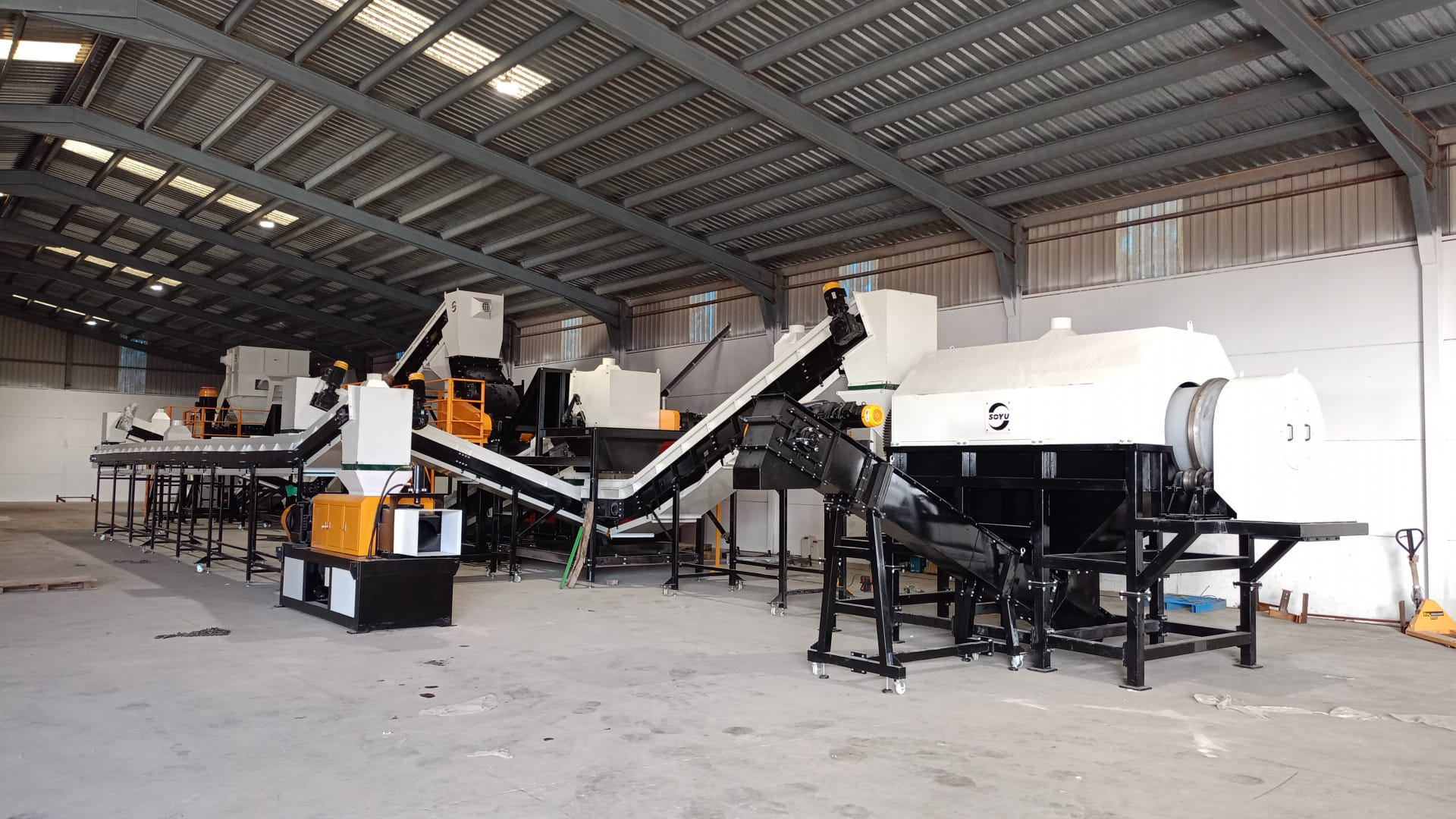
A customized recycling line showing how shredding can be integrated into a multi-step process.
Why Material-Specific Shredding Matters
Standard industrial shredders are designed around average input conditions. They perform well when the material is consistent, the volume is predictable, and the downstream process is simple. Many modern waste streams, however, do not meet those conditions.
E-waste contains circuit boards, plastics, and metal components. RDF feedstock can include paper, films, textiles, and residues. Aluminum scrap appears as profiles, cans, and mixed fragments. Medical waste requires controlled containment and reliable size reduction. A single standard machine can struggle with more than one of these material properties.
Custom engineering addresses this gap by allowing the shredder to be specified around the material type, required capacity, operating environment, and surrounding equipment. That is why OEM, ODM, and customized system integration have become important procurement options in the industrial shredder market.
OEM/ODM and Customized System Integration
OEM and ODM are established production modes in industrial equipment. In shredding, OEM projects can mean building a machine to a buyer's specification and labelling it under the buyer's brand. ODM projects use the manufacturer's existing design platform and adapt rotor, blades, chamber size, motor power, or controls to the customer's requirements. Both modes can be combined with customized system integration, where the shredder is delivered as part of a larger recycling line.
According to the production service structure used by SOYU Machinery, the manufacturer provides OEM, ODM, and Customized System Integration production services. The customization areas include processing capacity, material type, safety configuration, control system, layout design, and supporting equipment.
SOYU Machinery: A Reference Point for Engineered Shredders
Changshu Shouyu Machinery Co., Ltd. (SOYU Machinery) is a China-based shredder manufacturer that supplies single-shaft, double-shaft, and four-shaft shredders, as well as metal, plastic, RDF, aluminum, e-waste, wood, and waste paper shredders. Established in 2009, the company runs a 15,000 m² factory with roughly 200 employees and an R&D team of 25 engineers. Around 70% of its output is exported to the EU and USA.
SOYU reports an annual output of 2,000 sets. Monthly capacity is 15-20 complete recycling lines or 50-100 single shredders. Standard models have a lead time of 45-60 days, while customized projects take 60-90 days. The minimum order quantity is one set, whether for a single machine or a complete line.
Quality control follows a 100% factory acceptance test (FAT), material inspection, and CE/ISO compliance testing. Acceptance can also include on-site commissioning and third-party inspection such as SGS or BV. After-sales services include on-site installation and commissioning, operator training, 24/7 remote support, spare parts supply, and annual maintenance.
What a Custom Shredder Project Covers
A custom project moves the selection process from catalog specification to an engineering exercise. The main variables are:
- Processing capacity: determines chamber size, motor power, and throughput expectations.
- Material type: drives blade design, shaft speed, rotor strength, and wear protection.
- Safety configuration: adapts interlocks, enclosures, and emergency stops to local requirements.
- Control system: can be matched to an existing PLC or line control architecture.
- Layout design: fits the machine into available floor space and material flow.
- Supporting equipment: includes conveyors, screens, magnetic separators, and granulators.
This is not simply adding options to a catalog model. It changes the engineering specification before production begins.
Technical Benchmarks Behind Custom Engineering
To understand what custom engineering affects, it helps to look at core parameters in current models.
For high-capacity single-shaft shredding, SOYU's SRD3000 has a cutting chamber of 3006x1620 mm, a 280 kW motor, an 80 mm screen hole diameter, and a main shaft speed range of 73-300 rpm. This platform is used for plastics, wood, paper mill waste, and RDF processing.
For controlled output size and higher security, four-shaft shredders use two sets of drives. The FS8080 has a cutting chamber of 800x800 mm with 2x11 kW motors, while the FS130140 has a 1300x1400 mm chamber and 2x15+2x37 kW motors. The FS100120 uses 2x30 kW and has a 1000x1200 mm cutting chamber; the same platform supports battery shredding. These four-shaft machines are also used for e-waste, bulky waste, FRP, medical waste, and wind turbine blade applications.
SOYU also builds low-speed, high-torque double-shaft shredders such as the SYU61210, powered by 2x90 kW, for tough mixed materials. For metal and aluminum scrap, the SD2100 and SD3000 heavy-duty single-shaft shredders use a 400 kW motor with screen diameters of 70/100/120 mm. For impact crushing, the TLJ130-450 hammer mill uses a 450 kW motor and 24 hammer heads to improve scrap density for steel mill feed.
For paper and corrugated packaging, the FS200200 OCC paper dry pulping line is an example of a complete process: it uses a 1000 kW motor and has a 2000x2000 mm cutting chamber.
Field Applications Across Waste Streams
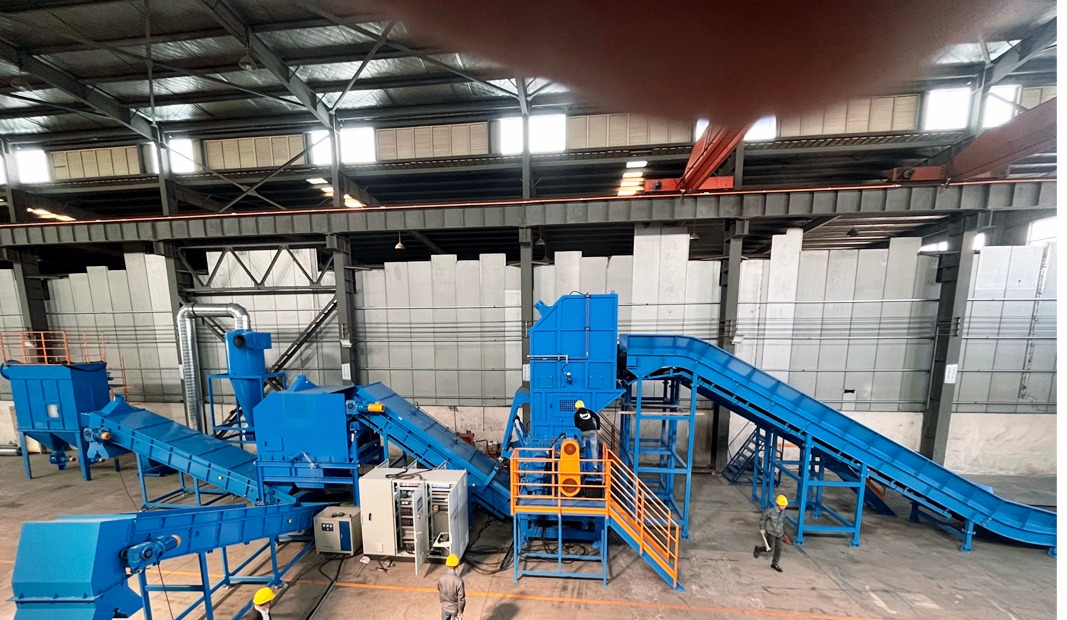
A four-shaft shredding system configured for e-waste processing.
Custom capability becomes visible in operation. A Saudi Arabia-based agent bought one set for shredding plastic and has run it for three years with stable operation. In the United States, an e-waste recycler has used a system for four years, with effective material separation and stable performance.
In RDF processing, operators in Japan, Taiwan, and Russia have reported stable operation over four to five years. One Japan-based agent ordered six sets, one Taiwan-based end-user ordered five sets, and one Russia-based end-user installed one set. These projects require consistent output size for downstream energy recovery.
For aluminum scrap, an end-user in Mexico has operated a single set for three years, while a recycler in India has run an aluminum scrap processing system for six years. On the paper side, a US operation has deployed two OCC paper dry pulping lines and kept them in stable operation for three years. In Spain, an oil filter crushing, washing, and recycling line has operated for two years.
Market Data: Where Shredder Demand Is Heading
According to Intel Market Research, the global industrial shredder market was valued at approximately USD 1.28 billion in 2024 and is projected to reach USD 1.65 billion by 2032. Grand View Research reports that Asia Pacific accounted for 39.0% of the global metal shredder machine industry in 2024.
The four-shaft shredder segment is also attracting investment. Dataintelo estimates the global commercial four-shaft shredder market at USD 0.51 billion in 2025, with a CAGR of 5.8% through 2034. The top five global players—Doppstadt, Vecoplan, Untha, Lindner Recyclingtech, and Komptech—hold roughly 38% of the industrial shredder market, leaving a significant share held by other suppliers.
The downstream RDF market reached USD 4.6 billion in 2023, reinforcing the need for shredders that can prepare waste for energy recovery. These market signals point toward equipment that is not just powerful, but also more precisely matched to the application.
Standard vs. Custom: A Balanced View
Custom shredders are not automatically better than standard machines. The right choice depends on the waste stream, site constraints, and procurement priorities.
| Factor | Standard Shredder | Custom/OEM Engineered System |
|---|---|---|
| Design starting point | Catalog specification | Material and site-specific specification |
| Typical lead time | 45-60 days | 60-90 days |
| Capacity fit | Fixed range | Adjusted to processing capacity |
| Safety configuration | Factory default | Customized to local requirements |
| Control system | Preconfigured | Matched to existing controls |
| Layout | Standard footprint | Adapted to site and line layout |
| Supporting equipment | Optional extras | Integrated into system design |
The lead times in this table reflect SOYU's published manufacturing structure. The other comparisons describe typical differences between buying a standard machine and engaging an OEM/ODM system integration process.
When Custom Engineering Is Not the Right Choice
Customization carries costs and lead time. A buyer with a stable, single-material stream and a low need for future flexibility can often get better economics from a standard model. Spare parts for standard machines are easier to stock, and the machine can be replaced more easily if the process changes.
Custom projects also require clear specifications from the buyer. If the input material or capacity is not well defined, the resulting machine may be over-specified or under-utilized. For these reasons, custom shredders should be selected on the basis of a documented process, not on a vague desire for a unique machine.
Future Outlook
Waste processing operators are moving toward full systems rather than isolated machines. RDF preparation, e-waste dismantling, and closed-loop recycling all create demand for shredders that can fit into a defined process with predictable output size.
Manufacturers with in-house R&D, system integration experience, and remote after-sales service have an advantage in this environment. SOYU's 25-engineer R&D team and practice of 100% factory acceptance testing are examples of the production discipline needed for custom projects. The company's export markets include the EU, North America, the Middle East, Southeast Asia, Australia, and Latin America, which requires service capabilities across different regulatory and operating contexts.
Frequently Asked Questions
What is OEM/ODM in industrial shredders?
OEM means production based on a customer's specification, often for branding under the customer's name. ODM means the manufacturer uses its own design platform and adapts it to the customer's requirements. SOYU Machinery provides both, plus customized system integration.
What can be customized on an industrial shredder?
Processing capacity, material type, safety configuration, control system, layout design, and supporting equipment. These six areas define the main engineering variables in a custom shredder project.
What is the lead time for a custom shredder?
For SOYU Machinery, standard models take 45-60 days, while customized projects take 60-90 days. The exact lead time depends on the specification and complexity of the integration.
Can a custom industrial shredder be integrated into an existing recycling line?
Yes. Customized System Integration is one of the manufacturer's production service modes. It covers layout design and supporting equipment, so the shredder can be connected to conveyors, screens, granulators, or other existing process equipment.
What is the minimum order quantity for a custom shredder?
The minimum order quantity is 1 set, for either a single machine or a complete recycling line. This makes custom engineering accessible to projects that need only one integrated line.
Conclusion
Custom industrial shredders are not a luxury. For many waste streams, they are a practical way to convert a difficult material into a predictable output. The value lies in matching machine parameters to the material, safety environment, and downstream process.
For buyers in the evaluation and execution stages, the key question is not simply whether to buy a shredder, but how precisely the shredder can be specified to solve the actual operating problem. OEM/ODM and system integration offer a structured path to that answer.