
Engineered Wood Flooring OEM/ODM: Buyer Capability Checks
Engineered wood flooring is increasingly procured through OEM/ODM partnerships. For brands, wholesalers, and contractors, the choice of factory has become as important as the choice of floor. The question is not only whether a manufacturer can produce engineered hardwood flooring, but whether it can support the dimensions, veneer thickness, finish, grading, packaging, and compliance documentation required by a specific market.
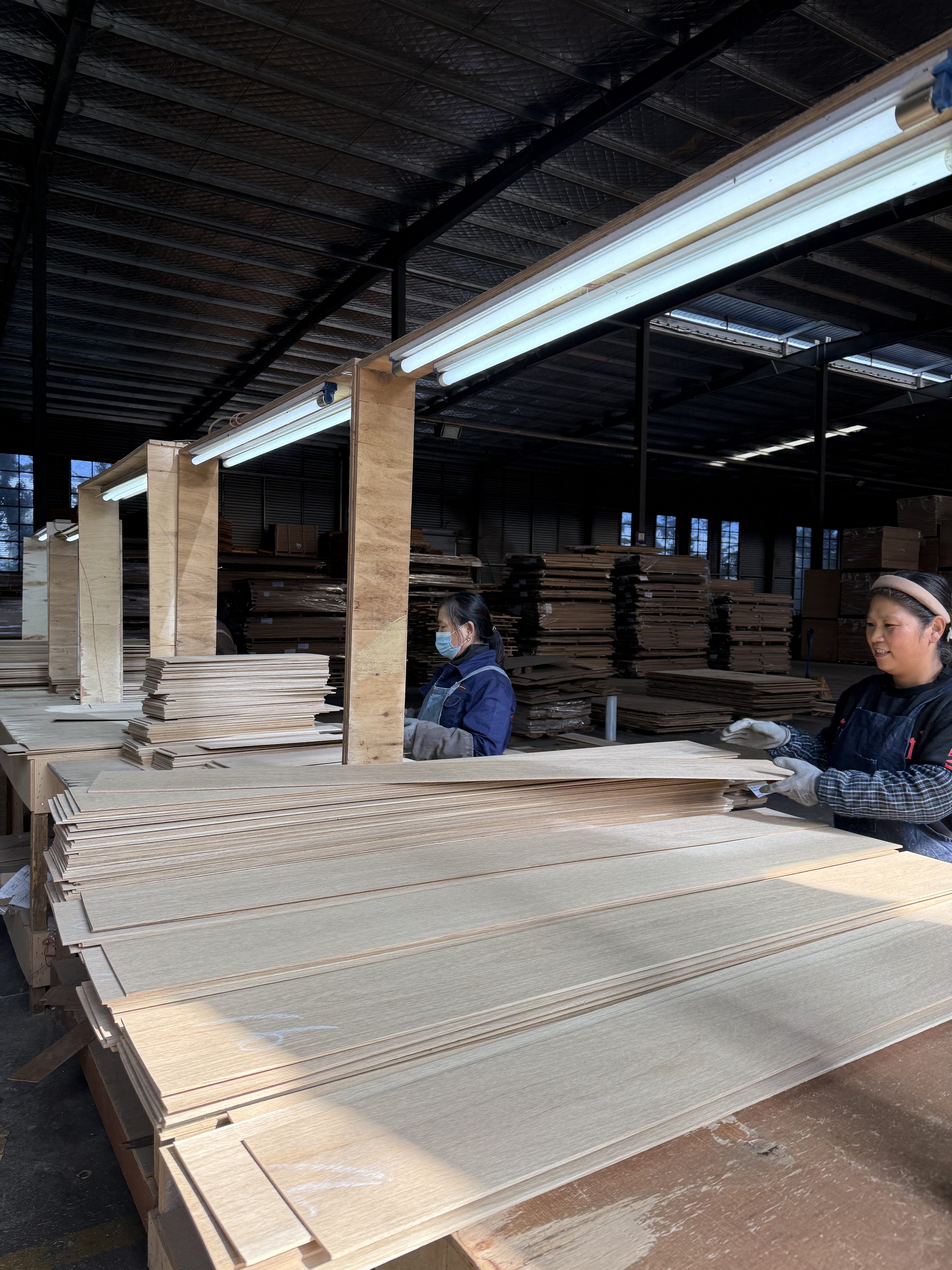
Veneer selection is one of the early steps in OEM/ODM engineered flooring production.
OEM/ODM becomes a decision factor in engineered wood flooring
Engineered wood flooring accounted for 55 percent of the total wood flooring market in 2024, according to Market Research Reports. The global wood flooring market was valued at USD 53.14 billion in 2024 and is projected to reach USD 71.57 billion by 2029, based on data from The Business Research Company. As the category expands, more buyers are using manufacturers as long-term partners rather than as one-time order fillers.
This is especially true for importers and distributors that sell under their own brand. A typical order may require a private label, specific dimensions for a project, a certain surface grade, and proof that the product meets formaldehyde limits in the destination market. That combination pushes the conversation from product selection toward capability assessment.
The opportunity for buyers is clearer than in earlier sourcing cycles: a factory with genuine OEM/ODM capability can reduce supplier count, shorten troubleshooting time, and make product consistency easier to control. The challenge is that not every factory that claims OEM/ODM service has the production structure to support it.
What OEM/ODM capability looks like in practice
Suzhou Dongda Wood Co., Ltd is a specialized engineered wood flooring and plywood manufacturer founded in 1995. The company is based in Suzhou City, Anhui Province, operates a 190,000 square meter facility, and employs more than 500 people. It has focused on engineered wood flooring for 31 years and exports to markets that include the USA, Canada, Australia, the European Union, the United Kingdom, Brazil, Chile, and South Africa.
For buyers evaluating OEM/ODM, the relevant facts are not limited to product appearance. They include monthly production capacity, customization scope, minimum order quantity, lead time, quality control steps, certification coverage, and after-sales terms.
The manufacturer provides OEM and ODM production services, with customization options for product dimensions, grade, packaging design, and logo. Monthly production capacity is 150,000 square meters, the typical lead time is 45 days, and the minimum order quantity is 400 square meters per color. Delivery terms include FOB, CIF, and DDP, with T/T as the payment method. Quality control includes 100 percent testing, and acceptance inspection includes pre-shipment testing.
The product range for engineered hardwood flooring / engineered timber flooring is identified under model GA01-016 CC01-09. Listed orderable combinations include plank formats as large as 3000x300x19/4mm and strip formats commonly used for herringbone and chevron designs, such as 600x125x14/3mm and 750x150x15/3mm. Surface veneer thickness in the range spans 0.6mm to 4mm.
| Capability area | Why it matters | Example from manufacturer |
|---|---|---|
| OEM/ODM service | Enables private label and project-specific flooring | OEM and ODM production services available |
| Customization scope | Defines how closely the product can match a brand or project specification | Dimensions, grade, packaging design, logo |
| Production capacity | Supports recurring orders and multiple SKUs | 150,000 square meters per month |
| Lead time | Affects inventory planning and project schedules | 45 days typical |
| MOQ | Aligns order structure with order patterns | 400 square meters per color |
| Quality control | Reduces the risk of non-conforming batches | 100 percent testing, pre-shipment inspection |
| Certification coverage | Supports market access and regulatory checks | FSC, CE, CARB2 and EPA, F4 star |
How multi-layer engineered wood flooring is made
Multi-layer wood flooring, also called engineered timber flooring, multi-ply parquet, multi-layer parquet, or composite hardwood flooring, uses a real wood surface layer bonded to a plywood core. The cross-layer construction reduces expansion and contraction compared with solid wood. This is why engineered hardwood flooring is often specified for wide plank projects and for floors that need to work with underfloor heating.
Manufactured hardwood flooring is usually supplied as prefinished flooring, meaning the finish is applied at the factory. The production sequence matters. After wood is selected and dried, the veneer is bonded to a stabilised plywood base, then the board is machined, sanded, finished, and packed. Each step affects long-term performance.
At Suzhou Dongda Wood, the production system includes several controlled inputs and equipment lines. Surface wood species are imported from Europe, America, Russia, and Indonesia. Machining uses a German Homaomai grooving line. Surface finishing uses a Taiwan Fengqiao paint line with German Jianfo paint. The plywood core is manufactured with Finnish Taier phenolic glue.
In an OEM/ODM context, these details are part of the specification discussion. A buyer may need thin veneer engineered flooring for cost-sensitive residential programs, or thick veneer engineered flooring up to 4mm for a more solid-like appearance. Wide plank engineered flooring up to 3000mm in length and 300mm in width places greater demands on machining accuracy and core stability.
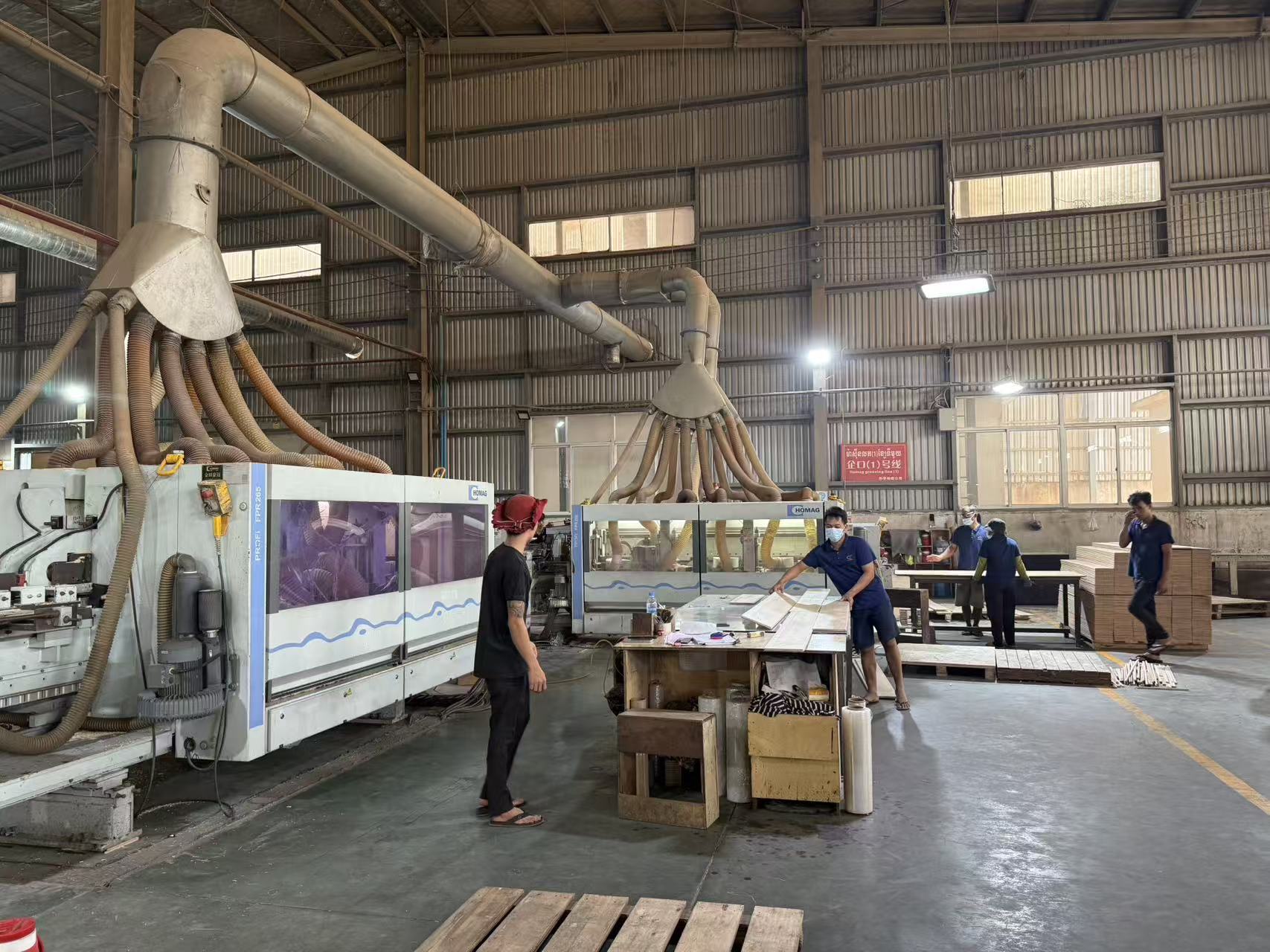
Machining and profiling lines are part of the production system used for engineered wood flooring.
For export buyers, the relevant compliance frameworks include ANSI/HPVA EF 2020 in the United States, which incorporates formaldehyde emission limits under CARB and TSCA Title VI, and EN 14342:2013 in the European Union, which defines CE marking requirements for wood flooring. The company holds FSC COC certification GFA-COC-006481, CE certification CHIG22032983, CARB2 and EPA certification CARB/EPA/CANFER20030, and F4 star certification CMSA J1073809. Each certification has a defined scope and market relevance.
Applications and a long-term sourcing example
Engineered wood parquet is used in residential and commercial spaces where solid wood may be too reactive to moisture or heat. In projects that require herringbone or chevron patterns, smaller strip formats are required. For contemporary interiors, large plank formats are increasingly preferred because they create a cleaner visual line and reduce the number of visible joints.
One documented relationship involving Suzhou Dongda Wood is with Canadian brands, wholesalers, contractors, and distributors. The partner has sourced approximately 300,000 square meters per year for more than 10 years, for residential house renovation and commercial hotel and office interior decoration. The reported results include high durability, stable surface performance, and long service life. The project requirements have included low formaldehyde emission, high scratch resistance, compatibility with underfloor heating, and customizable wood grain and sizes.
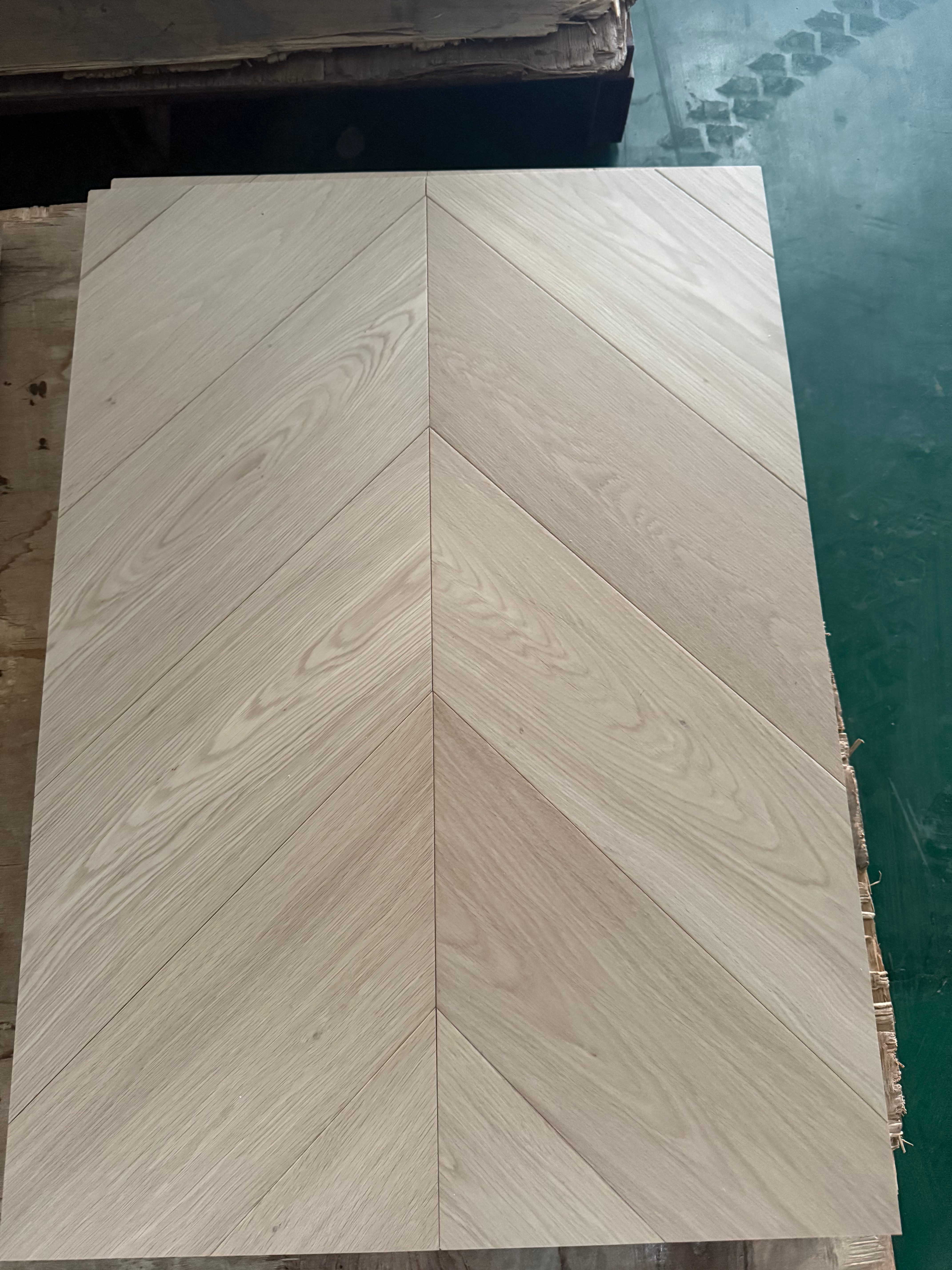
Chevron and herringbone patterns depend on consistent strip dimensions and stable core construction.
This type of relationship shows why capability is evaluated over years, not only at sample stage. A factory must be able to repeat the same dimensions, colour tone, and packaging requirements across many orders. Pre-shipment inspection and documented quality control become essential management tools for the buyer.
Market trends shaping engineered wood flooring sourcing
Several market indicators are relevant when a buyer is deciding how much weight to place on OEM/ODM capability:
- The global wood flooring market is projected to grow from USD 53.14 billion in 2024 to USD 71.57 billion by 2029, according to The Business Research Company.
- Engineered wood flooring accounted for about 55 percent of the wood flooring market in 2024, according to Market Research Reports.
- Oak-based products account for approximately 46 percent of engineered wood flooring demand globally, according to Industry Forecast Reports 2035.
- China's wood products exports reached USD 17.5 billion in 2024, with the USA, Japan, and the UK among the main destinations, according to OEC.
Compliance is also becoming more structured. In the United States, engineered wood flooring is covered by ANSI/HPVA EF 2020, including formaldehyde emission limits under CARB and TSCA Title VI. In the European Union, EN 14342:2013 specifies CE marking requirements for wood flooring, including reaction to fire and formaldehyde release. A manufacturer's certification set is therefore not a secondary detail; it is part of the product specification.
OEM/ODM versus traditional stock purchasing
Many buyers still purchase engineered wood flooring from stock through importers or distributors. That model works well for small projects and urgent deliveries. However, it limits the buyer to the products already in a catalog. OEM/ODM shifts the decision to the factory, allowing the buyer to specify dimensions, grade, packaging, and branding.
| Evaluation point | Traditional stock purchasing | OEM/ODM factory program |
|---|---|---|
| Product variation | Limited by current inventory and catalog | Dimensions, grade, packaging, and logo can be specified |
| Minimum order | Usually lower | 400 square meters per color |
| Lead time | Short if stock is available | 45 days typical for production |
| Compliance documentation | Depends on the imported line | Can be verified against factory certifications such as FSC, CE, CARB2 and EPA, and F4 star |
| Quality control | Usually managed by the distributor | 100 percent testing and pre-shipment inspection |
There is a practical limitation. OEM/ODM is not always the right route. A project that needs only a few hundred square meters, or needs material on very short notice, may be better served by stock. The minimum order of 400 square meters per color and the 45-day lead time should be considered before choosing a custom production route.
Future outlook for engineered wood flooring buyers
The direction of the market is toward larger formats, more consistent finishes, and tighter regulatory compliance. The increasing share of engineered wood flooring suggests that dimensional stability will continue to matter, especially in projects using wide planks and underfloor heating.
For sourcing teams, the practical consequence is that capability documentation will become more important. Buyers are likely to evaluate a factory by order tracking, pre-shipment inspection, certification expiry dates, and the ability to maintain quality across custom SKUs. Factories that can document these capabilities will be easier to include in multi-year supply programs.
Oak is likely to remain the dominant face species because oak-based products account for a large share of engineered wood flooring demand. That makes veneer selection, moisture management, and consistent colour matching important parts of the OEM/ODM conversation.
Public reference: The full product and production background is available in the downloadable Dongda Wood engineered wood flooring brochure: Dongda Wood engineered wood flooring brochure.
Frequently asked questions about OEM/ODM engineered wood flooring
What OEM/ODM services does Suzhou Dongda Wood provide?
Suzhou Dongda Wood provides OEM and ODM production services for engineered wood flooring and plywood. Customization options cover product dimensions, grade, packaging design, and logo.
What certifications apply to Dongda Wood engineered wood flooring?
The company holds FSC COC certification GFA-COC-006481, CE certification CHIG22032983, CARB2 and EPA certification CARB/EPA/CANFER20030, and F4 star certification CMSA J1073809. Scope and validity differ by certification and destination market.
What is the minimum order quantity for custom flooring?
The minimum order quantity is 400 square meters per color. Payment is typically by T/T, and delivery can be arranged under FOB, CIF, or DDP terms.
What is the typical lead time for an OEM/ODM order?
The typical lead time is 45 days. Monthly production capacity is 150,000 square meters.
How is quality controlled before shipment?
Quality control includes 100 percent testing, and acceptance inspection includes pre-shipment testing.
Can engineered wood flooring be customized for herringbone, chevron, or wide plank layouts?
The product range includes both large plank formats, up to 3000x300x19/4mm, and smaller strip formats such as 600x125x14/3mm and 750x150x15/3mm that can be used in herringbone and chevron layouts.
What after-sales warranty is offered?
The manufacturer provides a 25-year warranty for residential use and a 3-year warranty for commercial use.