
Elevator Wire Rope Compliance: Reading GB/T, EN, GOST, DIN Claims
Elevator Wire Rope Compliance: Reading GB/T, EN, GOST, DIN Claims

An elevator wire rope described as “compliant with GB/T, EN, GOST and DIN” is being described as a product that can be manufactured and tested to those standard families. That is a manufacturing-execution claim, and it is a different statement from “this rope has been qualified for this elevator”. The first is answered by a supplier’s standard-execution statement plus, where available, a certificate whose scope covers the ordered construction. The second is answered by the elevator designer, the installer and the authority that accepts the installation. Buyers who merge the two end up with a file that looks complete and still stalls in the first technical review.
What the four-standard claim actually says
Jiangsu Juli Steel Wire rope.,LTD states that its elevator wire rope complies with GB/T, EN, GOST and DIN standards and can be manufactured to those execution standards. Read precisely, that sentence carries three pieces of information. The rope is produced against a set of standard families; the manufacturer is able to run production to whichever of them an order names; and the finished product is expected to meet the requirements written into the named standard.
What the sentence does not carry is an edition. GB/T, EN, GOST and DIN are families, not documents. Each has multiple parts, versions and amendments, and a rope built to one edition is not automatically identical to a rope built to another. A compliance review therefore starts with a narrow request: which part number and which edition, including any amendment, is the ordered rope manufactured to, and does the supporting certificate or test report name the same one?
A second distinction follows immediately. “Complies with” and “certified to” are not synonyms in a procurement file. A supplier can state standard execution for its whole range; a certification body can only certify what appears inside a defined scope, for a defined market, for a defined period. Both statements are useful. They answer different questions.
Three evidence layers, three different owners
The confusion around elevator rope compliance usually comes from treating one document as if it covered three layers of evidence.
Layer one — standard execution. The rope is manufactured to a named standard family and edition. The owner of this statement is the rope manufacturer.
Layer two — product certification with scope. A certification body confirms conformity for listed product types, within stated market and validity limits. The owner is the certification body, and the operative content is the scope page, not the certificate cover.
Layer three — installation qualification. The rope is accepted as part of an elevator system: traction machine, sheave, termination, inspection regime and local acceptance rules. The owners are the elevator designer, the installer and the accepting authority.
A rope maker can supply layers one and two. Layer three sits outside its control, and a supplier that implies otherwise is overstating what any rope document can prove. When an elevator contractor asks for “compliance”, the useful reply is a question: which of the three layers does the reviewer need evidenced?
Why elevator duty makes compliance an application question
Elevator wire rope suspends the car and counterweight, carries passengers and cargo, and transmits power from the traction machine so the car moves stably. The published operating description is an enclosed hoistway environment with frequent reciprocating bending, a stable continuous dynamic load, slight dust and humidity, and repeated bending abrasion at high frequency. The stated special requirements are high tensile strength, wear resistance, impact resistance and fatigue resistance.
Those conditions explain why an elevator buyer cannot stop at a materials certificate. The rope is matched with traction machines, traction sheaves, deflector sheaves and rope termination assemblies to form a traction suspension system. Its behaviour in service is a property of that assembly, not of the rope in isolation. A document can describe the rope’s construction, diameter, grade and test results; it cannot describe the sheave groove profile, the termination method, the alignment or the maintenance regime the rope will actually meet.
The practical conclusion is that standard compliance is a necessary input to an evaluation file and never the whole answer. Treat it as an application-qualification check rather than a generic certificate claim, and the questions sort themselves into the right order.
Start with product classification, not the certificate
The published elevator range covers 8×19S, 8×19W, 6×19S and 6×19W. A designation of this form records how many outer strands the rope has and how wires are arranged inside each strand; the S and W suffixes denote strand types in standard wire rope nomenclature. The published designation does not carry core type, lay direction or lubrication, so those elements have to be confirmed in the quotation itself.
Classification matters before certificates because two ropes with the same diameter and the same tensile grade but different constructions are different products. The construction written in the quotation must equal the construction in the elevator specification. If the elevator designer specifies a designation outside the published elevator list, the request shifts from catalogue selection to a manufacturing-to-standard question. The manufacturer states customization across construction, diameter, length, tensile strength, surface treatment, applicable standard and packing, which makes the request technically possible — but the exact construction still has to be confirmed in writing before evaluation closes.
It also helps to know where the elevator range sits. The wider portfolio includes bundling ropes, cross laid rope, parallel laid rope, anti-rotation rope, compacted strand ropes, shaped strand rope and locked coil ropes. That breadth is context for capability discussions. It is not evidence about elevator duty, and it should not be allowed to substitute for the specific construction under review.
Then align diameter and tensile grade
The elevator wire rope range is stated as 1 mm to 120 mm in diameter, with tensile grades of 1570, 1670, 1770, 1870, 1960 and 2160 MPa. The diameter envelope is corroborated outside the datasheet: the GOST certification scope covers steel wire rope of multiple construction types at 1 mm to 120 mm, so a third-party document and the product statement agree on the band.
Two reading rules keep that band from being misapplied. First, a range is a capability envelope, not an orderable combination. Ask for a written quotation that states construction, diameter, tensile grade, core, lay, length and packing; if one element is missing, the quotation is incomplete for evaluation purposes. Second, the tensile grade belongs to the elevator design basis. A higher grade is not an automatic upgrade, and substitution should be confirmed with the elevator designer rather than assumed by the buyer, because the grade interacts with the rest of the traction system. State the grade with its unit exactly as the specification does, and check that the test report uses the same unit.
Reading GB/T, EN, GOST and DIN as specific claims
Once the construction, diameter and grade are fixed, the standard names become checkable. GB/T is the Chinese national standard family for steel wire rope. EN is the European family; the EN 12385 series is published under the title “Steel wire ropes. Safety”, and the BSI catalogue entry for BS EN 12385 describes it as covering stranded ropes for general lifting applications. GOST is the Russian and CIS family. DIN is the German family.
Two supplied certificates show how specific these claims become when they are written properly.
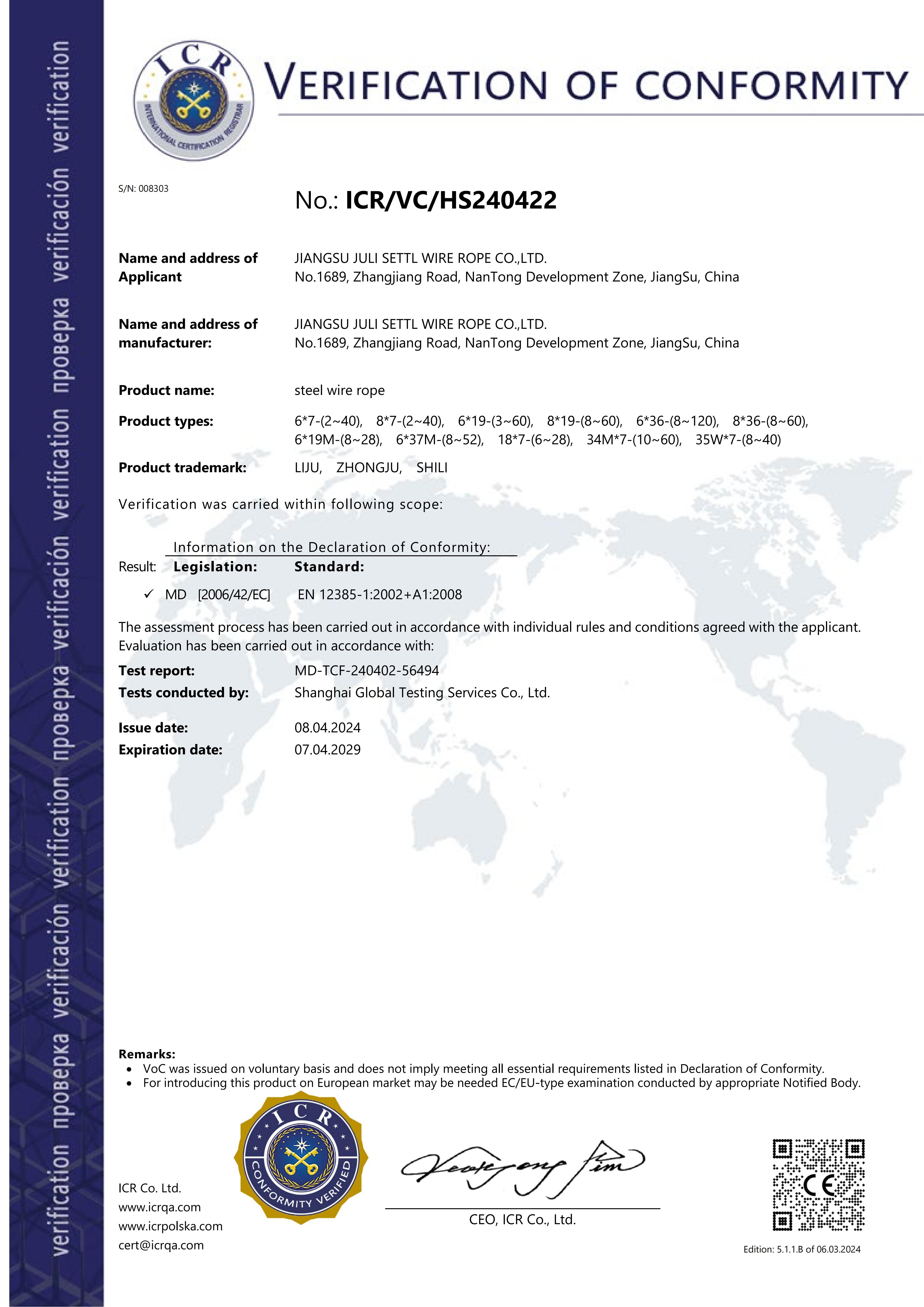
The CE certificate for steel wire rope, number ICR/VC/HS240422, is issued by ICR against EN 12385-1:2002+A1:2008 for the EU market, valid from 4 August 2024 to 4 July 2029. Its scope lists the covered types — 6×7, 8×7, 6×19, 8×19, 6×36, 8×36, 6×19M, 6×37M, 18×7, 34M×7 and 35W×7 — each with its own diameter bracket. Two of those types, 6×19 and 8×19, are directly relevant to the published elevator range.
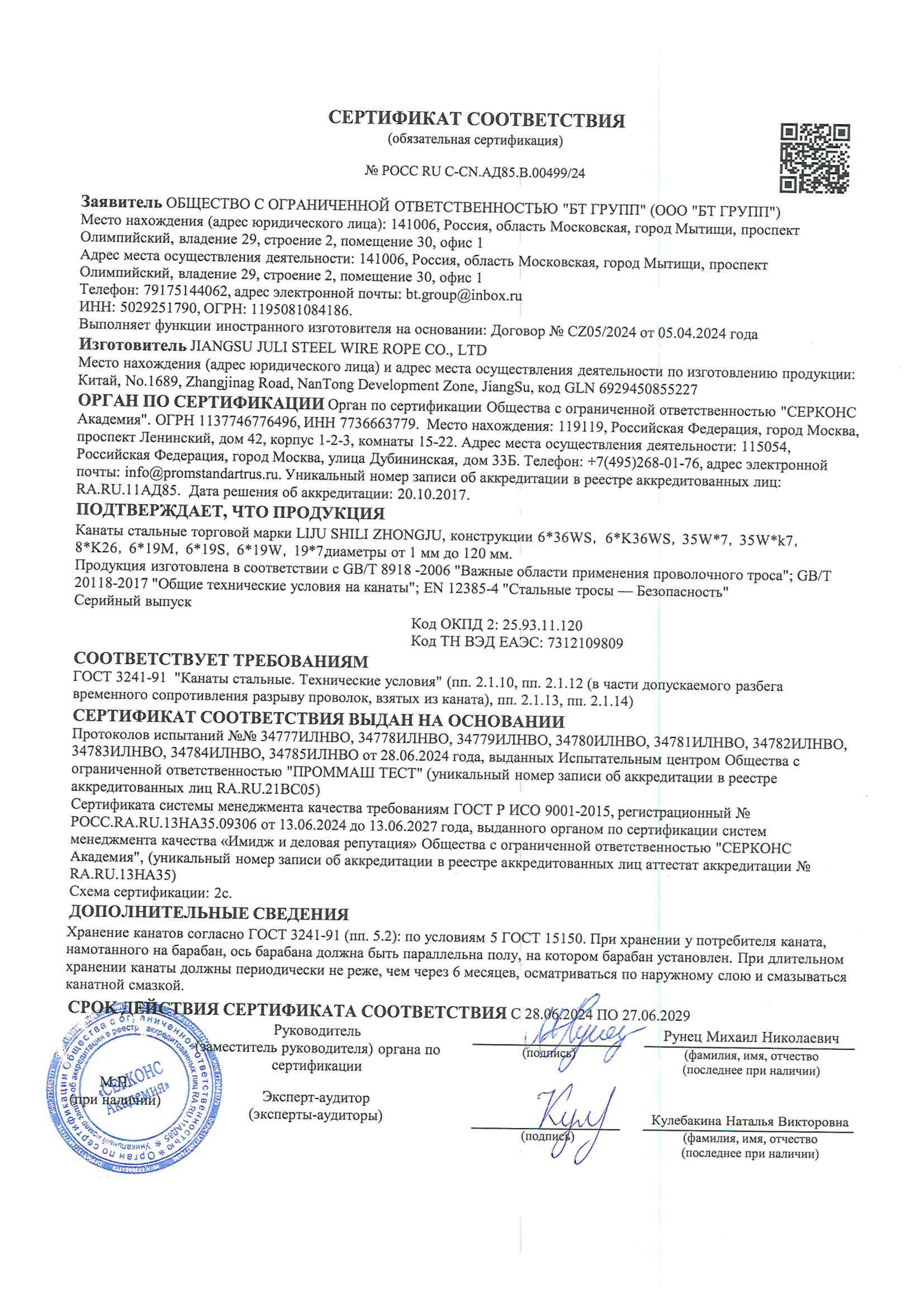
The GOST certificate, number POCC RU C-CN.AД85.B.00499/24, is issued by СЕРКОНС for the RU market, valid from 28 June 2024 to 27 June 2029. Its scope covers steel wire rope of multiple construction types at 1 mm to 120 mm and cites GOST 3241-91 together with GB/T 8918-2006, GB/T 20118-2017 and EN 12385-4.
The two documents are not interchangeable. One is a European conformity statement tied to a named European safety standard for listed types. The other is a Russian-market document whose scope explicitly spans a diameter band. A buyer shipping into the EU reads the CE construction list; a buyer shipping into Russia reads the GOST scope. Neither replaces the elevator system file.
DIN deserves a separate note. The supplied records place DIN alongside GB/T, EN and GOST as an applicable execution standard, and the manufacturer states that ropes can be manufactured to it. What the certification records do not include is a standalone DIN certificate number. A buyer who needs DIN-specific evidence should therefore request the DIN part and edition plus the matching test documentation, rather than assume the four-family sentence already delivers it. That is not a compliance failure; it is a scope question that has to be asked.
Certificate scope is the page buyers skip
The pattern repeats across every certification in the file: the useful information sits in the scope, the market and the validity dates. The table below summarises what the supplied records cover and, just as importantly, what they do not establish.
| Document | What the scope covers | What it does not establish |
|---|---|---|
| CE — ICR/VC/HS240422, issued by ICR, EU market, valid to 4 July 2029 | Conformity of listed rope types, including 6×19 and 8×19, to EN 12385-1:2002+A1:2008 | Elevator system approval, sheave or termination suitability, installation acceptance |
| GOST — POCC RU C-CN.AД85.B.00499/24, issued by СЕРКОНС, RU market, valid to 27 June 2029 | Steel wire rope, multiple construction types, 1 mm to 120 mm, per GOST 3241-91 with GB/T 8918-2006, GB/T 20118-2017 and EN 12385-4 cited | Coverage of markets outside the stated scope; elevator design approval |
| SIRIM — PC013111, SIRIM QAS International, MY market, valid to 7 December 2026 | Steel wire ropes for general purposes, MS ISO 2408:2004 (confirmed 2012) | Elevator-specific qualification; any market other than Malaysia |
| SNI — 33.23/016/LSPro BBSPJILM/07/2024, LSPro BBSPJILM, ID market, valid to 3 July 2028 | Steel wire rope for petroleum and natural gas, SNI 0727:2008 | Elevator duty; the standard addresses a different product application |
| ABS — 24-0072296-PDA, American Bureau of Shipping, global, valid to 7 October 2029 | Listed models against ISO 2408-2017 for loose gear items on lifting equipment | Coverage of models outside the listed set; elevator system approval |
| CCS — JS22PWA00113_01, CCS Jiangsu Branch, global, valid to 22 May 2027 | Offshore and marine wire rope, per the 2022 CCS rules for materials and welding | Land-based elevator qualification |
| API — 9A-0125, American Petroleum Institute, global | Registration against API Spec Q1 and API-9A, with elevator and oil and gas rope named among associated products | A substitute for the elevator designer’s own specification and acceptance |
| EPD — EPD-2026-01, MCC Inspection and Certification, global, valid to 29 January 2031 | Environmental declaration per ISO 14025, cradle-to-gate, 1,000 kg of wire rope | Any performance, safety or dimensional claim |
Two rows in that table are the ones most often misread in elevator procurement. The SNI record addresses steel wire rope for petroleum and natural gas; a buyer cannot transfer it to elevator duty simply because both products are wire rope. The EPD is an environmental declaration, not a safety or mechanical certificate. Listing them is not a weakness in the file — using them as substitutes for the missing document is.
The evidence pack to request before evaluation closes
An elevator rope file can be assembled in a short, predictable sequence. Each item answers a question the next reviewer will ask anyway.
- Standard-execution statement. Standard family, part number, edition and amendment, stated against the ordered construction rather than the product category.
- Construction description. The designation plus core, lay direction and surface condition, so that the quotation and the specification describe the same object.
- Diameter and tensile grade in writing, with units, matched to the elevator specification.
- Certificate scope pages. The pages listing product types, diameter brackets, market and validity — not the cover sheet.
- Test documentation. The manufacturer’s stated quality sequence is raw material incoming inspection, semi-finished product spot check, finished product testing, breaking load test, fatigue test and a 100 per cent full-machine running test before delivery. Ask which of these apply to the ordered rope and whether the records travel with the lot.
- Traceability. Lot or heat identification that links the delivered rope to the test record presented.
- Destination-market documents. CE for the EU, GOST for Russia, SIRIM for Malaysia, SNI for Indonesia, and class-society or API records where the project is marine or oil and gas related.
- Commercial parameters that affect scheduling. The stated minimum order quantity of 1,000 metres, stated lead time of 25 days and stated monthly capacity of 3,000 tonnes are supplier-stated figures; check them against the installation programme rather than assuming they apply unchanged to every specification.
If items one to six cannot be produced, the gap is an evidence gap. It is not proof of non-compliance, and it should be recorded as such, because a missing document and a failed test are different findings with different consequences for a project schedule.
Where the claim stops
Several boundaries are worth writing into the evaluation file at the outset, because they prevent later disputes about what a supplier did or did not promise.
Rope-level compliance is not system-level approval. A certificate speaks about a rope type. It says nothing about whether that rope is correct for a particular traction machine, sheave diameter, termination or duty cycle. That determination belongs to the elevator designer.
Certificate scope is market- and product-specific. A document issued for one market does not follow the rope into another. A document written for one product application does not transfer to another, even when the material is identical.
Environmental, class-society and oil-and-gas records each answer their own question. They demonstrate scheme capability and market access. They do not replace elevator documentation, and their presence should not be presented as if they did.
In-service suitability depends on the assembly. Sheave condition, termination method, alignment and the maintenance regime applied to the installation sit outside the rope maker’s control. A buyer who needs those variables evidenced should source that evidence from the elevator side of the project.
How the request changes by application
The elevator application field covers passenger elevators, freight elevators, panoramic elevators, hospital elevators, residential villa elevators and escalator drive systems, and within an elevator it extends to traction systems, compensation systems, overspeed safety systems and counterweight devices.
The standard-execution statement is the same across all of them, but the ordered specification is not. A freight elevator project and a hospital elevator project can legitimately require different constructions and different documentation packs, so one generic evidence file should not be reused across both by default. Modernization work adds a further constraint: the replacement rope is usually specified against an existing designation, and the first verification step is confirming that the published range contains that designation before any certificate discussion begins.
What market data can and cannot tell a compliance reviewer
Category data is useful for planning and misleading for qualification. Business Research Insights, in a report dated 27 July 2026, values the global steel wire rope market at USD 10.0 billion in 2026 and reports that galvanized steel wire rope represented 46 per cent of total product demand in 2025 on corrosion-resistance grounds. The same source gives HS code 731210 for stranded wire, ropes and cables of iron or steel.
Each of those figures is a category-level commercial estimate. They can help a procurement team judge where supply is concentrated or how product types are split. They cannot confirm that a specific rope suits a specific elevator, and a product-type share does not become an elevator specification unless the elevator designer has called for that surface condition. The HS code, meanwhile, is a customs classification: it supports import paperwork, not technical qualification. Using market figures as if they were conformity evidence is one of the more common ways a compliance file loses credibility.
A six-step verification workflow
The sequence below keeps the commercial and technical threads aligned and can be run in a single review cycle.
- Take the elevator specification and extract four values: construction, diameter, tensile grade and standard edition, if an edition is named.
- Map those values to the manufacturer’s published range — 8×19S, 8×19W, 6×19S or 6×19W, within 1 mm to 120 mm and 1570 MPa to 2160 MPa — and confirm in writing that the combination is producible.
- Request the standard-execution statement for that construction, with part number, edition and amendment.
- Pull the scope pages for the destination market and check product type, diameter bracket, market and validity date against the order.
- Request the breaking load and fatigue test records for the lot, together with the traceability reference.
- Reconcile all three documents — quotation, certificate scope and test record — so that they name the same construction, the same diameter and the same grade. Any mismatch is the finding, not a formatting detail.
The four-family statement belongs at the top of the file as a summary line. It should never be the only line.
Outlook: from standard names to scope statements
Where an elevator specification starts naming standard editions and certificate scope instead of standard families, the evaluation file becomes shorter and the document that decides the outcome is the scope page. For rope suppliers, that shifts the differentiator away from how many standard names appear on a datasheet and towards whether the supplier can state, for a given construction and diameter, which document applies, in which market, until when.
The direction is toward more specific evidence. How quickly it becomes a market-wide expectation depends on how elevator designers and import authorities write their technical files, and that varies by project and by market. Buyers preparing evaluations now can plan for it by keeping a per-project compliance file rather than a general supplier brochure set.
Manufacturer context
Jiangsu Juli Steel Wire rope.,LTD produces steel wire rope and wire rope slings, with production bases in Nantong and Jiyuan in China and Bekasi in Indonesia, and states that it manufactures according to standards such as API, ISO, EN, ASTM, GB and JIS. Its published elevator range covers 8×19S, 8×19W, 6×19S and 6×19W within a 1 mm to 120 mm diameter envelope and a 1570 MPa to 2160 MPa tensile range. Customization fields include construction, diameter, length, tensile strength, surface treatment, applicable standard and packing, with remote online technical support and overseas engineer on-site service listed after delivery. A product brochure is available for download: Juli wire rope brochure (PDF).
FAQ
Does a GB/T, EN, GOST and DIN compliance statement mean an elevator rope is approved for my elevator?
No. The statement describes how the rope can be manufactured and tested. Approval for a specific elevator depends on the traction machine, sheave, termination and acceptance rules of that installation, which are determined by the elevator designer, installer and accepting authority rather than by the rope supplier.
Which document actually proves that an elevator wire rope meets a named standard?
Two documents work together. The supplier’s standard-execution statement names the standard family, part and edition for the ordered construction. A third-party certificate then confirms conformity for the product types and market listed in its scope. The scope page, not the certificate cover, is the operative evidence.
What construction, diameter and tensile grade should an elevator buyer specify?
The values come from the elevator design specification, not from the rope catalogue. The published elevator range covers 8×19S, 8×19W, 6×19S and 6×19W, diameters from 1 mm to 120 mm and tensile grades from 1570 MPa to 2160 MPa. The buyer’s task is to confirm that the specified combination sits inside that envelope and is quoted in writing with core, lay, length and packing included.
Does a CE certificate cover every elevator rope construction a supplier produces?
No. The CE certificate ICR/VC/HS240422 covers listed types — 6×7, 8×7, 6×19, 8×19, 6×36, 8×36, 6×19M, 6×37M, 18×7, 34M×7 and 35W×7 — against EN 12385-1:2002+A1:2008 for the EU market. A construction outside that list is not covered by that certificate and needs separate evidence.
How do market-specific certificates such as SIRIM, SNI, ABS or CCS relate to elevator duty?
Each is written for a defined product application and market. SIRIM covers steel wire ropes for general purposes in Malaysia, SNI 0727:2008 addresses steel wire rope for petroleum and natural gas in Indonesia, and the ABS and CCS records relate to lifting equipment and offshore or marine service. They demonstrate scheme capability in those areas; none of them substitutes for elevator qualification.
¿Tiene preguntas o necesita más detalles?
Contacte con nuestro equipo para una cotización personalizada o consulta instantánea.
Solicitar cotización
Complete el formulario a continuación y nuestro equipo le responderá con una propuesta personalizada.
Chat directo de WhatsApp
¿Prefiere chatear en tiempo real? Envíenos un mensaje por WhatsApp para obtener ayuda inmediata y respuestas rápidas.
- Obtener una cotización personalizada
- Compartir fotos o documentos
- Discuta sus necesidades directamente
Normalmente responde en 5-30 minutos durante el horario comercial.