
Electric Water Pump Types: A Practical Buyer's Overview

An electric water pump is a motor-driven machine that converts electrical energy into hydraulic energy to lift, transfer, circulate or pressurise water. The term describes a broad equipment category rather than a single product: it covers surface-mounted centrifugal units, self-priming pumps, jet pumps, multistage boosters, clean-water submersibles, deep-well borehole pumps, and drainage or sewage pumps. For a buyer at the start of a sourcing project, the practical question is not whether to buy an electric water pump, but which family the intended duty belongs to.
Scale explains why the category matters. Commercial market research published by Grand View Research / Business Research Insights estimates the global water pump market at USD 76.1 billion in 2026, and the same research reports that centrifugal pumps accounted for 66.4% of global water pump market revenue in 2025. On the supply side, data from the General Administration of Customs China puts China's exports of centrifugal pumps (HS 841370) at USD 5.3 billion in 2024. Together these figures describe the field a buyer enters: a very large, centrifugal-dominated category, supplied largely by export-oriented manufacturers whose differentiation sits in configuration, duty point, materials and documentation rather than in the basic hydraulic principle.
This reference guide maps the main electric water pump families, explains the mechanical differences that determine suitability, describes the applications each type serves, and sets out the selection boundaries that should be established before a supplier shortlist is drawn up. Zhejiang Qiantao Pumps Co., Ltd., which manufactures under the CHIMP Pumps brand, is used as a worked example of how one manufacturer's portfolio is organised across these families.
What Counts as an Electric Water Pump
An electric water pump is a pump in which an electric motor drives an impeller to move water through a piping system. Everything else — how it is mounted, how it draws water, what water it tolerates, how much pressure it develops — is a design variable. That is why product names in this category mix three different classification axes, and why discovery-stage buyers often end up comparing incomparable products. The axes are worth separating explicitly:
- Installation position — surface-mounted (the pump sits above the waterline) or submersible (the pump operates underwater).
- Hydraulic behaviour — standard centrifugal, self-priming, jet-assisted, or multistage.
- Duty — domestic supply, pressure boosting, irrigation, transfer, or drainage of dirty water.
Once a buyer identifies the water source, the required flow, the required head and the water quality, the type family usually selects itself. The table below summarises the families that appear most often in export catalogues, using published range data from the CHIMP Pumps product documentation.
| Family and typical example | What it is for | Published range | Boundary to note |
|---|---|---|---|
| Vortex / surface pump (QB) | Small domestic supply, sprinkler systems, small air-conditioning circuits | 0.37–0.75 kW (0.5–1 HP); 35–60 L/min; head 35–50 m; max. suction 8 m; IPX4 | Above-water installation only; suction lift limited to 8 m |
| Self-priming pump (QT, WZB) | Lifting water from wells and tanks, garden irrigation, boosting | QT: 0.37–0.75 kW; 2–3 m³/h; head 30–40 m. WZB: 0.128–1.5 kW; 25–100 L/min; head 25–60 m | Suction limit 8 m; WZB liquid range 0–80 °C at pH 6.5–8.5 |
| Jet pump (Jet, STP, AUJET) | Household supply from wells, pressure boosting, small buildings | Jet: 0.45–1.5 kW; 30–80 L/min; head 36–65 m; suction 9 m. STP: 0.37–1.1 kW; 40–60 L/min; head 30–55 m | Clean water and similar liquids; suction still capped at 9 m |
| Centrifugal transfer pump (CPM, MHF) | Clean-water transfer, building and urban supply, HVAC, irrigation, fire-fighting circuits | CPM: 0.37–1.5 kW; 80–140 L/min; head 20–40 m. MHF: 0.75–3.0 kW; 350–900 L/min; head 12–18 m | Max. suction 8 m; MHF liquid temperature up to +40 °C |
| Multistage centrifugal pump (HM/VM) | Building water supply, main-line boosting, water treatment, boiler feed, RO and pool circuits | 0.37–3.0 kW; 2–12 m³/h; head 17–81 m; 3000 rpm; max. working pressure 1.0 MPa | Clean-water duty; max. liquid temperature 70 °C; max. ambient 50 °C |
| Clean-water submersible pump (QDX) | Household drainage, water transfer, farmland irrigation, tanks and marine drainage | 0.25–2.2 kW; 1.5–65 m³/h; head 7–32 m; outlet 1 to 4 inch; IPX8 | Max. immersion depth 5 m; 8 m cable length |
| Borehole / deep-well submersible pump (SDM/SP/SR/SD/ST/SK/QGD) | Water supply from wells and reservoirs for domestic, civil and industrial use | 0.25–25 HP; stainless steel construction; immersion depth up to 100 m | Requires correct motor selection (rewindable or screen-type, single- or three-phase) |
| Drainage and sewage submersible pump (V, WQ) | Wastewater transfer, construction, factory and municipal drainage | V: 0.18–2.2 kW; 8–40 m³/h; head 7–17 m. WQ: 0.75–18.5 kW; 6–180 m³/h; head 8–75 m | Fluid temperature up to 35 °C (WQ) and max. liquid temperature 40 °C (V); max. immersion 5 m |
The Discovery Problem: Overlapping Names, Different Duties
Most confusion in this category comes from search labels rather than from engineering. A buyer searching for a water pump for house, or for an automatic water pressure pump for home, is describing a duty, not a mechanism. A buyer searching for a self priming pump is describing a hydraulic property. A buyer searching for a submersible pump is describing an installation method. All three descriptions can be true of the same physical machine, and none of them alone is enough to select a model. The same overlap appears across the whole category:
- Duty labels — booster pump, home water pump, irrigation pump, agriculture water pump, sewage pump.
- Mechanism labels — centrifugal pump, vortex pump, JET pump, peripheral pump, monoblock pump.
- Installation labels — surface pump, submersible pump, borehole pump.
- Control labels — smart pump, frequency conversion pump, automatic pump station.
The opportunity is that this apparent complexity resolves quickly. Water source depth determines whether a surface or submersible solution is physically possible; required flow and head determine the size class; water quality determines whether a clean-water or a drainage design is needed. Buyers who fix those three inputs before contacting suppliers avoid the most common discovery-stage error: shortlisting pumps that cannot serve the site at all.
How the Main Types Work
The centrifugal base principle
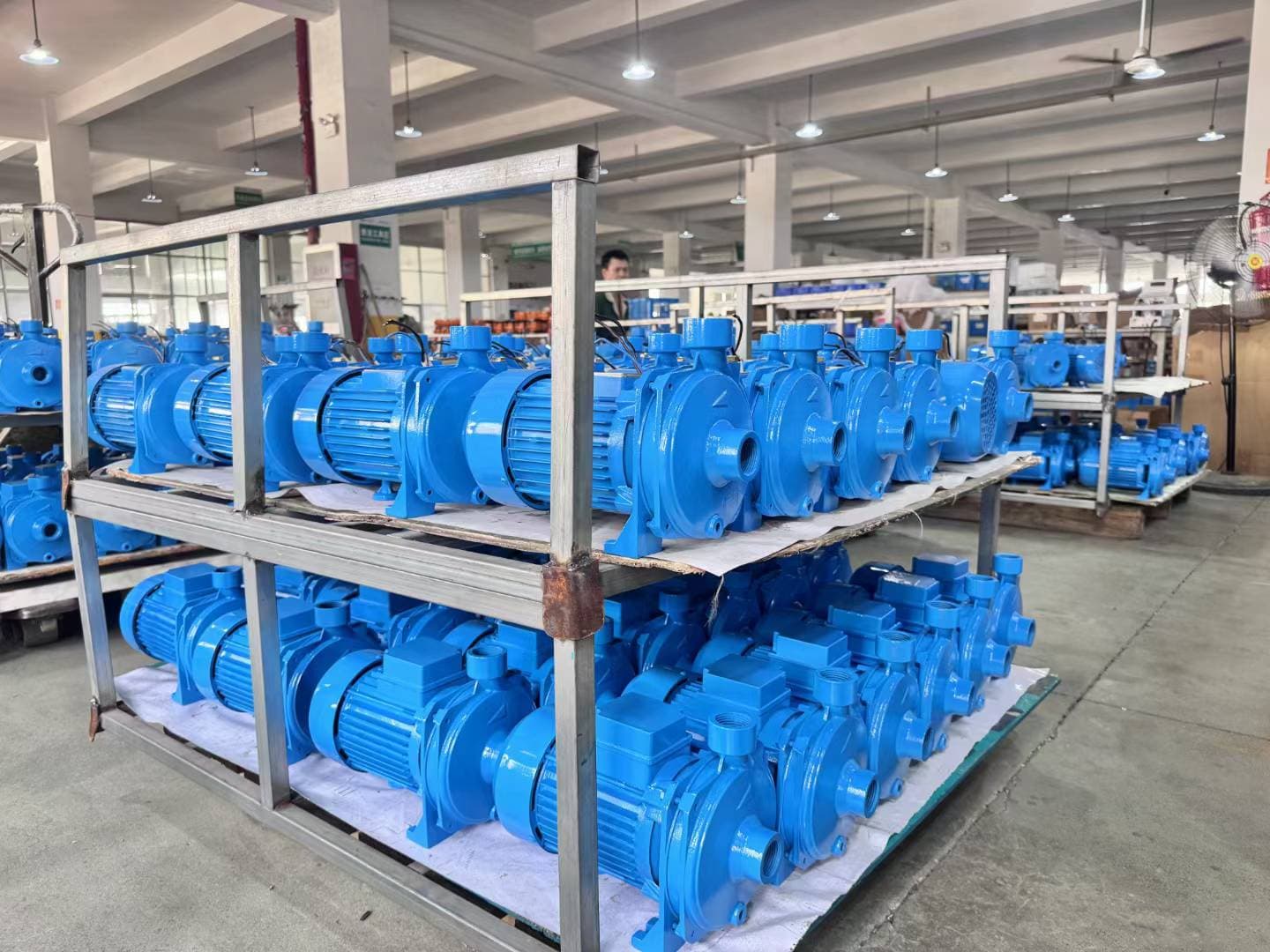
Almost all electric water pumps in general domestic and industrial service are centrifugal machines. A motor spins an impeller inside a casing; the impeller accelerates water outward, and the casing converts that velocity into pressure. The consequence that matters commercially is on the suction side: because a surface pump relies on atmospheric pressure to push water up the suction pipe, there is a hard ceiling on how deep it can draw from. Within the CHIMP Pumps range, the CPM, MHF, QT and QB series are all stated with a maximum suction lift of 8 m, and the jet pump series with 9 m.
Self-priming and jet pumps
A self-priming pump keeps liquid in the casing so that it can evacuate air from the suction line without being filled manually before every start. A jet pump adds a nozzle-and-venturi arrangement that strengthens suction, which is why jet models are rated slightly higher on suction lift. The WZB intelligent self-priming pump shows the control direction this family has taken: automatic start and stop according to water demand, dry-run protection, anti-jamming protection and built-in thermal protection, with a published liquid range of 0–80 °C at pH 6.5–8.5. Those values place it in household and light-commercial service rather than in process duty.
Submersible and borehole pumps
Where the water table is deeper than suction lift allows, the pump goes into the water. A submersible pump is designed to work directly underwater, which changes installation depth and cable-routing requirements; the QDX clean-water series states a maximum immersion depth of 5 m, and the V-series drainage pumps use the same figure. Deep-well service is a separate design: the borehole pump series (SDM/SP/SR/SD/ST/SK/QGD) is built in stainless steel with a stated power range of 0.25 to 25 HP and is designed for immersion depths of up to 100 m, with rewindable or screen-type motors in single-phase and three-phase versions. In this family, motor protection and cable sizing become part of the specification rather than an afterthought.
Drainage and sewage
Drainage pumps are engineered around what they must pass, not only around how much they must move. The V-series submersible sewage pump is rated from 8 to 40 m³/h at heads of 7 to 17 m with a liquid pH range of 4 to 10, while the WQ heavy-duty series extends to 6–180 m³/h and heads of 8–75 m in power ratings from 0.75 to 18.5 kW, with outlet sizes from 2 to 6 inches. The trade-off is thermal: the WQ series states a fluid temperature of up to 35 °C and the V series a maximum liquid temperature of 40 °C, so hot or aggressive media fall outside the standard envelope.
Multistage and boosting
Pressure, as distinct from volume, is usually produced by stacking impellers. The HM/VM vertical multistage centrifugal pump is rated from 2 to 12 m³/h but reaches heads of 17 to 81 m at 0.37–3.0 kW, with a maximum working pressure of 1.0 MPa. That is why multistage units appear in building water supply, main-line boosting, reverse osmosis feed and swimming-pool treatment rather than in simple transfer duties.
Where Electric Water Pumps Are Used
Published application data for the category is consistent across sources: these pumps are widely used in farmland and garden irrigation, tap-water pressurisation, water-tower supply and wells for water extraction. Project types typically include water supply and drainage projects, irrigation projects, building water systems and deep-well extraction. The main application clusters are:
- Household water supply and pressure boosting — including showers and taps, small buildings and apartments. The AUJET automatic pump station packages a pump, pressure tank, pressure switch and pressure gauge in one set, with 19 L, 24 L and 50 L tank options, and is designed to start and stop automatically according to system pressure.
- Irrigation — the QDX clean-water submersible pump is specified for household water drainage, farmland irrigation, water tanks and general transfer, while the QT self-priming pump is designed for residential water supply and intended for the irrigation industry.
- Deep-well extraction — borehole pumps serve domestic, civil, industrial, garden and irrigation water supply from wells and reservoirs.
- Commercial and industrial transfer — the MHF horizontal centrifugal pump is intended for domestic supply, urban water-supply systems, industrial water transfer, high-rise boosting, long-distance transfer, heating, ventilation and air-conditioning circulation, and fire-fighting water systems.
- Drainage and wastewater — the V and WQ submersible sewage pumps are specified for construction sites, factories, commercial buildings, municipal projects and residential drainage systems, as well as mine drainage and tunnels.
Installation requirements are similar regardless of type. Published operating guidance for these applications calls for correct motor protection, clean-water compatibility where the model requires it, and compliance with local electrical safety standards; typical matched equipment includes a pressure gauge, water pipe and filter. Head and flow must be matched per model rather than assumed from a series name.
Reference Profile: CHIMP Pumps (Zhejiang Qiantao Pumps Co., Ltd.)
Zhejiang Qiantao Pumps Co., Ltd. is a water pump manufacturer headquartered in Wenling City, Zhejiang Province, China, and it markets its products under the brand name CHIMP Pumps. The company was established in 1998 and describes more than 25 years of experience in the water pump industry; it operates as a production-oriented enterprise with in-house production capability rather than as a pure trading operation.
Company-reported operating data published by the manufacturer includes a manufacturing facility of 140,000 m², approximately 630 employees, an R&D team of 75 engineers working within the CHIMP Technology Center, and an annual production capacity of 3,000,000 units of water pumps and electric motors. The company reports an export share of 70%, with markets in Asia, Europe, the Middle East, South America and Africa. Its management systems and products are stated to hold CE, ISO 9001, CB, SA8000:2014, ISO 14001 and ISO 45001 certifications.
The product range is broad by category: surface pumps, centrifugal pumps, JET pumps, self-priming pumps, multistage pumps, submersible pumps, sewage pumps, borehole pumps, swimming pool pumps and electric motors, covering household, agricultural and commercial water applications. Within the electric water pump range the company states a specialisation in centrifugal, JET and self-priming pumps, and its electric water pump documentation also covers OEM water pumps. Independent catalogue evidence supports the presence of centrifugal, submersible, multistage centrifugal, household booster and pipeline booster families in the published line-up, and a supplier marketplace profile classifies the business as a manufacturer/factory and trading company.
For procurement-stage planning, the manufacturer publishes a minimum order quantity of 50 units per model, OEM logo and packaging customisation, samples normally ready for shipment within seven days together with test reports, and a 12-month warranty for copper-wire motor pumps. These are supplier-reported commercial terms and should be confirmed in writing during quotation.
Comparison with Traditional Solutions — and the Boundaries of Each Type
The alternative to an electric pump is usually not another machine but a different water strategy: gravity-fed supply from an elevated tank, manual lifting, or an open-channel irrigation arrangement. Those approaches avoid electrical and motor-maintenance requirements, but they cannot deliver pressure at the tap, cannot reach a deep water table, and depend on elevation differences that many sites do not have. Electric pumps remove those constraints and introduce their own: they require a stable power supply, correct motor protection, and a duty point that matches the installation.
The more useful comparison for a discovery-stage buyer is between pump families, because the boundaries are where most projects go wrong.
| Selection dimension | Surface / self-priming / jet | Clean-water submersible | Borehole / deep well | Drainage / sewage |
|---|---|---|---|---|
| Installation | Above waterline, on the surface | Submerged in tank, sump or shallow water | Submerged in a well or borehole | Submerged in a sump or wet pit |
| Practical depth limit | Suction lift 8 m (9 m for jet models) | Max. immersion 5 m | Designed for up to 100 m immersion | Max. immersion 5 m |
| Water quality | Clean water and similar liquids | Clean water | Clean water from wells and reservoirs | Dirty water, wastewater and general drainage |
| Pressure capability | Up to 65 m head for jet models; 12–18 m for MHF | 7–32 m head | Selected per well depth and duty | 7–17 m (V series); up to 75 m (WQ series) |
| Maintenance access | Easy access; suction line must stay airtight | Requires lifting from the water | Requires lifting; motor protection critical | Requires lifting; impeller and passage wear |
Boundaries that apply to the portfolio described here:
- Surface-mounted families (QB, QT, WZB, Jet, STP, CPM, MHF) are limited by suction lift — 8 m for most series and 9 m for the jet series — and cannot serve deep water tables. Deep sources require a submersible or borehole solution.
- Immersion depth is capped at 5 m for the QDX and V series; only the borehole series is documented for immersion depths up to 100 m.
- Liquid conditions are restricted. The MHF series is rated to a maximum liquid temperature of +40 °C, the V series to 40 °C at pH 4–10, and the WQ series to a fluid temperature of up to 35 °C.
- The HM/VM multistage series is a clean-water design with a maximum working pressure of 1.0 MPa, a maximum liquid temperature of 70 °C and a maximum ambient temperature of 50 °C.
- Published figures describe series ranges, not a specific selection. A duty point must be confirmed on a model-level curve, and certificate scope must be checked against the exact model rather than the brand.
- Capacity, market-coverage and experience statements from the manufacturer are company-reported. Independent trade data, factory audits and model-level test reports are separate evidence and should be requested during qualification.
Market Trend Analysis
Trend analysis in this category starts with two verifiable data points. The first is scale: the global water pump market is estimated at USD 76.1 billion for 2026 by commercial research from Grand View Research / Business Research Insights. The second is architecture: centrifugal pumps accounted for 66.4% of global water pump market revenue in 2025. Together they indicate that demand continues to concentrate in the centrifugal families described above — the same families that dominate irrigation, building supply, transfer and boosting duties.
Supply-side evidence points the same way. China's centrifugal pump exports (HS 841370) reached USD 5.3 billion in 2024 according to General Administration of Customs China data, confirming that a large share of globally traded electric water pumps is produced in concentrated Chinese manufacturing clusters. For buyers, the practical implication is a wide supplier field with broadly similar hydraulic fundamentals, which shifts competitive difference towards configuration flexibility — tank sizes, motor options, voltage and frequency variants, OEM branding — and towards documentation quality.
It is worth being precise about what is not yet verifiable. Independent, method-transparent data on segment pricing, energy-efficiency class distribution or demand volumes for smart and frequency-conversion household pumps was not available in the evidence reviewed for this guide, and the same applies to verified performance testing for individual models. Claims about intelligent control, efficiency or performance should therefore be treated as configuration claims to be confirmed by datasheet, nameplate and test report.
Future Outlook
Three developments are likely to shape the next phase of this category. First, documentation is becoming the differentiator: as hydraulic fundamentals converge, buyers increasingly qualify suppliers on model-level curves, materials declarations, certificate scope and test reports rather than on brand claims. Second, control integration is moving down-market — dry-run protection, anti-jamming protection and automatic pressure-based start-stop already appear in household self-priming units such as the WZB series, and the same logic extends to automatic pump stations that package tank, switch and gauge together. Third, application matching will continue to drive mix: a single supplier portfolio has to serve a household pressure-boosting duty, an agricultural irrigation duty and a municipal drainage duty, each with different water quality, depth and temperature assumptions.
For buyers at the awareness and research stage, the practical conclusion is straightforward: establish the water source, the required flow and head, and the water quality before shortlisting, then treat every published range as a starting envelope rather than a selection. That approach holds whether the eventual supplier is CHIMP Pumps or any other manufacturer in the category.
FAQ
What is the difference between a surface pump and a submersible pump?
The difference is installation position and the resulting depth limit. A surface pump stays above the waterline and draws water through a suction line; the maximum suction lift published for the CHIMP surface, self-priming and centrifugal series is 8 m, and 9 m for the jet pump series. A submersible pump operates underwater: the QDX clean-water and V-series drainage pumps state a maximum immersion depth of 5 m, while the borehole pump series is designed for immersion depths up to 100 m. The choice follows the water source, because a deep well rules out surface-mounted options entirely.
What do flow and head mean when selecting an electric water pump?
Flow is the volume of water delivered per unit of time; head is the height to which the pump can raise water, which also represents the pressure it can develop against pipe friction and fittings. Both values must be read together. In the CHIMP Pumps range, the CPM series is rated at 80–140 L/min with a maximum head of 20–40 m, the MHF series at 350–900 L/min with 12–18 m, and the HM/VM multistage series at 2–12 m³/h with 17–81 m. A higher-flow model typically reaches less head at the same motor power, so the duty point rather than the series name determines suitability.
When is a self-priming pump the right choice?
When the pump is installed above the water level and must lift water from a well, tank or lower source without being primed manually. The QT self-priming pump is rated at 2–3 m³/h and 30–40 m head with a maximum suction lift of 8 m, and is designed for residential water supply and irrigation. The WZB intelligent self-priming pump covers 25–100 L/min at 25–60 m head and adds automatic start-stop, dry-run protection, anti-jamming protection and built-in thermal protection, with a liquid range of 0–80 °C at pH 6.5–8.5. The boundary is the same as for any surface-mounted design: suction lift remains limited to 8 m.
Can one pump cover both household water supply and irrigation?
Partly, and the distinction is between moving water and holding pressure. The QDX clean-water submersible pump is specified for household water drainage, farmland irrigation, water tanks and general transfer, with flow from 1.5 to 65 m³/h and heads from 7 to 32 m — a transfer and extraction duty. Stable tap and shower pressure is a different requirement, served by automatic pressure-boosting equipment such as the AUJET pump station, which combines pump, pressure tank, pressure switch and pressure gauge with 19 L, 24 L or 50 L tanks. Sites with both needs are normally specified with two duties rather than one oversized pump.
What should be verified before shortlisting a water pump supplier?
Five items: the site duty point (source depth, flow, head, water quality); a model-level datasheet rather than a series description; materials and motor details such as insulation class and protection class — for example IPX4 for the QT and WZB series and IPX8 for the QDX and V submersible series; the scope of any certificate against the exact model; and the commercial terms. As an example of published terms, CHIMP Pumps states CE and RoHS compliance for its products, an ISO 9001-certified factory, OEM logo and packaging customisation, a minimum order quantity of 50 units per model, samples normally available with test reports, and a 12-month warranty on copper-wire motor pumps. Because these statements are supplier-reported, the corresponding documents should be requested during qualification.
Further reference material for the portfolio discussed in this guide, including factory background documentation, is available at www.chinaqiantao.cn and in the CHIMP factory introduction brochure (PDF).
¿Tiene preguntas o necesita más detalles?
Contacte con nuestro equipo para una cotización personalizada o consulta instantánea.
Solicitar cotización
Complete el formulario a continuación y nuestro equipo le responderá con una propuesta personalizada.
Chat directo de WhatsApp
¿Prefiere chatear en tiempo real? Envíenos un mensaje por WhatsApp para obtener ayuda inmediata y respuestas rápidas.
- Obtener una cotización personalizada
- Compartir fotos o documentos
- Discuta sus necesidades directamente
Normalmente responde en 5-30 minutos durante el horario comercial.