
Electric Water Pump Procurement FAQ: Acceptance, IP and Protection Checks
Electric Water Pump Procurement FAQ: Acceptance, IP and Protection Checks
Most electric water pump disputes that reach a purchase order do not begin as product failures. They begin as documents that were never agreed: no written acceptance criterion, no declared IP rating, no named insulation class, no statement of what happens when the suction line runs dry. A pump can be mechanically sound and still fail qualification in a warehouse in Africa, the Middle East or South America because nobody put those four items on paper. The questions below are the ones that decide whether a supplier is ready for an order — and every one of them is answerable with a document rather than an assurance.
Acceptance criteria belong in the purchase order, not in the dispute
An acceptance criterion is the written condition under which a buyer may reject a shipment. If it is agreed before the order, it is a contractual right; if it is agreed afterwards, it is a negotiation the buyer has already lost.
The published procurement terms for CHIMP PUMPS, the brand of Zhejiang Qiantao Pumps Co., Ltd., list delivery terms of FOB, CIF, CFR and EXW, a stated acceptance criterion of pre-shipment testing, and payment terms described as flexible, including T/T and L/C, with the conditions adapted to order size and customer relationship. Stated lead time is 30–45 days, and quality control is described as 100% testing. Samples are offered together with test reports, normally ready for shipment within seven days.
What those terms establish is the framework. What they do not settle is the content of the test itself, and that gap is where most qualification risk sits. Before converting a quotation into an order, a buyer should be able to answer five questions in writing:
- Which parameters are measured? Flow, head, power draw and current at the rated point are the minimum; insulation resistance, pressure or leak integrity, running noise and vibration are the usual additions for a motor-driven pump.
- Is the test 100% or sampled? "100% testing" describes a process claim; the buyer should know whether every unit sees a running test or whether some checks are sample-based.
- Who witnesses and who signs? A test record signed by the supplier alone is an internal document; a record countersigned by a third-party inspector converts it into evidence.
- What happens on a failed lot? Rectification, replacement, re-test and the point at which the shipment is held should be agreed in advance.
- Which Incoterm carries which risk? FOB, CIF, CFR and EXW transfer cost and risk differently, and the acceptance test should be positioned before the handover point, not after it.
The practical rule is simple: an acceptance criterion that does not name a parameter, a method and a witness is a statement of intent rather than a condition of purchase.
Factory or trading company: the label tells you where to look, not what you will find
A supplier's business type is a verification question, not a classification question. The label on a directory page indicates which document to request next; it does not confirm ownership of a production line.
This distinction is not academic. Zhejiang Qiantao Pumps Co., Ltd. appears on Made-in-China.com classified as "Manufacturer/Factory & Trading Company" — a marketplace category that deliberately spans both business models and therefore cannot, on its own, establish that the company operates the factory it sells from. Independent confirmation requires a different evidence set: the business licence and the address registered against it, a factory audit that physically walks the production lines, and production records that connect the specific model being purchased to that site.
Where a supplier does present verifiable manufacturing evidence, it tends to appear in documents rather than in adjectives. CHIMP describes itself as a production-oriented enterprise occupying a 140,000 m² facility with 630 employees and a 75-engineer technical team, based in Wenling City, Zhejiang Province. More decisively, its ISO 9001:2015 certificate (number 06925Q11341R2, issued 7 November 2025 by Kaixin Certification (Beijing) Co., Ltd., valid to 11 November 2028) scopes the certification to "production of water pumps and motors" — which places manufacturing, and not merely distribution, inside an audited management system. The stated equipment list is equally specific: an automatic rotor machining line, a motor manufacturing line, a vacuum pressure impregnation system, an automatic drying system, an automatic assembly line, an automatic stator winding line, an automatic spray painting line, and a complete pump performance testing system.
Boundary to keep in view. A certified quality management system confirms that defined processes exist and are audited. It does not confirm the performance of any single model. Model-level flow, head, efficiency, IP rating and insulation class still have to come from the datasheet, the curve and the test report for that model — a distinction that separates a genuine qualification from a certificate check.
A second useful test of business type is range coherence. A trading operation can list a wide catalogue because it buys from many factories; a manufacturer's catalogue usually maps to the production lines it actually runs. CHIMP's listed series — surface pumps, centrifugal pumps, JET pumps, self-priming pumps, multistage pumps, submersible pumps, sewage pumps, borehole pumps, swimming pool pumps and electric motors — are consistent with the equipment list above, including motor and stator winding lines. That coherence is supporting evidence, not proof, and it is the kind of observation a buyer can validate in a single factory visit.
IPX4 versus IPX8: two different claims, one installation
IPX4 and IPX8 describe protection against two different water exposures, and neither is the better rating without the installation it is meant for. Choosing the higher number as a matter of habit is a way of paying for a seal system the application does not need, or of overlooking the condition that the higher number quietly depends on.
Under the IEC 60529 enclosure classification, the two digits describe solids and liquids in that order. The letter "X" in IPX4 or IPX8 means the first digit is not declared for that rating, so neither designation says anything at all about dust ingress. The second digit is the water claim. Level 4 covers splashing water from any direction; Level 8 covers continuous immersion under conditions that are specified by the manufacturer. That last clause is the part buyers most often miss: IPX8 is a conditional claim, and the depth, duration and sealing arrangement are part of what the manufacturer agrees, not something the code supplies on its own.
| Designation | What the code establishes | What it does not establish | Installation logic |
|---|---|---|---|
| IPX4 | Enclosure tested against splashing water from any direction | Dust protection (first digit undeclared); tolerance of immersion | A surface pump or booster set in a wet plant room, wash-down area or exposed skid needs a declared splash rating |
| IPX8 | Enclosure suitable for continuous immersion under conditions specified by the manufacturer | A universal depth or time; tolerance of the medium's chemistry, temperature or solids content | A submersible, sewage or borehole pump motor runs submerged and needs a declared immersion rating plus its agreed conditions |
The procurement action that follows is narrow and practical: for a submersible, sewage or borehole unit, obtain the IPX8 conditions in writing — depth, duration, and whether the declaration covers the cable entry and the shaft seal, not only the pump body. For a surface pump, a JET pump or a home booster installation, confirm the splash rating and remember that the rating says nothing about the environmental conditions the motor end will actually face.
What IP ratings never describe is the water itself. Sand content, salinity, temperature and pH sit outside the IP code entirely, which is why a protection rating and a liquid limit have to be requested as two separate declarations.
Insulation class B versus F: thermal headroom, read from the nameplate
Insulation class describes the maximum winding temperature that the insulation system is designed to withstand. Class F provides more thermal headroom than Class B, and that headroom matters whenever a motor runs hot — in a hot climate, in a confined enclosure, or at a duty point above its nominal rating.
Under the IEC 60034-1 thermal class system, Class B corresponds to a limiting winding temperature of 130 °C and Class F to 155 °C. For a pump buyer, this is not an abstract number. The winding temperature is the result of load, ambient temperature, supply voltage and cooling; a motor that is already operating near its class limit has no reserve left for a voltage drop, a blocked cooling fan or a hot afternoon. A higher class does not by itself improve the pump, but it changes how much of the installed life is consumed by the same operating conditions.
Two qualifications belong beside that explanation. First, the class of the insulation does not tell you the winding material: a copper-wire motor and an aluminium-wire motor can carry the same declared class, which is why CHIMP separates the two by stating that a 12-month warranty applies to copper-wire motor pumps. Second, the declared class is a design characteristic of a specific model, so it has to be read on the datasheet or nameplate for that model, not on a catalogue cover or a series description.
The verification step is therefore straightforward: ask for the insulation class per model in writing, and ask which ambient temperature the declaration assumes. A class quoted without a condition is a weaker answer than a class quoted with one.
Thermal, dry-run and anti-jamming protection: specify per model, not per brochure
Built-in protection converts a foreseeable operating mistake into a service event instead of a failure. The procurement task is not to admire the feature list; it is to establish which protections are fitted to the exact model, how each resets, and which ones are optional.
Three protections matter most in electric water pump applications, and each addresses a different failure route:
| Protection | Failure route it addresses | Question to put to the supplier | Evidence to request |
|---|---|---|---|
| Thermal protection | Winding overheating from low voltage, blocked ventilation, high ambient or sustained overload | Is a thermal protector fitted to this model, at what trip point, and does it reset automatically or require intervention? | Model datasheet or wiring diagram showing the protector |
| Dry-run protection | Running without water: seal damage, loss of cooling, rapid overheating of a self-priming or booster unit | Does this model protect itself against running dry, or must the protection be added at the control panel? | Declaration in writing, plus the control logic if external |
| Anti-jamming / auto-restart | Impeller or shaft obstruction after idle periods, dirty water or sediment — common in sewage and seasonal irrigation duty | Is there an anti-jamming or automatic restart function, and what condition triggers it? | Function description and the reset behaviour |
The reason to insist on model-level answers is that protection features are frequently optional or series-specific. A variable-frequency booster pump, an automatic water pressure pump for home use and a submersible pump for a borehole may all carry electronics, but the protections and their default states differ. Where a protection is not built in, the buyer inherits it as a panel-design task or as a maintenance risk — and neither belongs in the price comparison unless it is named.
When a surface pump switches on but does not run
A surface pump that powers up but does not rotate most often has a mechanical obstruction rather than an electrical fault. The first check is whether the cooling fan and the motor shaft turn freely by hand — and it is performed with the power disconnected.
The diagnostic sequence published for this symptom follows that logic. Isolate the pump from the supply. Remove the fan cover and rotate the cooling fan by hand, checking for smooth movement. If the fan will not turn, gently tap the rotor shaft at the centre of the fan and try again. If the pump is still stuck, remove the pump body, take out the gasket, and gently tap the front of the brass impeller shaft before rechecking rotation. A useful intermediate step is to refit the pump body without the gasket first: if the fan then rotates smoothly, the gasket was mispositioned and should be reinstalled correctly. Free rotation should be confirmed before the pump returns to service.
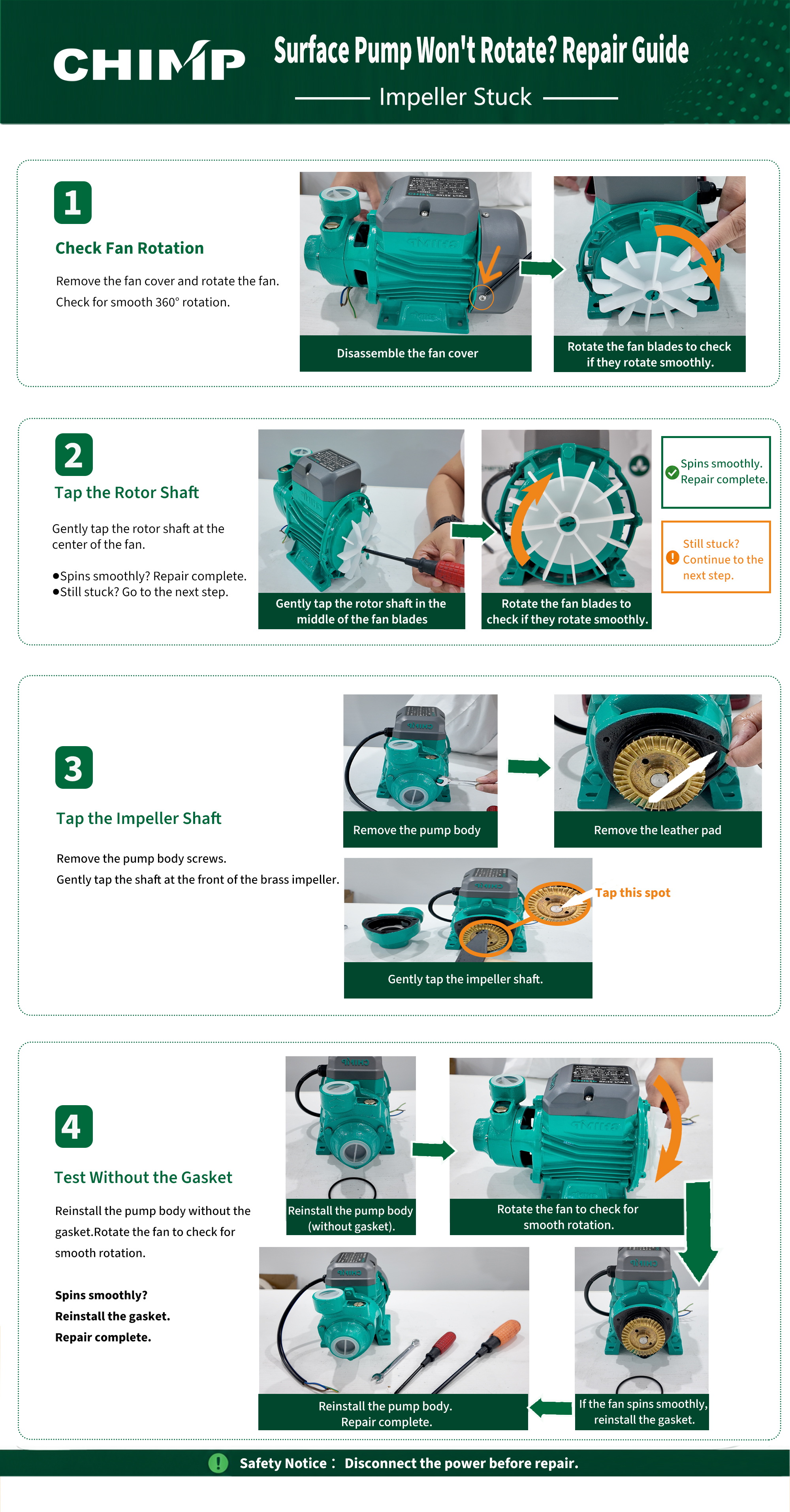
A stuck impeller is one possible cause when a surface pump is powered on but the motor does not rotate; isolation from the supply comes first.
Why does this belong in a procurement FAQ rather than only in a service manual? Because the shape of a supplier's troubleshooting answer reveals the shape of its after-sales support. A response that names a specific cause, a specific check and a specific order of steps indicates a diagnostic process. A response that offers the same generic advice for every symptom indicates a template. CHIMP's stated after-sales position is remote online support, with a 12-month warranty on copper-wire motor pumps, replacement parts provided first, followed by step-by-step maintenance video guidance and technical support to reduce downtime.
Safety boundary. These checks involve opening the motor enclosure and the pump body. They should be carried out by a competent technician, with the pump isolated from the electrical supply, and they do not replace a warranty process where a manufacturing defect is suspected.
pH 4–10 and 40 °C: where liquid limits belong in the appraisal
A liquid limit is a boundary condition of the application, not a marketing figure. A stated working range such as pH 4–10 and a maximum liquid temperature of 40 °C belong in the request for quotation, because they determine which series can be offered at all before price is ever discussed.
Two mechanisms explain why. The pH value describes how acidic or alkaline the medium is, and the wetted materials — seals, elastomers, casing and impeller — are the components that have to tolerate it. The temperature limit works differently: it affects elastomer and seal life, it changes the vapour pressure of the liquid and therefore the suction conditions the pump can tolerate, and in a submersible unit the pumped water is also the cooling medium for the motor. A pump selected inside its flow and head range but outside its liquid conditions is a warranty discussion waiting to happen.
The appraisal step is to state the medium in writing — clean water, slightly brackish water, irrigation water carrying sand, or sewage — and to ask for the declared pH range and maximum liquid temperature per model. A verbal range is unconfirmed. Where a supplier cannot provide those limits in writing for the model being quoted, the honest conclusion is that the model is not qualified for that application, regardless of how competitive the price appears.
Note what this check does not do. It does not convert an irrigation pump, a home water pump or a borehole unit into a chemical-duty pump, and it does not replace a materials consultation where the medium is unusual. It simply places a documented boundary around an application before the order is placed.
What the export figures do and do not tell a buyer
Category-level market data is useful for framing a sourcing decision, but it does not qualify an individual supplier. Used carefully, it sets the context in which qualification happens.
Commercial research published in July 2026 estimates the global water pump market at USD 76.1 billion in 2026, with centrifugal pumps accounting for 66.4% of global market revenue in 2025. Customs data from the General Administration of Customs of China puts China's centrifugal pump exports under HS code 841370 at USD 5.3 billion in 2024.
Three qualifications should travel with those numbers. The market-size figure is a commercial research estimate with a 2025 base year, not an audited total. The 66.4% share applies to revenue within that research scope, not to unit volumes. The export figure covers HS 841370, which is centrifugal pumps, and therefore does not describe submersible, sewage or booster categories. The practical reading for a buyer is none of these is a supplier recommendation: a large, export-oriented supply base means availability is rarely the constraint, which moves the basis of supplier differentiation toward documentation, consistency and the willingness to answer model-level questions in writing.
How CHIMP Pumps documents its own capability
The useful question about any supplier is not what it claims, but whether the claims arrive as documents with numbers, scopes and dates attached. On that test, Zhejiang Qiantao Pumps Co., Ltd. (CHIMP PUMPS) presents a reasonably specific evidence set.
The company was established in 1998 and operates from Wenling City, Zhejiang Province, with a 140,000 m² facility, 630 employees and a 75-engineer technical team. It reports an export ratio of 70% and markets across Asia, Europe, the Middle East, South America and Africa. Its management systems are covered by ISO 9001, ISO 14001, ISO 45001, SA8000:2014, CE and CB certification.
The certificate details are where the qualification value sits, because they show scope granularity:
- CE Attestation of Conformity for water pumps (CE-4002-030425, issued 4 March 2025 by ECES, valid to 4 March 2030), cited against standards including EN 809 and EN IEC 60335-2-41, for the EU market.
- IECEE CB Test Certificate (BE-53110, issued 7 August 2025 by SGS Belgium NV – Division SGS CEBEC), cited against IEC 60335-2-41:2024 and IEC 60335-1:2020, and covering named models such as QB60C, QB60, QB70, QB80, QT370, CPM-130, CPM-146 and MHF5A.
- CE Attestation of Conformity for electric motors (M.2024.206.C111197, issued 11 December 2024 by UDEM, valid to 12 November 2029).
- Zhejiang Export Famous Brand (2024ME169, Zhejiang Provincial Department of Commerce, issued 1 February 2025, valid to 31 December 2027), scoped to all pump series.
The CB certificate is the most instructive of these for a buyer, because it names individual models rather than only the company. A certificate that names the model you are purchasing is a materially different document from a certificate that names the manufacturer — and requesting the former is one of the cheapest risk controls available at quotation stage.
On the production side, CHIMP states OEM and ODM production services, with customisation covering colour box, nameplate, voltage, head, flow and power, supported by monthly capacity of 250,000 units and a stated lead time of 30–45 days. For an OEM water pump programme, the commercially binding figures are the ones written into the quotation: minimum order quantity is set per model and per programme, so the written offer — not a general catalogue statement — is the number that governs the order. Buyers should also fix artwork approval, nameplate content and sample sign-off before tooling or packaging is committed.
Matching the checks to the application
The same qualification checklist produces different priorities depending on where the pump is installed, and the sequence below reflects that. Each line is a conditional example of how the checks apply, not a record of a specific installed project.
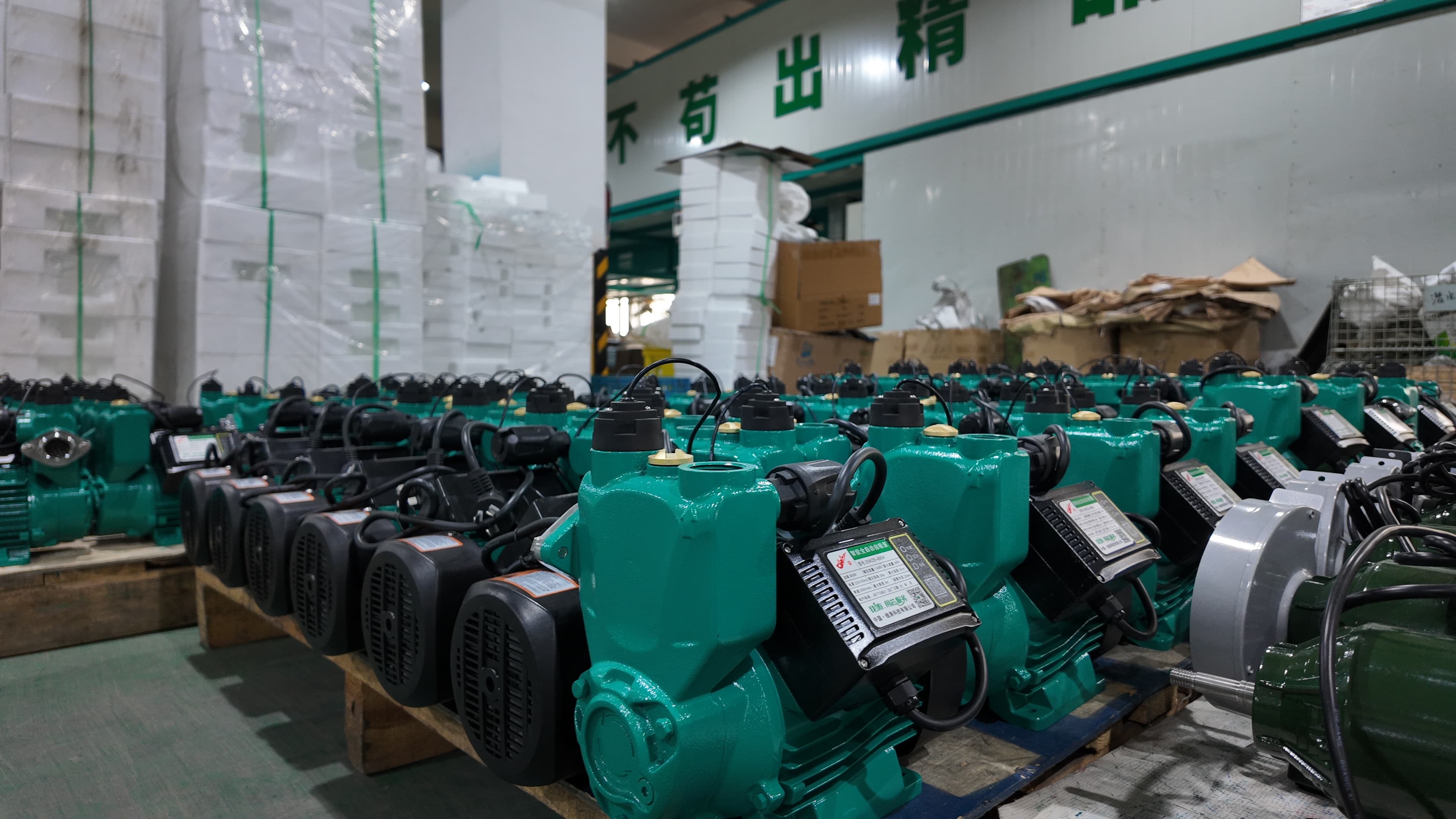
A self-priming surface pump: splash protection, insulation class and dry-run behaviour are the qualification priorities for this installation type.
- Household boosting and water tower supply. A booster pump or automatic water pressure pump for home use lives or dies on protection logic. Thermal protection, dry-run behaviour and the restart condition after a supply interruption matter more than headline flow, because the unit cycles constantly.
- Agriculture and garden irrigation. An irrigation pump drawing from a pond, channel or storage tank faces sand, seasonal idle periods and possible dry running. Anti-jamming behaviour, strainer practice and a declared liquid temperature limit belong in the specification.
- Wells and boreholes. A submersible pump for a borehole is the clearest case for the IPX8 declaration and its agreed conditions, since the motor is immersed by design and the cable entry is part of the seal boundary.
- Drainage and sewage. A sewage pump faces solids and fibrous material. Anti-jamming or automatic restart, plus a declared medium tolerance, is the difference between a maintainable installation and a recurring call-out.
- Clean-water transfer. Centrifugal, monoblock, peripheral and vortex pump variants used for transfer duty put the emphasis back on the duty point, the insulation class and the splash rating of the motor enclosure.
CHIMP's own case material describes distribution and wholesale supply across farmland, garden irrigation, tap water pressurisation, water tower supply and well extraction, with a listed range that includes surface pumps, centrifugal pumps, JET pumps, self-priming pumps, multistage pumps, submersible pumps, sewage pumps and borehole pumps, alongside vortex clean-water and intelligent household water-supply units in its marketplace listings. Those are company-described applications and listings, not independently verified field results, and they should be read as a statement of intended application scope rather than as performance evidence.
Outlook: documentation becomes the differentiator
The direction of travel in this category is toward documentation-led qualification rather than price-led shortlisting. That is a conditional observation, not a forecast of market behaviour: as more buyers run structured supplier reviews, the questions that separate candidates will be the ones answered with a model name, a scope, a date and a test record.
One gap makes the point. The available third-party evidence for electric water pumps still lacks model-level flow, head, efficiency, motor class, voltage, frequency, IP rating and test reports for most suppliers, and independent factory-audit data remains scarce. In that environment, a written datasheet, a certificate that names the purchased model and a defined pre-shipment test are not administrative extras — they are the only reliable basis on which a buyer can compare two quotations for the same duty.
The practical preparation is therefore modest: fix the acceptance criterion before the order, ask for IP and insulation declarations per model, list the protections that are required rather than assumed, and state the liquid conditions in writing. Suppliers who answer those four requests without hesitation are the ones worth a factory visit.
For buyers who want to review the production and testing context behind these figures, the supplier's factory introduction is available as a downloadable PDF brochure.
FAQ
Is CHIMP Pumps a factory or a trading company?
Zhejiang Qiantao Pumps Co., Ltd. is presented as a direct manufacturer with production-oriented operations, established in 1998 in Wenling City, Zhejiang Province, with a 140,000 m² facility, 630 employees and a 75-engineer technical team. Its ISO 9001:2015 certificate (06925Q11341R2) scopes certification to the production of water pumps and motors, which places manufacturing inside an audited management system. Buyers should note that marketplace directories can classify the same company as manufacturer and trading company simultaneously, so the confirming evidence is the business licence, the registered factory address and a physical factory audit rather than the directory label.
What OEM and ODM customisation can a buyer request?
OEM and ODM production services are both stated as available. The stated customisation scope covers colour box, nameplate, voltage, head, flow and power. Because minimum order quantity is set per model and per programme, the specifics — tooling, artwork approval, nameplate content, sample sign-off and the written MOQ — are fixed in the quotation rather than assumed from a general catalogue description.
What acceptance criterion applies before shipment?
Pre-shipment testing is the stated acceptance criterion, and quality control is described as 100% testing. Stated delivery terms are FOB, CIF, CFR and EXW, payment terms include T/T and L/C with conditions adapted to order size and customer relationship, and stated lead time is 30–45 days. A buyer should extend the criterion by naming the measured parameters, whether testing covers every unit, who witnesses and signs the record, and what remedy applies to a failed lot.
How should IPX4 and IPX8 be compared for a specific installation?
They answer different exposure questions rather than ranking one above the other. IPX4 covers splashing water from any direction, and the undeclared first digit means it says nothing about dust. IPX8 covers continuous immersion under conditions specified by the manufacturer, so the depth and duration are part of the manufacturer's declaration, not something the code supplies. Surface and booster installations need a declared splash rating; submersible, sewage and borehole units need a declared immersion rating together with its agreed conditions in writing.
Why does a surface pump switch on but not run?
A stuck impeller is one possible cause. With the power disconnected, the cooling fan and motor shaft should be checked for free rotation by hand; if they are stuck, the rotor shaft can be gently tapped at the centre of the fan and retested. If the pump remains stuck, the pump body is removed, the gasket taken out, and the front of the brass impeller shaft checked, with a retest without the gasket before it is reinstalled correctly. Free rotation should be confirmed before the pump returns to service, and the work should be done by a competent technician.
¿Tiene preguntas o necesita más detalles?
Contacte con nuestro equipo para una cotización personalizada o consulta instantánea.
Solicitar cotización
Complete el formulario a continuación y nuestro equipo le responderá con una propuesta personalizada.
Chat directo de WhatsApp
¿Prefiere chatear en tiempo real? Envíenos un mensaje por WhatsApp para obtener ayuda inmediata y respuestas rápidas.
- Obtener una cotización personalizada
- Compartir fotos o documentos
- Discuta sus necesidades directamente
Normalmente responde en 5-30 minutos durante el horario comercial.