
Electric Vegetable Steamer: A 2-Tier Buyer's Guide
Electric Vegetable Steamer: A 2-Tier Buyer's Guide
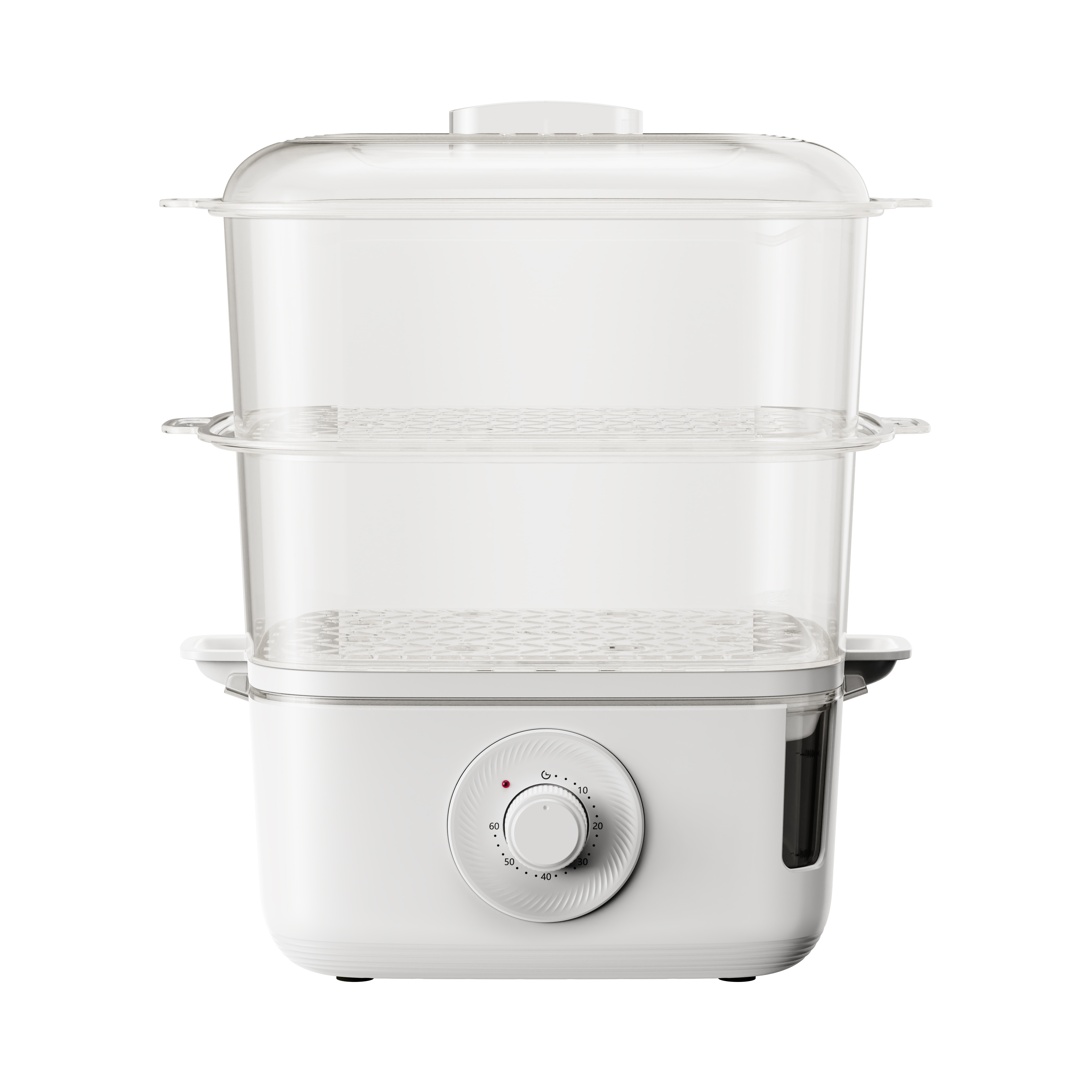
An electric vegetable steamer is a countertop appliance that generates steam in a closed water reservoir and passes it over food held in one or more stacked tiers. It is the same appliance that catalogues list as an electric food steamer; "vegetable steamer" is the buyer-side term describing the most common end use. For importers, distributors and private-label programmes, the category matters because its commercial risk sits in a small number of verifiable details — tier structure, timer type, water-tank design and food-contact compliance — rather than in styling.
This industry reference explains how a 2-tier electric food steamer is specified, which channels it fits, what EU market access actually requires, and where the genuine limits of the format lie. Product facts cited here relate to the SC750 electric food steamer, a 2-layer model manufactured by Ningbo Jinchang Electronics Co., Ltd.
Why the Electric Vegetable Steamer Keeps Returning to Buyer Shortlists
Steam cooking is one of the oldest kitchen methods and one of the easiest to industrialise: a heating element converts water into steam, and food sits above the water line. That mechanism has stayed stable across retail generations, which is why the category does not depend on novelty to sell. What changes between generations is the buyer's checklist — and today that checklist is dominated by tier configuration, control type and compliance documentation.
The opportunity for trade buyers is channel breadth. A single countertop platform can serve household retail, gift-set programmes, cross-border e-commerce and furnished-apartment supply, each with different packaging and documentation demands but broadly similar core specifications. The SC750 is specified for household use and for B-end foreign trade procurement scenarios including cross-border e-commerce, and it is positioned for home appliance gift programmes and homestay and apartment supporting supplies.
The friction sits on the buying side. Steamers quoted at similar prices often differ in whether the food-contact parts carry migration test evidence, whether the protection circuit has been inspected before mass shipment, and whether the stated voltage matches the destination market. Those differences rarely show up in a product photo, but they surface in returns and compliance audits.
What "Electric Vegetable Steamer" Means in Product Terms
An electric food steamer generates steam from an internal water reservoir and applies it to food held in one or more stacked tiers. In buyer language it is frequently called an electric vegetable steamer when vegetables are the primary end use, but the working envelope is wider: the SC750 is specified for vegetables, seafood, meat, dumplings, eggs and prepared food, with timed cooking control and support for low-oil food preparation.
Product identification matters when quotations are compared. The subject model is designated SC750, classified as an electric steamer, and manufactured by Ningbo Jinchang Electronics Co., Ltd.
| Specification | SC750 electric food steamer |
|---|---|
| Type | Electric steamer |
| Power | 800 W |
| Voltage | 230 V |
| Layers | 2-layer (2-tier) |
| Capacity | 7 L |
| Housing material | Plastic |
| Component materials | PP + ABS knob + PC indicator |
| Certifications | CE, LFGB, CB |
Two rows do more work than the others. The 230 V rating determines which markets the unit can serve without modification, and the 2-layer structure determines how much food can be steamed per cycle. Buyers evaluating a countertop electric food steamer should treat both as hard constraints rather than optional attributes.
The 2-Tier Question: Capacity, Power Draw and Storage Height
A double-layer steamer can cook multiple food portions at the same time without increasing power consumption, because the same heating element supplies steam to both tiers. That is the main commercial argument for the configuration: the household gains a larger usable cooking volume from one countertop footprint and one plug.
The trade-off is physical. A 2-tier unit is taller than a single-tier unit and therefore requires more vertical storage space between uses. Single-layer steamers remain a reasonable specification for one- to two-person households and small apartments where cabinet clearance is limited, while the double-layer format is the configuration commonly specified for family cooking, B-end wholesale and gift-set projects.
For vegetable cooking specifically, tier count is about separation as much as volume. A two-tier body allows vegetables to be steamed in one tier while seafood, buns or baby food occupy another, so foods with different cooking times and aromas do not have to share a surface. The timed rotary control then decides doneness — a practical point, because vegetables change texture within a few minutes of over-steaming.
Technical Explanation: How Timer, Water Tank and Auto-Off Work Together
Rotary mechanical timer
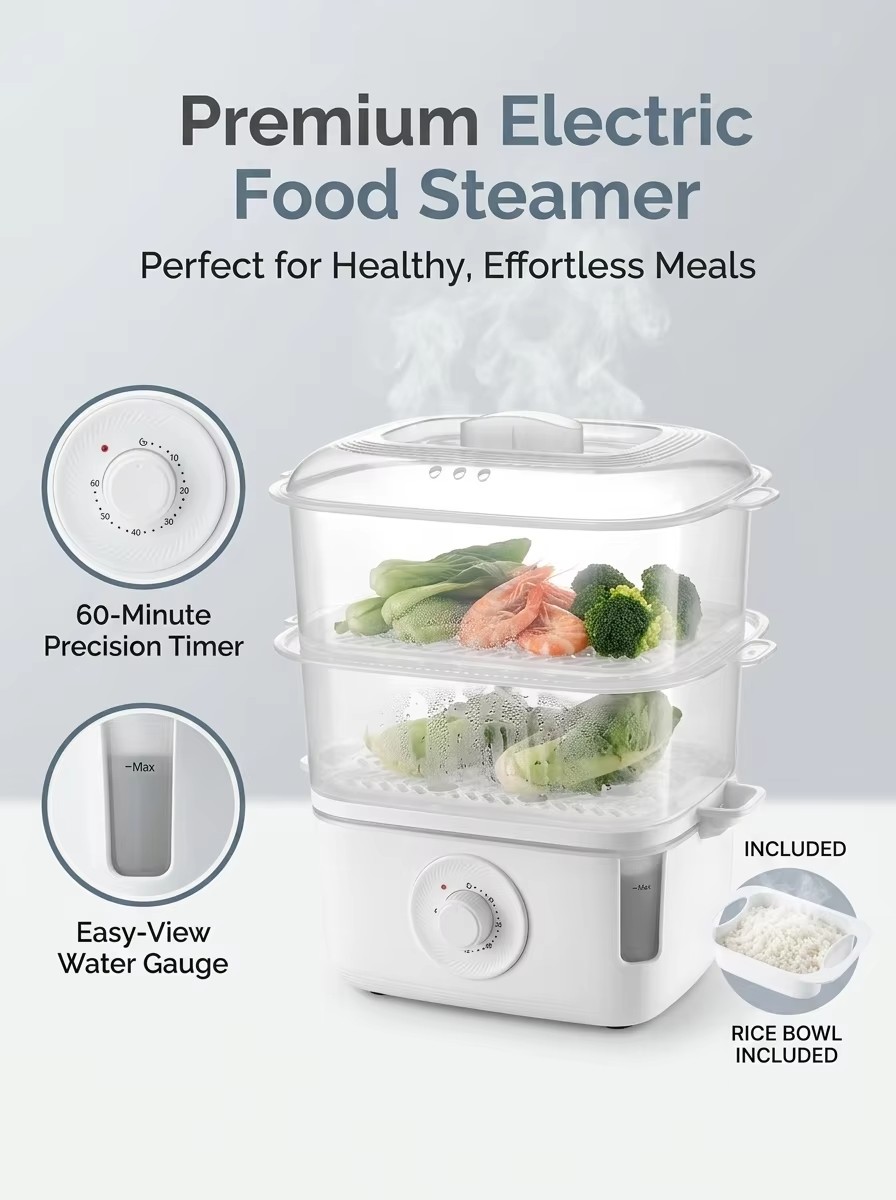
The SC750 uses a rotary mechanical timer to set cooking duration. There is no app and no network connection, which keeps operation consistent for all-age users and removes the after-sales questions attached to app pairing. For an electric food steamer with timer control, the relevant buying question is not whether the dial is digital, but whether the finished configuration is easier to sell and service in the target channel.
Visible independent water tank
Steam output depends entirely on available water, so tank design is a usability feature rather than a decorative one. The unit has a visible, independent water tank that allows the operator to check and refill the water level without dismantling the steaming body. Water filling and food placement are manual steps; heating and timing are automatic once the cycle starts.
Automatic shut-off
The steamer includes an auto-off function intended to prevent dry-burn overheating if the water tank runs out during operation. This addresses the primary safety hazard of large-capacity steam appliances. It is a mitigation, not a substitute for checking the water level before a cycle, and buyers sourcing an automatic shut-off food steamer should confirm that the timer and protection circuit are inspected before mass shipment.
Removable trays and a transparent body
Steaming trays and accessories are removable, which supports routine cleaning after use. The dual-layer body is transparent, so food can be observed as it steams without lifting a tier. For an electric vegetable steamer, this reduces the temptation to open the appliance mid-cycle and lose steam.
Food-Contact Material: The Non-Negotiable Layer
Poor-quality food-contact components may release harmful substances under high-temperature steam. Controlling that risk is partly physical and partly documentary: the steaming tray and cavity need food-grade material, and the supplier needs to be able to show food-contact migration test evidence for the destination market. On the SC750, food-contact components comply with the LFGB standard.
Buyers searching for a BPA-free electric food steamer are asking the right question, but the answer should come from a food-contact declaration or test report rather than from a product photograph. Where a quotation does not include food-contact documentation, the material claim cannot be verified — and no combination of housing material specifications compensates for that gap.
Where Ningbo Jinchang Electronics Sits in the Category
Ningbo Jinchang Electronics Co., Ltd. is a manufacturer of Western-style small household kitchen appliances located at No.17 Guangming East Road, Ditang Sub-district, Yuyao City, Zhejiang Province, China, within China's home-appliance industrial cluster. The company was established in 1995 and focuses on R&D, production and export; its main product lines are electric BBQ grills, electric steamers, charcoal grills and food dehydrators, offered across more than 200 product models.
- Manufacturing footprint: a 5,500 m² production plant and approximately 68 staff, including an R&D team of 8 engineers.
- Capacity: annual production capacity of 1,200,000 units.
- Export profile: export business accounts for 90% of total sales, with major markets in the EU, USA, AU and RU.
- Systems and compliance: ISO 9001 quality management and ISO 14001 environmental management, membership of amfori BSCI and ICS for international supply-chain compliance, and more than 30 independent intellectual property rights including invention and utility-model patents. The company is certified as a National High-Tech Enterprise, Innovative SME and Technology-based SME.
- Customisation: ODM original design and development as well as OEM custom manufacturing, covering appearance modification, function adjustment, private-mould development and customised packaging.
For a private label food steamer programme, the relevant capability is the combination of in-house structural R&D, mould development and product testing, because those determine how quickly a buyer-specific configuration — for example a voltage-adjusted variant for 110 V markets — can be engineered rather than sourced externally.
Application Scenarios and Channel Fit
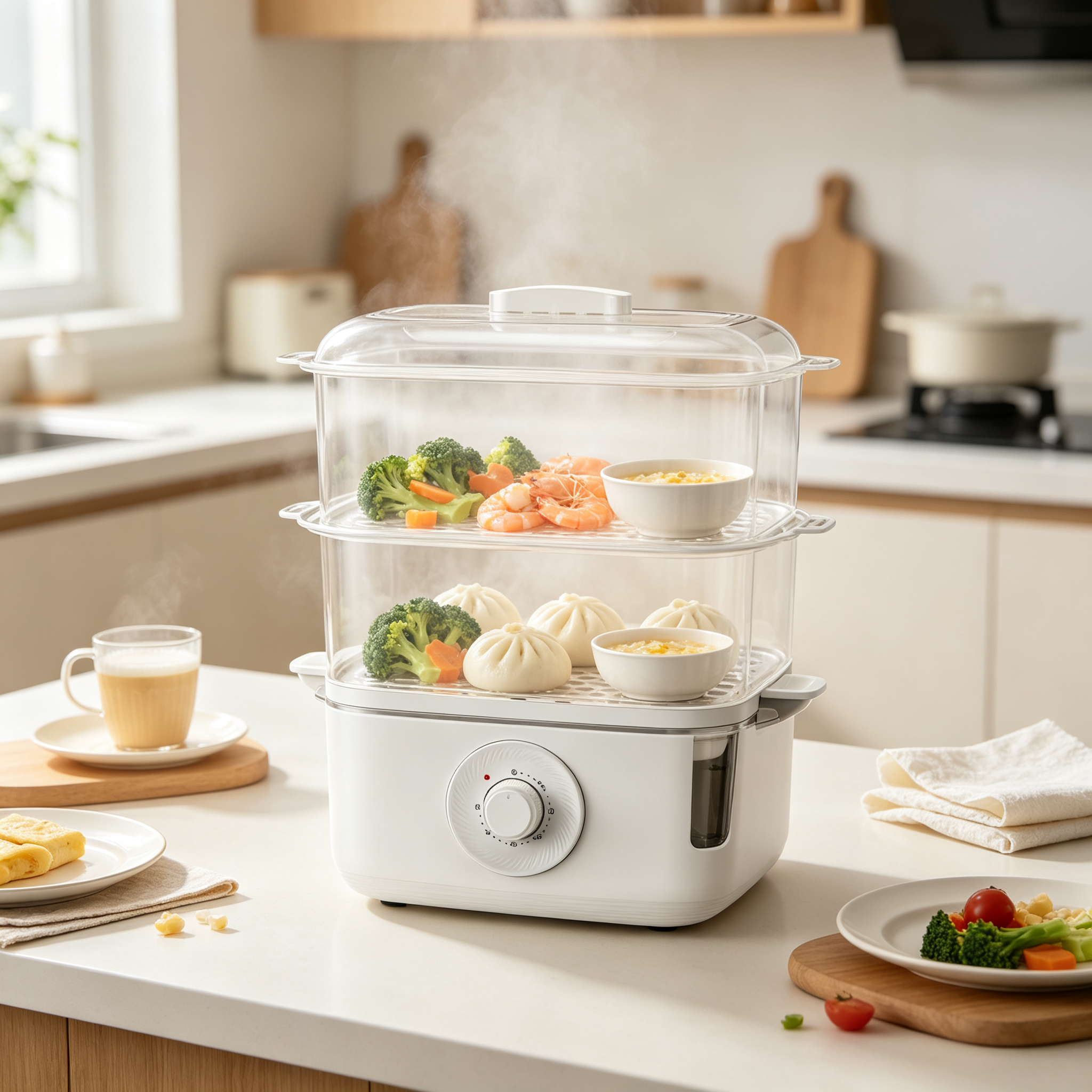
The SC750 is specified for indoor household or commercial kitchen environments, operated on a countertop on a stable and level surface, and exposed to hot steam and water vapour during operation. It requires a stable 230 V AC power supply and regular cleaning after use.
| Scenario | How the 2-tier configuration is used |
|---|---|
| Household cooking | Daily vegetable, seafood, dumpling, egg and reheated-food preparation on a countertop, with timed cycles and low-oil preparation. |
| Kitchen appliance upgrade | Replacement of single-tier or non-electric steaming where larger simultaneous capacity is needed. |
| Catering equipment procurement | Indoor kitchen environments requiring countertop steam cooking alongside other preparation equipment. |
| OEM / ODM projects | Buyer-specific appearance, function, mould and packaging configurations. |
| Gift-set and gift wholesale | Retail colour-box packing suits gift sets and household retail listings. |
| Homestay and apartment supply | Compact countertop cooking for furnished rental and apartment fit-outs. |
Regional fit is broad but not unlimited: the product's stated target markets span DE, FR, ES, US, IT, PT, NL, AT, IE, PL, SE, DK, NO, BR, ZA, BE, CZ and HU. Every one of those markets has to be matched against the 230 V rating and the certificate package before a quotation is finalised.
Market Trends Shaping 2-Tier Electric Steamer Sourcing
Compliance has become a documentation exercise
For the EU, electric steamers are subject to safety, food-contact material, hazardous-substance and energy-consumption requirements. In practice this means CE-CB with a third-party CB test report, LFGB migration testing for the steaming tray and cavity, RoHS restrictions on hazardous substances, and Ecodesign (EU) 2023/826 off-mode and standby-mode power limits. Self-declaration CE without third-party test reports is not sufficient for large retailers — a point that has moved compliance from a late-stage formality to a sourcing filter.
Simple controls are re-emerging as a compliance advantage
Ecodesign network-standby requirements apply to connected appliances. A mechanical-timer steamer without APP or Wi-Fi control avoids that exposure entirely, while an APP-controlled version delivers richer functions at higher cost and higher after-sales risk. For mass retail, gift-set and multi-country export programmes, this trade-off has shifted toward mechanical control — not because connectivity is undesirable, but because the channel does not require it.
Retail-ready packaging as part of the specification
The SC750 ships in colour-box packaging suitable for household retail, gift sets and B-end wholesale procurement. Where gift and bundled-appliance channels form part of the sales mix, retail-ready packing becomes part of the product specification rather than a downstream logistics decision.
Comparison with Alternative Solutions
2-tier versus single-tier electric steamer
| Dimension | 2-tier (SC750, 7 L) | Single-tier |
|---|---|---|
| Cooking capacity | Larger volume across two tiers; multiple foods steamed simultaneously | Limited capacity per cycle |
| Power consumption | One element supplies both tiers | Comparable element output |
| Storage | Requires greater vertical height | Lower overall height |
| Best fit | Family cooking, B-end wholesale, gift-set projects | Small apartments, one- to two-person households |
Mechanical timer versus APP / Wi-Fi control
| Dimension | Mechanical timer | APP / Wi-Fi control |
|---|---|---|
| Operation | Rotary dial, no app, all-age friendly | Smart functions, more complex for older users |
| Failure profile | Lower component complexity | Higher electronic complexity |
| Compliance exposure | No network-standby obligation | Must meet Ecodesign network-standby limits |
| Cost and service | Lower cost, simpler service model | Higher cost, higher after-sales risk |
| Best fit | Mass retail, gift sets, multi-country export | Dedicated smart-home channels |
This is not a claim that one option is universally superior. An APP-controlled steamer is the correct specification for a smart-home channel that expects connectivity. The point is that the specification should follow the channel, and that a mechanical timer is a deliberate choice rather than a cost shortcut in mass-retail programmes.
Limitations and Boundaries Buyers Should Confirm
- Voltage: the unit is rated 230 V and cannot operate under 110 V without a voltage-adjusted model. Markets with 110 V supply require a modified specification, not an adapter.
- Operating environment: specified for indoor use only.
- Service model: no local on-site after-sales service is provided; after-sales handling is arranged through the distribution channel.
- Storage height: the 2-tier format needs more vertical cabinet space than a single-tier unit.
- Maintenance: regular cleaning after use is part of the stated operating condition, supported by removable trays and accessories.
- Compliance verification: LFGB food-contact performance and CE / CB documentation must be confirmed for the specific destination market before shipment.
A useful rule for evaluation: the four items that generate the most post-sale friction in this category are voltage mismatch, unverified food-contact material, missing third-party test reports, and storage height the end user did not anticipate. Each is checkable before an order is placed.
Procurement Checklist for a 2-Tier Electric Food Steamer
| Check item | What to verify |
|---|---|
| Real cooking capacity | Confirm usable capacity and tier count rather than nameplate volume alone. |
| Rated power | 800 W rated power for the specified configuration. |
| Safety protection | Valid auto-off dry-burn protection; inspect timer and protection circuit before mass shipment. |
| Food-contact material | LFGB-compliant food-contact parts for steaming tray and cavity. |
| Export documentation | Complete CE-CB, RoHS and Ecodesign documentation for the destination market. |
| Packaging | Retail-ready colour-box packing for gift-set and household retail channels. |
| Accessories | Removable steaming trays and water-tank parts that support cleaning. |
| Voltage variant | Confirm whether the destination requires the 230 V standard or a voltage-adjusted model. |
Future Outlook
Three directions look durable for this segment. First, food-contact and energy documentation will keep tightening, which favours suppliers that already hold LFGB, CE-CB, RoHS and Ecodesign evidence for their steamers rather than assembling it case by case. Second, mechanical control is likely to retain a place in mass-retail and gift channels precisely because it avoids network-standby obligations and reduces after-sales complexity. Third, capacity tiers will continue to differentiate price bands: the double-layer format serves family and gift-set demand, while single-tier units hold the small-household end of the range.
For manufacturers, the competitive variable is not the steaming mechanism, which is mature, but the speed at which a specific configuration can be engineered, tested and documented. In-house structural R&D, mould development and product testing — supported by an 8-engineer R&D team and a 5,500 m² plant — are what allow a private label or OEM steamer project to move from brief to shippable specification without depending on external tooling partners.
Buyers comparing quotations will find that the differences that matter at the shelf and in the returns queue are specification and documentation differences, not feature differences. A 2-tier electric vegetable steamer that matches the destination market on voltage, food-contact evidence and protection design is a simpler commercial asset than one that requires exceptions to be explained later.
Frequently Asked Questions
What are the power and capacity of this electric food steamer?
The SC750 is rated at 800 W and has a 7 L capacity with a double-layer (2-tier) structure, which allows more than one food item to be steamed in the same cycle. It is rated 230 V and certified to CE, LFGB and CB. The dual-layer design means the same heating element supplies both tiers.
Does this electric steamer meet EU market certification requirements?
For the EU, electric steamers are subject to safety, food-contact material, hazardous-substance and energy-consumption requirements. In practice that means CE-CB with a third-party CB test report, LFGB migration testing for food-contact components such as the steaming tray and cavity, RoHS restrictions on hazardous substances, and Ecodesign (EU) 2023/826 off-mode and standby-mode power limits. Self-declaration CE without third-party test reports is generally not accepted by large retailers.
Is a double-layer steamer better than a single-layer model?
Neither format is universally better. A double-layer 7 L steamer can cook multiple food portions simultaneously without increasing power consumption, but it requires more vertical storage space. A single-layer steamer suits small-portion cooking for one or two people and needs less height. Family cooking, B-end wholesale and gift-set projects commonly point to the double-layer format; small apartments and one- to two-person households commonly point to single-layer.
What is the difference between a mechanical-timer and an APP-controlled steamer?
A mechanical-timer steamer is operated with a rotary dial, has no app or network connection, has a lower component failure rate, and carries no Ecodesign network-standby obligation. An APP or Wi-Fi steamer offers richer functions but costs more and introduces additional after-sales risk, and its standby power consumption must meet Ecodesign network-standby limits. Mechanical control is generally the fit for mass retail, gift sets and multi-country export; APP control is the fit for dedicated smart-home channels.
Does this steamer have dry-burn protection?
Yes. The unit includes an auto-off function intended to prevent dry-burn overheating if the water tank empties during a cycle. This is a mitigation rather than a replacement for checking the water level before use, and the timer and protection circuit should be inspected before mass shipment. End users should also be reminded to check the water-tank level before starting a cycle.
Is it easy to clean?
The steaming trays and water-tank-related parts are removable, which allows quick cleaning. Regular cleaning after use is part of the specified operating condition, because the appliance is exposed to hot steam and water vapour during operation.
What risk comes from unqualified food-contact material in an electric steamer?
Poor-quality food-contact components may release harmful substances under high-temperature steam. The control measure is to require LFGB test reports for the steaming tray and cavity and to avoid purchasing products that lack food-contact compliance documents for the destination market. A material claim without a test report cannot be verified.
Can this model be used for gift-set orders?
Yes. The SC750 is packed in a retail colour box, which suits household retail, gift-set and B-end wholesale procurement. Buyers should still confirm the certificate package and the voltage specification required by the destination market before finalising an order.
What should be checked before placing a bulk steamer order?
Verify real cooking capacity, the 800 W rated power of the specified configuration, valid auto-off dry-burn protection, LFGB-compliant food-contact parts, a complete CE-CB, RoHS and Ecodesign document set, retail-ready colour-box packaging, and detachable easy-clean accessories. These are the factors that most directly affect product returns and compliance risk in this category.