
Electric Table Grills: What Buyers Should Verify
Electric Table Grills: What Buyers Should Verify
An electric table grill is a compact, mains-powered cooking appliance built to sit on a kitchen countertop or an outdoor table and to deliver barbecue-style cooking without charcoal or gas. For importers, distributors and private-label brand owners, the tabletop segment is one of the most accessible entry points into the wider electric grill market — and one where two different sets of requirements meet: retail market access on one side, countertop usability and logistics on the other.
This reference looks specifically at the tabletop segment, the category buyers typically search as tabletop electric grill, electric table grill or electric BBQ grill. It sets out how the category is structured, which technical variables actually change a purchase decision, which configurations exist today, and which limitations should be accepted before an order is placed.
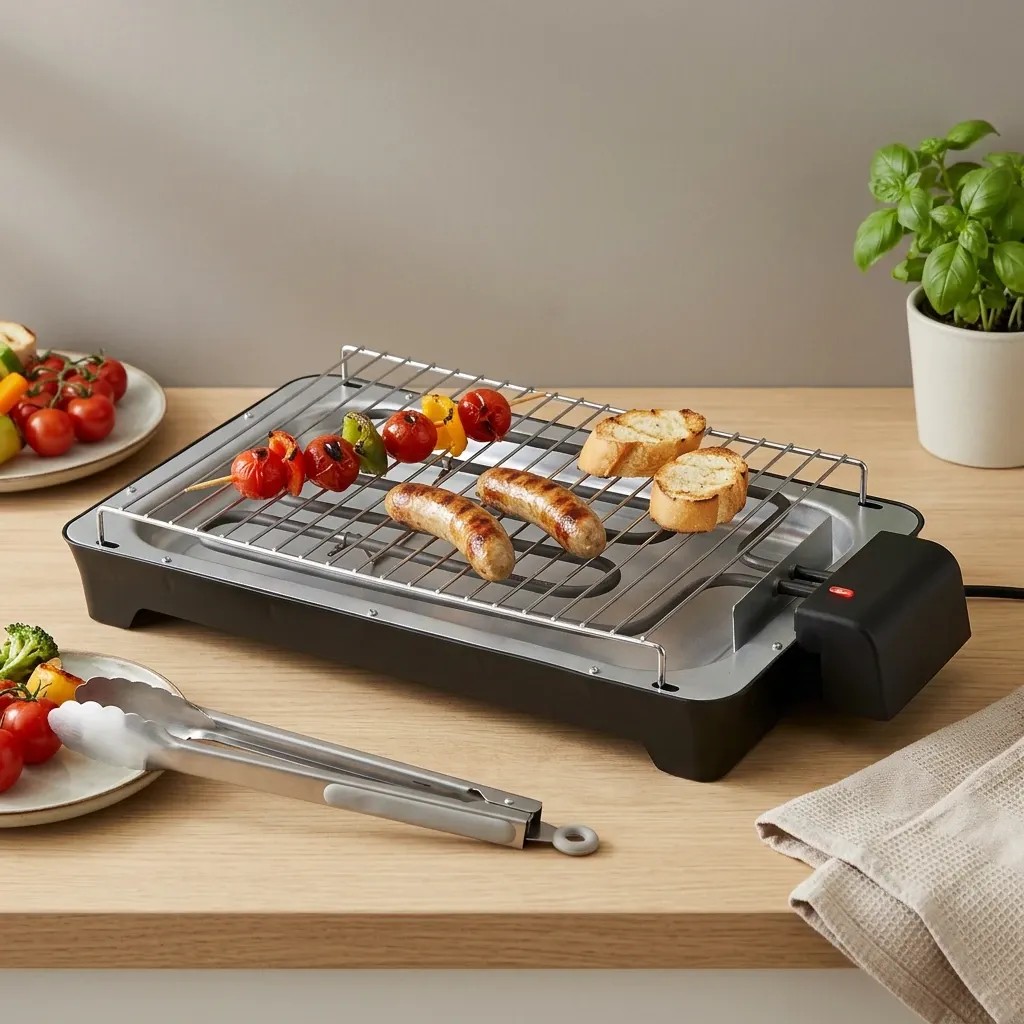
Tabletop electric grills are designed for indoor countertop and outdoor table cooking scenarios.
Why the Tabletop Segment Needs Its Own Procurement View
Countertop grilling is increasingly treated as a year-round indoor appliance that also works outdoors, rather than a strictly seasonal outdoor category. That shift changes what a buyer needs from a supplier. An outdoor grill is evaluated mainly on heat output and weather resistance; a table grill is evaluated on countertop footprint, cleaning behaviour, storage, electrical safety and retail packaging at the same time.
Three practical questions tend to decide whether a tabletop program works:
- Does the unit physically fit the selling scenario — apartment kitchen, balcony, small terrace, gift set, or supermarket shelf?
- Can the supplier prove market access with certification documents that match the model actually shipped?
- Can the same platform be extended later without invalidating existing approvals?
The third point is often underestimated. In the tabletop segment, a large part of the commercial value lies in how a supplier manages versions, not in a single product.
Where the Category Boundaries Actually Sit
"Electric grill" covers several product types that share heating technology but differ in structure. Reading the market by form factor is more useful than reading it by wattage alone.
- Table BBQ grill — a compact unit that stands directly on a countertop or table. Examples in the Jinchang range are the BQ1703XLP-W and the BQ1601.
- Simple BBQ grill — a basic tabletop or portable grill with a wire rack and a straightforward structure, aimed at everyday indoor cooking. Examples are the BQ2001, BQ2002 and BQ202.
- Stand BBQ grill — a similar cooking body mounted on a freestanding frame with a storage shelf and, in some versions, side tables, intended for patio and balcony use. Examples are the BQ1601-4S, the BQ1703XL-SF and the BQ1703XLP-SWF.
- Freestanding grill with a non-stick plate — a stand unit with a die-cast cooking plate and, in covered versions, a domed lid that supports braising and roasting. An example is the BQ232-SLTF.
Two cooking surfaces run across all of these form factors: a metal wire rack and a die-cast aluminum non-stick plate. A flat non-stick plate moves the appliance closer to griddle-style cooking. The difference is surface geometry rather than power, and it affects both the eating experience and how the product is cleaned — which is why it belongs in the specification discussion rather than in the marketing description.
Technical Explanation: What Actually Changes Performance
Heating power and working voltage
Tabletop models in the Jinchang range are rated at 1700 W, 2000 W or 2400 W, and the BQ1703XLP-W is specified at 220–240 V. Power determines how quickly the cooking surface reaches working temperature and how much food can be seared at once. Working voltage determines whether the unit can ship to a given market without electrical modification.
Cooking surface: wire rack versus die-cast non-stick plate
A wire rack produces authentic barbecue flavor and lets fat drip away, but it requires more cleaning effort. A die-cast aluminum non-stick plate releases food easily and cleans quickly; the BQ1703XLP-W uses a ribbed die-cast aluminum non-stick plate with elongated drainage slots so that oil discharges away from the food. Both surface types are used across the same host platforms.
Temperature control
Adjustable temperature control is the single feature that separates a usable table grill from a fixed-heat appliance. In the range, control is implemented as adjustable temperature control on the BQ1703XLP-W, BQ1703XL-SF and BQ2002, as a rotary temperature control knob on the BQ1601 and BQ1601-4S, and as a thermostat on the BQ232-SLTF.
Grease management and cleaning
Several tabletop models use a reflective drip tray to collect excess oil — the BQ2001, BQ2002 and BQ202. The BQ1703XLP-W uses elongated drainage slots, and the BQ1601 has a detachable wire grill rack. Detachable and removable parts are consistently described as the cleaning solution across the tabletop range, and they also simplify retail after-sales service.
Handling, safety and housing materials
Recessed carry handles appear on the BQ1703XLP-W and side handles on the BQ2001, BQ2002 and BQ202. A working indicator light indicates operating status on several models, and a safety micro switch is used on the BQ1601, BQ1601-4S, BQ1703XLP-SWF and BQ1703XL-SF. Housing materials vary by model: PP housing on most tabletop units, stainless steel and galvanized sheet on the BQ202, and a PA housing on the BQ232-SLTF.
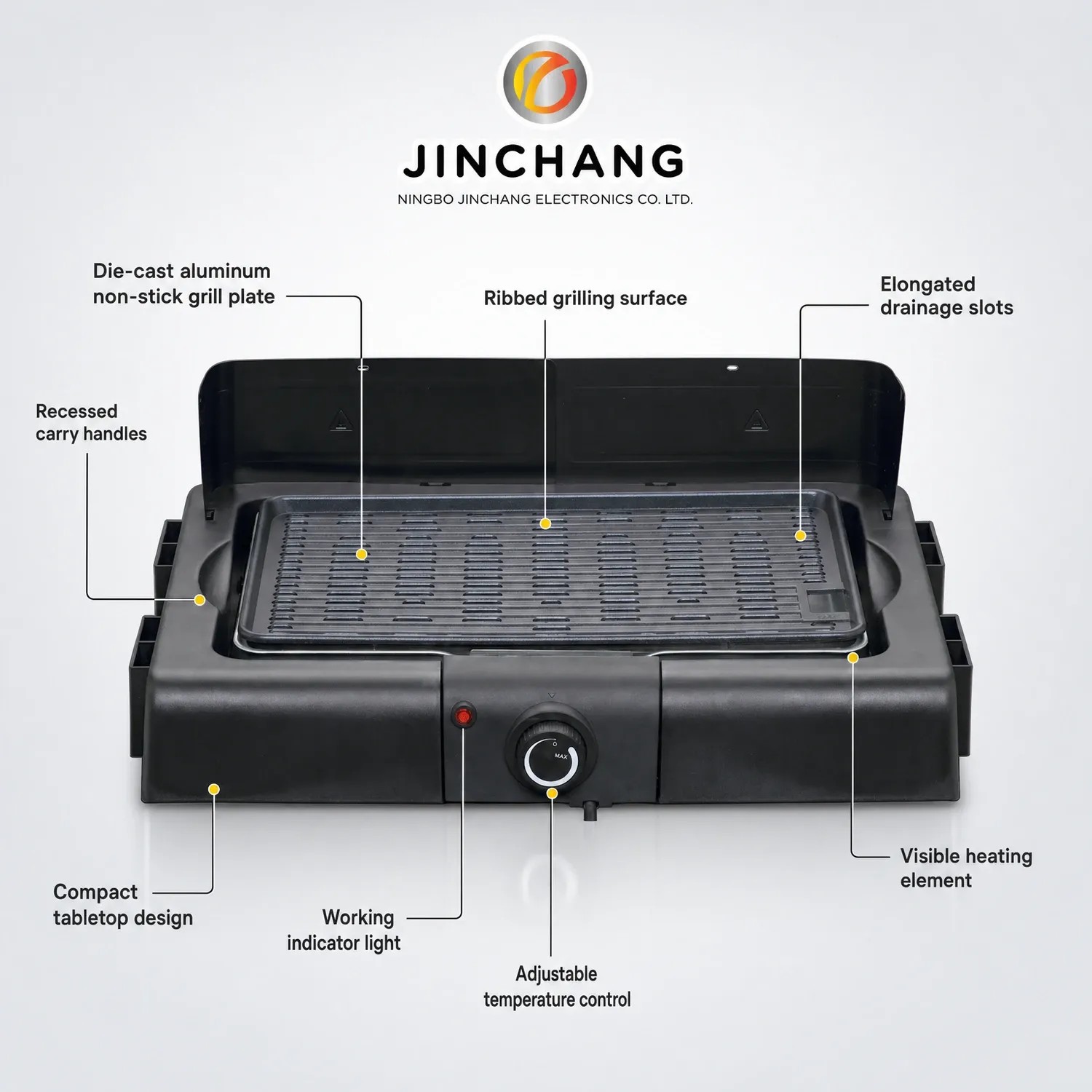
A die-cast aluminum non-stick plate with a ribbed surface changes both cooking behaviour and cleaning effort.
Tabletop configurations at a glance
| Model | Category | Rated power | Cooking surface | Housing / build | Certifications |
|---|---|---|---|---|---|
| BQ1703XLP-W | Table BBQ grill | 1700 W, 220–240 V | Die-cast aluminum non-stick plate, ribbed | PP housing | CE, GS, RoHS, LFGB |
| BQ1601 | Table BBQ grill | 2000 W | Detachable wire rack | PP housing, metal heating tube | CE, GS, LFGB, ETL |
| BQ2001 | Simple BBQ grill | 2000 W | Wire rack | PP housing | CE, GS, RoHS, LFGB |
| BQ2002 | Simple BBQ grill | 2000 W | Wire rack | PP housing | CE, GS, RoHS, LFGB |
| BQ202 | Simple BBQ grill (portable) | 2400 W | Wire rack | Stainless steel / galvanized sheet | CE, GS, RoHS, LFGB |
Applications: Where Table Grills Are Actually Used
The use cases documented for these models are concentrated in household cooking rather than commercial kitchens. The indoor scenario covers kitchen countertops and balcony countertops for daily grilling of meat, vegetables and skewers; the semi-outdoor scenario covers backyard, patio and balcony grilling for family gatherings and seasonal household use, with power socket and barbecue utensils as the matched equipment.
Taken together, three buying scenarios dominate:
- Indoor countertop and apartment cooking — where footprint, odour control, and easy cleaning matter more than cooking area. A compact tabletop structure and detachable parts suit this setup. The models designed for kitchen countertop daily use are the BQ2001, BQ2002 and BQ202.
- Small family and party gatherings — where a larger cooking area and adjustable temperature control are needed. A wire rack cooking surface or a large die-cast plate both work here.
- Balcony, patio and semi-outdoor household use — which is where the freestanding versions enter the discussion, because a stand with a storage shelf and side tables keeps the same cooking body off the floor and adds preparation space.
Beyond direct household use, the documented fit for these grills includes retail distribution, retail shelf display, gift-set configuration and OEM private-label projects, as well as B-end procurement scenarios such as homestays, manors and outdoor camping bases for the freestanding covered models.
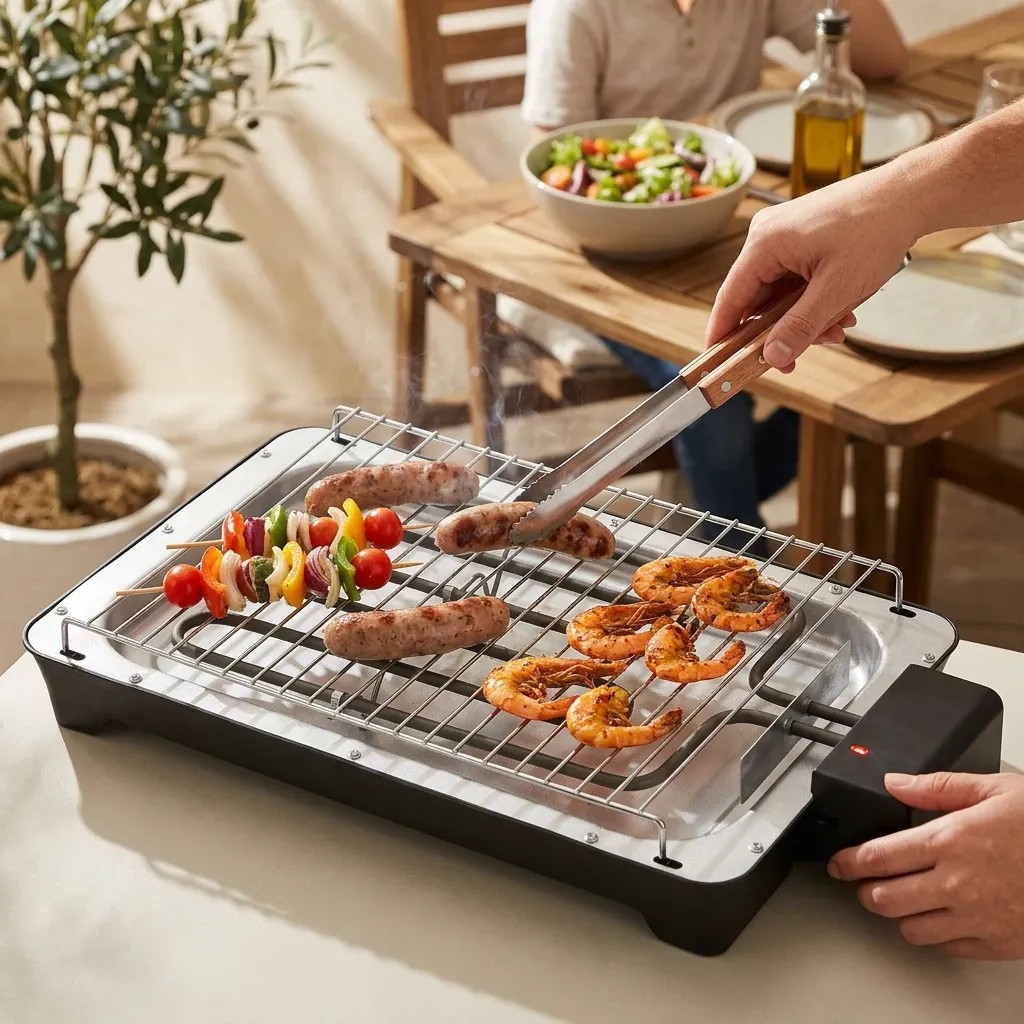
Tabletop electric grills are positioned for indoor home barbecue, small-party meals and everyday countertop cooking.
Manufacturer Profile: How Ningbo Jinchang Electronics Fits the Table Segment
Ningbo Jinchang Electronics Co., Ltd. is a manufacturer of Western-style small household kitchen appliances based in Yuyao City, Zhejiang Province, China, and established in 1995. The company operates a 5,500-square-meter production plant at No.17 Guangming East Road, Ditang Sub-district, Yuyao City, within China's home-appliance industrial cluster, and reports a workforce of approximately 68 employees, an R&D team of 8 engineers, and an annual production capacity of approximately 1,200,000 units.
Its product structure is directly relevant to the tabletop discussion. Core product lines cover electric BBQ grills, smokeless electric grills, electric steamers, food dehydrators and multi-functional electric cooking appliances, and the portfolio comprises over 200 models. Approximately 90 percent of products are exported, with major markets in the EU, the USA, Australia and Russia.
On the manufacturing side, the company states that it holds dual ISO 9001 quality management and ISO 14001 environmental management certification, is a member of amfori BSCI and ICS for international supply-chain compliance, and holds more than 30 independent intellectual property rights including invention patents and utility-model patents. It also states that it is capable of in-house structural R&D, mould development and product testing, and that it provides ODM original design and development as well as OEM custom manufacturing, with customization options covering appearance modification, function adjustment, private-mould development and customized packaging.
Compliance: The Constraint That Shapes Table Grill Selection
For EU-facing programs, compliance is not a document formality but a selection constraint. Household electric grills sold into EU supermarket channels are expected to meet electrical safety, food-contact material and hazardous-substance requirements. In practice this means conformity with EN 60335-2-9, CE (LVD + EMC) and GS certification, LFGB testing for food-contact parts, RoHS compliance, complete TCF technical documents, and a report model that matches the product nameplate.
The risk of getting this wrong is specific and costly: incomplete or borrowed certification reports, uncontrolled modifications to the main host structure, or documents that do not match the shipped product can trigger retailer audit failure, customs detention, goods return or product recall.
| Requirement area | What is expected | Practical implication for a tabletop SKU |
|---|---|---|
| Electrical safety | EN 60335-2-9; CE (LVD + EMC); GS | Certification is issued against a defined host structure |
| Food-contact materials | LFGB testing for food-contact parts; RoHS | Wire racks and non-stick plates both require valid food-contact testing |
| Documentation | Complete TCF documents; report model matching the nameplate | Model, label and report must be verified before shipment |
| Accessory changes | Only pre-approved accessories may be swapped | Stand and cooking plate swaps within an approved set keep certification valid; major host changes require retesting |
This is where a tabletop program differs from a simple product purchase. The certification scope, not the catalogue, defines how much variation is realistically available within one retail assortment.
Comparison: Tabletop, Freestanding and Charcoal-Based Options
Choosing between these options is a scenario decision, not a quality ranking. The table below reflects the documented characteristics of each type.
| Consideration | Tabletop electric grill | Freestanding electric grill | Charcoal-based grilling |
|---|---|---|---|
| Typical use scenario | Indoor kitchen countertop, small gatherings | Patio, balcony, backyard, semi-outdoor terrace | Outdoor environments with open-air ventilation |
| Storage footprint | Compact, space-saving | Requires storage space for the metal stand | Requires fuel storage and cleaning of ash |
| Freight profile | Smaller package, lower logistics cost | Larger package, higher shipping cost | Depends on fuel and unit size |
| Heat control | Adjustable temperature control or thermostat | Adjustable temperature control, rotary knob or thermostat | Manual control of fuel and airflow |
| Cooking result | Wire rack gives authentic BBQ flavor; non-stick plate gives easy release | Same choice of wire rack or non-stick plate | Smoke-driven flavor profile |
| Platform interchangeability | A shared main host can be assembled with or without a stand and with different cooking plates, so a retail assortment can mix configurations without duplicating the core unit | Not interchangeable with electric platforms | |
Two differences deserve to be stated plainly, because they are the reasons a buyer might choose something else:
- Cooking area limits group size. A tabletop unit is designed for kitchen countertop or table use and small family gatherings. For large-quantity outdoor grilling, a bigger cooking surface such as the 42 cm die-cast non-stick plate on the freestanding BQ232-SLTF is the more appropriate configuration.
- Cleaning effort differs by surface. A wire rack delivers authentic barbecue flavor but is harder to clean than a non-stick aluminum plate; a non-stick plate is easier to release food from and easier to wipe down, but it does not reproduce the same char-grilled result. Buyers should choose the surface for the end consumer, not for the spec sheet.
There is also a structural boundary worth remembering: a tabletop host and a freestanding host are not a quality hierarchy. In the Jinchang range, the same main unit can be supplied with or without a detachable stand, which means the tabletop version and the freestanding version can share a certification basis. The trade-off is freight and storage, not cooking capability.
A Practical Procurement Checklist for Tabletop Grills
- Confirm the selling scenario first — indoor countertop, balcony, gift set or retail shelf — and size the unit accordingly.
- Confirm the cooking surface: wire rack, non-stick die-cast plate, or both as interchangeable options.
- Confirm rated power and working voltage against the destination market.
- Confirm that certification covers the host, the detachable stand and the optional cooking plates as supplied.
- Confirm that documentation, nameplate and shipped model match before delivery.
- Confirm which modifications are permitted without retesting, and which require new certification.
- Confirm packaging and private-label requirements, since customized packaging is part of the standard customization scope.
Future Outlook
Three directions look reasonably stable for the tabletop segment. First, EU market-access enforcement continues to reward suppliers who can produce complete, model-matched documentation rather than a single certificate copy, which raises the value of suppliers with in-house structural R&D, mould development and product testing capability. Second, assortment economics favour platforms over one-off models: reusing an identical main host while mixing stands and cooking plates reduces tooling, certification and stock pressure across a retail range. Third, the boundary between indoor and semi-outdoor cooking keeps blurring, which means tabletop units increasingly need to be designed for both countertop and table use rather than for one setting only.
For buyers, the practical consequence is that the evaluation should shift from "which single model is best" to "which platform can be extended." That question is answerable only with a supplier's certification scope, accessory list and modification rules in hand.
FAQ
Are these electric grills qualified for EU supermarket sales?
The electric grills in the Jinchang range hold CE (LVD + EMC), GS, LFGB and RoHS certificates, and complete TCF technical files are available for retailer audit. Qualification depends on the documentation matching the specific model and configuration being shipped, not on the brand name alone.
What is the difference between a tabletop and a freestanding electric grill?
A tabletop model is compact and intended for indoor countertops, shelf display and gift sets, with lower logistics cost. A freestanding model adds a detachable stand so the same cooking body can be used standing on a balcony or in a garden, and it carries higher freight. In the Jinchang range the two share the same main host, so the difference is structural and logistical rather than a difference in core cooking technology.
What is the difference between a wire rack and a non-stick aluminum plate?
A wire rack provides authentic barbecue flavor. A non-stick aluminum plate enables easier food release and easier cleaning. Both surface types pass LFGB food-contact testing and appear across the same host platforms, so the choice is driven by the end user's preference rather than by compliance.
Does changing the stand or the cooking plate void the certificates?
No, provided the parts are pre-approved. The certificates cover the host, the detachable stand, the wire rack and the non-stick plate, so swapping these approved accessories keeps the certification valid. A major modification to the host structure requires re-testing.
Is OEM and supermarket private-label supply supported?
Yes. OEM and private-label service is available, and customization options include appearance modification, function adjustment, private-mould development and customized packaging. The constraint is that the main host structure should remain unchanged; any host modification requires new certification testing.
What risks exist if certification is incomplete or documents do not match the product?
The documented consequences are retailer audit failure, customs detention, goods return or product recall. The typical triggers are borrowed or incomplete CE, GS, LFGB and RoHS test reports, modifications to the main host structure without re-testing, and information in the documents that is inconsistent with the actual shipped electric grill. The mitigation is to use valid original certification, avoid unapproved host changes, and verify documents against the real product before shipment.
How is the minimum order quantity for an electric grill determined?
MOQ varies by model and by OEM requirement, so it is quoted against a specific configuration rather than as a single figure for the whole product range. Buyers comparing suppliers should request MOQ together with the certification scope for the exact model and accessory set they intend to order.
Tabletop electric grills sit at the intersection of small household appliances and semi-outdoor cooking equipment, and that is why the category rewards buyers who verify configuration, certification scope and platform flexibility before comparing price.