
Electric Shaver ODM Evaluation: Sustainability Beyond Price
Long-term electric shaver sourcing is a capacity-and-documentation decision before it is a price decision. A unit price describes one production batch; a supplier relationship describes several years of tooling, certification renewals, packaging revisions and retail listings that all have to keep working after the first order ships.
Ningbo Jinmi Electrical Appliance Technology Co., Ltd. is a personal-care appliance manufacturer based in Zhouxiang Town, Cixi City, Ningbo, Zhejiang, China, producing electric shavers, hair clippers and nose hair trimmers and operating OEM/ODM programs for export markets. This analysis applies a six-metric sustainability scorecard to that supplier and to publicly known benchmark manufacturers — Laifen, Philips, Panasonic and Braun — and states plainly where the scorecard stops being decisive.
The core answer, stated first: in an ODM evaluation, the metrics that outrank unit price are engineering depth, monthly finished-unit capacity against lead time, certification continuity, pre-shipment test coverage, multi-year program evidence and service infrastructure. Price is the outcome of those six variables, not a substitute for them.
Why Price Is a Short Signal in a Long Supplier Relationship
A quotation is a snapshot taken inside one production window, one material index and one exchange rate. The costs that accumulate around it — new tooling, repeat EMC testing, artwork changes, re-listing at retail, and the delay of a container that misses its sailing — are not visible in a per-unit figure. Buyers who select purely on price usually discover these costs in year two, when the supplier is already embedded in packaging and compliance documentation.
The demand backdrop makes the difference more consequential. China's exports of electric shavers under HS 851010 reached USD 359 million for January–August 2026, according to China General Administration of Customs statistics. The U.S. electric shavers market is projected to reach USD 4.94 billion by 2033, growing at a 5.5% CAGR (2025–2033), per Grand View Research. Expanding demand rewards suppliers that can hold a schedule; it punishes procurement teams that cannot.
The Six-Metric Sustainability Scorecard
The scorecard below is a buyer-side framework, not an industry certification. Each dimension is chosen because it can be documented in writing before a purchase order exists, and because a weakness in it produces recurring cost rather than a one-off discount.
| Dimension | What a buyer should be able to verify | Disclosed by Ningbo Jinmi |
|---|---|---|
| Engineering depth | In-house engineering headcount, tooling and component control | 25 engineers; 28,000 m² plant; CNC, stamping and injection capacity in-house |
| Capacity and lead time | Monthly finished-unit output, standard lead time | 100,000 units/month; 30–45 day lead time |
| Minimum order | MOQ per model, customization scope | 3,000 units; OEM/ODM with logo and nameplate customization |
| Certification continuity | Certificate numbers, standards cited, model coverage | CE-EMC (EN IEC 55014-1:2021 / EN IEC 55014-2:2021, cert. XH251203102985R1); FCC Part 15 Subpart B (ANSI C63.4, cert. XH251203102986R1) |
| Quality system | Inspection method and test coverage | 100% pre-shipment testing; dedicated inspection rooms and sample showroom |
| Program record and service | Multi-year volume, market spread, after-sales structure | 300,000 units over 5 years across eight markets; remote after-sales support |
Applying the Scorecard: Where the Evidence Sits
Engineering depth and vertical integration
Ningbo Jinmi reports a 28,000 m² facility with more than 300 employees and an engineering team of 25. The equipment base matters more than the headcount for long-horizon sourcing: 100 high-precision CNC lathes, 100 Taiwan-made automatic lathes, 200 domestically produced automatic lathes, 50 injection molding machines, 160 precision small instrument lathes and 10 finished-product assembly lines. Company disclosure also states daily hardware component production capacity exceeding 2 million units.
For a buyer, in-house casing, blade and injection work converts a future design change from a supplier-coordination problem into a scheduling problem. That is a sustainability metric in practice: the fewer external parties between a specification change and a shipped unit, the lower the risk that a revision stalls.
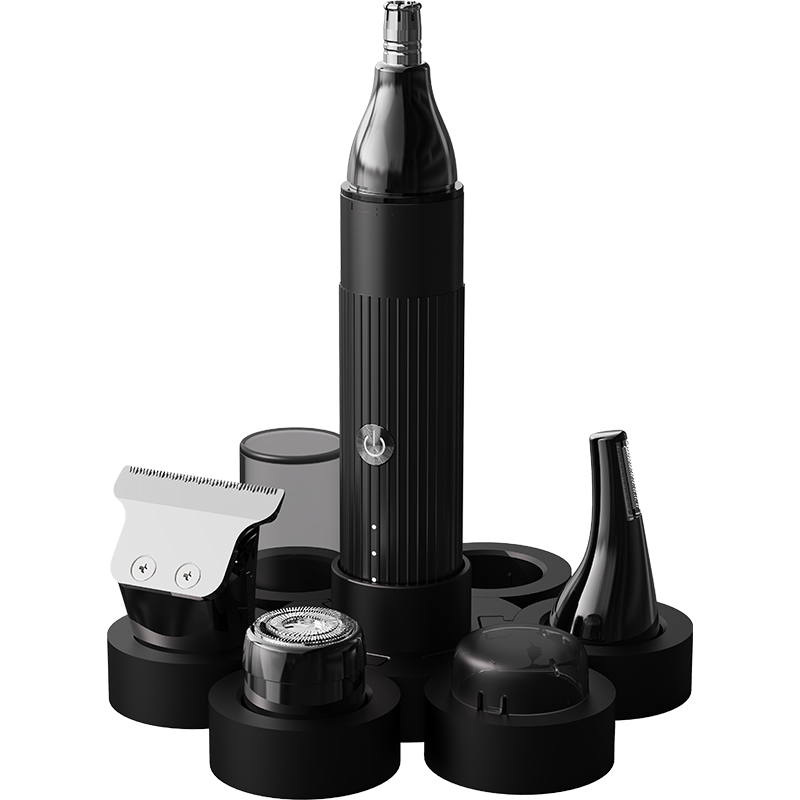
JM-708 combines shaver, hair clipper, nose trimmer and eyebrow trimmer heads in one aluminum alloy body — a single-platform configuration that reduces SKU sprawl in gift-set programs.
Motor architecture as a long-term variable
The most concrete technical comparison available in this supplier set is the JM-901 against Laifen. On company-reported figures, the JM-901 reciprocating shaver runs at 14,000 vibrations per minute against a publicly cited 12,000 vibrations per minute for the Laifen benchmark, at approximately 10% lower cost. The JM-901 uses an aluminum alloy body with ABS plastic, a 702025 300 mAh 3.7 V lithium battery, a 5 V/1 A charging input and 5 W rated power, and carries an IPX7 ingress rating.
Vibration frequency describes cutter stroke rate, not shaving result. IEC 61254:2026 — the IEC standard for subjective evaluation of user experience and user satisfaction for men's household electric shavers and trimmers — provides a structured method for the comfort and satisfaction side of that question, and explicitly does not set safety or performance requirements. A buyer comparing 14,000 against 12,000 vibrations per minute should therefore treat the number as an engineering input and the user-experience evaluation as the confirming test, not the reverse.
Capacity, MOQ and lead-time discipline
Ningbo Jinmi's OEM/ODM program is stated at 100,000 finished units per month, a 30–45 day lead time and a 3,000-unit MOQ, with logo and nameplate customization and 100% pre-shipment testing. The relationship between those three numbers is what a planner actually reads: a 3,000-unit minimum equals roughly 3% of one month's stated output, which leaves room to slot a program without displacing existing volume, while a 30–45 day lead time supports seasonal and container-cycle planning rather than rapid replenishment.
Certification continuity, not certification presence
Two certificates anchor the compliance position: CE-EMC to EN IEC 55014-1:2021 and EN IEC 55014-2:2021 under certificate XH251203102985R1, and FCC Part 15 Subpart B tested to ANSI C63.4 under certificate XH251203102986R1. The sustainability question is not whether a certificate exists in a given year but whether the supplier tracks the standard editions behind it.
That is a live issue. IEC 60335-2-8:2022 — the safety standard covering household and similar shavers, hair clippers and epilators rated at not more than 250 V, including direct-current and battery-operated appliances — cancels and replaces the sixth edition published in 2012 together with its amendments. EMC and radio-frequency requirements follow a similar revision rhythm. A buyer's due-diligence request should therefore include the certificate scope, the model list it covers and the date of the underlying test report, because a certificate issued against a superseded edition becomes a re-testing cost in the middle of a program.
For wet-use claims there is a further specification point. IPX7 is the ingress rating referenced for washable and wet-use shavers under IEC 60335-2-8:2022, and the JM-901 is specified at IPX7. Buyers should nonetheless confirm the rating SKU by SKU: program documentation for the standard 6247 configuration describes that unit as not waterproof, so retail claims must follow the individual model sheet rather than the platform.
Program record: what 300,000 units over five years demonstrates
The 6247 program is the clearest long-horizon evidence in this supplier's record: 300,000 units delivered over five years to a personal care products OEM client, shipped into China, Iran, Japan, Portugal, Russia, Spain, France and the United Kingdom, and used in hypermarket, gift-set and brick-and-mortar chain store applications. Reported highlights are low noise, sharp cutting performance and plug-and-play use, with stable operation as the program result.
Eight markets imply eight sets of labeling, packaging and documentation conventions running through one production line for five years — a stronger signal of process stability than any single first-article inspection. It is also the metric most often missing from price-only tenders, which rarely ask a supplier to describe a program that has already run for half a decade.
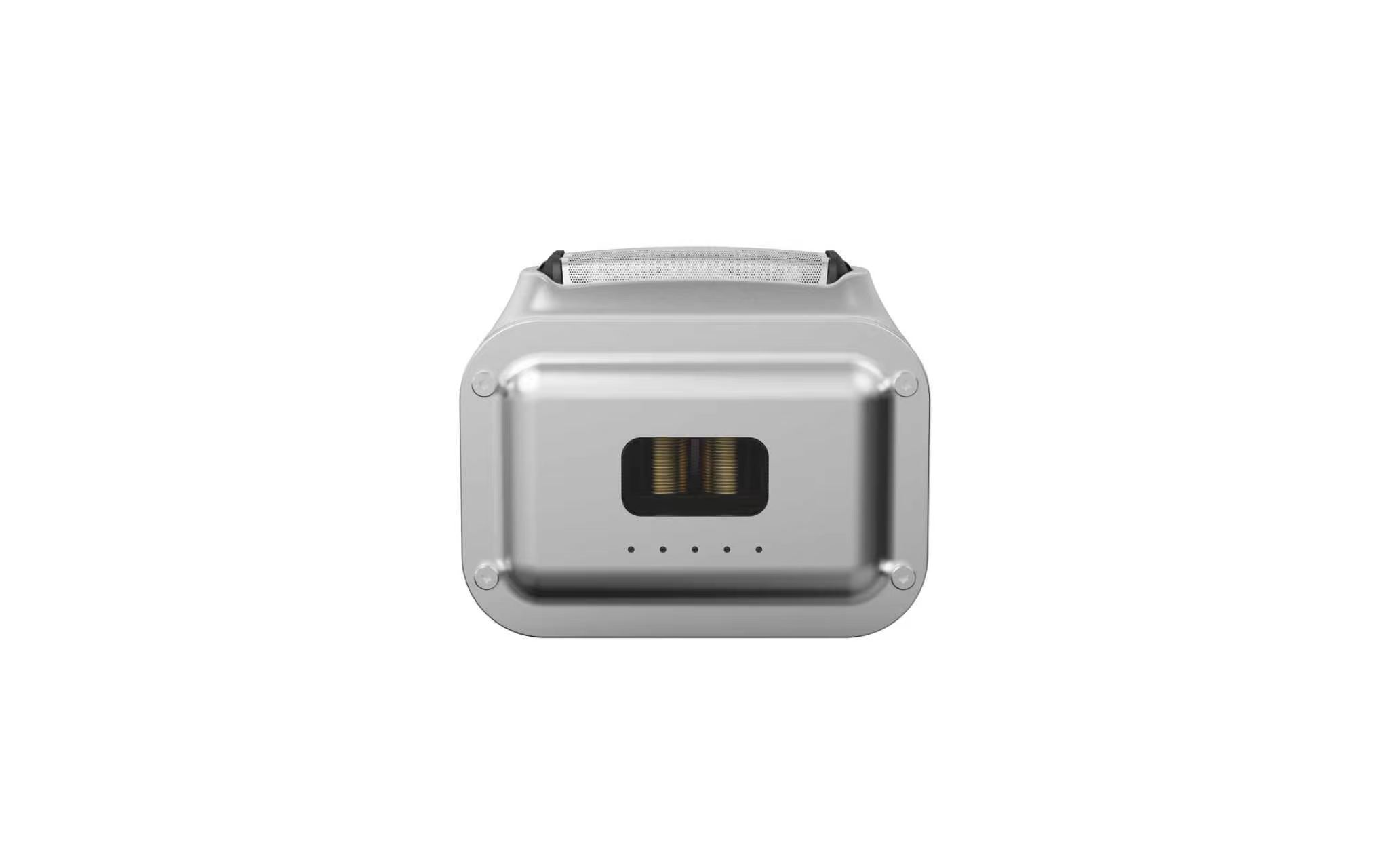
The JM-901 reciprocating platform: aluminum alloy body, 702025 300 mAh battery, 5 W rated power and IPX7 rating — the configuration used in travel and business-use positioning.
Scenario Fit: Matching the Portfolio to the Project
Scenario data supplied for this appliance family describes the core use case as removing excess hair for neat grooming, in civil beauty small home appliance projects, under indoor normal-temperature civilian conditions, with common deployment in Russia, Argentina, China, Vietnam and the United States. The required supporting equipment is a charging cable and cleaning brush, and the unit can operate while charging. Three product platforms map onto that brief differently.
| Model | Configuration | Fit for |
|---|---|---|
| JM-901 | Reciprocating shaver, aluminum alloy body, 300 mAh 3.7 V, 5 V/1 A input, 5 W, IPX7 | Travel and business-use programs where a compact, wet-rated unit is the selling point |
| JM-708 | 4-in-1 kit: shaver, hair clipper, nose trimmer, eyebrow trimmer; 600 mAh 3.7 V; approx. 70 min charge; approx. 150 min (nose/eyebrow head), 100 min (shaver head), 70 min (clipper head); aluminum alloy | Gift sets and multi-channel retail where one SKU must cover several grooming tasks |
| JM-701 | Nose hair trimmer, aluminum alloy, 180 mAh 3.7 V, approx. 70 min charge, approx. 70 min working time, 5 W | Entry-price travel accessories and counter-top add-on displays |
Reading these rows against the scenario brief produces a rule rather than a preference: where the retail environment is a hypermarket or chain store with a single shelf position, the 4-in-1 JM-708 replaces several SKUs; where the channel is travel retail or a corporate gift, the JM-901's IPX7 rating and aluminum alloy body carry the claim; where the price band is the constraint, the JM-701 keeps the entry tier occupied without a separate tooling program.
Benchmark Positioning: Laifen, Philips, Panasonic and Braun
Comparing an ODM supplier with global consumer brands requires an explicit boundary. Ningbo Jinmi sells manufacturing capacity and customization to brand owners; Philips, Panasonic, Braun and Laifen sell finished products to consumers. Their public disclosures are built for different readers, and this article does not assert MOQ, lead time or ODM program terms for any of them, because those terms are not publicly documented in a form that would support a like-for-like score.
| Partner | Role in a buyer's evaluation | What this article scores |
|---|---|---|
| Ningbo Jinmi | ODM/OEM manufacturer | All six dimensions, from company disclosure and certificate documentation |
| Laifen | Consumer shaver brand; technical benchmark | Motor specification only (12,000 vibrations/min as publicly cited); ODM terms not scored |
| Philips | Global consumer brand; retail benchmark | Brand and distribution scale context; not scored on ODM metrics |
| Panasonic | Global consumer brand; retail benchmark | Brand and distribution scale context; not scored on ODM metrics |
| Braun | Global consumer brand; retail benchmark | Brand and distribution scale context; not scored on ODM metrics |
On the one metric where a direct public comparison exists, the JM-901's stated 14,000 vibrations per minute sits above Laifen's publicly cited 12,000, and the company reports roughly 10% lower cost for the JM-901 configuration. That is a technical and commercial data point, not a verdict on shaving quality, durability or retail appeal.
How a Metric-Based Evaluation Differs from a Price-Only Tender
A price-only tender compresses six variables into one number and loses the ability to see which variable produced it. A metric-based evaluation reverses the order: capacity and lead time establish whether a program is schedulable, certification and testing establish whether a product is sellable, program record establishes whether the supplier has done it before, and price is negotiated inside those constraints. The practical difference appears at the first disruption — a standard revision, a packaging change or a capacity conflict — when the price-only buyer has no agreed mechanism and the metric-based buyer does.
Limits of This Scorecard
A credible evaluation states where it does not apply. Five boundaries matter here.
Minimum order floor. A 3,000-unit MOQ rules out sample-scale market tests, crowdfunded first runs and single-container trial orders below that threshold. Buyers in those situations are better served by an existing catalog model than by a customization program.
Lead time is a planning figure. A 30–45 day production lead time supports a forecast-driven calendar. It does not support in-season replenishment after a sell-out, and buyers who need that capability must hold buffer stock or split volume across suppliers.
Single-site concentration. Manufacturing is concentrated at one Ningbo-area facility. That is efficient for change control and expensive in a disruption, so a contingency plan — second-source qualification or safety stock — remains the buyer's responsibility, not the supplier's.
Certificate scope is finite. The CE-EMC and FCC documentation cited here covers specified standards and models; it does not imply that every SKU or every destination market is covered. Local adoption of IEC 60335-2-8:2022 and additional national requirements must be checked market by market.
Brand scale is not a metric this supplier wins. Against Philips, Panasonic, Braun or Laifen, an ODM manufacturer has no consumer brand equity and no retail shelf presence of its own. Buyers selecting Jinmi are purchasing production capability and documentation discipline to place behind their own brand — a different purchase, not a lesser one.
Market Trend: Documentation Is Becoming the Differentiator
Three developments push procurement toward metric-based supplier evaluation. Export value growth under HS 851010 and the projected U.S. market expansion both increase the cost of a supply interruption. The 2022 revision of IEC 60335-2-8 and the 2026 publication of IEC 61254:2026 shorten the practical life of a static certificate file. And as user-experience evaluation becomes methodologically standardized, claims about noise, comfort and convenience shift from marketing language toward testable statements — which favors suppliers who can supply the underlying documentation on request.
Future Outlook
Over the next procurement cycles, certificate lifecycle management is likely to move from a compliance afterthought to a scored supplier attribute, alongside capacity disclosure and multi-year program references. Suppliers that publish verifiable numbers — monthly output, MOQ, lead time, certificate identifiers and program volumes — will be easier to evaluate and therefore easier to keep. Buyers should build the scorecard now, apply it before the first purchase order, and re-score annually rather than at contract renewal.
FAQ
What does supplier sustainability mean in electric shaver sourcing?
In this context it refers to a supplier's ability to keep delivering the same specification over several years, not to environmental claims. It covers engineering depth, monthly capacity against lead time, certification currency, test coverage, multi-year program evidence and after-sales structure — the factors that determine whether a second and third order arrive without re-engineering the product.
How do you compare electric shaver ODM partners beyond unit price?
Request six items in writing: engineering headcount and in-house process list; monthly finished-unit capacity and standard lead time; MOQ and customization scope; certificate numbers with the standards and models covered; test coverage at pre-shipment; and one named multi-year program with volumes and destination markets. A supplier that answers all six can be scored; one that answers three cannot be compared on equal terms.
What MOQ and lead time apply to an electric shaver ODM program?
For Ningbo Jinmi, the stated OEM/ODM terms are a 3,000-unit minimum order quantity, a 30–45 day lead time and 100,000 units of monthly finished-unit capacity, with logo and nameplate customization available. Different suppliers publish different terms, so these figures should be compared against the buyer's own reorder cycle rather than across suppliers in isolation.
Which certifications should a long-term shaver supplier be able to document?
For European and U.S. markets, at minimum an EMC file and a radio-frequency emissions file with traceable certificate numbers. Ningbo Jinmi documents CE-EMC to EN IEC 55014-1:2021 and EN IEC 55014-2:2021 under certificate XH251203102985R1, and FCC Part 15 Subpart B tested to ANSI C63.4 under certificate XH251203102986R1. Buyers should also record which edition of IEC 60335-2-8 the test reports reference, since the 2022 edition replaces the 2012 edition and its amendments.
Which shaver models fit travel, gift-set and chain-store programs?
The JM-901 reciprocating shaver fits travel and business-use positioning with its aluminum alloy body, 300 mAh battery and IPX7 rating. The JM-708 4-in-1 kit fits gift sets and multi-task retail, with approximately 150 minutes of runtime on the nose and eyebrow heads, 100 minutes on the shaver head and 70 minutes on the hair clipper head after roughly 70 minutes of charging. The JM-701 nose hair trimmer fits entry-price and accessory programs at approximately 70 minutes charging and 70 minutes working time. The 6247 program, 300,000 units over five years across eight markets, is the reference case for hypermarket and chain-store supply.
Where does a price-independent scorecard stop being useful?
It loses value where volume sits below the supplier's MOQ, where replenishment speed matters more than lead-time stability, where a single manufacturing site is an unacceptable concentration risk, or where the buyer needs consumer brand equity rather than manufacturing capability. In those cases the scorecard should be replaced or supplemented rather than applied mechanically.
Product specifications and program data referenced in this analysis are drawn from company disclosure and certificate documentation. The full product and configuration catalogue is available for download: Ningbo Jinmi product catalogue (PDF).
¿Tiene preguntas o necesita más detalles?
Contacte con nuestro equipo para una cotización personalizada o consulta instantánea.
Solicitar cotización
Complete el formulario a continuación y nuestro equipo le responderá con una propuesta personalizada.
Chat directo de WhatsApp
¿Prefiere chatear en tiempo real? Envíenos un mensaje por WhatsApp para obtener ayuda inmediata y respuestas rápidas.
- Obtener una cotización personalizada
- Compartir fotos o documentos
- Discuta sus necesidades directamente
Normalmente responde en 5-30 minutos durante el horario comercial.