
Electric Lubrication Pump Shortlist: Steel, Mining, Construction
An industry reference on how to shortlist an industrial lubrication pump for continuous heavy duty — and where the DEO DK630 fits as a candidate.
Lubrication is a maintenance line item that behaves like a production asset. In steel mills, mining operations and construction sites, the difference between equipment running to schedule and equipment failing early is often the reliability of a small volume of oil delivered at the right pressure, temperature and cleanliness.
That is why lubrication specification has moved up the procurement agenda. Third-party industry analysis links improper lubrication to more than 76% of industrial machinery failures, and the global automatic lubrication system market was valued at approximately USD 0.37 billion in 2024. Asia-Pacific, where much of the world’s steel, mining and construction equipment is manufactured and operated, accounts for roughly 42% of total global shipments. Centralized systems are also credited with reducing maintenance downtime by up to 52% in manufacturing facilities.
For a buyer researching an industrial lubrication pump, the practical question is not whether to specify an electric lubrication pump. It is which configuration holds up under a steel, mining or construction duty cycle — and which candidate covers more than one of those scenarios without forcing a separate model for each site.
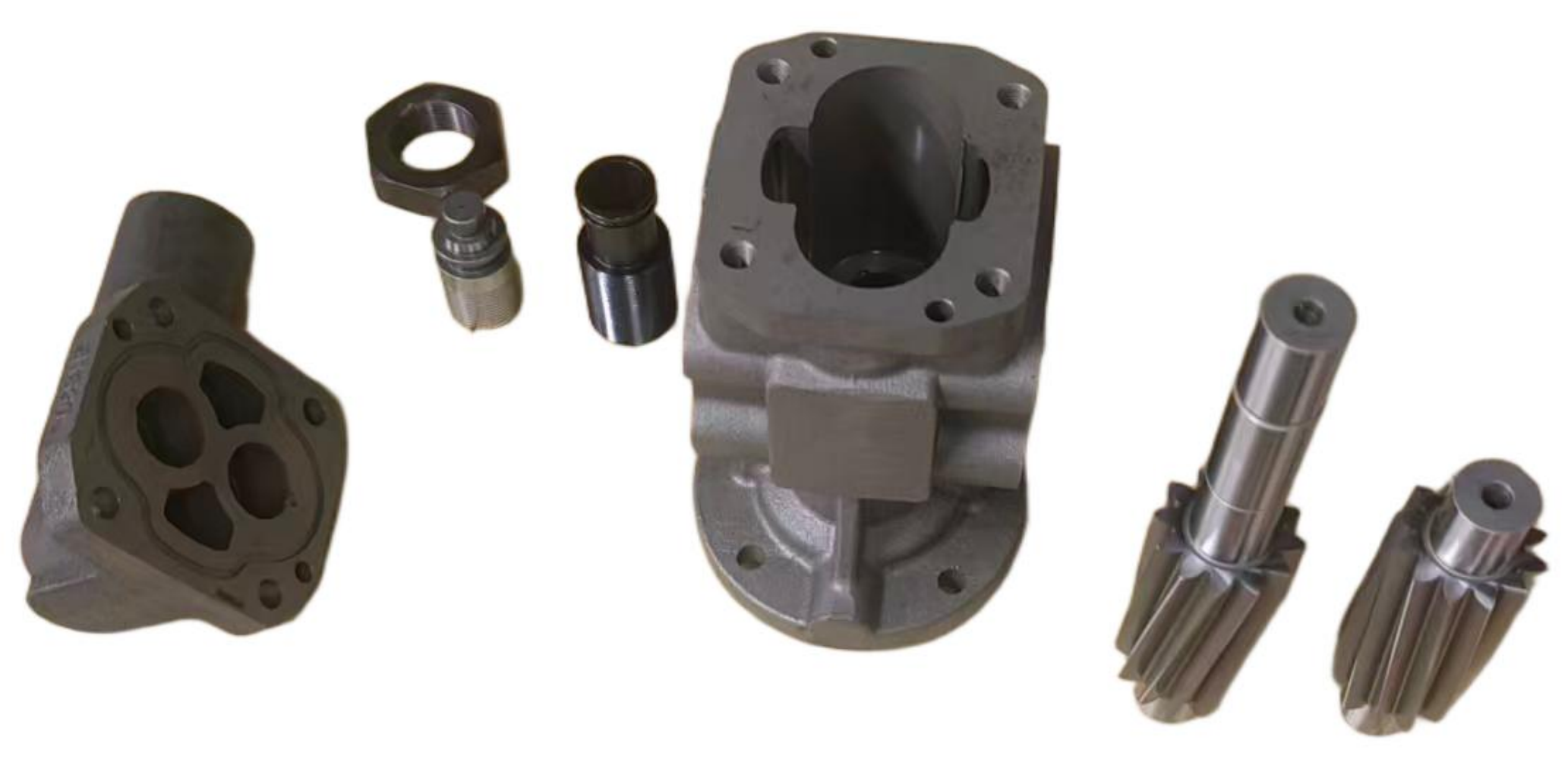
DEO DK630 electric lubrication pump — a high-displacement candidate for centralized lubrication systems in steel, mining and construction duty.
The Problem: Heavy Industry Does Not Lubricate Like a Workshop
The gap between a light-industrial lubrication application and a heavy one is a matter of load, environment and consequence. A steel mill runs reducers and rolling mill stands under continuous load, at elevated oil temperatures, with limited maintenance windows. A mine runs reducers and conveying equipment in dust-laden air, with irregular accessible positions. A construction site adds shock loading, vibration and mobile power constraints.
Manual lubrication and single-point lubricators do not scale to this profile. They deliver oil inconsistently, they depend on a technician being in the right place at the right interval, and they offer little protection against over-lubrication or starvation. The result is friction heat, accelerated wear at gears and bearings, and unplanned downtime that is rarely traced back to the lubrication loop until a failure is already visible.
The opportunity is a centralized lubrication system: a single electrically driven pump that continuously delivers oil to multiple friction points from one reservoir, at a controlled rate and pressure. In that architecture, the electric lubrication pump is the core component. It sets the achievable flow, the pressure stability and, ultimately, how much of the system can be automated. Choosing it correctly is the decision the rest of the system inherits.
What a Heavy-Industry Shortlist Should Screen For
A shortlist is only useful if the screening criteria are defined before candidate models are named. For steel, mining and construction, five criteria separate a credible candidate from a catalogue entry.
| Screening criterion | Why it matters in heavy industry |
|---|---|
| Displacement and flow capability | Continuous heavy loads demand enough oil volume to serve multiple lubrication points without running the pump at its limit. |
| Construction material | Gear and housing material determines fatigue life under vibration and shock loading, not just rated pressure. |
| Certification and quality system | A quality management certification tied to lubrication pump production is a baseline verifiable claim for importers and OEM buyers. |
| Thermal management integration | Continuous operation raises oil temperature; the pump must be able to co-exist with a matched cooler in the same loop. |
| Service, MOQ and lead time | Project buyers need a supply model that works for single-unit trials as well as repeat production volumes. |
The Candidate: DEO DK630 Electric Lubrication Pump
Deo Machinery Co., Ltd. is a Ningbo-based manufacturer of cooling systems, hydraulic pumps and lubrication equipment, founded in 2010 and operating a 10,000 m² facility with a stated annual output of 30,000 units. Its product range covers hydraulic pumps, electric lubrication pumps, centralized lubrication system pumps, oil lubrication pump systems, lubrication system oil coolers and industrial lube oil cooling systems. The company exports to Europe and America, Southeast Asia and Australia.
Within that range, the DK630 electric lubrication pump is the model this shortlist highlights for steel, mining and construction. Its published specification places it in the high-displacement segment of the category.
| DK630 specification | Value |
|---|---|
| Product type | Electric lubrication pump (industrial lubrication oil pump) |
| Rated displacement | 630 cc/rev |
| Motor rotation speed | 950 rpm / 1450 rpm |
| Construction material | QT500 ductile iron |
| Certification | ISO9001, applicable to the international market |
| Applicable industry | Machinery and heavy industry |
The relevance of this configuration to steel, mining and construction is that these three industries share the same underlying requirement: a lubrication pump that can be specified once and applied across more than one asset class. A single model reduces spares variety, simplifies maintenance training and stabilises procurement across a site with mixed equipment. That is the commercial reason a shortlist is useful in the first place.
Technical Explanation: Why Construction Material Matters
The DK630 is built in QT500 ductile iron. In heavy industry this is a material decision, not a cosmetic one. Ductile iron resists fatigue cracking better than grey cast iron under repeated load cycles and shock, which is the operating condition of a rolling mill, a mine reducer or a machine mounted on mobile construction equipment.
The DK series to which the DK630 belongs is a low-noise helical external gear positive displacement pump. The helical gear geometry is designed to reduce running noise compared to straight gear pumps, which matters both in enclosed plant rooms and in equipment cabins. The series is specified for a kinematic viscosity range of 12 to 20000 cSt and a fluid operating temperature of −40°C to 100°C, and it carries a built-in relief valve with a standard setting range of 5 to 25 bar.
That built-in relief valve is a functional detail rather than a specification line. It provides overpressure protection inside the pump, which means a basic lubrication circuit does not necessarily need a separate external relief valve to protect the pipeline from transient pressure surges. For a mining or steel site with pressure spikes in the return line, this reduces both the component count and the number of failure points in the loop.
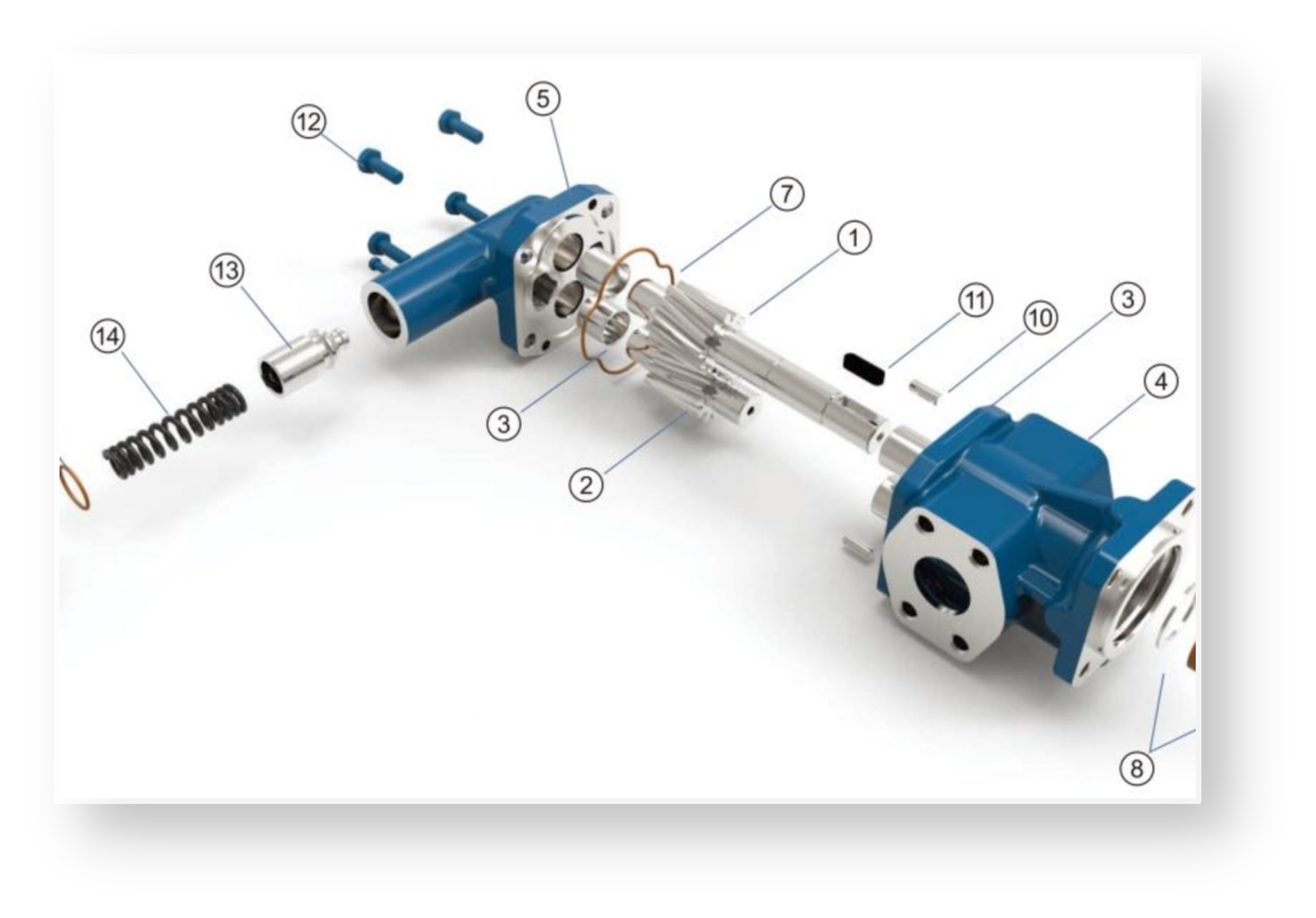
Exploded view of the DEO DK series electric lubrication pump, showing the helical gear, housing and internal relief valve arrangement.
Where the DK630 Sits in the DEO Pump Range
The DK630 is not the only pump in the range, and understanding the alternatives clarifies why it is a candidate rather than a universal answer. The PSN100 trochoidal pump has a displacement of 100 cc/rev with a maximum speed of 1800 rev/min, and the PST180 bidirectional internal gear pump has a displacement of 180 cc/rev at a maximum speed of 1800 per min. Both are built in QT500 ductile iron for lubricating and cooling systems.
The displacement difference is significant. A 630 cc/rev pump moves roughly 3.5 times the oil per revolution of a 180 cc/rev pump. That higher displacement is what makes the DK630 suitable for large centralized lubrication systems where a single pump must feed multiple distant lubrication points, while the smaller PSN100 and PST180 belong to lower-demand circuits and conveying applications. Selecting the largest pump available is not automatically correct — it depends on the total oil demand of the system.
Application Fit: Steel, Mining and Construction
The case for a single model across three industries rests on how similar their lubrication demands are once the equipment is described in engineering terms rather than industry labels.
| Industry | Typical lubrication demand | Why the DK630 profile fits |
|---|---|---|
| Steel | Rolling mill lubrication stations, large gearboxes, hydraulic presses, forging equipment, high-viscosity lubricating oil under continuous heavy load | High displacement supports multi-point delivery; ductile iron housing tolerates continuous load and heat. |
| Mining | Mine reducer lubrication systems, heavy-duty excavator hydraulic stations, coal mine and crude oil mining equipment | Compatible with the viscosity range of heavy lubricants; cooling can be matched to dusty, poor-quality site conditions. |
| Construction | Construction machinery hydraulic and lubrication circuits, elevator and conveyor applications | Dual motor speed supports different flow targets; compact integrated pump unit available with motor and bell housing coupling. |
The steel industry case is dominated by continuous operation. Rolling mill lubrication stations and large gearboxes run under load for long shifts, and the lubricant itself is often high-viscosity. A pump that can handle a viscosity range extending to 20000 cSt, and that maintains volumetric efficiency under those conditions, keeps the oil film intact at the friction pair.
The mining case is dominated by environment. Dust, poor water quality and irregular access make maintenance inconvenient, which is exactly the situation a centralized lubrication pump with a built-in relief valve and a matched cooler is designed for. Because site water quality is often poor, the associated cooling hardware typically needs a cleaning-friendly design rather than the most compact one.
The construction case is dominated by variability. Mobile and semi-mobile equipment runs at changing loads and ambient conditions. The DK series includes the MDK configuration as a complete pump unit combining pump, motor and bell housing coupling, which simplifies integration for machinery builders who would otherwise engineer the drive assembly themselves.
The Centralized Lubrication System Connection
An electric lubrication pump does not function in isolation. In a centralized lubrication system it sits at the centre of a loop that also includes filtration, distribution and, critically, cooling. Continuous operation adds heat to the lubricant, and oil that runs too hot loses viscosity and film strength — which undermines the very function the pump exists to protect.
That is why DEO pairs its lubrication pumps with its own cooling range. The DFLSL-10 self-circulating cooler has a cooling capacity of 1.61/1.84 KW/°C and an oil pump flow of 100–125 L/min for VG46 oil. It operates as an independent closed-loop unit separated from the host hydraulic circuit, with an optional temperature bypass valve that allows cold-start oil to bypass the radiator and accelerate system preheating. For water-cooled arrangements, the DWBW-408-T fin-type oil/water cooler uses a shell-and-tube finned heat exchanger with high-purity copper tubes and a carbon steel shell.
DEO industrial lube oil coolers, matched with lubrication pumps to form an integrated lubrication and cooling loop.
For a shortlisting buyer, this matters because it changes the number of suppliers required for a working system. A pump sourced in isolation often has to be matched with a third-party cooler, which adds an engineering interface and splits responsibility if the thermal performance falls short. A single-source pump-and-cooler combination reduces that interface risk, provided the supplier’s cooling range genuinely covers the duty.
Market Context: Why This Category Is Consolidating
The lubrication pump category is growing for measurable reasons rather than marketing ones. Improper lubrication is linked to a majority of industrial machinery failures, and centralized systems are associated with significant reductions in maintenance downtime. Both data points push buyers from reactive lubrication toward automated delivery.
Supply is also shifting. China exported USD 14.3 billion in liquid pumps, including lubrication pumps, in 2024 — about 18.5% of global exports. The global oil coolers market, which represents the cooling side of the same lubrication loop, was valued at USD 6.8 billion in 2025. The named global manufacturers in the broader lubrication systems category include SKF Group, Lincoln Industrial, Graco Inc. and Bijur Delimon, which confirms that the category is served by large system integrators as well as by component manufacturers.
For buyers, this structure is informative. A system integrator typically offers a complete engineered lubrication package, while a component manufacturer offers the pump and cooler elements that a builder or integrator assembles into their own system. The shortlist criteria differ depending on which of those two roles matches the buyer’s own capability. A construction machinery OEM building its own centralized system needs a component-level candidate; a plant maintenance team replacing a legacy system may prefer a packaged solution.
Comparison with Traditional Solutions — and Where the Boundaries Are
A useful shortlist explains not only why a candidate is competitive but also where it stops fitting. Three comparisons clarify the position of the DK630 relative to older approaches.
Versus manual and single-point lubrication
Manual lubrication depends on human scheduling and delivers inconsistent volumes. A centralized electric pump removes that variability and can protect multiple points from one unit. The trade-off is that a centralized system requires an initial engineering step — flow calculation, pipe routing and filtration — that manual lubrication does not. The DK630 is a component of that system, not a substitute for the system design work.
Versus straight-gear pumps
The DK series uses helical gear geometry specifically to reduce running noise compared with straight gear pumps. For sites where lubrication equipment runs near occupied work areas or inside equipment cabins, that difference is a genuine operating benefit. It does not, however, change the fundamental positive-displacement behaviour, so it does not eliminate the need for correct flow matching.
Documented operating limits
The DK series carries several real constraints that a shortlisting buyer should weigh honestly before committing:
- Contamination sensitivity. The oil must be free of metal chips, sand and other solid impurities. Particle contamination scratches gear surfaces and wears the bushings rapidly, so filtration is mandatory in heavy-duty service.
- No dry running. Operating the pump without oil medium is prohibited; dry friction damages shaft bushings and gears quickly.
- High-viscosity limits. For oil above 1000 cSt, pump speed should be reduced to avoid excessive suction resistance and cavitation.
- Relief valve is for transient protection only. Continuous overflow operation will overheat the pump and accelerate wear; the built-in valve protects against pressure spikes, not against sustained oversupply.
- Fixed displacement. As a positive-displacement design, the DK630 delivers a defined volume per revolution. Where a process requires variable flow on demand, additional control is required, and a different pump concept may be the better starting point.
- Displacement may be oversized for simple loops. A 630 cc/rev pump is a high-capacity component. For small lubrication circuits or low-demand conveying points, the smaller PSN100 or PST180 pumps in the same range may be the more proportionate choice.
Certification and Verifiable Claims
For importers, OEM buyers and plant engineers, certification is a screening filter rather than a differentiator. The DK630 electric lubrication pump is certified to ISO9001, applicable to the international market. The underlying quality management system certificate carries the number 16426Q00565R001, was issued by Huazhong International Certification and Inspection Group, and is aligned with the standard GB/T 19001-2016/ISO9001:2015. Its scope covers the production of coolers and lubricating oil pumps for mines, ships and hydraulic machinery, and it is valid from 2026-04-07 to 2029-04-06.
Two elements of that record are worth noting for procurement. First, the certification scope explicitly names mines and hydraulic machinery, which places the DK630 and its associated products inside the certified envelope rather than adjacent to it. Second, the certificate is current, which matters because buyers increasingly verify certification dates during supplier qualification rather than accepting a certificate without a validity check.
Beyond certification, DEO publishes its manufacturing parameters openly: OEM/ODM production is offered with customization of colour and oil pump configuration, monthly capacity is stated at 2500 units, lead time is 35–45 days, and the minimum order quantity is one unit with 100% testing. For a project buyer, a one-unit MOQ is a practical point because it allows a single unit to be validated on site before a production-volume commitment is made.
Future Outlook
The direction of travel in industrial lubrication is toward tighter integration between pumping, filtration, cooling and monitoring. Each element of the loop is already available as a discrete product; the value moving forward lies in how well they are matched as a system rather than sold as separate parts.
For steel, mining and construction, two pressures will shape the next generation of specifications. The first is energy and thermal efficiency: as continuous-operation equipment is optimised, the cooling side of the lubrication loop — already a USD 6.8 billion market globally — becomes a larger share of the design decision. The second is verifiability: as supply chains diversify and more buyers source from multiple regions, certification scope, documented operating limits and transparent manufacturing parameters will carry more weight than brand familiarity alone.
A shortlist built on verifiable specification rather than assertion is more durable in that environment. The DK630 is a candidate in that shortlist because its parameters — 630 cc/rev displacement, 950/1450 rpm motor speed, QT500 ductile iron construction and ISO9001 certification with a mine-inclusive scope — are stated and checkable, not because any single parameter is uniquely superior.
Frequently Asked Questions
The DK630 electric lubrication pump is certified to ISO9001 and the certification is applicable to the international market. The associated quality management system certificate is number 16426Q00565R001, issued by Huazhong International Certification and Inspection Group against standard GB/T 19001-2016/ISO9001:2015, and its scope covers the production of coolers and lubricating oil pumps for mines, ships and hydraulic machinery. It is valid from 2026-04-07 to 2029-04-06.
Q2. What displacement and motor speed does the DK630 run at?The DK630 has a rated displacement of 630 cc/rev and a motor rotation speed of 950 rpm or 1450 rpm. The two speed options allow the achievable flow to be adjusted to the oil demand of the lubrication points, while the displacement determines the volume of oil moved per revolution.
Q3. What material is the DK630 built from, and why does that matter in heavy industry?The DK630 is constructed in QT500 ductile iron. In steel, mining and construction applications, ductile iron is chosen for its fatigue resistance under repeated load cycles and shock loading, which is the typical operating condition of rolling mill stands, mine reducers and mobile machinery mounting points.
Q4. What are the operating limits a buyer should check before specifying the DK series?The DK series is specified for a kinematic viscosity range of 12 to 20000 cSt and a fluid operating temperature of −40°C to 100°C, with a built-in relief valve set between 5 and 25 bar. Documented limits include: the oil must be free of solid impurities and filtration is mandatory in heavy-duty service; dry running is prohibited; oil above 1000 cSt requires reduced pump speed to avoid cavitation; and the built-in relief valve protects against transient pressure only, not continuous overflow.
Q5. What are the order lead time, minimum order quantity and testing policy for DEO industrial lubrication pumps?DEO states a lead time of 35–45 days, a minimum order quantity of one unit, and 100% testing of production. OEM/ODM production is offered with customization of colour and oil pump configuration, and the stated monthly capacity is 2500 units.
Q6. Can one electric lubrication pump model cover steel, mining and construction applications at the same time?The three industries share a common requirement for continuous heavy-duty oil delivery, which is why a single high-displacement model can serve all three when the total oil demand and lubricant viscosity are correctly matched. The DK630 is applicable to machinery and heavy industry and is certified for a scope that includes mines. However, where a specific circuit has low oil demand or requires variable flow, a different displacement or pump concept may be the more appropriate specification, and the smaller PSN100 and PST180 models exist for those cases.
For full specifications, drawings and the DEO product range — including electric lubrication pumps, centralized lubrication pumps and matched industrial oil coolers — the company brochure is available for download: DEO Machinery product brochure (PDF).