
Electric Forklift Procurement FAQ: Battery, Controllers, Lift Range
Three specification points cause more procurement delays in electric forklift orders than capacity or price: battery chemistry, controller brand and lift height. Each one changes the truck's usable working envelope, its maintenance profile and its spare-parts supply chain, which is why experienced buyers settle them on paper before a purchase order is released rather than after the unit arrives.
Ningjin Shunhao Trading Co., Ltd. (Mightlift) is a B2B-focused electric forklift manufacturer based in Hebei Province, China, producing OEM and ODM material handling equipment, including counterbalance trucks, stackers and pallet trucks, for distributors, manufacturing plants, cold-chain enterprises and warehouse operators. Its CPD-series counterbalance range covers 1.0 to 3.5 tonne configurations, with load-capacity customisation available. This reference answers the specification questions that recur most often during that buying process: whether a lithium battery is optional or restricted to selected models, which controller brands can be named in a tender, and what lift height a CPD30 actually delivers.
Scope note: this article addresses configuration questions only. It does not publish prices, delivery terms or commercial conditions, and every specification discussed here is fixed in a signed technical specification before production begins.
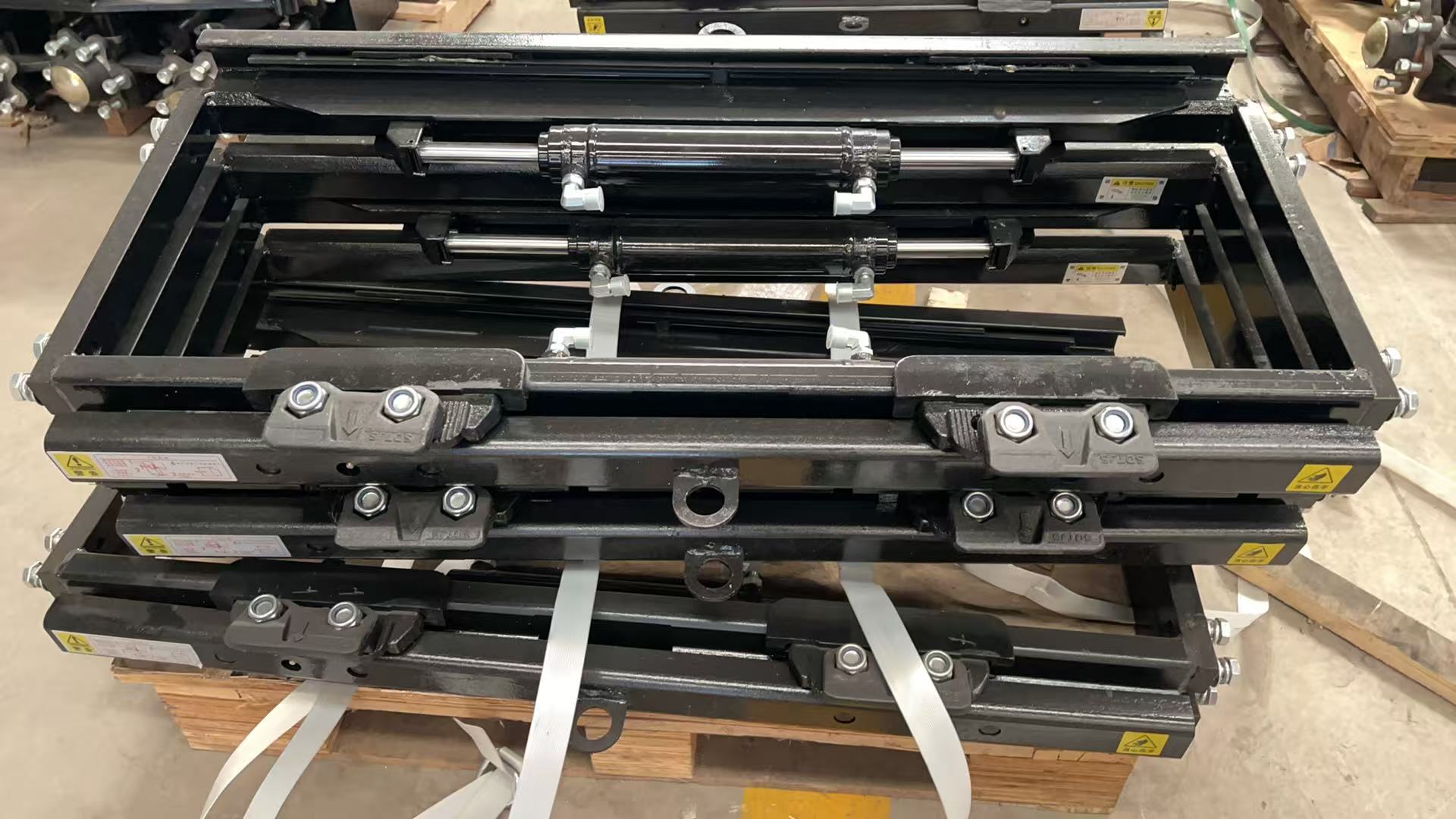
Production area at the electric forklift manufacturing base: battery type, controller brand and mast specification are confirmed before a unit enters the line.
Why battery, controller and lift height outweigh headline capacity
Capacity is the first number a buyer asks for and the least informative on its own. A 3.0-tonne rating describes what a truck can lift at a defined load centre, not what it can lift in every configuration a buyer might order. Lift height, mast type, attachment weight and battery type all move the effective limit.
The practical consequence is that a specification which looks like a close match at quotation stage can be under-rated in the aisle. Three questions therefore decide more of the final performance than the capacity figure:
- Which battery type is fitted, and how does it charge during a shift?
- Which controller brand drives the traction and hydraulic systems?
- What lift height is required at the actual load centre?
Answering them first shortens the approval loop, because these are the questions that most often trigger a second quotation round.
Battery type: heavy-duty lead-acid as standard, lithium optional on all models
Across the CPD range, a heavy-duty lead-acid battery is the standard configuration, and a lithium battery is available as an option on all models rather than being restricted to particular sizes. Buyers therefore treat battery chemistry as a configuration decision, not as a reason to move to a different truck class.
That distinction matters commercially because battery type is one of the few specification choices that changes how the truck is operated, not only how it is bought.
| Decision dimension | Heavy-duty lead-acid (standard configuration) | Lithium battery (optional on all models) |
|---|---|---|
| Availability across the range | Standard configuration | Optional; not restricted to selected models |
| Opportunity charging | Short top-ups during breaks significantly harm battery longevity | 15 to 30 minute top-ups during breaks do not degrade cycle life |
| Cold-environment behaviour | Capacity retention falls more sharply at low temperature | Retains significantly more capacity than lead-acid in applications down to -20 C |
| Typical fit | Single-shift operations with a fixed charging room and predictable duty cycles | Multi-shift, high-frequency operations where charging downtime must be minimised |
Lithium adoption shows how quickly this choice has moved. Lithium-ion accounted for 35% of new global forklift shipments in 2024, up from 22% in 2021, according to LiTrue's analysis of the forklift battery market. The direction is clear, but the installed base remains mixed, which is why both chemistries stay orderable.
Charging behaviour is where the two differ most in daily operation. Published charging guidance from Toyota Forklifts notes that opportunity charging, meaning short 15 to 30 minute top-ups during breaks, does not degrade lithium-ion cycle life, while the same pattern significantly harms lead-acid longevity. A site that wants to charge during shifts is effectively choosing lithium; a site with a fixed charging room and one shift per day can run heavy-duty lead-acid comfortably.
Cold environments add a second consideration. Mordor Intelligence reports that lithium-ion batteries in cold storage applications down to -20 C retain significantly more capacity than lead-acid alternatives, a performance gap it links to an 11.6% CAGR in the food industry segment.
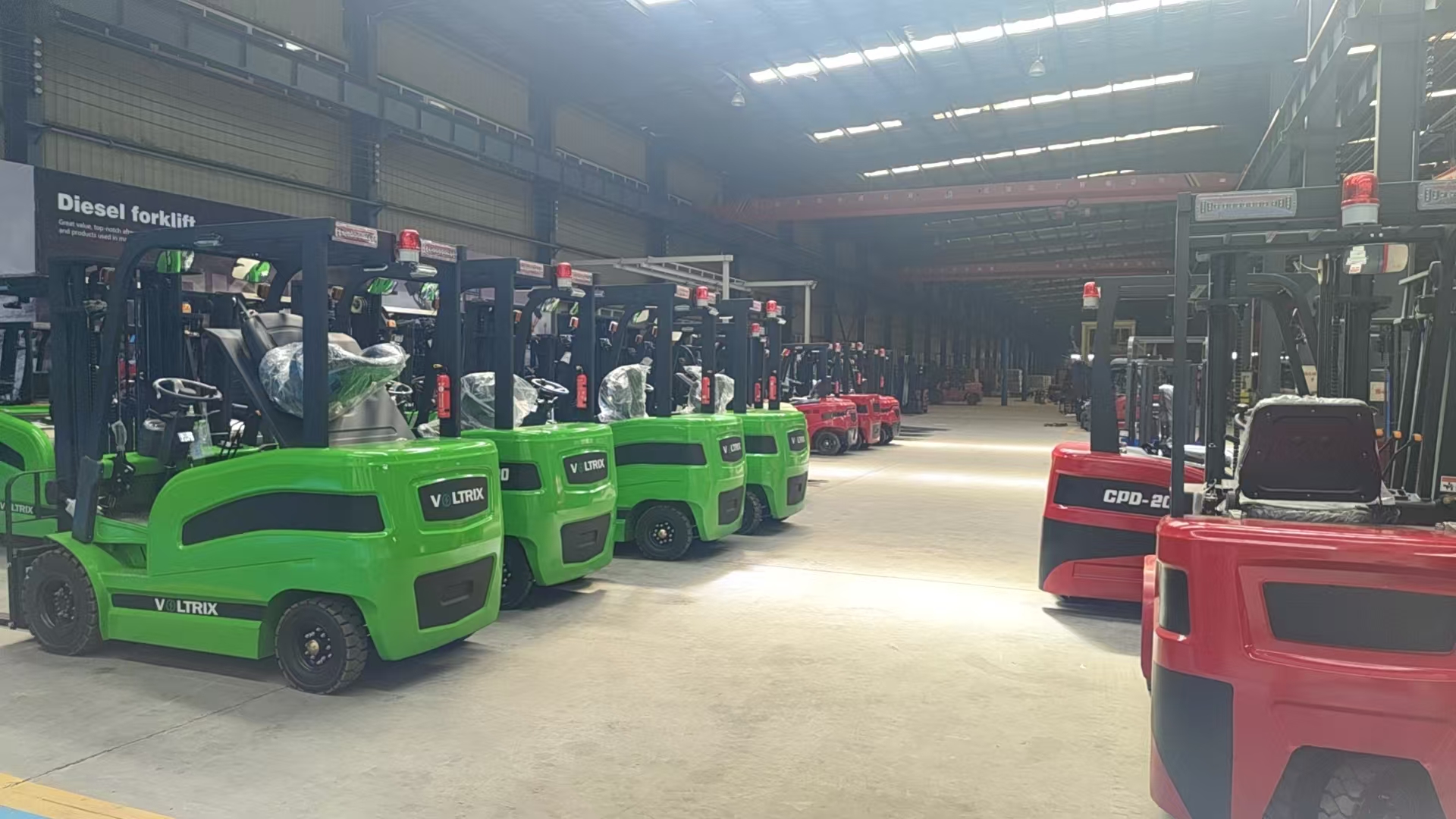
Battery chemistry and mast specification are configuration decisions made against the site's shift pattern, not against the capacity label alone.
Controller brands: SANTROLL, CURTIS, INMOTION and ZAPI
SANTROLL, CURTIS, INMOTION and ZAPI are the controller brands that can be specified as named options on these trucks. In an electric forklift, the controller is the electronic unit that governs how the traction motor and the hydraulic pump motor are driven, including acceleration ramps, regenerative braking behaviour and fault logging.
For procurement teams, the controller question is rarely about peak performance and usually about three practical points:
- Fleet standardisation. A buyer already operating a fleet on one controller family may prefer to keep diagnostics and technician familiarity consistent across sites.
- Service and spare-parts reach. Controllers are replaceable service items, so the relevant question is how quickly a replacement can reach the site.
- Tender documentation. Public and multi-site tenders often require a named component brand rather than a performance description, and a named option removes ambiguity at the award stage.
Because the controller interacts with the battery management and hydraulic systems, the brand selected is recorded in the technical specification approved before production. Changing it later is not a shipping detail; it is a re-specification.
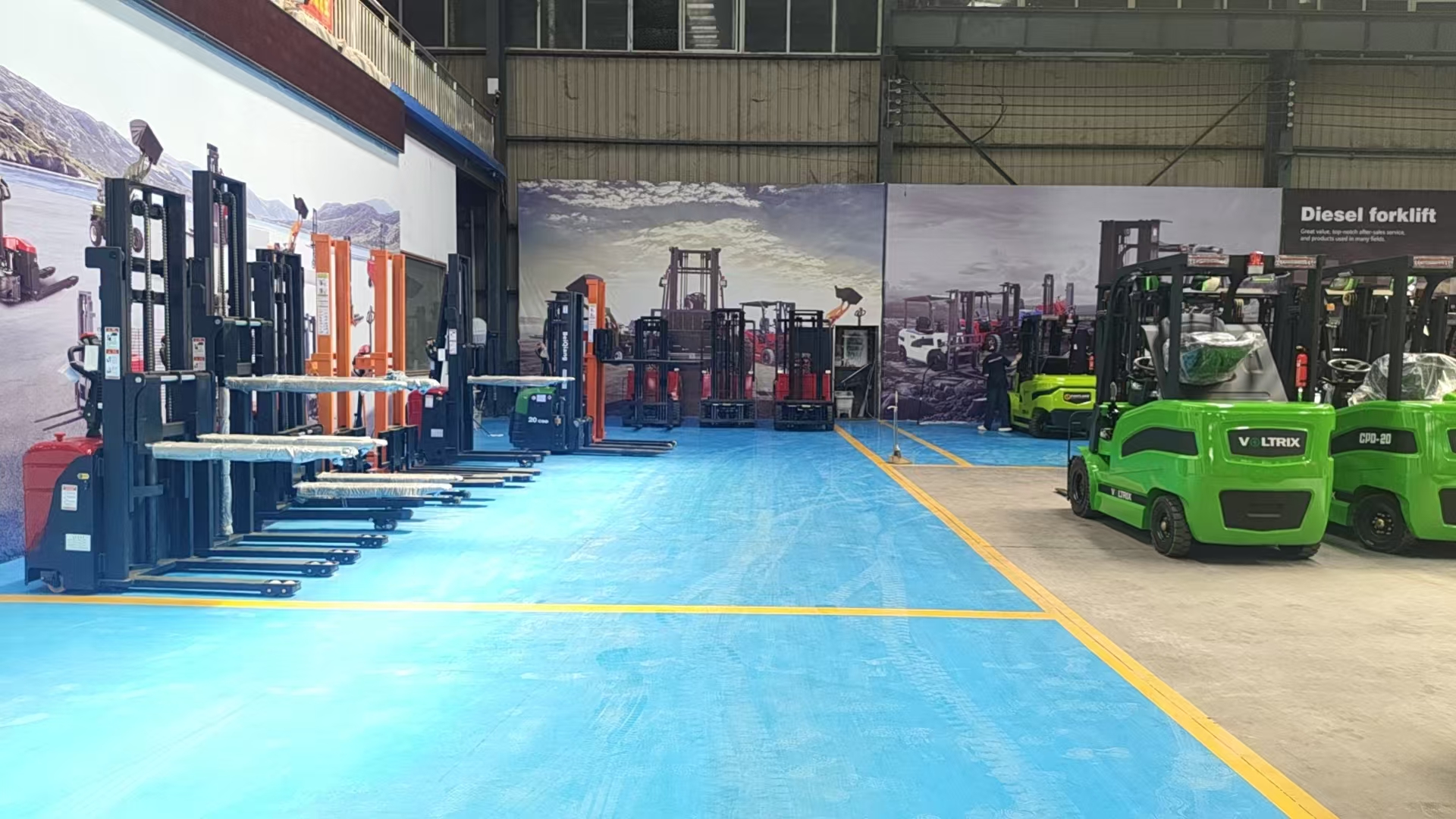
Controller brand, battery type and lift height are recorded together in the approved technical specification before build.
Lift height: what the 3,000 to 7,000 mm range means on a CPD30
For the CPD30, the standard lift height range is 3,000 to 7,000 mm. That span covers most racking and stacking duties in warehousing and production, from low-level pallet handling to high-rack put-away.
The range exists because lift height is a mast and load-centre decision rather than a standalone number. Three effects follow from moving up the range:
- Residual capacity falls as lift height rises. A truck rated at 3.0 tonnes at a standard load centre will not carry the same mass to the top of a 7,000 mm mast. The higher the lift, the more the effective limit depends on the load's centre of gravity.
- Mast and site geometry must be checked together. Overhead clearance, door openings, sprinkler lines and floor flatness all constrain practical lift height, not only the racking beam level.
- Attachment weight consumes capacity. Side-shift, clamps and other attachments add to the load side of the calculation.
These are the variables behind a documented pre-order control: confirm maximum pallet weight, load centre, lift height, attachment weight and residual capacity before order approval. Where a site's load pattern sits outside the standard envelope, load-capacity customisation across 1.0 to 3.5 tonne configurations is available, and a signed technical specification is approved before production.
Matching the specification to the operating environment
Battery, controller and lift height are answered differently depending on where the truck works. The combinations below reflect where each configuration is typically applied.
| Operating environment | Specification typically emphasised | Why |
|---|---|---|
| Warehouse and logistics park transfer | Lithium option, high-frequency duty | Multi-shift operation and opportunity charging during breaks |
| Cold storage and food processing | Lithium option, low-temperature specification | Capacity retention at low temperature and hygiene requirements |
| Chemical workshop | Explosion-proof refitting | Equipment used in explosive atmospheres is regulated in the EU by ATEX Directive 2014/34/EU |
| Narrow-aisle storage | Mast and chassis configuration | Aisle width constrains usable lift height and turning envelope |
| Port terminal and heavy-load handling | Higher capacity configuration, residual-capacity check | Load centre and attachment weight dominate the effective limit |
Customisation on these trucks extends beyond the three headline specifications. Load-capacity adjustment, low-temperature and explosion-proof refitting, branded appearance optimisation and intelligent system reservation are all available as project-level modifications, which means the specification conversation can include a site's future automation plans rather than only its current layout.
What the market data says about the direction of travel
Electrification of material handling is no longer a forecast. The global electric forklift market was valued at USD 53.01 billion in 2024 and is projected to reach USD 94.55 billion by 2032, according to Maximize Market Research. Regionally, electric forklifts reached a 71% share of North American retail orders in 2024, per Industrial Truck Association data reported by Batteries International.
China, the largest production base, shows how far the shift has progressed domestically: electric forklift sales reached 946,300 units in 2025, accounting for 76.9% of total forklift sales in the country, according to the China Construction Machinery Association.
Growth is not evenly distributed by truck class. Mordor Intelligence identifies Class II narrow-aisle trucks as the fastest-growing electric segment, with a projected 9.28% CAGR through 2030, driven by warehouse densification. That trend puts mast specification and aisle geometry at the centre of procurement rather than at its edge.
The competitive structure is also worth noting for buyers benchmarking suppliers. Toyota Industries reported 2023 revenues of USD 16.32 billion, roughly 28 to 29% of the global market, while the two largest Chinese manufacturers, Anhui Heli and Hangcha Group, reported USD 2.45 billion and USD 2.30 billion respectively in the same year, ranked seventh and eighth globally. Between the volume leaders and the low-cost tier, the buyer's real decision is often about which specification commitments a supplier can actually document.
Advanced electric drive versus a conventional 3.0-tonne electric forklift
The comparison that decides most 3.0-tonne purchases is not electric versus diesel. It is a modern electric drive against a conventional electric truck at the same capacity, where the differences concentrate in energy management, control architecture and maintenance frequency.
| Dimension | Modern electric drive, 3.0 t | Conventional 3.0-tonne electric forklift |
|---|---|---|
| Drive and control | Advanced electric drive, intelligent energy management, optimised vehicle control | Conventional electric drive with a basic control system |
| Response and operating time | Faster response, longer effective operating time, reduced charging downtime | Standard operating efficiency with longer charging and downtime |
| Energy and running cost | Lower energy consumption and reduced long-term operating costs | Conventional energy management with relatively higher power consumption |
| Maintenance | Simplified maintenance, fewer service visits, longer maintenance intervals | More frequent inspections and routine maintenance required |
| Commercial profile | Lower long-term operating cost | Lower initial investment in some configurations, but higher long-term energy and maintenance costs |
| Best fit | High-frequency warehouses, factories, logistics centres, cold storage and indoor operations | General warehouses and standard material handling |
The table is a decision aid, not a verdict. The conventional configuration remains the rational choice for low-intensity, single-shift operations where annual hours are too low for lower energy and maintenance costs to offset a higher upfront price. The correct question is how many hours the truck will run and how much charging downtime the operation can absorb.
Limits, trade-offs and what the specification does not solve
A specification reference that lists only advantages is not useful in a tender. The following limits are inherent to the choices described above.
- Higher lift means lower residual capacity. Ordering a CPD30 at the top of the 3,000 to 7,000 mm range and planning to move 3.0 tonnes at that height misunderstands the rating. Load centre and attachment weight must be confirmed before approval.
- Battery choice depends on site infrastructure. A lithium option changes the charging pattern and the equipment the site needs to support it, while a lead-acid standard configuration requires a managed charging area with adequate ventilation.
- Advanced drive economics scale with utilisation. Where annual operating hours are low, the lower energy and maintenance cost of a modern drive takes longer to offset a higher initial investment, which is exactly the case the conventional truck still serves.
- Controller brand availability varies by region. A named controller brand is only useful if local service and spare-parts support exists for it, and that should be checked before it is written into a tender.
- Explosion-proof and low-temperature refitting are customisations. They change specification, approval and production steps rather than being order-form options, and they must be defined in the signed technical specification.
The common thread is documentation. Every item above is resolved by a signed technical specification approved before production, which is why that step, rather than the quotation, is the real control point in an electric forklift purchase.
Future outlook
Three pressures are likely to shape the next round of electric forklift specifications. First, lithium adoption continues to climb from the 35% share recorded in new global shipments in 2024, which pushes charging strategy into the specification conversation rather than the operations manual. Second, warehouse densification keeps narrow-aisle configurations growing faster than the wider electric segment, with a projected 9.28% CAGR through 2030. Third, automation is moving from pilot to procurement: ISO 3691-4:2023 sets updated safety requirements for driverless industrial trucks and their systems, which turns intelligent system reservation into a specification line item rather than a future wish.
For buyers, the practical implication is that a truck ordered today should be specified against a site's next layout, not only its current one, and against documented component and compliance choices rather than marketing descriptions.
FAQ: Electric forklift procurement questions answered
Is a lithium battery optional on every electric forklift model?
Yes. A lithium battery is available as an option on all models in the range, while a heavy-duty lead-acid battery is the standard configuration. Buyers do not need to move to a different truck class in order to select lithium, and no model is restricted to a single battery chemistry.
Which controller brands can be specified?
SANTROLL, CURTIS, INMOTION and ZAPI are the named controller options. The controller manages traction and hydraulic pump motor behaviour, so the selected brand is recorded in the technical specification approved before production rather than treated as an interchangeable shipping detail.
What lift height does a CPD30 offer as standard?
The standard lift height range for the CPD30 is 3,000 to 7,000 mm. Usable capacity within that range depends on the load centre, the attachment fitted and the actual lift height, so residual capacity at the working height should be confirmed rather than assumed from the nominal rating.
How should a procurement team confirm capacity before approving an order?
Confirm maximum pallet weight, load centre, lift height, attachment weight and residual capacity before order approval, then approve a signed technical specification before production begins. Where the standard envelope does not fit the load pattern, load-capacity customisation is available across 1.0 to 3.5 tonne configurations.
How does a modern electric drive compare with a conventional 3.0-tonne electric forklift on running cost?
A modern electric drive uses intelligent energy management and optimised vehicle control, which the manufacturer documents as lower energy consumption and reduced long-term operating costs, together with simplified maintenance requiring fewer service visits and longer intervals. A conventional 3.0-tonne electric forklift typically carries a lower initial investment in some configurations but higher long-term energy and maintenance costs. The balance depends on annual operating hours.
Can these trucks operate in cold storage or in explosive atmospheres?
Cold storage is primarily a battery-selection question: lithium-ion retains significantly more capacity than lead-acid in applications down to -20 C, according to Mordor Intelligence. Explosive atmospheres are a compliance question: within the European Union, ATEX Directive 2014/34/EU is mandatory for electric forklifts used in explosive atmospheres, and low-temperature and explosion-proof refitting is available as a project-level customisation. For CE marking more broadly, EN 1175:2020 is the harmonised European standard covering electrical and electronic safety requirements for self-propelled industrial trucks.
Used as a checklist, the three questions raised at the start of this reference, namely battery type, controller brand and lift height at the working load centre, resolve most of the specification risk in an electric forklift order before it reaches the production line.