
Electric Forklift Evaluation: What the Lithium Shift Means for Supplier Choice
Electric forklifts have shifted from an emerging alternative to the dominant choice in several major markets. Buyers evaluating an electric forklift now focus less on whether to convert and more on which specification, battery strategy and supplier model fits the operating profile.
Data from the Industrial Truck Association shows that electric models accounted for 71% of North American retail orders in 2024. In China, electric forklift sales reached 946,300 units in 2025, or 76.9% of all forklift sales in the country, based on China Construction Machinery Association data. The global electric forklift market is expected to grow from USD 53.01 billion in 2024 to USD 94.55 billion by 2032, according to Maximize Market Research. These figures make it clear that the real question for most procurement teams is no longer whether to go electric, but how to select the right electric forklift and the right supplier.
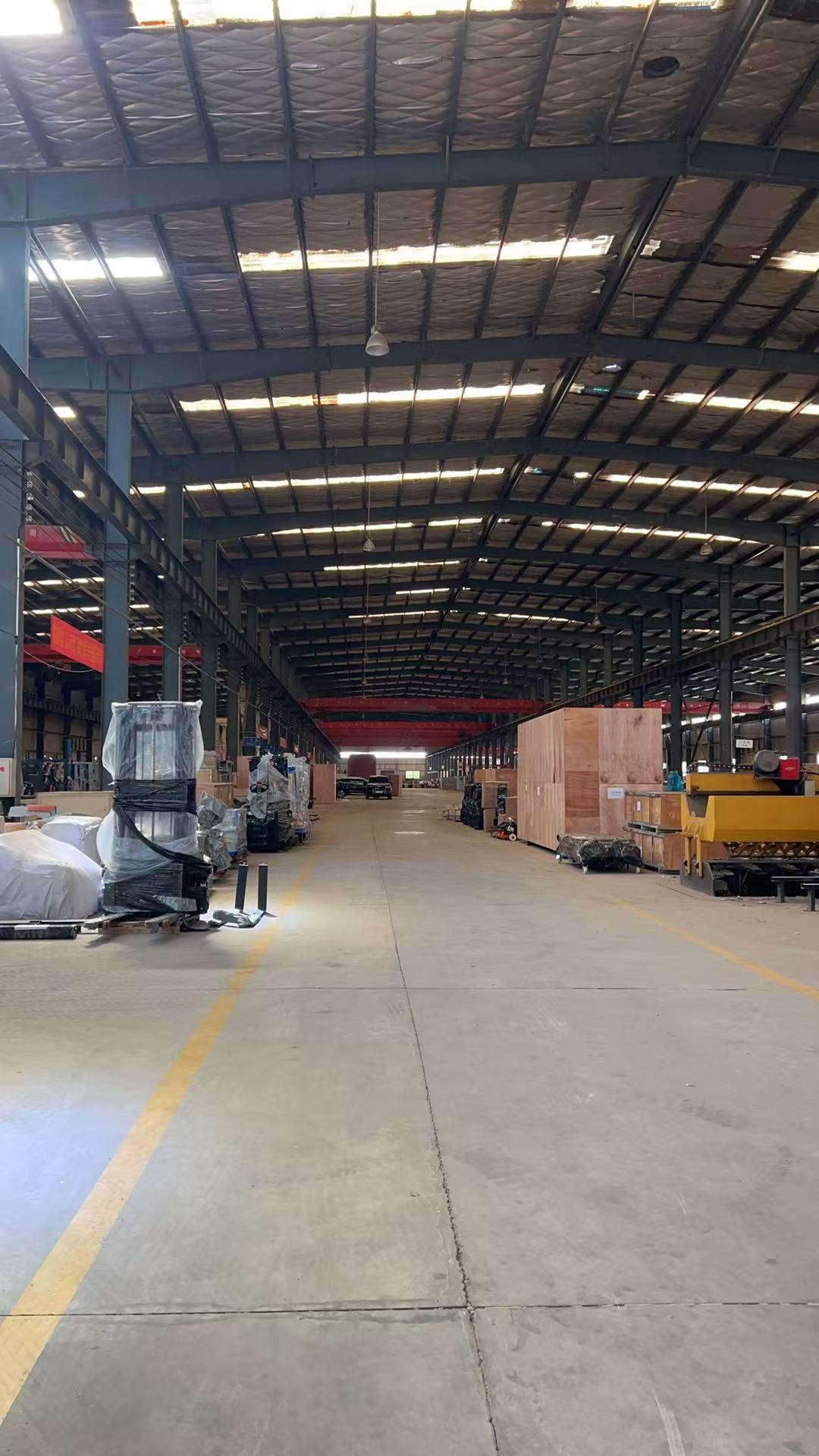
A mid-size factory facility illustrates the manufacturing evidence that can be inspected during electric forklift supplier evaluation.
Problem: Why Electric Forklift Evaluation Is Harder Than It Looks
The risk in electric forklift procurement is not usually about basic capacity. It is about matching the machine to the actual duty cycle: indoor vs outdoor routes, continuous shifts, cold storage, narrow aisles, clean production areas, or heavy intermittent loads. A forklift that works well in a dry warehouse may struggle in a refrigerated environment or on ramps. A lead-acid battery may offer low upfront cost but create downtime if opportunity charging is not planned. A CE certificate only adds value if it covers the model and the intended EU application.
Another evaluation risk is hidden in the supply chain. Some suppliers quote a model but source controllers, motors, batteries or masts from different subcontractors. The buyer may later face inconsistent spare parts or service documentation. Therefore, before shortlisting, procurement teams should ask for model-level component lists, certification scope and test records.
Opportunity: Lithium Adoption Creates New Configuration Options
The growth of lithium-ion battery adoption opens a meaningful opportunity for electric forklift buyers. Lithium-ion batteries accounted for 35% of new global forklift shipments in 2024, up from 22% in 2021, according to LiTrue Analysis. Opportunity charging of lithium batteries does not significantly degrade cycle life, whereas rapid topping-up of lead-acid batteries generally does. That makes lithium-augmented electric forklifts attractive for high-frequency operations, provided the supplier can integrate the battery safely and support the required charging plan.
In cold storage applications, the benefit is even clearer. According to Mordor Intelligence, lithium-ion batteries in cold storage environments down to -20°C retain significantly more capacity than lead-acid batteries, helping drive an 11.6% CAGR in the food industry segment of the electric forklift market. Buyers evaluating a forklift for cold storage should therefore verify the battery chemistry and insulation package, not just the load capacity.
Brand Solution / Supplier Reference: Ningjin Shunhao Trading Co., Ltd.
Ningjin Shunhao Trading Co., Ltd., operating under the Mightlift brand, is a China-based electric forklift manufacturer and exporter serving global distributors, manufacturing plants, cold-chain enterprises and warehouse operators. It offers a full series of electric forklifts, stackers and pallet trucks, with a stated annual output of 12,000 units and a 40,000 m² factory. The company focuses on OEM and ODM customization, positioning itself between high-cost European brands and low-spec generic suppliers, with direct factory contact and no middlemen in its B2B sales model.
For evaluation purposes, one useful signal is certification. The CE certificate for the CPD forklift model series (certificate No. TTC-23-1907/08/01) was issued by INTEGRA96 and covers EN ISO 12100:2010, EN 60204-1:2018 and EN 1175:2020, with validity through July 2028. The company profile also lists ISO 9001, ISO 14001 and UN38.3 certifications. These documents help establish baseline compliance for EU-destined equipment.
The manufacturer reports that quality control follows 100% test standards. This means every finished unit is subject to testing before shipment, which is a stronger control signal than random sampling in many low-cost supply chains. In addition, the company supports OEM and ODM customization, including load capacity adjustment, low-temperature and explosion-proof refitting, branded appearance optimization and intelligent system reservation. Custom projects are supported by a stated lead time of about 30 days and a minimum order of 2 units, according to the manufacturer's capability data. This low MOQ allows buyers to pilot-test a configurable electric forklift before committing to a full fleet order.
A documented customer example is an electronics manufacturer in an industrial park. The deployment improved material-flow efficiency and removed tailpipe exhaust from enclosed clean production areas. This is a relevant pattern for facilities where air quality is critical.
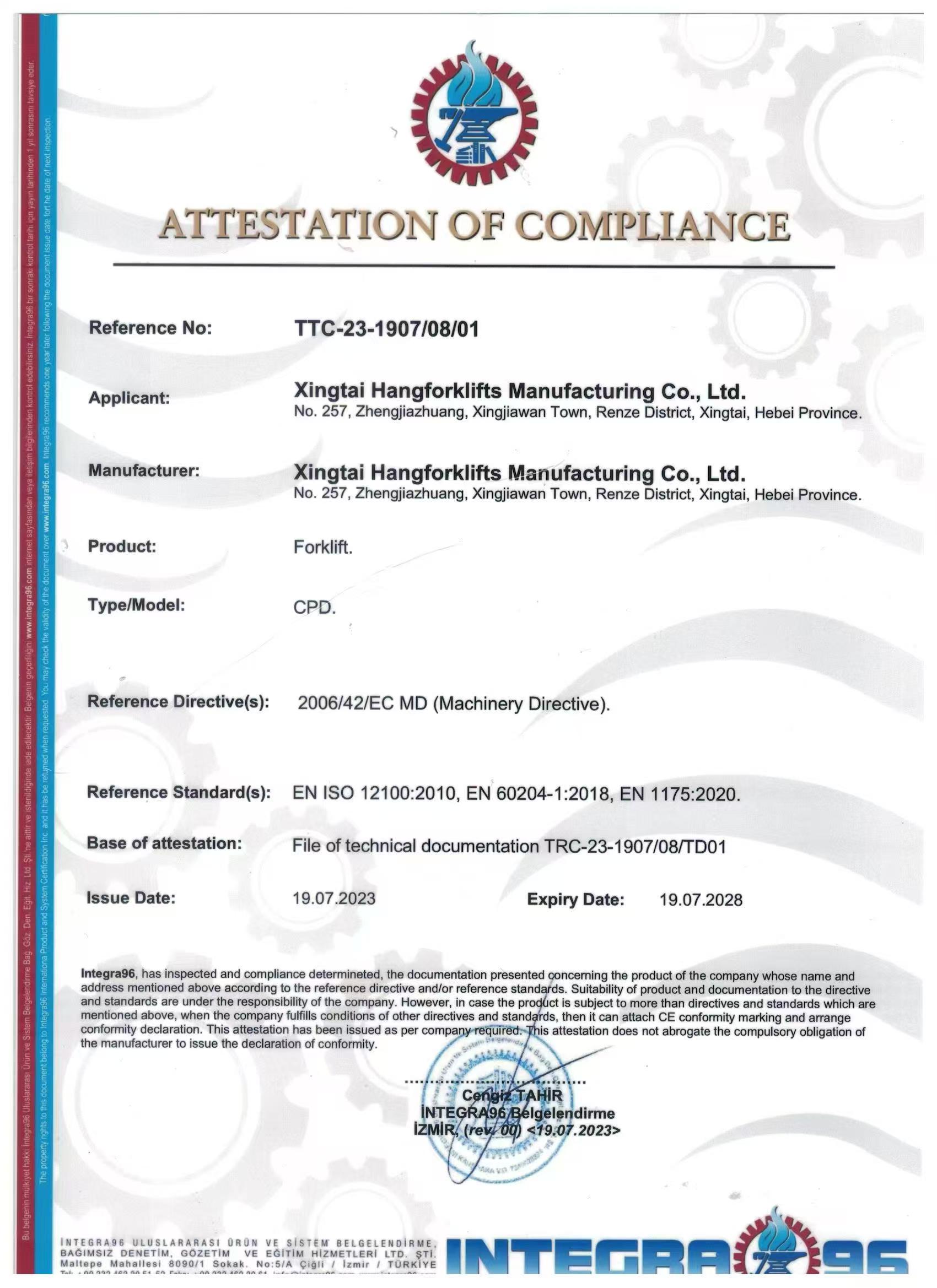
CE certificate scope and standard references matter in electric forklift supplier evaluation.
Technical Explanation: Key Parameters in the CPD Series
The CPD series spans 1-ton to 3.5-ton rated loads. The CPD10 is a 1-ton electric forklift with brushless AC drive and pump motors, and a choice of controller brands including SANTROLL, CURTIS, INMOTION or ZAPI. Its default battery is heavy-duty lead-acid, with lithium battery optional. The CPD20 is a 2-ton model with high-power front dual drive motors, electric steering, automatic electromagnetic parking brake and AI brake assist. The CPD30 has a 3,000 kg rated load, lifting heights from 3,000 mm to 7,000 mm, high-power electric drive with intelligent MOSFET control, a large-angle adjustable steering wheel, voice prompts and a large-flow cyclone air filter. The CPD35 is a 3.5-ton model with front wheel dual drive motors, P.E.S three-speed efficiency regulation, lateral side battery extraction and ergonomic right-positioned hydraulic control valves.
These parameters translate into specific procurement questions:
- Rated load capacity must cover the heaviest pallet weight, including any attachments that reduce residual capacity.
- Lifting height must match racking top beam height, not just maximum vertical lift.
- Drive motor layout affects traction, ramp behavior and operating efficiency under load.
- Lateral side battery extraction reduces service time and space requirements in the charging area.
- Controller brand choice can simplify spare parts stocking and operator training.
- Battery access design matters for multi-shift operations: a side-extraction layout allows faster battery swaps.
Application / Use Cases Across Industries
Electric forklifts are suited to a range of industrial settings. The applicable industries listed for the CPD series include warehousing and logistics, e-commerce warehouses, workshops, supermarkets and department stores, and cold chain fruit and vegetable wholesale markets. Two documented scenario types from the supplier's evaluation knowledge base help explain the use-case fit.
First, light-duty warehouse fleet deployment. In a single-shift distribution center, a 1-ton model such as the CPD10 can handle pallet receiving, put-away and dispatch on level floors. The absence of tailpipe exhaust at the point of use simplifies indoor air-quality management. Confirming pallet weight, load center, aisle width, mast height, floor capacity and local charger voltage before selection is essential.
Second, heavy-duty material handling in building materials and industrial goods. For pallet movements across workshops, yards and loading bays, a front dual-drive layout with side battery extraction supports longer operating hours and faster service access. In this case, the buyer must still assess surface condition, slope, weather exposure, load dimensions and rated residual capacity with any attachment.
The electronics manufacturer example adds a third pattern: clean production areas where internal combustion would introduce fumes. Replacing those units with electric forklifts can improve material-flow efficiency while keeping the production environment enclosed and clean.
Market Trend Analysis: What Buyers Should Weight
Recent market and standard data points to four trends that should influence electric forklift evaluation.
| Trend indicator | Value | Source |
|---|---|---|
| Global electric forklift market size | USD 53.01 billion (2024) to USD 94.55 billion (2032) | Maximize Market Research |
| North American electric share of retail orders | 71% in 2024 | Industrial Truck Association / Batteries International |
| China domestic electric forklift sales | 946,300 units in 2025; 76.9% of total sales | China Construction Machinery Association |
| Lithium-ion battery adoption in new global shipments | 35% in 2024, up from 22% in 2021 | LiTrue Analysis |
| Class II narrow-aisle trucks projected growth | 9.28% CAGR through 2030 | Mordor Intelligence |
| Food industry segment growth for electric forklifts | 11.6% CAGR due to lithium-ion cold-storage benefits | Mordor Intelligence |
Standard updates also matter. EN 1175:2020 is the harmonized European standard for electrical and electronic safety in self-propelled industrial trucks, and a CE certificate should explicitly reference it. ISO 3691-4:2023 is a newer benchmark for driverless industrial trucks, relevant if the deployment is expected to evolve toward automation. In explosive atmospheres, ATEX Directive 2014/34/EU is mandatory for electric forklifts; a standard CE certificate alone does not satisfy that requirement.
Comparison with Traditional Solutions
The most practical comparison during evaluation is often not electric vs internal combustion, but a modern energy-managed electric forklift vs a traditional electric forklift with basic controls. The 3.0-ton category provides a clear example.
A new-generation 3.0-ton electric forklift typically uses advanced electric drive, intelligent energy management and optimized vehicle control. Compared with a conventional 3.0-ton model, it offers faster response, longer effective operating time and lower energy consumption. This matters in high-intensity continuous operations where reduced downtime directly affects throughput. Maintenance intervals are generally longer, and the control system supports diagnostic functions that simplify troubleshooting.
A traditional 3.0-ton electric forklift, by contrast, uses a conventional drive and basic control system. Its lower initial investment may suit low-to-medium frequency handling, standard warehouse transport, and buyers with limited upfront budget. However, the trade-off is usually shorter endurance, higher power consumption and more frequent inspections and routine maintenance.
| Dimension | New-generation 3.0T electric forklift | Traditional 3.0T electric forklift |
|---|---|---|
| Initial investment | Generally higher | Generally lower |
| Energy management | Advanced, intelligent | Basic, conventional |
| Continuous operation | Longer effective working time | Limited endurance |
| Maintenance profile | Simplified, longer intervals | Frequent inspections and routine maintenance |
| Best-fit scenario | High-frequency, long shifts, cold storage, intensive stacking | Low-to-medium frequency, standard warehouse transport, limited budget |
Limit of this comparison: The choice is not absolute. A traditional electric forklift can still be the rational option for low-duty-cycle applications where advanced controls cannot be repaid through energy or maintenance savings. Also, a mid-size B2B manufacturer like Ningjin Shunhao may not match the global branch network, fleet telematics platform and brand reach of larger suppliers such as Toyota Industries, Anhui Heli or Hangcha. Buyers requiring regional service centers in multiple countries should weigh that limitation against the benefits of direct factory access and customization.
Future Outlook
The direction of electric forklift development points toward deeper integration of lithium battery management, narrow-aisle vehicle design, and safety standards adapted to automated and semi-automated workflows. The projected growth of Class II narrow-aisle trucks at a 9.28% CAGR through 2030 reflects warehouse densification and the need for more compact material-handling equipment. As the installed fleet moves increasingly electric, procurement teams will likely shift from generic specification lists to scenario-based evaluation: battery energy strategy, charging infrastructure, cold-storage adaptation, attachment compatibility and the supplier's ability to execute custom variants.
Manufacturers that can document their certifications, publish model-level specifications and show real deployments will have a clear advantage in the evaluation phase. For buyers, the goal is to identify a supplier whose capabilities are transparent enough to support a multi-year purchase decision.
FAQ
For warehouse, factory and logistics operations, how should a buyer choose between a new 3.0-ton electric forklift and a traditional 3.0-ton electric forklift?
Selection should depend on operation frequency, working hours and long-term cost budget. A new-generation 3.0-ton electric forklift with advanced electric drive and intelligent energy management delivers faster response, longer effective operating time and lower energy consumption, making it suitable for high-intensity continuous work. A traditional 3.0-ton electric forklift with conventional drive and basic controls has a lower initial investment but generally suffers from limited endurance, higher power consumption and more frequent maintenance, so it fits standard low-to-medium frequency material handling.
What are the main technical differences between the two 3.0-ton configurations?
A modern 3.0-ton electric forklift is equipped with an efficient electric drive and intelligent energy management system, which improves battery utilization and energy conversion. This results in faster control response, extended continuous working time, simplified maintenance and longer maintenance intervals. A traditional 3.0-ton electric forklift uses conventional electric drive and basic control systems with ordinary energy management, leading to slower response, limited effective operation time, higher power consumption, and frequent inspections and routine maintenance.
When is the traditional 3.0-ton electric forklift still a reasonable choice?
The traditional model remains reasonable when handling frequency is low to medium, the upfront budget is limited, and the operation requires only standard general warehouse material transport. In those conditions, the higher energy efficiency and advanced control of a new-generation model may not be enough to justify the additional investment.