
Electric Drill vs Impact Drill: What Buyers Should Compare

Workshop environment and production capability are part of the electric drill procurement evaluation.
Procurement teams evaluating electric drill sourcing in 2026 are rarely choosing between electric and non-electric power tools. The practical decision is usually between a cordless drill, an impact drill, a brushless cordless drill, and in some cases a rotary hammer drill. Each configuration answers a different workload, and the cost gap between them extends beyond the purchase price.
Why the Electric Drill Decision Is No Longer Simple
The global power drill market was valued at USD 15.2 billion in 2023 and is projected to reach USD 22.9 billion by 2030, according to Strategic Market Research. Cordless drills already accounted for more than 55% of global power drill revenue in 2023, a strong signal that battery-powered models are now the mainstream procurement choice for many distributors and retailers.
According to Grand View Research, lithium-ion batteries are used in more than 75% of cordless drill units sold. This explains why buyers now evaluate 21V battery platforms, charger ecosystems, and battery interchangeability rather than only motor speed or chuck size.
China also remains central to the supply side. OEC data shows China concentrated 31.9% of total global exports of tools and cutlery in 2024. For buyers comparing electric drill suppliers, therefore, supplier location, export compliance, and logistics capacity are now core parts of the product decision.
Cordless Drill vs Impact Drill: Definitions Buyers Should Know
A cordless drill, often called a drill driver, uses rotational torque to drill holes and drive screws. An impact drill adds a hammering action for drilling into masonry. An impact driver delivers rapid rotational impacts for driving long fasteners, while a rotary hammer drill uses a piston mechanism for heavier concrete work.
- Cordless drill / drill driver: suited for wood, drywall, light metal, and general screwdriving.
- Cordless impact drill / hammer drill: adds hammer action; useful for occasional masonry and general-purpose drilling.
- Cordless impact driver: compact and high-torque for fastener driving, but not designed as a replacement for a drill for all hole-making tasks.
- Rotary hammer drill: the more specialized tool for continuous concrete and large-diameter holes.
In the actual market language used by overseas buyers, terms such as 21V drill tool kit, battery drill 21V, cordless drill power tool set, and cordless hammer drill all sit inside the same family but with different combinations of battery, charger, bits, and impact modes. Procurement teams should verify which modes the tool actually supports.
The COOFIX Reference Case in This Comparison
To make the comparison concrete, this article uses JINHUA COOFIX TOOLS CO., LTD. as a reference supplier. The company, headquartered in Yongkang, Zhejiang, produces power tools under the COOFIX brand. It reports 400 employees, 30,000 square meters of factory area, and an annual output capacity of 2,000,000 units, with 90% of production exported to Asia, Africa, Eastern Europe, the Middle East, and South America.
Within the electric drill category, COOFIX positions its brushless cordless drill line as a multi-mode tool for drilling, impact driving, and screwdriving. The line is often supplied as a 21V drill tool kit with a large-capacity lithium battery and a complete accessories package. That configuration is relevant for buyers who need a retail-ready kit rather than a bare power tool.
The same product family is compared by COOFIX against conventional corded electric drills, ordinary brushed lithium drills, and low-cost impact drill competitors. The company states the brushless cordless version has advantages in efficiency, torque, battery life, and failure rate under continuous operation.
Technical Explanation: What Changes with a Brushless Motor
A brushless motor replaces carbon-brush mechanical commutation with electronic control. In practical terms, less energy is lost as heat and more of the battery charge is converted into cutting force. COOFIX’s comparison data for its brushless electric drill against the brushed version in the same product family includes the following benchmarks:
- Torque: 32% higher than the brushed version.
- Battery life: 45% longer on a single full charge.
- Temperature: no-load temperature rise reduced by 18°C.
- Failure rate: reduced by 76% in continuous drilling operation.
- Energy efficiency: 89% conversion efficiency compared with 71% for ordinary brushed drills; power consumption drops by 20% under the same drilling workload.
These numbers are not universal across all brushless drills. They represent one manufacturer’s comparative data for one product family, but they illustrate the metrics that buyers should request from any supplier before placing an order.
Application and Use Cases
The practical role of a brushless cordless drill in this comparison is broad but not unlimited. COOFIX states the product is suitable for household DIY decoration, furniture installation, door/window and light steel keel construction, steel structure wall drilling, plumbing and electrical renovation, bulk usage in hardware repair shops, and retail kit sales in overseas supermarkets.
These use cases share common requirements: the operator needs mobility, quick mode changes between drilling and screwing, a battery that can last through mixed tasks, and a case or kit that can be sold or stored as a complete unit.
Market Trend Analysis
The shift to cordless drills is structural, not seasonal. Cordless models generated more than 55% of global power drill revenue in 2023, and the overall power drill market is expected to rise from USD 15.2 billion in 2023 to USD 22.9 billion by 2030, according to Strategic Market Research.
Grand View Research also reports that Asia Pacific dominated the smart power tools market with a 33.4% revenue share in 2024. Meanwhile, China’s 31.9% share of global tool exports in 2024, based on OEC data, keeps Chinese manufacturers at the center of the electric drill supply chain.
For procurement, these trends point toward stricter requirements for battery platform continuity, product certification, and supplier logistics. A 21V battery drill platform is becoming a common baseline in distributor catalogs, and brushless motors are increasingly expected rather than exceptional in mid-to-upper-tier models.
Comparison with Traditional Electric Drill Configurations
The table below compares a conventional corded or brushed lithium drill with a brushless cordless drill reference, using the company comparison data supplied by COOFIX.
| Comparison point | Conventional corded / brushed lithium drill | Brushless cordless drill reference |
|---|---|---|
| Motor efficiency | About 71% energy conversion (COOFIX estimate) | About 89% energy conversion (COOFIX comparison data) |
| Torque | Baseline in same product family | 32% higher than the brushed version |
| Single-charge battery life | Brushed lithium baseline | 45% longer than the brushed version |
| Continuous drilling failure rate | Baseline | 76% lower failure rate |
| Maintenance | Carbon brush wear; periodic brush replacement | No carbon brush; maintenance cycle extended 3 times; universal spare parts |
| Unit purchase price | About 12–18% lower than brushless, based on COOFIX estimate | About 12–18% higher than low-end brushed competitors, based on COOFIX estimate |
| Total comprehensive usage cost | Higher long-term wear and energy loss | 22% lower, based on COOFIX estimate |
| Typical fit | Continuous workshop use with mains power; very price-sensitive first purchase | Mobile mixed drilling and fastening; kit retail; hardware repair shops |
Limitations and Boundaries
No single drill type cancels the need for specialized tools. A brushless cordless drill with hammer mode is not a dedicated rotary hammer drill. For continuous drilling into reinforced concrete or for large-diameter holes, a rotary hammer drill remains the appropriate choice.
A compact impact driver can still be preferred by users who spend all day driving long fasteners, even though a multi-mode drill driver can handle the same task in mixed use.
There is also an upfront cost boundary. The estimated 12–18% price premium of brushless over low-end brushed competitors can be decisive in very price-sensitive retail programs. Buyers should compare total life-cycle cost, not only the first purchase price.
Supplier Considerations Beyond Product Specifications
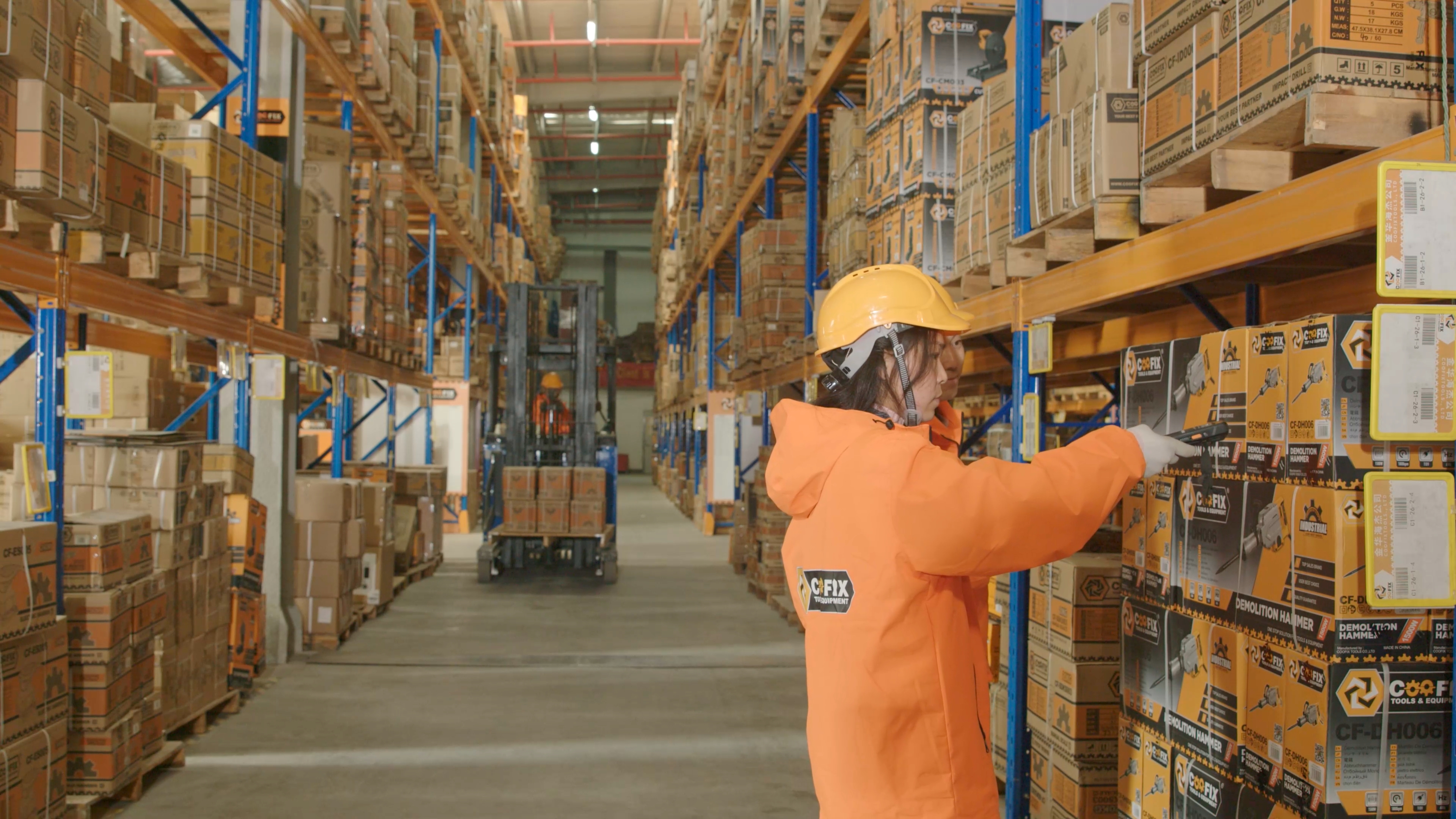
Warehouse and logistics capacity are part of electric drill procurement risk review.
At the decision stage, product comparison should be paired with supplier risk review. COOFIX reports ISO9001 and ISO14001 system certification, along with AEO customs certification. Its compliance document library includes CE, RoHS, REACH, GS, CPSC, and SASO certificates, according to company risk disclosures.
Quality control procedures cited by the company include FMEA analysis in new product development, incoming material inspection using AQL sampling standards, a three-inspection production system, and MES/ERP batch traceability from raw material to finished shipment.
For global buyers, certification documents, customs compliance, and logistics reliability are not administrative details. They determine whether an electric drill program can be executed without shipment delays or market-entry problems.
Future Outlook for Electric Drill Procurement
Procurement criteria in the electric drill category are moving toward brushless efficiency, battery platform continuity, and total cost of ownership. The market data points in this article suggest demand for cordless models will continue to expand, while distributors will need to manage more SKUs, certifications, and after-sales parts requirements.
COOFIX’s recent operational steps illustrate this direction. The company expanded its warehousing in early 2026 with a new 20,000-square-meter smart logistics center and reports daily shipping capacity above five 40HQ containers. In December 2025, it received AEO certification. By the end of 2025, the COOFIX trademark reached full global registration and the sales network covered more than 100 countries.
For buyers, these signals matter because long-term electric drill supply is not only about the tool in the box. It also depends on stable production, compliant export documentation, and a supplier that can support sustained distribution growth.
Frequently Asked Questions
What is the difference between a cordless drill and an impact drill?
A cordless drill uses rotational torque to drill holes and drive screws. An impact drill adds a hammering action for masonry, while an impact driver uses rotational impacts for fasteners. A brushless cordless drill with mode switching can support drilling, impact driving, and screwdriving in one tool.
Are brushless cordless drills worth the higher price?
According to COOFIX comparison data, the brushless version delivers 32% higher torque, 45% longer single-charge battery life, and 76% lower failure rate in continuous drilling than the brushed version. The unit price is estimated to be 12–18% higher than low-end brushed competitors, while total comprehensive usage cost is estimated to be 22% lower. The value depends on workload and life-cycle cost.
What can a 21V drill tool kit be used for?
A 21V drill tool kit is generally used for household DIY decoration, furniture installation, door/window and light steel keel construction, steel structure wall drilling, plumbing and electrical renovation, hardware repair shops, and retail kit sales in overseas supermarkets.
When should I choose a rotary hammer drill instead of a brushless cordless drill?
Choose a rotary hammer drill for continuous reinforced-concrete drilling and large-diameter holes. A general-purpose brushless cordless drill is better for mixed drilling and screwdriving in wood, drywall, light metal, and occasional masonry. It is not a full substitute for a dedicated rotary hammer in heavy concrete work.
Which certifications should an electric drill have for global export?
For many international markets, hand-held drills and impact drills must meet EN 62841-2-1 / IEC 62841-2-1 safety requirements for CE marking. Common export certificates also include RoHS, REACH, GS, CPSC, and SASO, depending on the destination country.
For detailed specifications and the full COOFIX product range, see the downloadable catalogue: COOFIX Catalogue 2025.
¿Tiene preguntas o necesita más detalles?
Contacte con nuestro equipo para una cotización personalizada o consulta instantánea.
Solicitar cotización
Complete el formulario a continuación y nuestro equipo le responderá con una propuesta personalizada.
Chat directo de WhatsApp
¿Prefiere chatear en tiempo real? Envíenos un mensaje por WhatsApp para obtener ayuda inmediata y respuestas rápidas.
- Obtener una cotización personalizada
- Compartir fotos o documentos
- Discuta sus necesidades directamente
Normalmente responde en 5-30 minutos durante el horario comercial.