
Electric Bike Shortlist for Facility Patrol: 20, 27.5, 29-In
Facility patrol is a vehicle-matching problem before it becomes a purchasing decision. An outdoor sports facility usually combines paved internal walkways, service roads behind stands or courts, gravel margins and, on larger sites, grass or unpaved perimeter tracks. Matching an electric bike to that route profile, rather than to a single headline specification, is what separates a patrol fleet that is used daily from one that stays parked.
This shortlist sets out three ACOPLEX models for outdoor sports facility patrol duty, organised by the surface each is built for: a 20-inch compact platform for paved internal paths, a 27.5-inch platform for mixed surfaces, and a 29-inch fat-tire platform for rough ground. It is a set of recommended options for different patrol routes — not a universal ranking, and not a claim that one wheel size fits every site.
ACOPLEX Electric Bike is the electric bicycle line supplied by Wuxi Purino International Trade Co., Ltd, a Wuxi, Jiangsu-based trading enterprise that supplies electric bicycles, kids scooters and children's balance bikes to buyers in the EU, North America and other markets, with CE and EN15194 certification across its e-bike range. The three models below share a design language — 6061 aluminum alloy frames, front and rear hydraulic disc brakes, LCD displays and Samsung lithium-ion packs — while differing in wheel size, gearing and published torque.
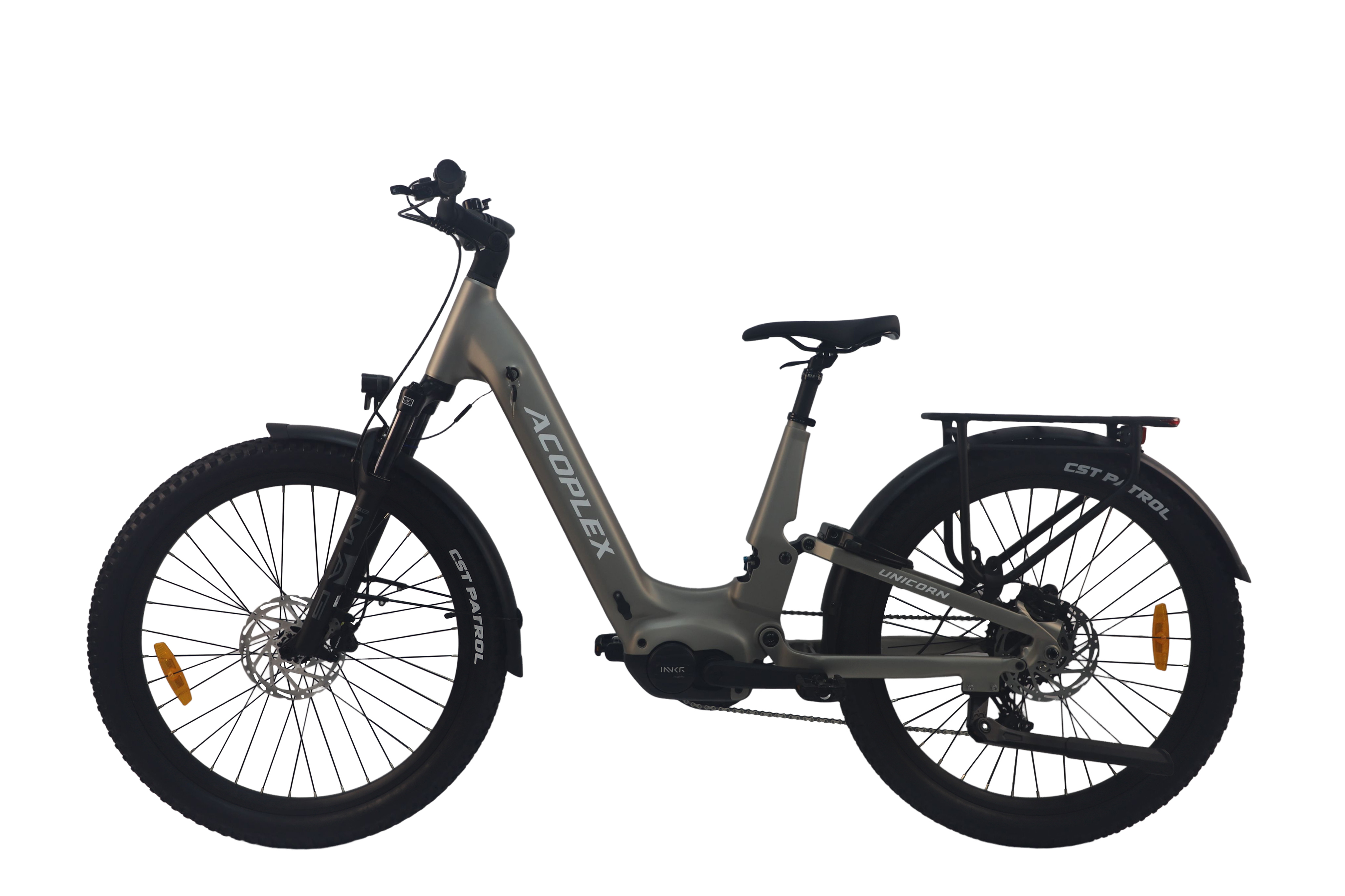
The 27.5-inch ACOPLEX UNICORN occupies the middle of a three-wheel-size patrol shortlist, intended for routes that alternate between pavement and gravel.
Patrol routes, not product tiers, decide the shortlist
Patrol duty is stop-start and low-speed by nature: an officer moves a few hundred metres, stops, checks a gate or a lighting column, then continues. That duty cycle puts weight on four specification areas — tire volume and wheel diameter, crank torque, gear range, and usable battery capacity between charges — and much less weight on peak speed.
Because those four areas trade off against each other, one model rarely covers an entire site. A paved loop around courts and a spectator concourse behaves nothing like a gravel service road or a grass perimeter. Treating both as a single requirement is how facilities end up with a fleet that is over-specified for the paved loop or under-built for the perimeter.
The three-model structure below follows that logic. Each entry states the surface it is built for, the specification that supports it, and the boundary at which a different model should be considered instead.
Selection criteria: what to compare before a patrol shortlist
| Criterion | What to compare | Why it matters on patrol | How the three models differ |
|---|---|---|---|
| Wheel and tire | Diameter and tire width; CST fitment | Larger diameter rolls over kerbs, roots and gravel; wider tire adds grip on grass and spreads load | 20x2.0 / 27.5x2.6 / 29x4.0 CST |
| Torque | Newton-metres at the motor or crank, not wattage alone | Loaded starts, ramps and grass require torque at low speed | 60 N.m (TRAVEL); up to 95 N.m (ROCKET); not published for UNICORN |
| Drivetrain | Number of ratios, chain and crankset | Gear range lets the rider hold cadence on slopes and use motor torque efficiently | SHIMANO 8 / 9 / 11-speed, KMC chain |
| Battery and charging | Voltage, capacity, chemistry, charge time, charger input | Sets kilometres per shift and how the fleet rotates around charging | 48V/7Ah Samsung on all three parameter lines; ROCKET description cites 14.7Ah; 3-4 h vs 4-6 h charge |
| Frame, brakes, fork | Frame alloy, brake type, suspension fork | Stop-start duty loads brakes; alloy frames tolerate outdoor storage | 6061 aluminum and hydraulic discs on all three; ZOOM fork (TRAVEL), Suntour fork (UNICORN, ROCKET) |
Tire choice is the first filter because it is the hardest to change later. A 20x2.0 CST set is a pavement specification; a 27.5x2.6 set is a mixed-surface specification; a 29x4.0 fat tire is a rough-ground specification. Buying a narrow tire for a route with loose gravel is a specification error, not a maintenance issue.
Torque is the second filter. Wattage describes electrical input, while newton-metres describe what the rider feels when pulling away under load or climbing. For patrol work the torque figure predicts whether a bike leaves a standing start cleanly or labours.
The third filter is gearing, because on a mid-drive the selected gear multiplies the torque reaching the wheel. The fourth is battery and charging, which determines the shift plan rather than the ride quality.
The 20-inch option: ACOPLEX TRAVEL for paved internal paths
ACOPLEX TRAVEL is an electric city bike built on 20x2.0 CST tires and a 6061 aluminum alloy frame, with a whole-vehicle weight of 23.5 kg. The compact geometry lowers stand-over height, which matters where staff of different sizes share a pool bike and mount and dismount repeatedly at gates, doors and stairwells.
The drive unit is a 48V 250W Oxygen Comfort mid-drive motor weighing 3.0 kg and rated at 60 N.m, paired with a 48V/7AH Samsung lithium-ion battery. Published practical range is 40-50 km with a 3-4 hour charge from a universal smart charger. Shifting is handled by a SHIMANO 8-speed drivetrain with a KMC chain and a 52T aluminum crankset; braking is front and rear hydraulic disc, and the suspension fork is a ZOOM aluminum alloy unit.
On a paved internal loop — concourses, service paths between courts, spectator walkways — that combination is proportionate. Sixty newton-metres covers kerb ramps and gentle gradients, and the 20-inch wheel keeps the turning circle small in congested areas.
The boundary is surface quality. A 2.0-inch tire on a 20-inch wheel is the least forgiving of the three options on loose gravel, wet grass or unpaved margins, and the 40-50 km figure assumes a duty cycle that repeated stop-start patrolling will not always match. Where a route leaves pavement for any distance, the 27.5-inch option is the better starting point.
The 27.5-inch option: ACOPLEX UNICORN for mixed surfaces
ACOPLEX UNICORN steps up to 27.5x2.6 CST tires on aluminum alloy double-wall rims, and that wider, larger tire is why it sits in the middle of this shortlist. It runs a 6061 aluminum alloy frame with an aluminum handlebar and stem, a Suntour suspension fork, front and rear hydraulic disc brakes, a SHIMANO 9-speed drivetrain and an LCD display. Net weight is 32 kg and maximum load is 125 kg.
Its control detail is an SS01 speed sensor, which reads riding speed to keep assist output consistent as the rider pedals — relevant on patrol, where speed changes constantly and a surge-prone assist becomes tiring over a long shift. The charger is a 100-240V smart 4.5A unit completing a full charge in 4-6 hours, and the bike ships with two programmed speed limits: 25 km/h for the EU market and 32 km/h for the USA and Canada.
That specification set is designed for routes that change surface several times per shift: paved approach roads, gravel service tracks, uneven ground behind stands or equipment compounds. The 2.6-inch tire spreads load and adds grip where a 2.0-inch tire begins to deflect.
The boundary here is published data. The parameter line lists a 48V 250W Oxygen Comfort motor without a mounting designation and does not publish a torque figure, so a buyer comparing this model against the other two is comparing gearing, tire volume and weight rather than newton-metres. At 32 kg it is also 8.5 kg heavier than TRAVEL, which matters wherever a bike must be pushed through a doorway or lifted onto a rack.
The 29-inch option: ACOPLEX ROCKET for rough ground
ACOPLEX ROCKET is the electric mountain bike in the set: 29x4.0 CST fat tires on a 6061 aluminum alloy frame, a Suntour suspension fork, front and rear hydraulic disc brakes, and a SHIMANO 11-speed drivetrain with a KMC chain. The model description rates the Oxygen plus mid-drive motor at up to 95 N.m of torque, the highest of the three, and cites 80-100 km of range with a 48V 14.7Ah Samsung battery and a 4-6 hour charge. The LCD display includes a USB port for charging a phone or handheld device on shift.
Fat tires and a 29-inch diameter are what make this the rough-ground option: the tire provides grip on sand, snow and loose trail surfaces, and the larger diameter rolls over roots, ruts and kerbed edges that would stop a smaller wheel. On a large facility with grass perimeters, unpaved maintenance tracks or winter conditions, that capability is the difference between a usable patrol bike and a stored one.
The trade-off is manoeuvrability and mass. A 29x4.0 platform has the widest turning footprint in this group and is the least convenient option on a tight paved concourse, and its torque advantage only pays back where the route actually demands it. Buyers should also fix the battery specification in writing: the parameter line lists a 48V/7Ah Samsung pack, while the model description cites a 48V 14.7Ah pack for the 80-100 km range.
Side-by-side: the three patrol options compared
| Model | Wheel and tire | Motor and torque | Drivetrain | Brakes and fork | Battery and charging | Best-fit patrol surface | Main constraint |
|---|---|---|---|---|---|---|---|
| TRAVEL | 20x2.0 CST | 48V 250W Oxygen Comfort mid-drive, 3.0 kg, 60 N.m | SHIMANO 8-speed, 52T crankset, KMC chain | Front and rear hydraulic disc; ZOOM suspension fork | 48V/7AH Samsung; 40-50 km; 3-4 h charge | Paved internal walkways, concourses, tight loops | Least tolerant of gravel and grass; shortest range |
| UNICORN | 27.5x2.6 CST, double-wall alloy rims | 48V 250W Oxygen Comfort; mounting and torque not published | SHIMANO 9-speed | Front and rear hydraulic disc; Suntour suspension fork | 48V/7AH Samsung; 100-240V 4.5A charger; 4-6 h | Mixed pavement, gravel and uneven paths | 32 kg net weight; torque figure not published |
| ROCKET | 29x4.0 CST fat tires | 48V 250W Oxygen plus mid-drive, up to 95 N.m | SHIMANO 11-speed, KMC chain | Front and rear hydraulic disc; Suntour suspension fork | 48V/7Ah per parameter line, 48V 14.7Ah per description; 80-100 km; 4-6 h | Rough ground, grass, sand, snow, long perimeters | Widest turning footprint; battery capacity stated two ways |
What the three models share, and where the documentation differs
All three list a 48V 250W motor from the Oxygen Comfort family, 6061 aluminum alloy frames, front and rear hydraulic disc brakes, LCD displays and Samsung lithium-ion packs. Two documentation points deserve attention during evaluation.
Shared platform details also carry procurement value. All three frames are 6061 aluminum alloy, a material that accounts for approximately 73% of global e-bike production, according to Dataintelo, largely for corrosion resistance and stiffness at low weight. All three use hydraulic discs front and rear, which matter on patrol because repeated short stops from low speed are exactly the duty that mechanical systems fade under.
Technical reading: why torque, gearing and capacity matter more than top speed
Torque at the crank, not wattage alone
Every model in this shortlist is rated at 48V 250W, yet published torque spans 60 N.m to 95 N.m. Wattage describes electrical input; newton-metres describe the force the rider feels when starting under load or climbing. For patrol, torque is the figure that predicts whether a bike pulls away cleanly from a standing start at a gate or labours on a ramp.
Gearing multiplies whatever the motor produces
The number of ratios matters because assist output is delivered through the drivetrain. An 8-speed setup with a 52T crankset covers flat paths and gentle slopes; an 11-speed setup gives finer steps for sustained climbs and variable surfaces. A mid-drive motor benefits directly, since it drives through the gears rather than operating independently of them.
Mid-drive is a specification choice, not the market default
Hub motors held a 66% share of the e-bike drive market in 2024, according to Global Market Insights, which means crank-mounted systems remain a deliberate selection. The practical case for mid-drive on patrol is gearing: torque is multiplied by the selected gear and mass stays central, which helps at low speed. The practical case against is integration complexity — more interfaces between motor, frame and drivetrain to service.
Battery capacity sets the shift plan
Published range figures assume a riding pattern; a patrol shift is not that pattern. A 7Ah pack with 40-50 km of practical range suits a single shift with charging between shifts, and 3-4 hours is short enough to fit a changeover. Longer routes and cold conditions push toward the larger pack cited for ROCKET. Either way, the charger input range — 100-240V on UNICORN — and the number of packs per bike belong in the purchase specification, not in a footnote.
Where these models fit in facility procurement
The documented application profile for these bikes covers commercial fleet and rental deployment, campus and resort rental, and retail or distributor procurement. Outdoor sports facilities sit inside that profile when bikes are pooled rather than individually assigned. Three practical points follow.
Fleet use changes the durability and after-sales requirement. Commercial and rental deployment is documented as needing enhanced durability and after-sales provisions, which in practice means agreed spare-parts coverage, brake and tire consumables, and a defined response route for battery faults.
The shortlist is also configurable rather than fixed. ACOPLEX supports OEM and ODM projects with customized frame and fender colour, wheel size and battery capacity, at a minimum order quantity of 50 pcs and a lead time of 45-60 days, against a monthly capacity of 10,000 units. Every unit is subject to 100% component inspection and whole-bike test riding before shipment, and the range carries CE and EN15194 certification for the EU market, where EN15194 compliance is mandatory for e-bike sales.
Supplier context matters when a facility buys through a distributor. Wuxi Purino International Trade Co., Ltd operates from a 2,300 m2 facility with an annual output of 200,000 pcs, a three-engineer R&D team, and export sales directed to the EU and USA. Product documentation is published at purinocycle.com. Buyers scoping a patrol fleet should request the parameter sheet, the certification file and a sample unit for a route test before committing a full order.
Market context for facility and fleet e-bike procurement
Global electric bike market revenue reached USD 38.7 billion in 2024, according to Strategic Market Research, and the category's centre of gravity has moved toward specified, documented purchases rather than generic imports. Two data points show why specification discipline is now a procurement requirement rather than best practice.
In Germany, 2.05 million e-bikes were sold in 2024 — 53% of all bicycle sales, according to ZIV, the German Bicycle Industry Association — and e-MTBs accounted for 40% of e-bike sales. A market at that level of penetration has an installed base of trained riders and technicians, and buyers there expect parameter-level documentation.
At the same time, EU imports of electric bicycles fell by 27% in 2023 to 867,000 units, according to Eurostat. Falling import volume alongside rising domestic penetration points to consolidation: fewer suppliers, each carrying more of the specification and compliance burden. For a facility buying patrol bikes, that argues for suppliers who can produce the parameter sheet, the certification file and component traceability rather than a category brochure.
Component economics support the same conclusion. Lithium-ion batteries hold an 85% share in the electric cargo segment, according to Strategic Market Research, and aluminum dominates frame production. Both are mature choices, which means differentiation between suppliers now sits in drive configuration, torque, gearing and after-sales coverage — the same variables this shortlist is organised around.
Comparison with conventional patrol transport
An e-bike is not the default answer for every facility. Compared with a conventional pedal bicycle, the assisted models above reduce rider fatigue across repeated shifts and make loaded starts and gentle gradients manageable, at the cost of a charging window of 3-6 hours depending on model, battery lifecycle management and a higher unit price. Compared with a small utility cart or ATV, an e-bike is narrower and can use pedestrian paths and doorways, but it carries no payload beyond what racks and boxes add, and it gives the operator no weather protection.
| Patrol transport option | Where it fits | Constraint to plan for |
|---|---|---|
| Conventional pedal bicycle | Short paved loops, low shift frequency | Rider fatigue on repeated shifts and slopes; no assist for loaded starts |
| Compact e-bike (20-inch) | Paved internal paths, tight access, pooled bikes | 3-4 hour charge; 40-50 km range; limited tolerance of loose surfaces |
| Mixed-surface e-bike (27.5-inch) | Routes alternating between pavement, gravel and uneven ground | 4-6 hour charge; 32 kg net weight; torque not published |
| Fat-tire e-bike (29-inch) | Grass perimeters, unpaved tracks, sand or snow | Widest turning footprint; battery capacity stated two ways in current documentation |
| Utility cart or small ATV | Equipment-heavy patrols, sheltered operator | Needs wider access routes; not suited to narrow pedestrian paths |
The honest reading is that e-bikes win on access and flexibility and lose on payload and continuous availability. Facilities running 24-hour rotas should plan two bikes per continuous post, or a spare-pack rotation, rather than assuming one bike covers every shift.
Limits and boundaries buyers should plan around
Range depends on duty cycle. The published figures — 40-50 km for TRAVEL, 80-100 km for ROCKET — describe the models' intended use, not a guarantee under stop-start patrol with accessory loads, inclines or low temperatures. Treat them as an upper planning boundary and test against a real route.
Charging time constrains fleet design. A 3-4 hour charge on TRAVEL and 4-6 hours on UNICORN and ROCKET means a bike taken out of service at the end of a shift is unavailable for the next unless a second pack or a second bike is in the pool. Charging infrastructure — secure, dry, with the correct socket for a 100-240V smart charger — belongs in the capital plan.
Speed settings must match the destination market. EN15194 compliance is mandatory for e-bike sales in the EU, and UNICORN ships with a factory-programmed 25 km/h limit for the EU and 32 km/h for the USA and Canada. A buyer ordering for multiple markets has to specify the setting per destination; it is not a rider preference.
None of these three is a cargo model. Carrying tools, first-aid kits, cones or signage requires racks and boxes added to the platform, and load capacity has to be checked against the published maximum — 125 kg for UNICORN — rather than assumed.
Future outlook
Facility procurement is moving from category buying to duty-cycle specification. Instead of asking for an electric bike, buyers increasingly describe the route: surface mix, gradient, shift length, load and parking. That shift favours shortlists organised by terrain, as here, over single-model catalogues.
Three developments are likely to shape the next buying cycle. Battery capacity variants will be specified per route rather than per model, with dual-pack rotation normalised in fleet contracts. Regional speed programming will appear as a line item on the purchase order rather than a factory default discovered at delivery. And documentation quality — parameter sheets, certification files, component traceability — will keep working as the practical differentiator between suppliers whose products look similar on paper.
Mid-drive configuration is likely to remain a specification-driven choice rather than a default, given that hub motors still held a 66% share of the drive market in 2024. Buyers who need torque at low speed on slopes and rough ground will keep asking for crank-mounted systems, and suppliers who can document torque, gearing and battery capacity will be easier to shortlist.
FAQ
Which wheel size is right for paved internal facility paths?
A 20-inch platform such as ACOPLEX TRAVEL, which uses 20x2.0 CST tires, a 6061 aluminum alloy frame and a 23.5 kg whole-vehicle weight. The smaller diameter gives the tightest turning circle and the lowest stand-over height of the three models, which suits concourses, service paths between courts and repeated mounting at gates. Its limit is surface quality: a 2.0-inch tire is the least tolerant of gravel and grass.
How much motor torque does a patrol e-bike need on slopes?
There is no universal figure, because required torque depends on rider and equipment weight, gradient and gearing. For reference within this shortlist, TRAVEL is rated at 60 N.m from a 48V 250W Oxygen Comfort mid-drive, and ROCKET is rated at up to 95 N.m. UNICORN's parameter line does not publish a torque figure. Because a mid-drive delivers torque through the drivetrain, the selected gear changes torque at the wheel, so gearing belongs in the same comparison.
Do TRAVEL, UNICORN and ROCKET share the same motor and battery?
All three list a 48V 250W Oxygen Comfort family motor and a Samsung lithium-ion pack, and all three parameter lines state 48V/7Ah. Two details differ in the documentation. TRAVEL and ROCKET are identified as mid-drive in their parameter line and model description respectively, while UNICORN's parameter line gives no mounting designation. ROCKET's description cites a 48V 14.7Ah Samsung battery for its 80-100 km range, against 7Ah in the parameter line. Both points should be fixed in writing before ordering.
What are the limits of a compact 20-inch e-bike for patrol work?
Three. Practical range is published at 40-50 km with a 3-4 hour charge, so a bike cannot cover back-to-back shifts without a second pack or a pool rotation. The 20x2.0 CST tire is designed for pavement rather than loose gravel, wet grass or unpaved margins. And the platform carries no cargo capacity of its own, so equipment needs racks or boxes. Within those boundaries it is the most manoeuvrable option in the shortlist.
Which model suits mixed and rough ground?
UNICORN is the mixed-surface option: 27.5x2.6 CST tires on double-wall aluminum rims, a 125 kg maximum load, a 32 kg net weight, an SS01 speed sensor, and a 100-240V 4.5A charger completing a full charge in 4-6 hours. ROCKET is the rough-ground option: 29x4.0 CST fat tires, a Suntour suspension fork, SHIMANO 11-speed gearing, up to 95 N.m of torque and a cited 80-100 km range. ROCKET's larger, fatter tires provide grip on sand, snow and loose trail surfaces, at the cost of a wider turning footprint.
What should procurement verify before placing a patrol fleet order?
Drive configuration and mounting position per model; battery capacity and chemistry per model, including the ROCKET discrepancy; the speed setting for each destination market (25 km/h EU and 32 km/h USA and Canada on UNICORN); charger input range (100-240V on UNICORN); brake and fork specification; EN15194 and CE documentation for EU sales; spare-parts and after-sales coverage appropriate to commercial fleet use; and commercial terms — 50 pcs minimum order quantity with a 45-60 day lead time, and customized frame colour, wheel size and battery capacity available under OEM and ODM projects.
¿Tiene preguntas o necesita más detalles?
Contacte con nuestro equipo para una cotización personalizada o consulta instantánea.
Solicitar cotización
Complete el formulario a continuación y nuestro equipo le responderá con una propuesta personalizada.
Chat directo de WhatsApp
¿Prefiere chatear en tiempo real? Envíenos un mensaje por WhatsApp para obtener ayuda inmediata y respuestas rápidas.
- Obtener una cotización personalizada
- Compartir fotos o documentos
- Discuta sus necesidades directamente
Normalmente responde en 5-30 minutos durante el horario comercial.