
Electric Actuator Selection for Oil & Gas: CHENGLEI vs Global Leaders
Electric Actuator Selection for Oil & Gas: CHENGLEI vs Global Leaders
Oil and gas operators rarely buy an electric actuator as a machine in isolation. They buy the final link between a control system and a valve that has to stroke on command — on a wellhead manifold in a desert gathering field, on an emergency shutdown valve at a midstream compressor station, or on a custody-transfer line where a failed stroke becomes a commercial event. That is why actuator selection in this industry begins with constraints rather than with price: hazardous-area certification, ingress protection, ambient temperature range, duty cycle, control interface and documentation all have to line up before commercial terms are even discussed.
The commercial stakes are substantial. Zion Market Research estimates the global electric actuator market at approximately USD 11.5 billion in 2024, with a projected 6.5% to 7.2% CAGR through 2034. Dataintelo reports that Asia-Pacific held a 38.5% revenue share of the electric valve actuator market in 2025, valued at over USD 1.8 billion. Published market-size figures vary considerably with scope — estimates expand sharply when complete valve-and-actuator assemblies are counted instead of standalone actuators — so the useful reading is directional: valve-control electrification keeps growing, and the supplier base serving it keeps widening.
This analysis examines how CHENGLEI — formally Changzhou Chenglei Valve Technology Co., Ltd., a valve electric actuator manufacturer based in Changzhou, Jiangsu, China — maps onto oil and gas requirements, using Rotork, Auma and Emerson as the benchmark names that most procurement teams already shortlist. It is written for buyers in the research and evaluation stages who need to separate constraints that can be negotiated from those that cannot.
What Oil & Gas Actuator Selection Actually Requires
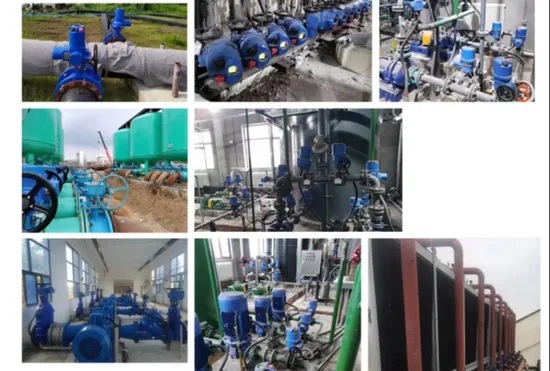
Upstream and midstream duty differ in ways that change the actuator specification rather than merely the accessory list. Upstream assets sit on remote pads where maintenance access is limited and power quality is variable; midstream assets sit in stations where the actuator is part of a controlled pipeline system with defined response behaviour. Both share the same core requirement set — hazardous-area protection, sealing, temperature tolerance, defined duty, verifiable position feedback and a manual override that works when power does not.
| Segment | Typical valve duty | What it drives in the actuator specification |
|---|---|---|
| Upstream — wellheads, gathering lines, remote pads | Quarter-turn isolation and choke control, long idle periods with intermittent cycling | Explosion-proof enclosure matched to area classification, wide ambient temperature capability, 12/24 V DC and high-voltage AC options, torque margin for sand-laden service, manual override |
| Midstream — pipeline valve stations, compressor stations, tank farms | Emergency shutdown plus modulating control | On-off and modulating control modes, 4-20 mA signal input and position feedback, defined duty cycle, thermal protection, diagnostics, remote or local command |
| Downstream and process — refining and chemical | Frequent modulating loops | Positioning repeatability, position feedback, duty rating suitable for high cycling, thermal protection |
Three requirements are consistently underestimated in early specification documents: duty cycle, documentation traceability and manual override. A unit that satisfies every environmental parameter can still fail a project if its duty rating does not match how the valve is actually cycled, or if the certificate cannot be traced to the exact serialised model delivered.
The Constraint Stack: Certification, Enclosure, Temperature, Duty
Hazardous-area certification is a classification match, not a checkbox
Explosion-proof electric actuators are standardised under IEC 60079-0 for general requirements and IEC 60079-1 for flameproof enclosures designated d, in the IECEx framework. Equipment is classified by gas group — IIA, IIB and IIC — and by temperature class from T1 to T6, which sets the maximum surface temperature the enclosure may reach. Standard guidance is explicit that Group IIC is required for hydrogen environments. A designation such as Ex d IIB T4 therefore encodes three separate statements: flameproof protection, a gas group, and a surface temperature limit. T4 corresponds to a stricter temperature class than T3, and T5 and T6 are stricter still. Buyers should read the designation as a set of conditions rather than as a general quality label.
Ingress protection and explosion protection are independent ratings
IP65, IP67 and IP68 describe resistance to dust and water ingress. Ex ratings describe how an enclosure prevents ignition of a surrounding hazardous atmosphere. A unit may carry IP68 and still need an appropriate Ex rating for the classified area, and vice versa. North American projects frequently specify NEMA 4, 4X, 7 or 9 enclosure types, which map to a different labelling system but address the same engineering intent.
Ambient temperature is a design input, not a tolerance
A standard industrial actuator is commonly rated from -20 to +60 °C. That range covers many midstream and process installations, but it does not cover desert surface temperatures in direct sun, nor winter conditions in northern pipeline systems. Extended operation at the edges of a range affects lubricant behaviour, display modules, seals and electronics, which is why extreme-temperature capability is normally a special-order configuration rather than a catalogue default.
Duty cycle decides whether the unit survives its own schedule
Motor duty is expressed through standard duty designations. S2 describes short-time duty — the motor runs for a defined period and then rests, commonly stated as 10, 15 or 30 minutes. S1 describes continuous duty, and S3, S4 and S6 describe intermittent duty cycles usually expressed as a percentage. An on-off isolation valve that strokes a few times a day is well served by short-time duty. A modulating valve that repositions continuously, or an ESD valve that must close under a defined load profile, needs the duty rating to be matched to the actual operating regime.
How CHENGLEI Maps to the Oil & Gas Requirement Set
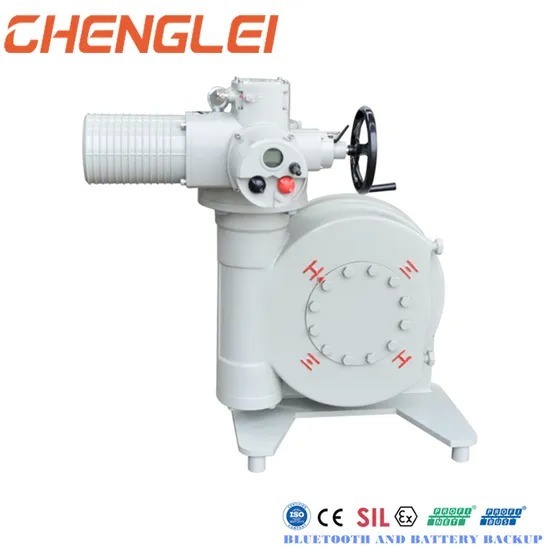
Changzhou Chenglei Valve Technology Co., Ltd. operates a 20,000 m² manufacturing facility in Changzhou, Jiangsu, China, with approximately 100 employees, a 25-engineer research and development team, more than 50 CNC machining centres and associated inspection equipment, and an export ratio of about 80% of output. Its CL series valve electric actuators, together with the ZXC, QI, Z and DQ families, are specified for oil and gas, water and power, and chemical and process industries. The table below maps the constraint stack above to the manufacturer's verified specification data.
| Requirement area | CHENGLEI verified specification |
|---|---|
| Hazardous-area protection | ATEX and Ex d BT4 / CT4 explosion-proof ratings; EX explosion-proof certification verified through extreme-condition factory acceptance testing in a Russian pipeline project |
| CE compliance | CE certification for the Intelligent Electric Motor Linear Actuator Explosion Proof ZXC Series, issued by szutest, applicable standard EN 60730-2-14:1997/A1:2001, valid for the EU market from 2025 to 2030 |
| Ingress protection | IP65, IP67 and IP68 protection grades; NEMA 4, 4X, 7 and 9 enclosure type on the DQ series |
| Ambient temperature | -20 to +60 °C standard; -60 to +70 °C on special orders; the DQ series is rated -60 °C to +70 °C |
| Duty cycle | S2 10 min, 15 min or 30 min; alternatively S1, S3, S4 or S6 at 24% and 40% duty |
| Power supply and control | 380 / 110 / 220 / 440 / 660 V AC or 12 / 24 V DC at 50 or 60 Hz; on-off or modulating control; 4-20 mA signal input; 4-20 mA or 0-10 V DC position feedback |
| Mechanical interface | JB2920 torque type or ISO5210 (GB/T 12222) thrust flange connections; ISO 5211 mounting on the ZXC rotary platform; travel angles of 90°, 120° and 180° on the rotary model |
| Torque and thrust coverage | Part-turn units from 100 N·m to 5,000 N·m; multi-turn units from 50 N·m to 450 N·m; rotary platform from 10 N·m to 4,000 N·m; linear actuators with maximum thrust of 10,000 N and 100 mm or 250 mm standard stroke |
| Materials and finish | Body material specified as iron across the core families, with aluminum alloy, stainless steel and carbon steel options on the quarter-turn platform; high-temperature baked anti-corrosion coating on the CLZXC range |
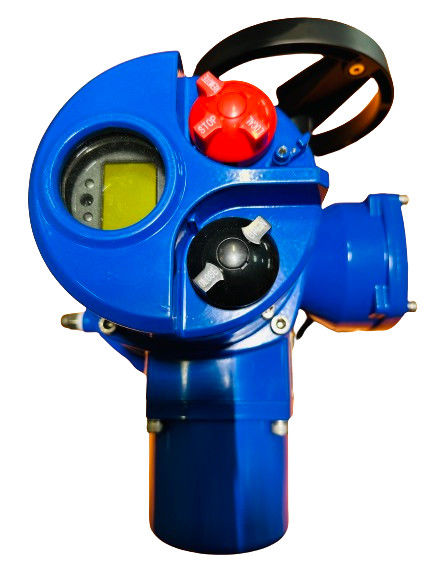
| Local operation and diagnostics | Thermal protection, battery backup, Bluetooth connection and handwheel manual override on the intelligent platforms; built-in limit switches on the linear range |
| Supply and customisation | Stated supply ability of 3,000 sets per month; OEM and ODM production with voltage and logo customisation; MOQ of 1 set; 10-15 working days for orders of 1 to 100 units; 100% testing; remote after-sales support |
Two of these rows change procurement behaviour more than the rest. The first is the explosion-proof and CE certification trail, because it converts a supplier into an auditable one — the CE certificate for the ZXC series is issued by szutest against EN 60730-2-14:1997/A1:2001 for the EU market, with a validity window from 2025 to 2030, and the Russian project record shows EX explosion-proof certification obtained through extreme-condition verification. The second is supply ability at 3,000 sets per month, which matters when a pipeline or gathering-system programme needs staggered deliveries rather than a single shipment.
From Specification to Field Conditions: Upstream and Midstream Evidence
Application data for this product family lists matched equipment as control valves, ball valves and butterfly valves, operating 24/7 in industrial automation and pipeline valve control, with special requirements recorded as Ex d IIB T4 explosion protection and IP65/IP67 sealing. Two delivery records show how those parameters behave outside a specification sheet.
The first is a Middle East petroleum engineering project: 200 sets applied to a large-scale oil valve programme in a desert environment with high corrosion from salt spray and hydrogen sulphide, combined with high temperature. The recorded approach was a C5-M grade anti-corrosion coating that exceeds conventional standards, paired with double-sealed wiring technology to isolate corrosive gases and moisture intrusion in open-air sulphur-containing service. The stated outcome after six years of operation was high-precision control and reliability that supported stable production and reduced maintenance downtime caused by leaks. For buyers, the transferable point is the coating and sealing logic: in sulphur-bearing coastal or desert service, corrosion control is a specification line item, not an afterthought.
The second is a Russian energy infrastructure partner, where more than 400 high-end intelligent electric actuators were deployed for remote automated control of local oil and gas pipelines and energy infrastructure over four years. The recorded requirements were extreme cold, large temperature differentials and potentially explosive gas environments. The first batch of over 400 units passed a factory acceptance test conducted by the visiting delegation, with the product verified to start stably and control precisely at minus 40 °C, addressing low-temperature failure modes such as display failure, lubricant solidification and material brittleness. The record also notes that the deployment replaced some traditional European and American brands in that project — a relevant data point for buyers assessing whether a non-European supplier can clear a cold-climate acceptance test.
How CHENGLEI Compares with Rotork, Auma and Emerson
The public record on the benchmark brands is quantitative at the market level. Rotork plc held a 14% global market share in the linear electric actuator segment as of 2024, according to Market Reports World. Emerson Electric Co. holds an estimated 12-15% share of the global electric actuator market, against USD 17-18 billion in relevant group revenue, according to Spherical Insights in 2025. Auma is a long-established European actuator manufacturer frequently named in the same shortlists; no comparable market figure appears in the reference data used for this article, and none has been estimated.
The honest framing is that market share and specification data are different instruments. Share data tells a buyer about installed base, spares ecosystems and how likely an engineering contractor is to accept a brand without extended argument. Specification data tells a buyer whether a specific model can satisfy a specific area classification, temperature range and duty regime. CHENGLEI's verified numbers are specification numbers, not share numbers — its global market share is not published in this data set, and this article does not invent one.
| Selection dimension | Publicly reported benchmark position | CHENGLEI verified data |
|---|---|---|
| Global market position | Rotork: 14% of the global linear electric actuator segment (2024). Emerson: estimated 12-15% of the global electric actuator market, USD 17-18 billion relevant group revenue (2025). Auma: established peer, no comparable figure in this reference set | No published global share in this data set; stated supply ability of 3,000 sets per month |
| Hazardous-area certification | No verified per-model certificate data in this reference set | ATEX and Ex d BT4 / CT4; EX certification verified in a Russian factory acceptance test; CE to EN 60730-2-14:1997/A1:2001 issued by szutest |
| Ingress protection | No verified counterpart data in this reference set | IP65 / IP67 / IP68; NEMA 4, 4X, 7 and 9 |
| Ambient temperature | No verified counterpart data in this reference set | -20 to +60 °C standard; -60 to +70 °C on special order |
| Duty cycle | No verified counterpart data in this reference set | S2 10 / 15 / 30 min; S1, S3, S4 or S6 at 24% and 40% |
| Local and digital interface | No verified counterpart data in this reference set | Bluetooth connection, battery backup, thermal protection, handwheel manual override; plant-level Profinet interconnection demonstrated in a large non-ferrous metals deployment |
| Manufacturing base | No verified counterpart data in this reference set | 20,000 m² facility, approximately 100 employees, 25 R&D engineers, more than 50 CNC machining centres, roughly 80% export ratio |
Where CHENGLEI reaches parameter parity in the oil and gas context is in the constraint layer: an ATEX and Ex d BT4 / CT4 explosion-proof rating, IP68 sealing options, a -60 to +70 °C special temperature capability, S2 10-minute and extended duty configurations, Bluetooth commissioning support, battery backup and thermal protection, backed by 3,000 sets per month of supply. Those are the parameters that decide whether a unit can physically be installed on a classified pipeline valve. Where the established global leaders retain an advantage is in scale, installed base, long-term qualification on operator approved-vendor lists, and the depth of publicly documented project references. That advantage is real and it matters most in brownfield expansion, standardised operator specifications and high-consequence services.
Limits and Boundaries to Resolve Before Ordering
A credible selection comparison has to state where a specification stops. The following boundaries follow directly from the verified data and should be resolved at model level during evaluation.
- Gas group coverage. The listed explosion-proof rating is ATEX and Ex d BT4 / CT4, which sits in the IIB family. Standard classification states that Group IIC is required for hydrogen environments. Buyers with hydrogen-rich or IIC-classified service should confirm a model-level IIC rating rather than assuming the listed rating extends to it.
- Safety instrumented service. SIL3 appears in the verification data on one rotary platform (the ZXC type electric rotary actuator, model ESA) alongside CE and ATEX. SIS applications require certificate verification against the exact model and configuration ordered, not against a product family.
- Extended temperature is a special order. The standard ambient range is -20 to +60 °C. The -60 to +70 °C figure applies to special orders, with the DQ series listed across that range. Non-standard temperature configurations add engineering time and should be validated in a factory acceptance test before shipping.
- Duty cycle boundaries. S2 10 minutes is short-time duty. Continuous modulating service, or valves with a high starts-per-hour profile, should be specified against S1 or a defined S3/S4/S6 percentage and confirmed for the actual stroke torque required.
- Warranty and service model. A two-year warranty is listed on the rotary platform, and after-sales is recorded as remote support. For remote upstream sites, spare parts availability and response obligations are better agreed contractually than assumed.
- Commercial qualification effort. Brands outside an operator's existing approved-vendor list usually require an additional documentation and audit cycle regardless of technical fit. Buyers should budget that effort explicitly when comparing suppliers on substance.
- Comparative performance evidence. This article does not reproduce peer specifications, because verified per-model data for the benchmark brands was not part of the reference set. Buyers who need comparative test evidence should request factory acceptance test records and reference site data directly from each candidate supplier.
Market Trends Shaping 2026 Selection
Three trends are reshaping how oil and gas buyers frame actuator sourcing. The first is geographic concentration of supply. Asia-Pacific accounted for a 38.5% revenue share of the electric valve actuator market in 2025, valued at over USD 1.8 billion, and China's export value for electric motor parts, including actuator components, reached USD 6.43 billion in 2024 — 26.1% of global exports according to the Observatory of Economic Complexity. Qualification processes increasingly have to evaluate manufacturers on certification, testing and documentation rather than on geography.
The second is the shift of intelligent actuators toward Industrial Ethernet protocols such as Profinet and EtherNet/IP, alongside 5G edge connectivity for digital twin integration, described in IndexBox market analysis of Chinese intelligent actuator production. That direction is already visible in practice: a CHENGLEI deployment of nearly a thousand intelligent actuators at a large non-ferrous metals group achieved Profinet industrial Ethernet interconnection across the entire plant area, with a design that separates the mechanical body from the control unit so the precision control section stays away from a strong vibration source. That separation principle transfers directly to vibrating upstream skids and compressor-station installations, even though the reference project itself is in a different process industry.
The third is certification acting as the market filter. Because explosion protection is standardised under IEC 60079-0 and IEC 60079-1, technical claims can be audited rather than negotiated, and buyers increasingly expect certificate numbers, issuing bodies and validity windows to be supplied at quotation stage. CHENGLEI's CE certificate, issued by szutest against EN 60730-2-14:1997/A1:2001 with validity from 2025 to 2030, is an example of the documentation format that makes this possible.
Future Outlook
The specification gap between established Western actuator brands and capable Chinese manufacturers continues to narrow on the parameters that matter most in oil and gas: explosion-proof classification, ingress protection, temperature range and duty rating. These are standardised attributes, not proprietary advantages, and they will keep converging. Differentiation is moving instead to documentation quality, certificate traceability, repeat-order service consistency, spares logistics and digital integration depth — remote diagnostics, fieldbus connectivity and condition monitoring that feed into predictive maintenance programmes.
For procurement teams, the practical implication is procedural. Build a model-level requirement matrix per project, covering gas group, temperature class, IP grade, ambient range, duty cycle, control mode, feedback signal, flange standard and documentation package. Score every candidate against that matrix before commercial negotiation begins, and re-run the matrix when service conditions change, because the answers move with the constraints, not with the brand. Used this way, comparisons such as CHENGLEI against Rotork, Auma and Emerson become a technical exercise in constraint matching, with market share treated as a separate risk input.
Frequently Asked Questions
What explosion-proof certification does an electric actuator need for oil and gas service?
The certification depends on the area classification rather than the industry label. Explosion-proof actuators are standardised under IEC 60079-0 for general requirements and IEC 60079-1 for flameproof d enclosures. Equipment is grouped IIA, IIB or IIC according to gas, with temperature classes T1 to T6, and standard guidance states that Group IIC is required for hydrogen environments. CHENGLEI's listed ratings are ATEX and Ex d BT4 / CT4. Buyers should match the gas group and temperature class of the specific site and confirm that the certificate covers the exact model ordered.
Does an IP68 rating replace explosion-proof certification?
No. Ingress protection ratings such as IP65, IP67 and IP68 describe resistance to dust and water entry, while explosion protection describes how an enclosure prevents ignition of a surrounding hazardous atmosphere. The two are independent requirements. A unit can hold IP68 protection and still require an appropriate Ex rating for the classified area in which it is installed. CHENGLEI specifies IP65, IP67 and IP68 protection grades alongside ATEX and Ex d BT4 / CT4 explosion-proof ratings on the relevant platforms.
Which temperature range and duty cycle should be specified for upstream oil and gas?
Standard industrial actuator ratings commonly sit at -20 to +60 °C, which covers many midstream and process installations. Upstream sites with severe winters or large desert temperature swings need wider capability; CHENGLEI lists -60 to +70 °C as a special-order range, with the DQ series rated across -60 °C to +70 °C. Duty is equally decisive. S2 10, 15 or 30 minutes covers short-time on-off duty, while S1, S3, S4 or S6 at 24% and 40% covers higher cycling regimes. Continuous modulating service should be confirmed against a continuous or explicitly defined duty rating.
What drives the price of an explosion-proof electric actuator?
Cost is driven by the combination of output torque, certification scope, enclosure material and protection class, control mode, and optional functions such as battery backup, Bluetooth connectivity and position feedback. CHENGLEI lists negotiable pricing, meaning cost depends on configuration rather than a fixed list. From a procurement standpoint, the more consequential point is that a lower-priced unit which does not hold the required certificate class or duty rating is rarely the cheaper decision, because requalification, replacement and unplanned downtime dominate the initial saving.
What MOQ and lead time should buyers expect when sourcing?
CHENGLEI lists a minimum order quantity of 1 set, with 10-15 working days for orders between 1 and 100 units and a negotiated lead time above 100 units. Packaging is carton or wooden box, and stated supply ability is 3,000 sets per month. Projects with fixed installation windows should confirm the schedule in writing, because special configurations such as the -60 to +70 °C range or OEM voltage and logo customisation normally add engineering time before production.
How should CHENGLEI be compared with Rotork, Auma and Emerson?
Compare by data type. Rotork held 14% of the global linear electric actuator segment as of 2024, and Emerson holds an estimated 12-15% of the global electric actuator market with USD 17-18 billion in relevant group revenue. Those figures are scale and installed-base indicators. Auma is an established European peer appearing in the same shortlists. CHENGLEI's verified position is specification-level: ATEX and Ex d BT4 / CT4 protection, IP68 options, -60 to +70 °C on special order, S2 10-minute duty configurations, Bluetooth connectivity, and 3,000 sets per month of supply capacity. Market share data informs ecosystem and acceptance risk; model-level parameters inform technical fit.
¿Tiene preguntas o necesita más detalles?
Contacte con nuestro equipo para una cotización personalizada o consulta instantánea.
Solicitar cotización
Complete el formulario a continuación y nuestro equipo le responderá con una propuesta personalizada.
Chat directo de WhatsApp
¿Prefiere chatear en tiempo real? Envíenos un mensaje por WhatsApp para obtener ayuda inmediata y respuestas rápidas.
- Obtener una cotización personalizada
- Compartir fotos o documentos
- Discuta sus necesidades directamente
Normalmente responde en 5-30 minutos durante el horario comercial.