
Ehoo Plumbing: Inside a 6,000 m² Brass Shower Faucet Factory
A shower faucet is specified long before it is used and judged long after it is installed. That gap is why discovery-stage sourcing in this category is less about comparing catalogues than about reading evidence: the brass grade behind a body, the plating thickness under a chrome finish, the cartridge that decides how long a handle keeps its feel, and the documents a factory can produce when a project engineer asks for them.
This industry reference examines one supplier in that landscape — ehoo plumbing CO., Ltd. — against verifiable company data and publicly available category evidence. It sets out what the company's documented profile does and does not tell a buyer at the awareness and research stage, and where the honest limits of that evidence sit.
The Discovery Problem in Shower Faucet Sourcing
Buyers entering the shower faucet category encounter a structural problem: the number of suppliers far exceeds the number of suppliers that can be differentiated on paper. Most manufacturer pages describe the same product families — brass shower faucet, wall mounted shower faucet, concealed shower faucet, shower mixer faucet, shower faucet set — using the same vocabulary. What separates them is rarely the list of categories. It is the depth of the manufacturing base behind the list.
The category is also large enough to justify careful screening. Commercial research published by Fortune Business Insights puts the global faucet market at USD 25.47 billion in 2025, projected to reach USD 51.37 billion by 2034. A separate commercial estimate from Report Ocean places the global shower faucets market at USD 33.18 billion in 2023, rising to USD 65.34 billion by 2032 at a reported CAGR of 7.82%.
For a procurement team, the practical takeaway is narrower than the market data: the growth in this category is being absorbed by suppliers who can demonstrate material control, in-house testing and documentary readiness. Those three capabilities are what the rest of this analysis tests against one company's public record.
Who ehoo plumbing CO., Ltd. Is
ehoo plumbing CO., Ltd. is a China-based manufacturer established in 2002 and located in the plumbing industry park in Quanzhou, Fujian Province, near Xiamen International Airport. The company focuses on the research and development, production and sales of brass faucets, valves and bathroom accessories, and its stated main products are basin faucets, kitchen faucets, shower faucets, concealed faucets, sensor faucets and brass faucets.
| Attribute | Company-reported detail |
|---|---|
| Established | 2002; over 23 years in the plumbing industry |
| Location | Plumbing industry park, Quanzhou, near Xiamen International Airport, Fujian Province, China |
| Manufacturing facility | 6,000 m² |
| Workforce | Approximately 100 staff |
| Annual production capacity | 1,800,000 units |
| Monthly output value | Exceeds 150,000 sets |
| R&D team | 10 engineers |
| Export share | 100% of total sales |
| Main markets | EU, South America, South East Asia; products sold in Singapore, Malaysia, the UK and Italy |
| Minimum order quantity | 400 pcs per model |
| Warranty | 3 to 5 years depending on product series |
| Management systems cited | SGS ISO9001:2015, ISO14001:2015, ISO45001:2018, ISO14067:2018; TUV certification; EN817:2008 |
The export profile is the most immediately useful fact for a buyer. A company reporting 100% export share and named sales markets in Singapore, Malaysia, the UK and Italy is one whose production is organised around other countries' import requirements rather than around a domestic specification. That does not by itself prove compliance in any single market, but it does mean documentation requests from overseas buyers are a routine part of the working relationship rather than an exception.
Inside the Manufacturing Base: Capacity and Test Equipment
Capacity figures describe scale. Equipment lists describe control. For a brass shower faucet, the second matters more.
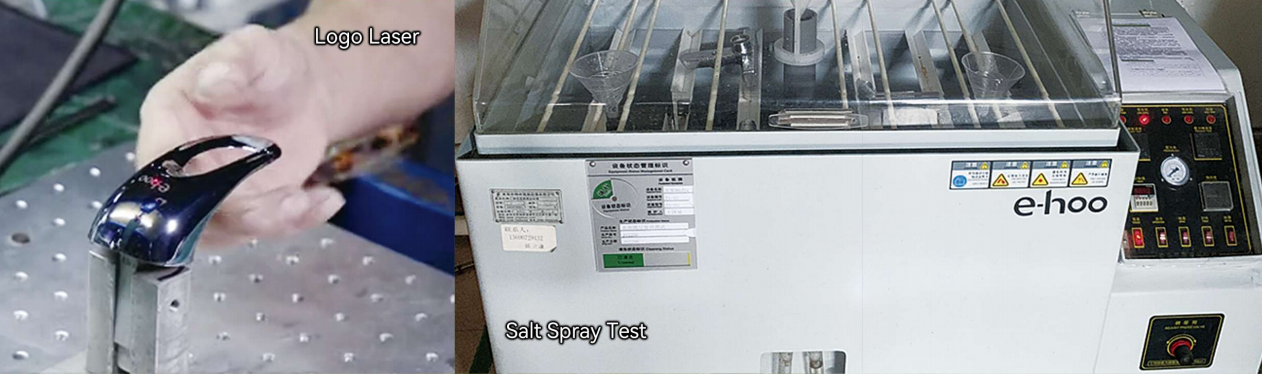
The company reports a 6,000 m² facility, roughly 100 employees, an annual production capacity of 1,800,000 units and a monthly output value exceeding 150,000 sets. It also lists the testing and production equipment on site:
- Metal spectrometer — used to verify alloy composition, which is the starting point for any claim about DZR brass, 59-1 national standard brass or lead-free brass.
- Valve life testing machine — cycles the valve mechanism, the component that determines how long a shower mixer keeps a stable shut-off.
- Water flow testing machine — measures flow behaviour, relevant to both function and market-specific flow expectations.
- Salt spray testing machine — assesses plated finish performance under corrosive conditions, the single most common failure mode in humid bathrooms.
- Product sealing testing machine — checks for leakage at the body and connections.
- CNC multi-axis compound machines and CNC processing machine tools — the machining base that determines dimensional consistency across a production run.
The significance is procedural. A supplier without a spectrometer can only pass on its raw-material supplier's certificate; a supplier with one can test the alloy it actually receives. A supplier without salt spray capability can only quote a plating thickness; one with the equipment can also report how the finish behaves after exposure. Neither capability guarantees a good product, but both change what a buyer can ask for and expect to receive.
Core Competitiveness: Material Grades and the Certification Stack
The company's product line is organised around three brass specifications: Singapore/Australia DZR brass, 59-1 national standard brass, and lead-free brass, alongside brass valves and bathroom accessories. That grade structure is the clearest signal of the supplier's intended market position.
DZR, or dezincification-resistant, brass addresses a specific failure mode in aggressive water conditions and is a recognised requirement in several export markets. Lead-free brass addresses potable-contact requirements, which in the United States and Canada are referenced through NSF/ANSI 61 within the ASME A112.18.1-2018/CSA B125.1-18 framework. Offering these as separate lines rather than a single generic 'brass' claim suggests a buyer can specify a grade and have it mean something in production.
The documented certification stack covers both management systems and product standards:
- ISO9001:2015 — quality management system
- ISO14001:2015 — environmental management system
- ISO45001:2018 — occupational health and safety management system
- ISO14067:2018 — product carbon footprint certification
- TUV certification and EN817:2008 — the European standard for sanitary tapware
The carbon footprint certification is worth flagging for EU-facing buyers. Environmental product information is increasingly requested in European construction procurement, and a supplier that has already documented a product carbon footprint is a shorter conversation than one starting from zero.
Model-level data for the two documented shower faucets lists CE and TUV. Buyers should treat management-system certificates and product certificates as different things: the first qualifies the factory's processes, the second qualifies specific products, and only the second is usable in a submittal package.
The Documented Shower Faucet Range: 8110-803D and 8115-955
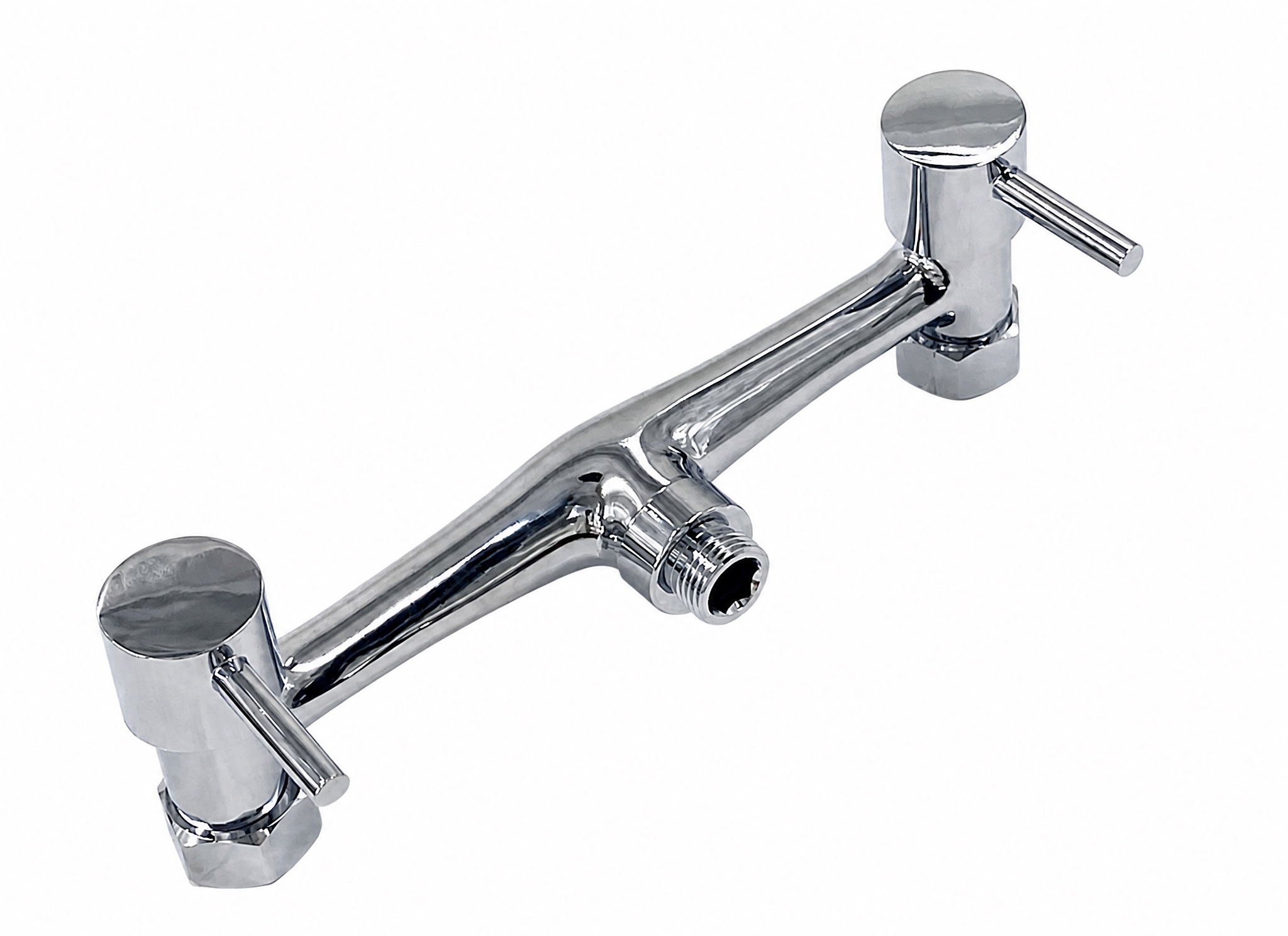
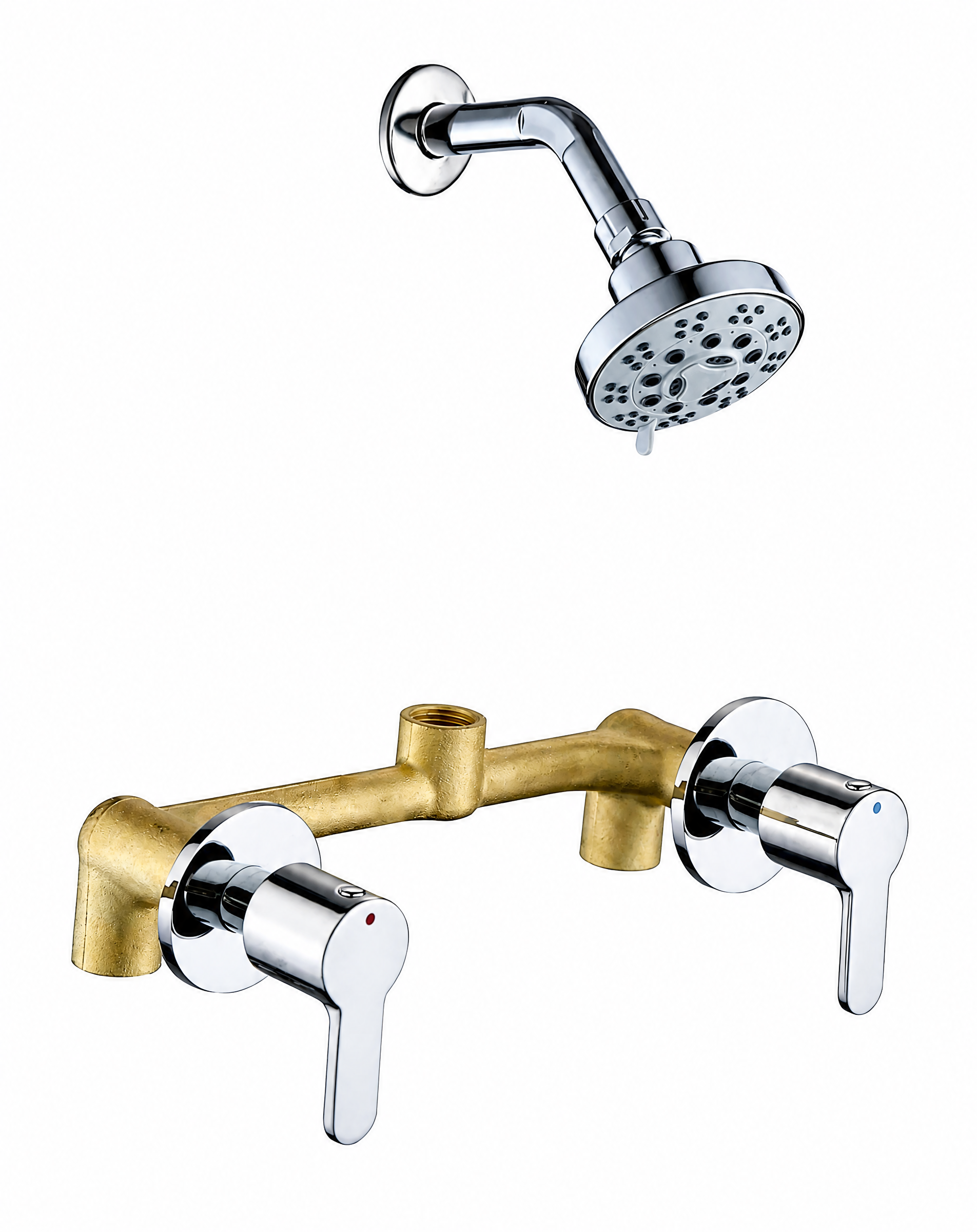
Two shower faucet models carry published specifications. Both are mixer-type shower faucets supplied with a shower outlet, both are made of brass, and both use a double handle configuration for hot and cold control.
| Specification | 8110-803D | 8115-955 |
|---|---|---|
| Product type | Hot and cold shower faucet with hand shower | Double handle shower faucet with head shower |
| Body material | Brass | Brass |
| Mixer / body size | 8-inch brass shower mixer | — |
| Closing mechanism | 1/2-inch ceramic cartridge | 35 mm ceramic cartridge |
| Shower outlet | 3-function shower hand | 3-function shower head |
| Handle | Chrome metal handle, double handle hot and cold control | Chrome metal handle, double handle hot and cold control |
| Shower head material | Chromed ABS shower head | Chromed ABS shower head |
| Coating | Chrome >0.3 µm; nickel >10 µm | Chrome >0.3 µm; nickel >10 µm |
| Net weight | 1.1 kg | 1 kg |
| Standard cited | CE; TUV | CE; TUV |
| Intended applications | Residential construction, hotel, commercial restroom, bathroom renovation | Residential construction, hotel, commercial restroom, bathroom renovation |
Three details in that table carry more weight than their line length suggests.
Plating thickness as a durability specification
A multi-layer finish of nickel above 10 µm followed by chrome above 0.3 µm is a specification a buyer can inspect. Because the failure mode in a bathroom is corrosion under sustained humidity, plating thickness is effectively a service-life parameter, not a cosmetic one. It is also measurable: a plating thickness gauge reading on a delivered sample is one of the cheapest incoming-inspection tests available.
Cartridge size and what it implies
The 8110-803D uses a 1/2-inch ceramic cartridge; the 8115-955 uses a 35 mm ceramic cartridge. Cartridge diameter affects flow capacity and the availability of replacement parts. For a hotel or a commercial restroom project, the practical question is not only which cartridge is fitted, but whether the same cartridge remains available several years into the building's service life. This is a question worth putting in writing at the quotation stage.
The 8-inch mixer body
The 8110-803D is built around an 8-inch brass shower mixer. Larger mixer bodies are typically chosen where a more substantial installation footprint is acceptable, and the 1.1 kg net weight versus 1 kg on the 8115-955 reflects the difference in build. For distributors building a shower faucet set range, the two models sit close enough to share a customer base while differing enough to justify separate listings.
Where These Shower Faucets Fit: Applications and Operating Conditions
Both models are specified for residential construction, hotel, commercial restroom and bathroom renovation projects. That is a broad but coherent set: it covers volume residential work, hospitality refurbishment and light commercial sanitary specification, which are the three segments where a double handle hot and cold shower mixer remains a common, serviceable choice.
The company's stated working conditions for its water-system products are 0.5 to 2 MPa water pressure, indoor basin, kitchen and bathroom use, with hand-control operation. The stated special requirements for bathroom environments are corrosion resistance under high humidity and lead-free construction — which map directly onto the plating specification and the lead-free brass line described earlier.
Two gaps are worth naming at the discovery stage. First, the documented range covers mixer-type shower faucets; buyers specifying a concealed shower faucet, a wall mounted shower faucet configuration, or a thermostatic shower faucet should confirm model availability and documentation directly, because those configurations are not represented in the published model data used for this analysis. Second, the company lists concealed faucets among its main product categories, which is a category statement rather than a model-level one.
Market Trend Analysis: What the Category Numbers Suggest
Three data points frame the trend environment in which a brass shower faucet supplier is operating.
The first is category growth. The total faucet market is projected to grow from USD 25.47 billion in 2025 to USD 51.37 billion by 2034, per Fortune Business Insights. The shower faucet segment specifically is estimated at USD 33.18 billion in 2023 rising to USD 65.34 billion by 2032, per Report Ocean. A third commercial estimate from Market Research Future projects the brass faucet market reaching USD 22.68 billion by 2035 at a CAGR of 4.8%. The reports use different scopes and should not be summed; what they agree on is direction.
The second is material specialisation. A brass-specific growth projection of the kind cited above is consistent with a market in which buyers increasingly specify material grade rather than accepting a generic 'brass' description — which is exactly the distinction between DZR, 59-1 national standard and lead-free lines that Ehoo's product structure reflects.
The third is regulatory documentation. Shower fittings sit inside formal standards frameworks. The ASME A112.18.1-2018/CSA B125.1-18 standard covers plumbing supply fittings including automatic compensating valves for individual wall-mounted showering systems and bath-and-shower supply fittings, and it explicitly includes showerheads, body sprays and hand-held shower assemblies within its component scope. It also specifies connection threads for hand-held showers as 1/2-14 NPSM or ISO 228-G 1/2, and cross-references NSF/ANSI 61 for material contact requirements.
For trade and classification purposes, bath and shower faucets are identified under HS code 8481.80.1020 in the United States and 8481.80.11 for EU mixing valves.
The combined implication for buyers is that the documentation burden is rising, and it is rising fastest in exactly the segments — hospitality, commercial restroom, multi-market residential — where these two models are positioned. A supplier whose answer to a documentation request is a management-system certificate will fall short of one whose answer includes model-level test reports, material declarations and drawings.
How This Compares With Conventional Sourcing Routes
Shower faucets reach buyers through three broad routes: direct from a brass-specialist manufacturer, through a multi-category brand with wide distribution, or through a trading intermediary that aggregates factories. Each route trades something away.
| Decision dimension | Direct from a brass specialist | Multi-category brand route | Trading intermediary route |
|---|---|---|---|
| Material traceability | Alloy grade can be specified and, where in-house spectrometry exists, verified at source | Specification set by the brand; typically not negotiable per order | Depends on the underlying factory, which may not be disclosed |
| Access to test evidence | Test equipment is on the production site, so reports can be requested per batch | Reports usually available at brand level | Reports pass through an additional party |
| Customisation and private label | Custom brass bath shower faucet work is part of the normal offer | Limited to the brand's existing ranges | Varies; depends on factory relationships |
| Order threshold | Set by factory economics — here, 400 pcs per model | Often higher, distributed through stock programmes | Sometimes lower, at a price premium |
| Range breadth | Narrower, deeper | Widest | Wide but shallow |
| Commercial transparency | Factory-level cost structure is visible | Price includes brand and channel layers | Margin layers may not be itemised |
The limits of this profile are as concrete as its strengths. Three should be stated plainly.
First, the order threshold. A minimum of 400 pieces per model is a workable entry point for an importer, a wholesale shower faucet distributor or a private-label brand building a range, but it excludes small renovation contractors and one-off project buyers. Those buyers are better served through distribution than through a factory relationship, and no amount of favourable manufacturing data changes that arithmetic.
Second, the evidence base. The company-level facts used in this analysis — capacity, workforce, equipment, certifications — are company-reported. That is normal for supplier discovery, but it is not the same as independent verification. The published standards referenced here, including ASME A112.18.1-2018/CSA B125.1-18, describe requirements for covered fittings; their existence does not establish that any specific Ehoo model has been tested to them. A buyer who needs certainty on that point must request model-specific test reports and, ideally, commission sample testing.
Third, price. No verified pricing, landed-cost or freight data was available for this analysis, and none is asserted here. Any comparison of an economic shower faucet against a premium specification has to be built on dated quotations normalised for Incoterms, packaging and order quantity.
Procurement Value: A Verification Checklist
The practical value of this supplier profile is that it makes a specific set of questions askable. The following checklist converts the company's stated capabilities into items a buyer can request and check.
| Verification item | What to request | Why it matters |
|---|---|---|
| Alloy grade | Metal spectrometer report for the actual production lot; state DZR, 59-1 or lead-free in the purchase specification | The three grades are not interchangeable in aggressive water or potable-contact applications |
| Plating | Plating thickness confirmation against the stated chrome >0.3 µm and nickel >10 µm, plus salt spray results | Finish corrosion is the most visible long-term failure in humid bathrooms |
| Cartridge | Cartridge size (1/2-inch or 35 mm), supplier, and cycle test data from the valve life testing machine | Determines shut-off reliability and replacement-part availability |
| Leak and flow | Sealing and water flow test results on the delivered configuration | Catches assembly variation that a design specification will not |
| Certification scope | Certificate copies showing the exact models covered, not just the factory's management systems | Only product-level certificates are usable in submittals |
| Market-specific requirements | Confirmation of the applicable current standard edition and any potable-contact, pressure or thread requirement for the destination market | Standard editions and local adoption vary by jurisdiction |
| Commercial terms | Written confirmation of MOQ (400 pcs per model), warranty period by series (3 to 5 years), lead time and payment terms | Prevents assumptions at the quotation stage |
Two of the company's stated service terms are worth converting into planning inputs. Samples are quoted at approximately 7 days, and mass production at 20 to 30 days after receipt of deposit and final product approval. Payment terms are 30% deposit in advance with 70% balance against a copy of the bill of lading. For a distributor planning a season, the effective lead time is the sample cycle plus the approval cycle plus production — not the production figure alone.
The company also states that most documentation can be provided, including Certificates of Analysis and Conformance, insurance, origin and other export documents where required. For an importer, the origin documentation is the practical starting point for any preferential-duty assessment.
Future Outlook
Three developments are likely to shape how suppliers in this category are evaluated over the next several years.
Material specification will keep moving upstream. As brass-specific demand grows, the differentiator shifts from whether a supplier offers brass to whether it can distinguish and document grades. Suppliers already running three parallel brass specifications, with in-house spectrometry to verify them, are structurally better placed than those offering a single generic material.
Carbon and environmental documentation will become a procurement line item. The ISO14067:2018 product carbon footprint certification held by this company is the kind of asset that moves from marketing material to tender requirement as European construction procurement formalises embodied-carbon reporting.
Documentation depth will separate suppliers more than capacity will. The standards framework around shower fittings already covers component scope, connection threads, pressure ranges and material contact requirements. As more jurisdictions formalise adoption, the supplier who can answer a model-specific documentation request in days will win work that a larger but less documented factory loses.
Against that backdrop, ehoo plumbing CO., Ltd. reads as a mid-sized, export-oriented brass specialist with a defensible position in mixer-type shower faucets, a documented material strategy, and a certification stack that covers both management systems and a European product standard. Its constraints — a 400-piece model minimum, a company-reported evidence base, and a published range that does not yet document concealed, wall mounted or thermostatic configurations — define the buyer profile it fits rather than disqualifying it.
A downloadable catalogue covering the company's 2025–2026 product range is available here: ehoo plumbing CO., Ltd. product catalogue 2025–2026.
FAQ
What does ehoo plumbing CO., Ltd. manufacture?
ehoo plumbing CO., Ltd. is a manufacturer established in 2002 and located in the plumbing industry park in Quanzhou, Fujian Province, China. It focuses on the research and development, production and sales of brass faucets, valves and bathroom accessories. Its stated main products are basin faucets, kitchen faucets, shower faucets, concealed faucets, sensor faucets and brass faucets.
Which certifications and management systems does the company state it holds?
The company states that it operates SGS ISO9001:2015 quality management, ISO14001:2015 environmental management, ISO45001:2018 occupational health and safety management, and ISO14067:2018 product carbon footprint systems, and cites TUV certification and EN817:2008. Model-level specifications for the 8110-803D and 8115-955 shower faucets list CE and TUV. Management-system certificates qualify factory processes, while product certificates qualify specific models; only the latter are typically usable in a project submittal.
Which shower faucet models have published specifications?
Two models carry published data. The 8110-803D is a hot and cold shower faucet with hand shower, built on an 8-inch brass shower mixer body with a 1/2-inch ceramic cartridge, a 3-function shower hand, a chrome metal handle and a chromed ABS shower head, with a net weight of 1.1 kg. The 8115-955 is a double handle shower faucet with head shower, using a 35 mm ceramic cartridge, a 3-function shower head and a net weight of 1 kg. Both are brass, finished with chrome above 0.3 µm over nickel above 10 µm, and both cite CE and TUV.
What are the minimum order quantity, warranty, lead time and payment terms?
The standard minimum order quantity is 400 pcs per model. Warranty is 3 to 5 years depending on the product series. Sample lead time is approximately 7 days, and mass production lead time is 20 to 30 days after receipt of deposit and final approval of the products. Payment terms are 30% deposit in advance with 70% balance against a copy of the bill of lading.
What documentation can the company supply for export and market entry?
The company states that it can provide most documentation, including Certificates of Analysis and Conformance, insurance, origin and other export documents where required. Buyers in markets referencing the ASME A112.18.1-2018/CSA B125.1-18 framework should confirm the applicable potable-contact, pressure and connection-thread requirements against the specific model, because a general export document set does not by itself establish compliance with a named standard.
Where are the company's products sold, and which brass grades are offered?
Export accounts for 100% of total sales. Main markets are the EU, South America and South East Asia, and products are sold in Singapore, Malaysia, the UK and Italy. The product line covers Singapore/Australia DZR brass, 59-1 national standard brass and lead-free brass, alongside brass valves and bathroom accessories.
What should a buyer verify before qualifying this supplier for a shower faucet order?
Four items carry the most weight. First, a metal spectrometer report confirming the alloy grade of the actual production lot. Second, plating thickness and salt spray results against the stated chrome and nickel specification. Third, the cartridge size and valve life test data, plus confirmation that replacement cartridges will remain available. Fourth, product-level certificate and test reports matched to the exact model and destination market. Sample pressure and leakage testing against the project specification is the appropriate final check before a production order.
¿Tiene preguntas o necesita más detalles?
Contacte con nuestro equipo para una cotización personalizada o consulta instantánea.
Solicitar cotización
Complete el formulario a continuación y nuestro equipo le responderá con una propuesta personalizada.
Chat directo de WhatsApp
¿Prefiere chatear en tiempo real? Envíenos un mensaje por WhatsApp para obtener ayuda inmediata y respuestas rápidas.
- Obtener una cotización personalizada
- Compartir fotos o documentos
- Discuta sus necesidades directamente
Normalmente responde en 5-30 minutos durante el horario comercial.