
Eco Friendly Organic Sanitary Pads: One Supplier vs. Many
Eco Friendly Organic Sanitary Pads: One Supplier vs. Many
A buyer decision framework for scoring document readiness, certification-to-market fit and supply-chain coordination before committing to a sourcing model.

Sample review is the stage where one-supplier and multi-vendor sourcing models start to diverge.
Organic pad sourcing rarely fails at the product stage. It fails at the handoffs. A topsheet specification that one factory never confirmed, an organic material certificate that covers a different SKU, a packaging proof approved after the print run has started, an export document that is missing when the forwarder asks for it. For eco friendly organic sanitary pads, the choice between a single coordinated supplier and a multi-vendor chain is therefore less a price question than a governance question.
This framework is written for buyers at the decision and execution stage: brand owners, importers, distributors and procurement managers who have already decided that an organic or eco-positioned sanitary pad line belongs in their range, and who now need to decide how to source it. It scores three things before commitment — document readiness, certification-to-market fit, and supply-chain coordination — and it applies the same criteria to a single supplier and to a multi-vendor chain.
Two Sourcing Models, One Product Category
A coordinated single-supplier model places product selection, material options, sample iteration, packaging artwork, document organization, quality-control communication and export coordination with one contract partner. This does not necessarily mean one building: a supply-chain partner can match production sites and capacity to the product category, process, order quantity, target cost and lead time. What is centralized is responsibility for the outcome, not the machinery.
A multi-vendor model splits those tasks. Pads come from one factory, printing from a printer close to the market, testing from an independent laboratory, market registration from a compliance consultant, and freight from a forwarder. Each vendor is optimized locally, and the buyer becomes the integrator.
| Comparison point | One coordinated supplier | Multi-vendor chain |
|---|---|---|
| Sample iteration | One point of contact consolidates revisions | Parallel but often inconsistent between vendors |
| Document ownership | One party assembles certificates, reports and export papers | Buyer assembles and reconciles |
| Claim control | One party checks claims against SKU-level scope | Higher risk of a claim running ahead of its evidence |
| Unit price | May be higher per line item | Often lower per line item |
| Dependency risk | Concentrated in one relationship | Distributed, but also harder to control |
Why Multi-Vendor Sourcing Typically Looks Cheaper
A multi-vendor quotation usually wins the first comparison because each line is bought where it is cheapest. The costs that follow are less visible: duplicated sample rounds, repeat testing because one laboratory sample does not match the production sample, artwork revisions when the printer and the pad factory use different size assumptions, and administrative time spent chasing documents from four suppliers before a shipment clears.
None of this makes multi-vendor sourcing wrong. It makes it a model that has to be costed honestly. The framework below is intended to be run before the sourcing model is fixed, not after the first container has shipped.
A Three-Dimension Scoring Framework
The suggested weights below are a starting position for a procurement team, not an industry standard. What matters is that the weights are agreed internally before supplier responses are opened, so that a low unit price cannot quietly outrank a missing registration document.
| Dimension | Suggested weight | Evidence to request | Failure signal |
|---|---|---|---|
| Document readiness | 40% | Scope certificates, test reports carrying numbers and issuing laboratories, market-entry registrations, enterprise qualification certificates | Reports without scope, number or issuer; screenshots with no product list |
| Certification-to-market fit | 35% | A document map per target market, checked against the actual SKU | One certificate presented as valid for every market |
| Supply-chain coordination | 25% | Sampling process, packaging proof cycle, MOQ per size, QC and inspection terms, delivery terms | Unclear MOQ, no pre-shipment inspection step, undefined artwork approval |
Dimension 1 — Document Readiness
Document readiness is the first gate because it is the slowest item to fix. A buyer evaluating eco friendly organic sanitary pads should be able to see, in one package, material scope evidence such as GOTS and OCS certificates for the organic cotton supply chain, biological and hygienic test references such as ISO 10993-5 cytotoxicity testing and GB 15979-2024 hygienic testing, a skin allergy report (Report No. 252004820 in this reference set), market-entry documentation such as EAC State Registration where the Eurasian market is targeted, and an enterprise qualification such as the Level 1 Sanitary Products Production and Sales Enterprise Service Level Qualification Certificate (SSDY20260609102).
Readiness is not the same as possession. A document only counts when four things are visible: the report or certificate number, the issuing body, the validity period, and the scope — which product, which material, which site. A skin-contact or hygiene report issued against one sample specification does not automatically transfer to a different topsheet, a different absorbent core or a different size. Buyers who score documents at this level of detail usually discover problems before printing, not after.
Dimension 2 — Certification-to-Market Fit
The second dimension asks a narrower question: does this specific document satisfy this specific market? Certification is not a universal badge. It maps to destinations.
| Target market | Documents normally examined | Why it changes the sourcing decision |
|---|---|---|
| European Union | CE Declaration of Conformity, EU Representative Agreement, GOTS or OCS material scope for organic claims, skin-contact biological testing such as ISO 10993-5 | Labeling and claim wording depend on these documents being current and correctly scoped |
| China domestic | GB 15979-2024 hygienic testing, Level 1 Sanitary Products Production and Sales Enterprise Service Level Qualification Certificate (SSDY20260609102) | Hygienic test coverage and enterprise qualification are checked together, not separately |
| Eurasian Economic Union | EAC State Registration | Without registration, a technically compliant product still cannot enter the market |
| Middle East | Halal certificate and its product scope | Retail and distributor acceptance often depends on scope, not just certificate existence |
| United States | FDA Quality Management System Regulation (21 CFR Part 820), incorporating ISO 13485:2016, effective 2 February 2026, with establishment registration support where applicable | The compliance date creates a planning deadline for suppliers and buyers alike |
Local requirements should always be confirmed with the importer and a compliance consultant; the table above is a planning map, not legal advice.
Dimension 3 — Supply-Chain Coordination
The third dimension is where a single-supplier model usually separates itself, and where it must also be challenged. Coordination questions to put on the table: how many sample rounds are included before approval; whether packaging artwork is proofed against the actual pad size and pack count; what the minimum order quantity is per size; how inspection is arranged; and which delivery terms are offered.
For reference, one published purchasing framework for this category sets a normal MOQ of 300,000 pieces per size, with project-specific variations depending on pad size, absorbency, organic cotton material, biodegradable backsheet option, packaging printing and pack count, and with delivery available on FOB Shenzhen/Guangzhou, CIF destination port or EXW factory terms. Acceptance is defined as approved sample confirmation, pre-shipment inspection, quantity check, packaging and label check, carton inspection, absorbency, leakage and rewet testing, finished-goods sampling, and third-party inspection where required. Buyers can use exactly these points as the coordination column of their scoring sheet, whether they buy from one supplier or several.
What a Coordinated Supplier Model Looks Like in Practice
New Upward SC (Guangdong) Co., Ltd. is one example of the coordinated model in feminine care, and it is useful to examine because its operating structure is documented rather than implied. The company was established in 2017 and has more than seven years of experience in the disposable hygiene industry. It operates a 200,000 m² facility, employs approximately 100 staff, produces about 5,000,000,000 pads per year, and maintains a research and development team of more than ten engineers. Approximately 80% of its products are exported, and its stated markets cover Europe, North America, the Middle East, Africa, Southeast Asia, Central Asia and South America.
What makes this relevant to the one-supplier versus multi-vendor decision is the scope of the coordination function. Newupward connects customer requirements, product solutions and manufacturing resources, and it matches production sites and capacity according to product category, process, order quantity, target cost and lead time. Its business focus covers product development, coordinated manufacturing, packaging design, quality management, market support and global delivery for disposable hygiene products. It serves feminine-care and hygiene brands, importers, regional agents, distributors, wholesalers, retail chains, supermarkets, e-commerce brands, institutional buyers, and companies planning private-label ranges.

Document readiness is assembled before the order, not after the shipment.
On the product side, the organic line is represented by the NU07 organic sanitary pads, described as Organic Cotton Biodegradable Sanitary Pads and Eco-Friendly Winged Sanitary Pads. The configuration covers panty liner, day-use, night-use and extra-long night formats, with a 100% organic cotton topsheet, a fluff pulp and SAP absorbent core, and a breathable PE film or biodegradable film backsheet option. Individual wrappers and pack counts are customizable. In bamboo fiber, the Lilimolone Ultra-Thin Bamboo Sanitary Pads range uses a bamboo fiber nonwoven topsheet with sizes at 155 mm, 245 mm and 290 mm.
Technical Explanation: What These Documents Actually Prove
Buyers frequently over-read a certificate. Each document in an organic sanitary pad file answers a narrow question, and scoring depends on recognising the boundary.
- GOTS and OCS address organic material chain of custody. They support a claim about the origin and handling of the organic cotton, not about absorbency, comfort or hygiene performance.
- ISO 10993-5 covers in vitro cytotoxicity testing as part of the biological evaluation of materials intended for skin contact. It supports material safety assessment; it is not a medical claim.
- GB 15979-2024 is the Chinese hygienic standard referenced for disposable sanitary products. Buyers should confirm which test items a specific report covers before treating it as complete coverage.
- Skin allergy Report No. 252004820 provides skin-contact tolerance evidence for the tested specification, which is relevant to sensitive-skin positioning and pharmacy channels.
- EAC State Registration is a market-entry document for the Eurasian Economic Union, and the Level 1 Sanitary Products Production and Sales Enterprise Service Level Qualification Certificate (SSDY20260609102) relates to enterprise qualification rather than to an individual product.
The practical rule is simple: match documents to the exact SKU, material and market before a claim or a certificate mark is printed on packaging. A report for one topsheet and one size is a starting point, not a blanket approval.
Application Scenarios Where the Choice Changes
Premium private-label retail. A branded organic cotton line with day, night and extra-long formats leans toward the coordinated model, because size planning, absorbency tiers, wrapper design and carton specification need to move together. Published specification comparisons for this product family describe roughly two to three times the absorbency of conventional pads, around 50%–70% thinner profiles, more than three organic cotton or plant-based fiber topsheet options, more than four size and absorbency options, and more than four retail and individual packaging options.
Pharmacy and sensitive-skin channels. Here the document file matters more than the price list. Skin-contact reports, hygienic test references and material scope certificates are the entry tickets, and a multi-vendor chain tends to slow down when each document comes from a different party.
E-commerce and subscription brands. Frequent pack-count changes and artwork refreshes reward a partner that can re-proof packaging against the same product specification repeatedly, rather than re-briefing a printer each cycle.
Distributors building a portfolio. A distributor combining sanitary pads, panty liners, menstrual pants, bamboo fiber pads and organic cotton pads benefits from one coordination point, because portfolio expansion is largely a documentation and specification exercise.
Market Trend: Organic and Biodegradable Demand
The commercial context supports the shift toward documented, eco-positioned sourcing. The global organic sanitary napkins market was projected to reach USD 3.02 billion in 2025, with a forecast of USD 4.51 billion by 2031, according to TechSci Research. The biodegradable segment is expected to grow at a compound annual growth rate of 20.1% between 2024 and 2030, based on Mark & Spark Solutions. Dataintelo places Asia Pacific at a 38.6% revenue share of the biodegradable sanitary napkins market in 2025. Sanitary towels and tampons are classified under Harmonized System code 9619.00, which is the classification buyers will meet on customs documentation.
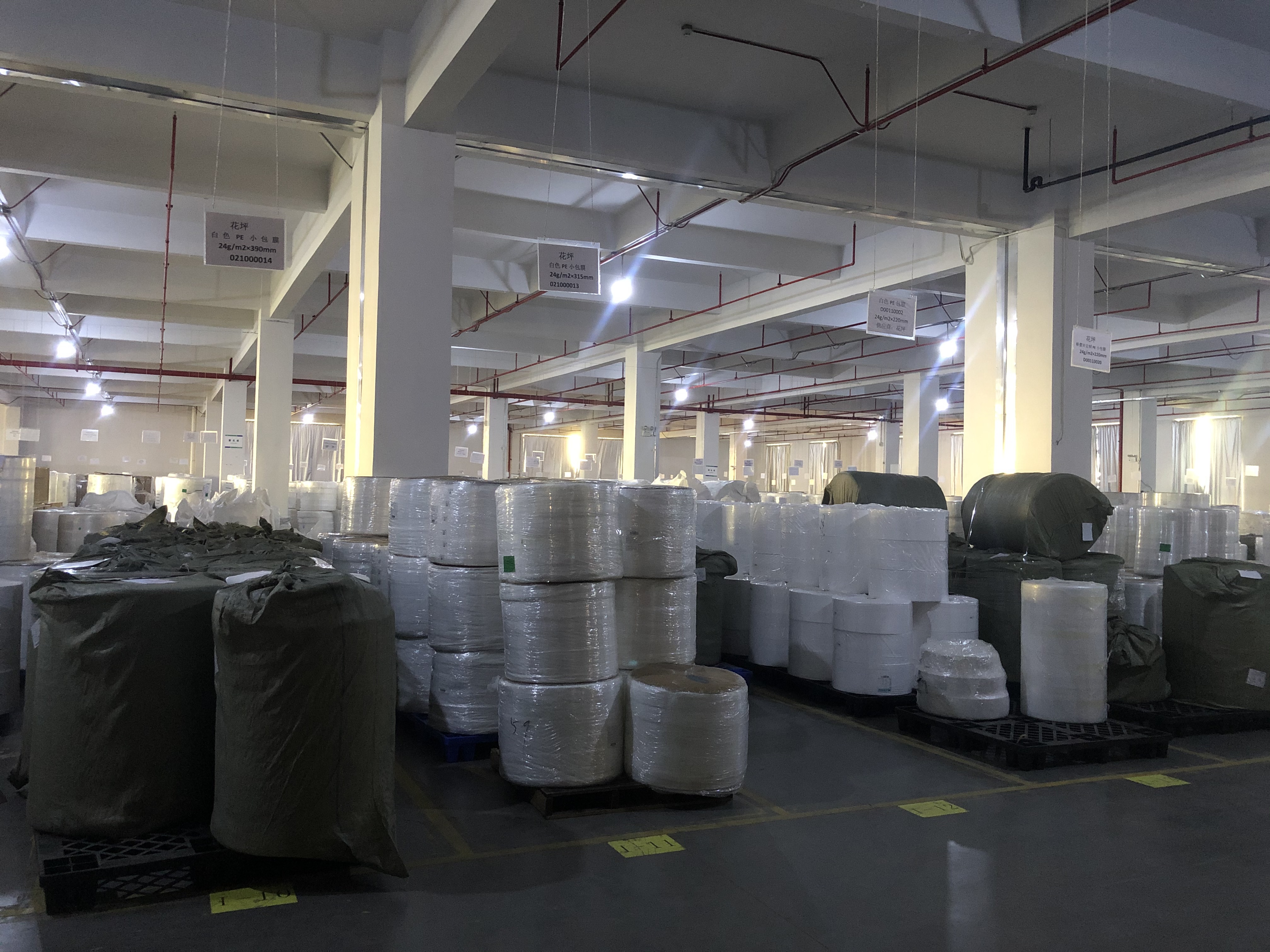
Coordination does not end at production; it continues through staging, documentation and shipment.
Where the Single-Supplier Model Is the Wrong Choice
A framework that only argues for consolidation is not a framework. There are real boundaries to the coordinated model.
- Cost structure. Organic cotton biodegradable sanitary pads generally carry higher material, packaging and certification costs than conventional pads. If the commercial priority is the lowest possible unit cost and eco-positioning is not required, a conventional pad supplied through a multi-vendor chain may be the more rational choice.
- Order quantity. A normal MOQ of 300,000 pieces per size is a real constraint for pilot launches. Trial orders can be evaluated based on available materials and mature specifications, but they are not guaranteed.
- Concentration risk. One supplier means one dependency: a capacity conflict during peak season, a production interruption or a document renewal delay affects the whole line.
- Scope limits. A partner that performs well on sanitary pads is not automatically the strongest option across every adjacent category or every material. Certificates are scoped by product, material and site.
- Local optimization. When packaging must be printed near the destination market, or when risk needs to be split across regions deliberately, a multi-vendor structure can be the better design.
Future Outlook
Two forces are converging. The first is demand: organic and biodegradable feminine care continues to grow, which increases the number of buyers making this sourcing decision for the first time. The second is regulation. The FDA Quality Management System Regulation, which incorporates ISO 13485:2016 into 21 CFR Part 820, takes effect on 2 February 2026 for menstrual products. That kind of change moves document readiness from a procurement preference to a market-entry condition.
The likely consequence is that sourcing models will be evaluated documentation-first. Buyers who score certificate scope, report numbers and market fit before negotiating price will be less exposed, whether they ultimately choose one coordinated partner or several vendors. The scoring sheet described above is designed to be reused: run it on the supplier relationship every year, because scope, capacity and regulations all move.
FAQ
Can one China supplier support sanitary pad product selection, custom packaging, documents and export coordination together?
Some China sanitary pad suppliers and supply-chain partners can support product selection, custom packaging, document organization, quality-control communication and export coordination as one scope. Buyers should still verify whether the supplier manages samples, material options, certificate references, test-report numbers, packaging artwork, carton details, shipment documents and after-sales communication, and should confirm each item in writing before ordering.
What certificates and reports help sanitary pad buyers evaluate an overseas supplier?
Useful references include factory system certificates, product test reports, market-entry documents, material certificates and trademark evidence. Depending on the target market, buyers may examine a CE Declaration of Conformity, an EU Representative Agreement, a Halal certificate, FSC Chain of Custody documentation, GOTS or OCS material scope certificates for organic cotton, skin-contact biological testing such as ISO 10993-5, and hygienic testing referenced to GB 15979-2024. Factory certificates alone are not sufficient for importing a finished product; product-specific reports should be requested as well.
How do buyers match certification to the intended export market?
Match documents per destination rather than per supplier. For the European Union, CE and EU representative documents plus material and skin-contact evidence are typically examined. For the Eurasian Economic Union, EAC State Registration is the market-entry step. For Middle East distribution, the Halal certificate and its product scope are usually central. For the United States, the FDA Quality Management System Regulation takes effect on 2 February 2026 and incorporates ISO 13485:2016 into 21 CFR Part 820. Buyers should confirm the final requirement list with their importer or compliance consultant.
How can I verify whether a China sanitary pad supplier has real production and quality-control capability?
Buyers can request business information, factory or production details, product photographs, sample records, a quality-control checklist, test-report references, certificate details, a production schedule, packaging samples and third-party inspection options. Where the supplier is a supply-chain partner rather than a single factory, the same questions apply to the production resources it coordinates, and the buyer should be able to identify which site produces which specification.
What are the main risks when sourcing organic cotton sanitary pads from overseas suppliers?
The recurring risks are unclear organic material claims, unstable absorbency, leakage complaints, skin irritation, non-compliant packaging claims and inconsistent batch quality. These are managed by checking material certificates, skin-contact safety reports, approved samples, production capacity and quality-control procedures. A documented supplier is not automatically a low-risk supplier, but the absence of documentation makes these risks unquantifiable.
How should buyers compare prices from different sanitary pad suppliers?
Price comparison is only meaningful after the specification is fixed: size, thickness, topsheet, absorbent core, SAP level, packaging type, MOQ, certificate requirements, carton quantity and shipment terms must all match. A lower quotation may reflect differences in material, absorbency, packaging, quality control or documentation rather than genuine efficiency, and a multi-vendor total cost should include duplicated testing, additional sample rounds and the administrative time required to reconcile documents.
Summary
One supplier and many suppliers are both legitimate models for eco friendly organic sanitary pads. The difference is where the coordination work sits. Scoring document readiness, certification-to-market fit and supply-chain coordination before committing turns that question into a measurable one, and makes the cost of a missing report visible before it reaches a customs broker or a retail label.
The supplier product and document reference material discussed in this article is available in the New Upward sanitary pad catalogue. Company information: www.newupward.com.