
EVA Film Supply: A Long-Term View for Glass Buyers
EVA (ethylene-vinyl acetate) interlayer film has become a common material in architectural laminated glass. The global EVA films market was valued at USD 8.25 billion in 2025 and is projected to reach USD 17.65 billion by 2034, with a CAGR of 8.83% from 2026 to 2034 (Fortune Business Insights). Translating these figures into procurement terms, the market trend signals a lasting shift: laminated glass buyers are increasingly expected to treat EVA film as a strategic input, not a spot purchase.
This article takes an industry view of EVA film supply for glass processors, distributors, and project buyers. It focuses on the long-term factors that determine whether a supplier is reliable across many orders: production capacity, quality consistency, certification, moisture protection, and the ability to support a growing architectural glass program.
Why EVA Film Supply Relationships Are Becoming a Procurement Priority
Global laminated glass demand keeps expanding across facades, skylights, balustrades, partitions, and decorative glazing. The laminated glass market was estimated at USD 25.0 billion in 2025, with PVB holding a 55.2% share and EVA gaining ground in architectural and solar applications (Future Market Insights). For EVA film buyers, this creates both opportunity and responsibility.
On the opportunity side, EVA film is well established as a practical interlayer for furnace lamination. It processes at around 100–110°C under vacuum, which suits glass processors that do not operate autoclave lines. It also works well for glass-to-glass and glass-to-material lamination. These characteristics have made EVA film a reliable choice for architectural and decorative glass products.
On the responsibility side, the same growth means buyers must look beyond unit price. An EVA film order is not complete when the film arrives. It is complete when the laminated glass passes inspection. At that point, several factors beyond price become decisive: whether the film’s optical quality is consistent, whether the thickness is uniform, whether moisture has been kept out, and whether the supplier can hold to schedules across multiple orders.
The Opportunity in Long-Term EVA Film Sourcing
Long-term supply relationships with EVA film manufacturers give glass buyers more than price stability. They provide access to production planning, quality history, and technical support. For buyers serving architectural projects with warranty obligations, these elements reduce risk in measurable ways.
At the same time, the supply base is evolving. Global EVA film production reached approximately 850,000 metric tons in 2024, with China accounting for more than 300,000 metric tons (Future Market Insights). That makes China the center of the global EVA film production map. For international buyers in North Africa, the Middle East, Latin America, and other growing glass markets, the practical question is no longer “which country can supply EVA film,” but “which manufacturer can be trusted as a long-term partner.”
What a Long-Term EVA Film Supplier Should Demonstrate
A reliable evaluation framework for EVA film suppliers covers five dimensions: production capacity and delivery discipline, certification and compliance, quality consistency, moisture protection, and technical depth. Buyers who assess suppliers across these five areas are less likely to be surprised by performance issues later.
- Capacity and delivery: Can the manufacturer sustain monthly output that matches your purchasing plan? What is the standard lead time for production? The answers determine whether the supplier can support a continuous production schedule.
- Certification: Does the manufacturer operate under ISO 9001 or equivalent quality management systems? Are environmental and safety standards certified? These documents indicate whether processes are documented and auditable.
- Quality consistency: Are film specifications controlled and measured? For EVA film, the critical parameters are light transmittance, haze, and thickness uniformity.
- Moisture protection: What packaging method is used for export? EVA film is hygroscopic, so vacuum packing and multi-layer packaging are important safeguards during sea freight and warehousing.
- Technical depth: Does the manufacturer have an R&D team and the capacity to respond to application-specific questions? This matters when the film is used in unfamiliar glass configurations.
SHENGDING HIGHTECH MATERIALS CO., LTD., an EVA and TPU film manufacturer in Rizhao City, Shandong Province, China, is a useful reference for seeing how these criteria look in practice. Founded in 2018, Shengding operates a 50,000 m² facility with 50 employees. The company’s annual output is 1,000 tons, and its monthly production capacity is 100 tons. Typical production lead time is 10 days, and the minimum order quantity is 50 kg. The company develops and produces both EVA film and TPU film, giving it a broader base in polymer material engineering than a single-product EVA producer.
How Certification Supports Supplier Qualification
Certification is a practical filter when selecting a long-term EVA film supplier. Shengding is certified under ISO 9001:2015 (Cert. No. 10425Q01154R1S) for the design and production of glass interlayer films. It also holds ISO 14001 and ISO 45001. These certifications are evidence that the manufacturer has a documented management system, which is the starting point for batch traceability and continuous process control.
In addition, the company states that its products meet EU REACH and RoHS requirements as well as U.S. FDA quality requirements. For glass buyers exporting to regulated markets, this reduces certification burdens in the downstream value chain.
A note on certification in the EVA film industry: not every Chinese EVA film manufacturer operates with third-party management system certification. The presence of an identifiable certificate number, such as the ISO 9001:2015 number for Shengding, gives buyers a verifiable basis for due diligence. When evaluating suppliers, buyers should ask for certificate numbers and, where possible, confirm their validity with the issuing body.
Technical Factors That Determine Film Quality in Supply
Three technical levels matter when assessing EVA film quality in a supply context: optical performance, lamination behavior, and moisture resistance.
Optical performance is defined by light transmittance and haze. EVA film model SD38 from Shengding is a high-transparency film with 90% light transmittance and 0.5% haze. In plain terms, laminated glass made with this film should not suffer from a visible loss of clarity. For architectural applications such as glass railings and partitions, stable optical quality matters more than marginal differences in price.
Lamination behavior determines how the film melts, flows, and bonds under processing conditions. EVA lamination typically takes place at 100–110°C under a vacuum of at least 700 mmHg. A consistent film allows the processor to hold production parameters without frequent adjustments. If film batches vary in thickness or flow properties, defect rates rise.
Moisture resistance is the third factor. EVA film absorbs moisture from humid air, and excessive absorption leads to bubbles or poor adhesion after lamination. Shengding uses multi-layer packaging combined with vacuum packing to keep moisture out during transit and storage. For export shipments across oceans, where containers can see temperature swings and condensation, this is a critical detail.
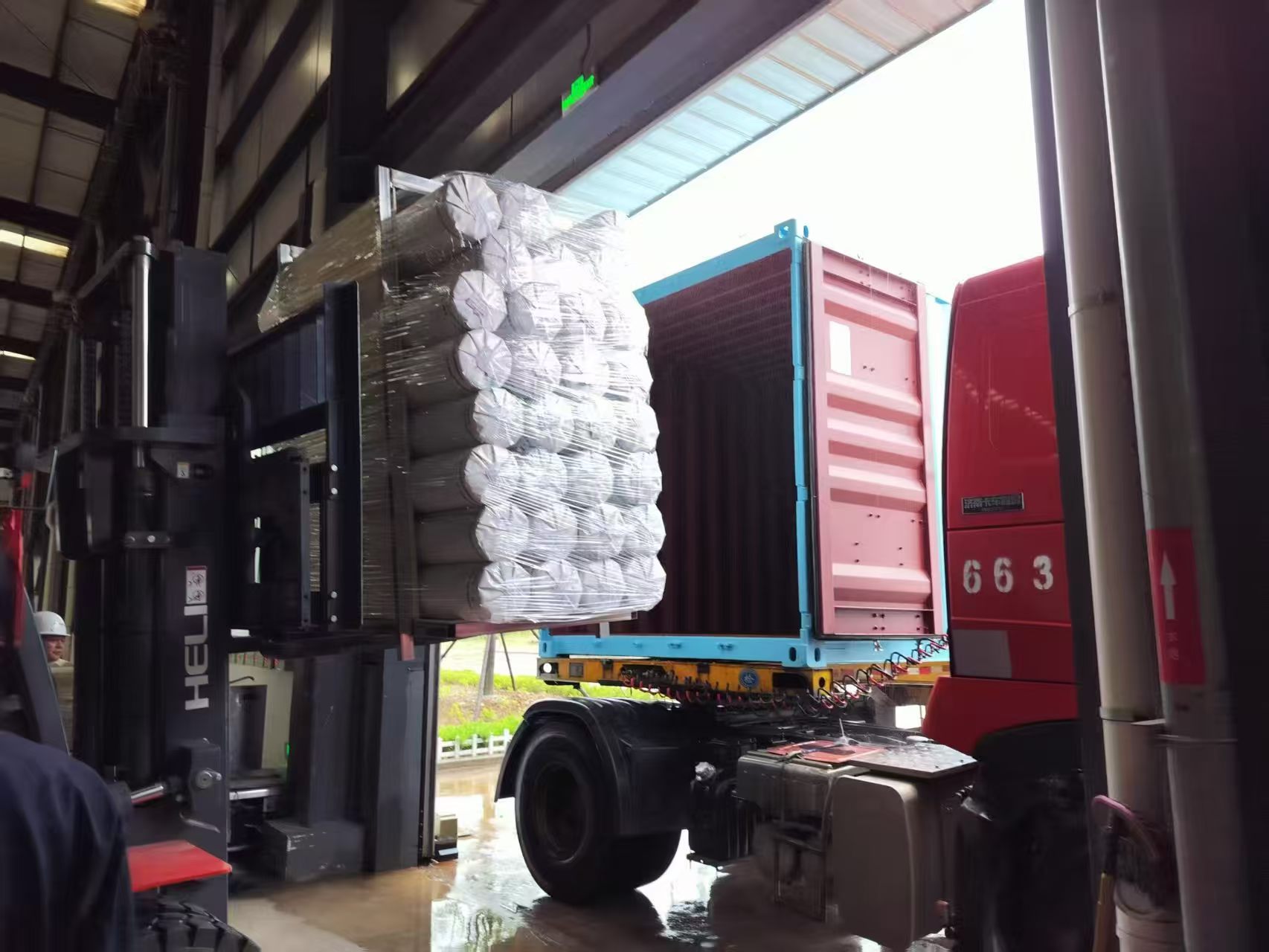
Moisture protection: vacuum packing combined with multi-layer packaging for EVA film export shipments.
Applications: Where EVA Film Fits in Architectural Glass
EVA film is used primarily for architectural glass and decorative glass lamination. Common end products include laminated safety glass for facades, skylights, glass floors, balustrades, and partitions. The film is also suitable for laminating glass with decorative materials such as fabric, paper, or metal mesh, which gives designers flexibility in interior glazing projects.
One reason EVA is popular in these applications is its lower processing temperature range. The 100–110°C window allows furnace-based lamination without autoclave investment. For glass processors that serve both standard and custom projects, this flexibility is a practical advantage.
At the same time, the choice of interlayer is not always EVA. For exterior facades exposed to years of strong sunlight, PVB has a longer track record in building codes and project specifications. Buyers using EVA film should evaluate the supplier’s performance history in real-world installations, especially for outdoor glazing in high-UV climates.
Market Trends That Affect EVA Film Sourcing
Four verified market trends are relevant for EVA film procurement planning.
First, sustained growth in EVA film demand. The global EVA films market is expected to grow at a CAGR of 8.83% from 2026 to 2034, driven by renewable energy and construction demand (Fortune Business Insights). Architectural glass is part of this construction demand, translating into predictable growth for interlayer film consumption.
Second, the evolving interlayer mix. The laminated glass market is still led by PVB (55.2% share in 2025), with EVA growing in architectural and solar applications (Future Market Insights). This means EVA film manufacturers will serve multiple end markets, and buyers should seek suppliers that are committed to architectural film quality rather than generic commodity output.
Third, China’s production scale. Global EVA film production was about 850,000 metric tons in 2024, with China contributing more than 300,000 metric tons (Future Market Insights). Chinese manufacturers are central to global supply. However, scale does not automatically mean quality. The capabilities gap between well-managed manufacturers and commodity producers remains wide.
Fourth, standardization of product quality. For architectural laminated glass, the ASTM C1172 standard defines quality requirements for laminated architectural flat glass. Buyers should confirm that the film supplier’s products can support the quality levels demanded by the end market.
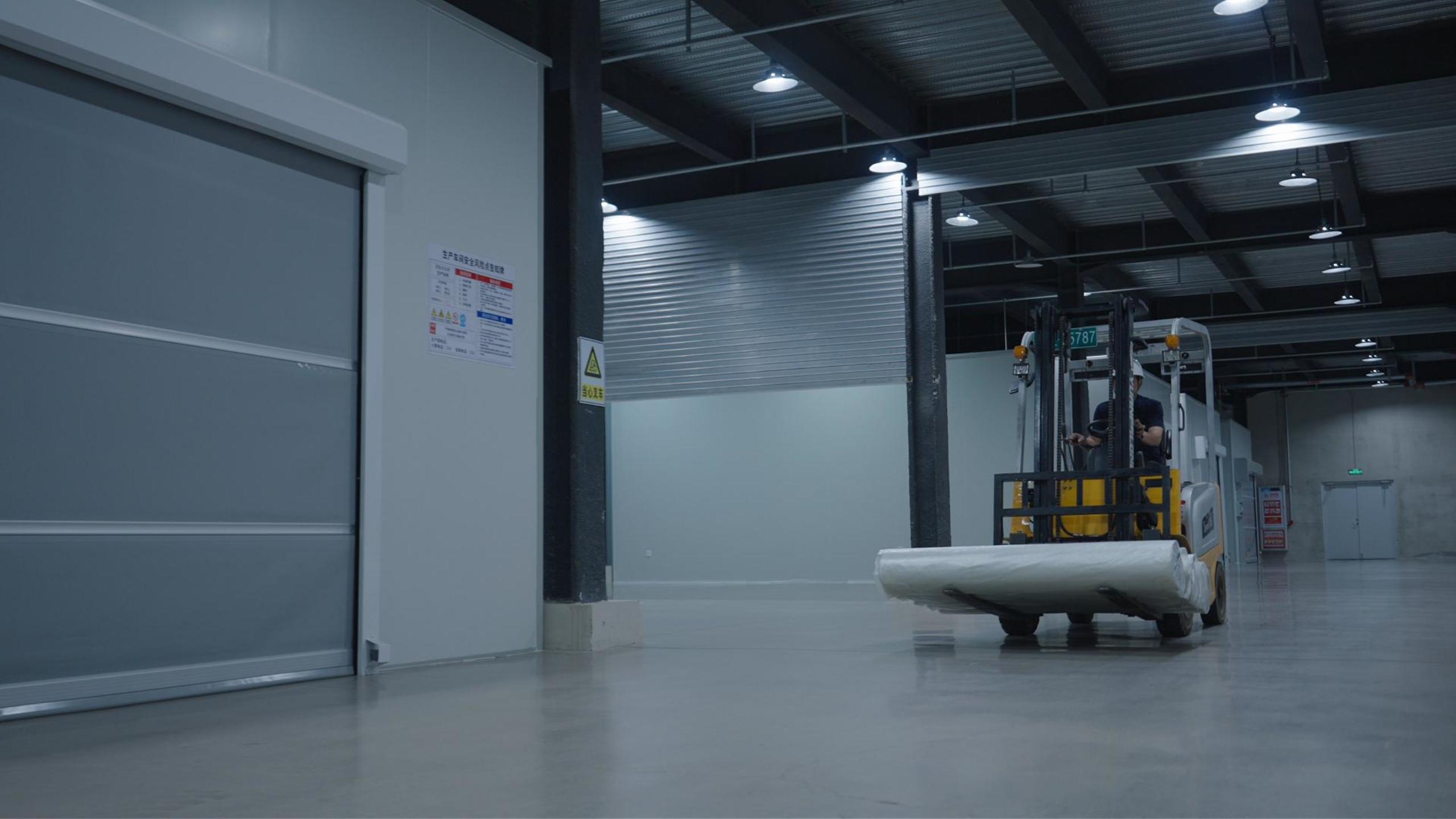
Production operations at an EVA and TPU film manufacturing facility in Rizhao, Shandong.
Transactional vs. Long-Term Sourcing: A Comparison
The difference between transactional and long-term sourcing of EVA film is not just contract length. It changes the information that buyers need and the way risks are allocated.
| Dimension | Transactional Sourcing | Long-Term Supply Relationship |
|---|---|---|
| Price approach | Quoted per order | Agreed framework and purchasing schedule |
| Quality control | Incoming inspection per batch | Continuous monitoring across batches |
| Capacity visibility | Unknown until the supplier confirms | Known, with monthly output disclosed |
| Delivery planning | Rebuilt for each order | Committed production lead time |
| Moisture protection | Depends on the shipment | Standardized packaging protocol |
| Technical support | Limited to the sales process | Available through the R&D team |
| Risk allocation | Most risk stays with the buyer | Supplier shares quality and delivery responsibility |
In practice, a long-term relationship changes the conversation. The buyer asks: What is your monthly production capacity? What is your typical lead time? What is the minimum order quantity? How do you package film for export? Which certifications do you hold?
For Shengding, the verifiable answers are as follows. Monthly production capacity is 100 tons. Typical production lead time is 10 days. Minimum order quantity is 50 kg. Moisture protection uses multi-layer packaging combined with vacuum packing. ISO 9001:2015 certification (Cert. No. 10425Q01154R1S) covers the design and production of glass interlayer films. The EVA film model SD38 offers 90% light transmittance and 0.5% haze.
The Limits of EVA Film—and What They Mean for Buyer Decisions
A responsible procurement view also includes the boundaries of EVA film technology. EVA is not a substitute for every interlayer. In exterior glazing subject to prolonged weather exposure, PVB has a longer record of outdoor performance validation and broader acceptance in some building codes. EVA film also requires disciplined storage: because it is hygroscopic, moisture control is not fully solved at the factory. The buyer must store film properly after delivery.
These limits do not exclude EVA from architectural use. They simply mean that buyers should match the interlayer to the project. When EVA is the right technical choice, supplier selection becomes the decisive factor. A supplier that is transparent about capabilities and limits—rather than claiming EVA solves every lamination problem—provides a stronger basis for a long-term partnership.
A Checklist for Evaluating an EVA Film Supplier
For buyers at the decision or execution stage, the following checklist summarizes the information that should be confirmed before formalizing a supply relationship.
- Verify manufacturing capacity: annual output, monthly production capacity, and facility size.
- Confirm delivery discipline: typical production lead time and minimum order quantity.
- Check certification: ISO 9001, ISO 14001, ISO 45001, and relevant product compliance (REACH, RoHS, FDA).
- Review product specifications: model number, light transmittance, haze, and applicable glass types.
- Investigate moisture protection: packaging method, vacuum packing, and export experience.
- Assess technical depth: R&D team size, engineering support, and responsiveness to application questions.
- Study export track record: target markets, export share, and experience with long-distance logistics.
In the case of Shengding Hightech Materials, these checks lead to a consistent picture. The company operates from a 50,000 m² facility in Rizhao City, Shandong Province, with an annual output of 1,000 tons and monthly capacity of 100 tons. Production lead time is 10 days. It holds ISO 9001:2015, ISO 14001, and ISO 45001 certifications. Its SD38 EVA film delivers 90% light transmittance and 0.5% haze for architectural and decorative glass. Export shipments use multilayer and vacuum packaging to protect against moisture. The R&D team includes 10 engineers at the factory and 5 professors at the Beijing R&D Center. About 70% of production is exported, with main markets in North Africa, the Middle East, and Latin America.
Future Outlook: EVA Film Supply Beyond 2026
The global EVA film market is entering a phase of steady growth, not short-term spikes. Between 2026 and 2034, the projected CAGR of 8.83% means buyers should expect further tightening in demand for quality film, particularly in the architectural segment. China’s production scale will remain central, with Chinese manufacturers supplying a significant share of the global EVA film volume.
For glass processors and distributors, the implication is clear: identify a small group of reliable suppliers and build deeper relationships with them. This approach does not mean accepting higher prices. It means verifying that the supplier has capacity, quality systems, packaging discipline, and technical support before committing to a multi-order program.
As architectural glass specifications continue to evolve—from larger glass panels to energy-efficient glazing systems—the role of EVA interlayer film will expand beyond simple lamination. Buyers who build the right supply relationships today will have the production flexibility to serve that demand. Shengding Hightech Materials is one example of a manufacturer with measured capacity and a documented quality system, offering buyers a basis for long-term supply planning.
A company brochure for SHENGDING HIGHTECH MATERIALS CO., LTD. is available for public reference at https://cdn.socialarks.com/sbsp/24741/0/2026/0418/69e2e8271e41f.pdf
Frequently Asked Questions
Q1: What certifications does Shengding Hightech Materials hold for EVA interlayer film production?
Shengding holds ISO 9001:2015 certification (Cert. No. 10425Q01154R1S) for the design and production of glass interlayer films, along with ISO 14001 and ISO 45001. Products comply with EU REACH and RoHS requirements and U.S. FDA quality requirements.
Q2: What are the optical specifications of the SD38 EVA film?
SD38 is a high-transparency EVA film with a light transmittance of 90% and a haze of 0.5%. It is designed for architectural glass and decorative glass applications.
Q3: What is the minimum order quantity and typical lead time for Shengding EVA film?
The minimum order quantity is 50 kg. Typical production lead time is 10 days. Monthly production capacity is 100 tons, with an annual output of 1,000 tons.
Q4: How does Shengding prevent moisture damage in EVA film shipments?
Shengding uses multi-layer packaging combined with vacuum packing. This protects the hygroscopic EVA film from moisture absorption during storage and long-distance transport.
Q5: Does Shengding have enough capacity for long-term EVA film supply?
Shengding operates with a monthly production capacity of 100 tons and an annual output of 1,000 tons. The company has a research team of 10 engineers at the factory and 5 professors at the Beijing R&D Center, supporting long-term product consistency and development.
Sources
- Fortune Business Insights. EVA Films Market. https://www.fortunebusinessinsights.com/eva-films-market-105320
- Future Market Insights. Laminated Glass Market Report 2035. https://www.futuremarketinsights.com/reports/laminated-glass-market
- Future Market Insights. EVA Film Market Trends Analysis 2035. https://www.futuremarketinsights.com/reports/eva-film-market
- ASTM International. ASTM C1172. https://www.astm.org/c1172-24.html
- HTNXT Supplier Qualification Report. https://htnxt.com/tpu-film-for-laminated-glass-performance-case-studies-supplier-qualification/