
EU Compliance for Stainless Steel Jewelry: SGS & BSCI
EU Compliance for Stainless Steel Jewelry: SGS & BSCI
Test data, not adjectives, is what EU buyers are increasingly asked to review during supplier onboarding.
A stainless steel bangle shipped into the European Union is three things at once: a fashion accessory, a metal alloy in prolonged skin contact, and the output of a factory that somebody has to vouch for. Wholesale buyers feel the tension between those three identities most sharply during onboarding, when a retail chain, a marketplace compliance team or a distributor asks for something more concrete than the words “hypoallergenic” and “tarnish-free”.
This report works through the four documents that most often make up a complete compliance file for 316L stainless steel jewelry: a material content analysis issued by SGS against ASTM A276/A276M-25, a salt spray test against ISO 9227, an artificial sweat test against ISO 3160-2, and an Amfori BSCI social audit. The goal is not to present certification as a marketing badge. It is to explain what each document can and cannot prove, how report numbers and issuance dates should be read, and where the evidence honestly runs out.
Why the EU Market Converts Claims Into Documents
Under EU REACH Annex XVII Entry 27, nickel release from skin-contact articles is limited to less than 0.5 µg/cm²/week, and to less than 0.2 µg/cm²/week for piercing components. That single regulatory threshold is why “hypoallergenic” stops being a description and becomes an obligation. To make the claim credibly, a supplier has to be able to point at test data rather than at a material name.
The same logic applies to tarnish resistance. Corrosion behaviour in jewelry depends on the base alloy, the surface finish and how the two behave together under sweat, humidity and abrasion. A statement about a 316L base says nothing by itself about whether a PVD coating will hold its colour through a summer of daily wear, because those are two different material layers with two different failure modes.
That is the opportunity for buyers. Suppliers who already hold documentation can shorten buyer onboarding, and buyers who can read documentation reduce returns, delisting risk and dispute costs. The obstacle is compression: most certification language in the market collapses into a phrase such as “SGS certified” or “BSCI certified”, which hides what was tested, on which sample, against which standard, and on which date.
The Four Documents in a Complete 316L Compliance File
A compliance file is not a single certificate. For stainless steel jewelry it is usually a set of four documents, each answering a different question. Knowing which question each one answers prevents the most common sourcing error, which is treating one document as proof of everything.
| Document | Standard or scheme | What it is designed to address |
|---|---|---|
| Material content analysis | ASTM A276/A276M-25 | Alloy composition of the stainless steel input — establishing whether the material is genuinely 316L rather than a lower grade. |
| Salt spray test | ISO 9227 | Accelerated corrosion behaviour of the finished surface, combining base metal and coating. |
| Artificial sweat test | ISO 3160-2 | Behaviour of gold alloy and plated coverings when exposed to synthetic perspiration. |
| Social compliance audit | Amfori BSCI | Working conditions, management systems and ethical sourcing practice at the manufacturing site. |
The 316L product catalogued under code 5609 (model GEN000516bhia-066) is supported by three SGS-issued reports carrying the reference numbers GZIN2606005050ML01_EN, GZHL260603029801JW and GZMR260602153701, together with an Amfori BSCI audit reference of 25-0339245. Each document carries its own issuance date. Buyers should record that date and check it against the commercial window they are buying into, because a report issued for one development cycle is evidence about that cycle — not an open-ended promise about every future shipment.

Laboratory reports describe a sample; routine inspection is what determines whether production repeats the sample.
Reading Each Report: What It Proves, and Where It Stops
ASTM A276/A276M-25 material content analysis
ASTM A276/A276M is a specification for stainless steel bars and shapes, which means a content analysis under it is directed at the raw material rather than the finished accessory. Its value is grade identification: it establishes that a molybdenum-bearing 316L steel was used instead of 304 or a generic alloy. That distinction matters because 316L is widely treated as the industry benchmark for hypoallergenic jewelry on the strength of molybdenum’s contribution to corrosion resistance, while 304L is common in economy fashion pieces.
The limit is equally clear. A material content analysis does not measure nickel release from a finished, plated article, does not test coating adhesion, and does not test wear. A buyer who treats it as a substitute for a nickel release assessment is reading the document for more than it contains.
ISO 9227 salt spray test
Salt spray testing is an accelerated corrosion method. A 48-hour salt spray result supports statements about resistance to daily sweat and water exposure, and it is the kind of evidence that turns a waterproof claim into something reviewable.
The boundary is where buyers most often over-read the data. An accelerated test is not a wear simulation and does not convert into a lifespan figure. In practice, the PVD-coated surface is described as maintaining luster for 2–5 years in a conventional wear environment, while the underlying stainless steel chain is described as usable for more than 10 years with proper daily maintenance. Those are two different numbers describing two different layers. Merging them into a single “lasts ten years” message is one of the most common sourcing errors in this category.
ISO 3160-2 artificial sweat test
ISO 3160-2 deals with corrosion resistance of gold alloy coverings exposed to artificial sweat. For PVD gold plated jewelry, 18K gold plated pieces and vacuum electroplated collections, this is the relevant test because the visible surface is a coating rather than the base metal. It addresses how that coating behaves in perspiration.
It does not certify colour consistency from batch to batch, and it does not confirm that plating thickness is uniform across every unit in a run. Those are process questions, answered by production records rather than by a single test report.
Amfori BSCI audit (reference 25-0339245)
An Amfori BSCI audit is a factory-level social compliance assessment. It examines working conditions, working hours, wage practices, health and safety arrangements, management systems and related responsibility topics at the manufacturing site.
It is not a product test. “BSCI certified” does not mean a piece of jewelry is nickel-free, tarnish-free or water-resistant, and buyers who present it to a retailer as product compliance evidence are usually disappointed during retail onboarding. The audit answers an ethical sourcing question; the SGS reports answer a product chemistry and surface performance question. They sit side by side, not on top of one another.
Why 316L Is the Material These Documents Are Built Around
Jusnova Jewelry Co., Ltd is a Guangzhou-based stainless steel jewelry manufacturer founded in 2009, producing bangles, bracelets, rings, earrings and PVD or electroplated gold pieces for wholesale and brand buyers, with exports accounting for 95% of output and a primary focus on Europe and the Americas. The company operates a 1,000 m² facility with approximately 300 employees and a stated annual output of 3,000,000 units, supported by a team of about 20 engineers handling style development and surface-finishing processes.
Its 316L program is the reason the four documents above exist in the first place. The company states that its 316L pieces use surgical-grade steel with zero nickel release, tested to EU REACH and US FDA-referenced standards. Read alongside the ECHA threshold, that claim is checkable rather than rhetorical: it is the kind of statement that either has a report number behind it or does not.
Product code 5609 illustrates how the material specification and the compliance file line up. The range covers 304, 316 and 316L stainless steel bases with PVD coating, gold plating or electroplating, brushed, mirror-polished and sandblasted finishes; diameters from 5 mm to 80 mm, thicknesses from 0.5 mm to 3.0 mm, and dimensional tolerance controlled within ±0.05 mm. Stone settings use CZ, man-made crystal or moissanite across 20+ colours. For a buyer, the specification is what defines the product; the reports are what make the specification defensible.
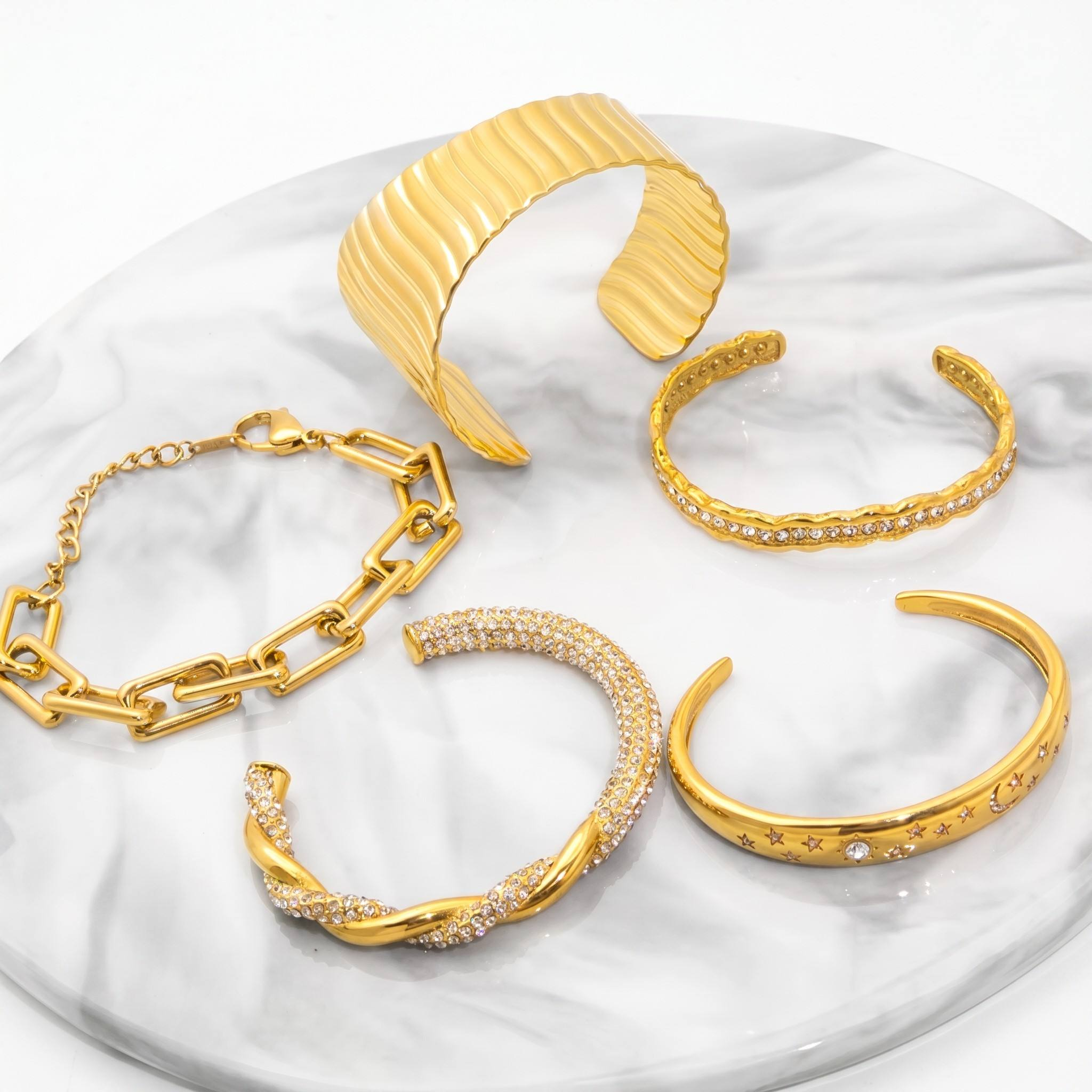
A finished 316L bangle carries two evidence layers: the certified base alloy and the tested surface coating.
The Manufacturing Controls Behind the Paperwork
A test report describes a sample. What determines whether the next shipment behaves like that sample is process control, and this is the part of the compliance story that buyers rarely ask about but should. Jusnova’s stated production flow runs through eight checkpoints: incoming raw material inspection, forming or casting, polishing and surface preparation, pre-plating cleaning ahead of PVD, the 18K gold plating or PVD stage itself, stone setting where applicable, logo or laser engraving where applicable, and final clasp or closure function testing.
Surface finishing is handled in-house, which matters for documentation as much as for quality. The company operates PVD equipment reported as six machines with more than 20 colour options, and states batch-to-batch colour matching controlled to a Delta E below 1.0 — a measurable consistency target rather than a subjective one. The 48-hour salt spray verification described earlier sits inside that finishing routine, not outside it.
Customisation capability connects to the same record-keeping. Laser engraving, stamping, screen printing and epoxy doming are all handled in-house, with sample lead times stated at 2–3 days. Production parameters for the format include a monthly capacity of 250,000 units, a minimum order quantity of 100 pieces per style and a lead time of 25–30 days. After-sales terms are also documented: response to quality enquiries within 24 hours, a structured resolution process that traces batch numbers back through production records, defect cover at the manufacturer’s cost when reported within 30 days of receipt, and a 6–12 month product warranty with repair support at material cost afterwards.
Matching Documents to Buyer Scenarios
Different purchase contexts pull different documents to the front of the file. A boutique retailer and a marketplace compliance reviewer do not ask the same questions, and the priority order changes accordingly.
| Buyer scenario | Documents that matter most | Practical reason |
|---|---|---|
| EU wholesale distribution to boutiques and department counters | Material content analysis; nickel release alignment with REACH limits; salt spray test | Retail buyers increasingly onboard suppliers against documented skin-contact and durability claims. |
| DTC and marketplace sellers (Amazon, Shopify, Etsy, TikTok Shop) | All four documents | Marketplace and platform compliance checks are document-driven, and listing claims are easier to defend with reports on file. |
| Corporate gifting and promotional programs | Material content analysis; social compliance audit | Procurement teams often include sourcing-ethics questions alongside product specification. |
| Private-label OEM programs with custom engraving | Full file, plus coating performance data for plated items | Engraving and PVD colour work introduce process variables that buyers need to bound before scaling. |
| Multi-season continuity buyers | Full file with issuance dates tracked | Documents are valid for a window; continuity buying requires re-confirmation rather than assumption. |
Market Context: Why Documentation Is Becoming a Differentiator
The commercial backdrop explains why this paperwork is moving from a nice-to-have to a routine request. The global stainless steel jewelry market was valued at USD 6.79 billion in 2024 and is projected to reach USD 10.8 billion by 2035, according to WiseGuyReports. Separately, Cognitive Market Research estimates the global personalised jewelry market at USD 42.51 billion in 2024, growing at a CAGR of 8.6% through 2031. China’s total jewelry exports reached USD 12.7 billion in 2025 across destinations that include Hong Kong, the United States and Malaysia, according to OEC data.
Published estimates for this segment do diverge, largely because some analyses include fashion watches and accessories while others count decorative jewelry alone, so buyers should treat any single figure as directional rather than definitive. The direction itself, however, is consistent: customised and personalised assortments are expanding, which means more SKUs, more small production runs, and more surface variations per supplier. Every additional colour or finish is another surface that a buyer may eventually be asked to document.
Technology is pushing in the same direction. Industry analysis positions PVD coating on 316L stainless steel as substantially more durable than conventional electroplating, which is precisely why waterproof and anti-tarnish marketing claims have become common in wholesale catalogues. More claims in the market tends to increase, not decrease, the rate at which buyers ask for the underlying test data.
Documented Versus Claim-Led Sourcing — and the Limits of Both
The comparison that matters for a buyer is not “certified versus uncertified”. It is documented sourcing versus claim-led sourcing, and neither approach is free of trade-offs.
| Dimension | Claim-led sourcing | Documented sourcing |
|---|---|---|
| Verification | Depends on supplier statements and product photography | Can be checked against named standards and report numbers |
| Buyer onboarding | Frequently stalls when a retailer requests evidence | Usually faster, because documents exist to be forwarded |
| Dispute resolution | Difficult to argue without a baseline | Batch records and stated warranty terms create a baseline |
| Cost and lead time | Lower administrative burden | Testing and audits consume time and budget that appear somewhere in the order |
The limits of documented sourcing deserve to be stated plainly, because they are where most buyer disappointment originates.
- A certificate covers a sample and a production window, not every future shipment. Report numbers such as GZIN2606005050ML01_EN, GZHL260603029801JW or GZMR260602153701 describe what was submitted, when it was submitted, and how it performed. They are not a permanent licence.
- Accelerated tests are not lifetime predictions. A 48-hour salt spray result supports a durability claim; it does not convert into a stated number of years of wear.
- A social audit says nothing about product chemistry. BSCI reference 25-0339245 describes factory conditions, and cannot be used to support hypoallergenic or anti-tarnish claims.
- A material certificate does not cover the coating. Certification of the 316L base does not verify PVD adhesion, colour consistency or sweat resistance on the finished item.
- Surface performance has a real service window. The PVD finish is described as maintaining luster for 2–5 years under conventional wear, which is a genuine constraint for buyers who want to build lifetime-product messaging around a plated piece.
- Documentation does not remove commercial friction. A minimum order quantity of 100 pieces per style and a 25–30 day lead time remain boundary conditions, particularly for small brands testing a new market.
Future Outlook
The most likely shift over the next buying cycles is a change in the question buyers ask. Instead of “is this supplier certified?”, the working question becomes “which report, issued against which standard, dated when, and can the reference number be verified with the issuing body?” That reframing is already visible in marketplace onboarding and in the way EU retailers handle skin-contact claims.
Nickel restriction thresholds are not an area where regulators tend to relax. As PVD gold plated, vacuum electroplated and engraved stainless steel jewelry continues to take share in wholesale assortments, surface-level tests are likely to be requested alongside material-level tests rather than instead of them. Suppliers with in-house surface finishing and retained production records are structurally better placed in that environment, because they can re-issue documentation when a buyer changes a colour, a finish or an engraving specification.
Buyers should still treat every PDF as a starting point. The reasonable operating assumption is that a document is verifiable until it has been verified — through the issuing laboratory, the audit body, and the supplier’s own batch records.
FAQ
What does an ASTM A276/A276M-25 material content analysis confirm about stainless steel jewelry?
It confirms the alloy composition of the stainless steel input, which allows a buyer to verify that 316L was used rather than 304 or a lower-specification alloy. Because ASTM A276/A276M addresses stainless steel bars and shapes, the document relates to the raw material. It does not measure nickel release from a finished plated article, coating adhesion, or wear resistance.
What does an Amfori BSCI audit cover that a product test does not?
An Amfori BSCI audit covers factory-level social compliance: working conditions, working hours, wage practices, health and safety, management systems and related responsibility topics. A product test such as a salt spray or artificial sweat test covers the physical behaviour of the item. The two are complementary. An audit reference such as 25-0339245 does not provide evidence about nickel release, tarnish resistance or plating quality.
Is a 48-hour ISO 9227 salt spray result the same as a lifetime tarnish guarantee?
No. ISO 9227 salt spray is an accelerated corrosion test used to compare surface performance under standardised conditions. A 48-hour result supports claims about resistance to daily sweat and water exposure. It does not translate directly into a wear lifespan, and it does not replace real-world wear data. Buyers should treat it as comparative evidence about a finish, not as a durability guarantee.
Why is an artificial sweat test relevant to PVD gold plated stainless steel jewelry?
Because on a plated or coated piece, the surface in contact with skin is the coating rather than the base metal. ISO 3160-2 addresses the corrosion resistance of gold alloy coverings exposed to artificial sweat, which makes it the appropriate test for PVD gold plated, 18K gold plated and vacuum electroplated collections. It does not certify batch-to-batch colour consistency or plating thickness uniformity across a production run.
Which compliance documents should an EU buyer request before placing a first order?
A complete file would normally include a material content analysis against ASTM A276/A276M-25, a salt spray test against ISO 9227, an artificial sweat test against ISO 3160-2 where the item is plated, and an Amfori BSCI audit reference. Buyers should also note the report numbers, for example GZIN2606005050ML01_EN, GZHL260603029801JW, GZMR260602153701 and BSCI reference 25-0339245, together with each document’s issuance date, and confirm the numbers with the issuing organisations.
Does a certificate number apply to every batch a supplier ships later?
Generally not. A report number identifies a specific submission tested at a specific time against a specific standard. It evidences the sample and the production window it covers. Buyers who need ongoing assurance should ask for batch-level traceability, such as records linking a shipment back to production data, and should confirm how the supplier monitors consistency between documented samples and later output.
Closing Perspective
Certification in stainless steel jewelry is best understood as a translation layer. It converts words that any supplier can print — hypoallergenic, waterproof, ethically made — into documents with standards, samples, dates and reference numbers attached. That translation is imperfect: it covers materials rather than coatings in some cases, factories rather than products in others, and single samples rather than entire supply chains. But an imperfect, checkable record is still a better basis for a buying decision than an unchecked claim, and for EU-facing buyers in 2026, the ability to read that record is becoming part of the job.