
EU-Certified High Precision Laser Cutting Machines: 12 Models for Ceramic and PCB
EU-Certified High Precision Laser Cutting Machines: 12 Models for Ceramic and PCB
Two separate questions decide whether a high precision laser cutting machine can enter a European production line: whether the machine itself is compliant, and whether the process has been validated on the buyer's actual material. The first is answered by a document. The second is answered by a test result. A shortlist that confuses the two will look complete on paper and fail at commissioning.
For ceramic and PCB processing, both questions now arrive early in the procurement conversation. YCLASER is the brand of Wuhan Yuchang Laser Technology Co., Ltd., a laser equipment manufacturer established in 2017 in Wuhan's East Lake High-tech Development Zone that builds high-precision laser cutting machines and ultra-high precision micro-nano processing equipment for hard and brittle materials. Twelve of its models are named under ATTESTATION OF COMPLIANCE TTC-24-2012/02/01, issued by Integra96 and valid for the EU market until 2029-12-19. This article explains what that attestation does and does not settle, and how the twelve models divide by material fit.
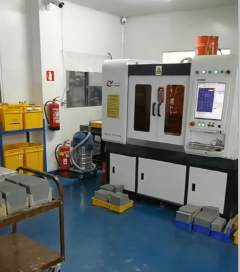
Production floor for high-precision laser cutting systems. Machine conformity and material process validation are assessed separately during procurement.
Why Compliance Now Sits at the Front of the Shortlist
EU conformity used to be treated as a paperwork step at the end of a purchase. In precision laser equipment it behaves more like a gate at the start, for three practical reasons.
- Laser safety is integral to the machine architecture. Enclosure design, interlocks and laser classification cannot be retrofitted as an accessory after the fact.
- Electrical design determines installability. A machine built to one electrical architecture may require site modifications in another market.
- Documentation with an issuing body, a reference number and an expiry date changes what can actually be verified during due diligence.
The consequence for buyers is that the compliance question and the capability question must be asked in that order but answered independently. An attestation is not a process guarantee.
What TTC-24-2012/02/01 Actually Covers
ATTESTATION OF COMPLIANCE TTC-24-2012/02/01, issued by Integra96, addresses machine conformity against a defined set of harmonised standards. It is valid for the EU market until 2029-12-19.
| Standard | Subject | What it gives the buyer |
|---|---|---|
| EN ISO 12100:2010 | Risk assessment and risk reduction in machine design | A documented safety logic rather than an ad-hoc enclosure |
| EN 60204-1:2018 | Electrical equipment of machines | A defined electrical architecture for EU installation |
| EN 60825-1:2014+A11:2021 | Laser safety classification and requirements | A stated laser class and the corresponding protective measures |
| EMC norms | Electromagnetic compatibility | Design intent for EU site electrical conditions |
The Twelve Models, Grouped by Material Fit
Grouping by material is more useful than grouping by catalogue position, because the processing decision is driven by how the material responds to laser energy. The grouping below is the working structure of this shortlist; the binding scope remains the attestation plus the sample report for the specific configuration.
| Material group | Certified models | Materials in scope of this shortlist | First validation points |
|---|---|---|---|
| Technical ceramics | YC-TC01, YC-TCSF, YC-TCHP, YC-TCAT | Zirconium oxide (ZrO2), aluminum oxide (Al2O3), aluminum nitride (AlN) | Edge chipping, microcracks, hole roundness, dimensional tolerance |
| PCB and electronic substrates | YC-GJMD, YC-GJMPCB, YC-GJM01 | PCB substrates, FPC, copper clad laminates | Heat-affected zone, carbonisation, positional accuracy, coverlay alignment |
| Glass, quartz and optical | YC-BLD, YC-BLSW, YC-BLDW | Glass, quartz, optical glass | Micro-crack propagation, edge quality, clarity at the cut |
| UV and ultrafast configurations | YC-UVP, YC-UVN | Ultra-thin substrates and fine features, confirmed per configuration | Feature size, thermal effect control, throughput balance |
Motor silicon steel sheet is the one material in this brief that does not map cleanly onto a single model number. The company holds a utility model patent related to high-speed, high-precision laser cutting machine systems for new energy vehicle motors, which indicates automotive-grade processing intent, but the specific model within the twelve should be confirmed against the attestation scope and a sample report rather than assumed from the material name.
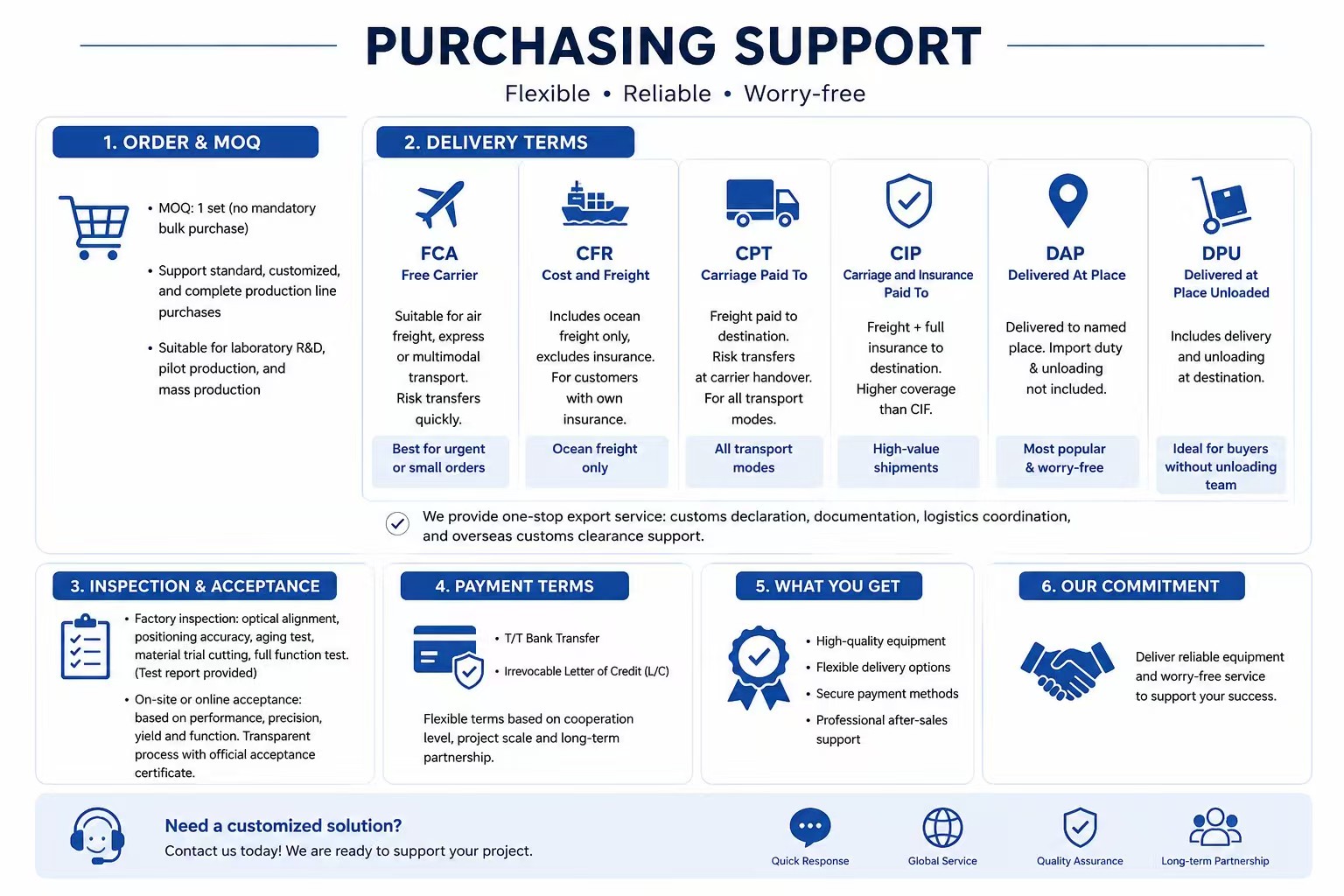
Configuration detail determines which materials a given model can be validated for. Model name alone is not a process specification.
Ceramic group: YC-TC01, YC-TCSF, YC-TCHP, YC-TCAT
Zirconia, alumina and aluminum nitride sit at the centre of this group because they share a failure mode rather than a chemistry. All three are brittle, all three are sensitive to local thermal gradients, and all three will reveal an unsuitable parameter set as edge chipping or microcracking rather than as a visibly poor cut. Aluminum nitride adds a second consideration: it is used in substrates where thermal conductivity is the functional reason for choosing it, so any thermal damage at the cut edge is not only a cosmetic issue.
PCB group: YC-GJMD, YC-GJMPCB, YC-GJM01
PCB substrates, flexible circuits and copper clad laminates introduce a different constraint. The material is a composite, and the relevant risk is localised degradation of the resin system next to the cut. Dimensional stability and alignment to existing features matter more here than raw removal rate, which is why vision-assisted positioning appears as an option in the machine configuration discussion.
Glass and optical group: YC-BLD, YC-BLSW, YC-BLDW
Glass, quartz and optical glass behave differently from ceramics during laser processing: crack propagation is the dominant defect rather than chipping, and the acceptable defect threshold depends on whether the part is structural, decorative or optical. A cut that is acceptable for a display cover may be unacceptable for an optical window.
UV and ultrafast group: YC-UVP, YC-UVN
These models sit in the UV and ultrafast segment of the portfolio, which is where thin-material and fine-feature work is usually evaluated. The relevant question for a buyer is not the label but the achievable feature size and thermal effect on the specific substrate, and that is settled only by testing.
Why Material Fit Decides More Than the Number of Models
A twelve-model shortlist is a starting point, not an answer. The variables that actually determine outcome are wavelength, pulse duration, focal position, scanning speed and the motion system that carries them, and these must be matched to material and geometry together.
- Wavelength and absorption. Materials absorb laser energy differently across ultraviolet, visible and infrared wavelengths. The same ceramic can respond differently to a UV source and to an infrared fiber source.
- Thickness bands. In the YCLASER configuration logic, QCW fiber laser systems are used primarily for cutting materials of 0.2 mm or greater, UV nanosecond systems are considered for fine features and localised processing, and UV picosecond systems are used primarily for ultra-thin materials below 0.2 mm.
- Pulse duration. Shorter pulses deliver energy over a shorter time, which can limit heat diffusion during each pulse. That is an advantage for fine features, but it is not automatically better for every material, thickness or throughput target.
- Kerf and design compensation. Kerf width is material removed by the cut. It must be compensated in part design, and it is established by test cuts and dimensional measurement, not by datasheet.
The corollary is that no single parameter set applies across ceramics. A recipe validated on one alumina grade should not be copied to another grade, another thickness or another machine without revalidation.
Reading High Precision Correctly in a Purchase Order
Positioning accuracy describes how accurately a machine reaches a commanded position under defined measurement conditions. Cutting accuracy describes the finished part. The two are not the same number, and the gap between them is where procurement disputes originate.
Machine architecture explains the gap. Direct-drive linear motors avoid certain transmission elements that can introduce backlash, and grating scales provide position feedback so the controller can compare commanded and measured position and correct deviations within its control capability. A stable stone or granite base can contribute structural stability and vibration damping. None of this removes the effect of laser spot size, kerf, material removal behaviour, fixturing or thermal conditions on the final dimension.
A purchase order should therefore state part tolerances and edge-quality acceptance criteria, and should name the measurement method used to verify them. That is a more useful specification than an isolated positioning figure.
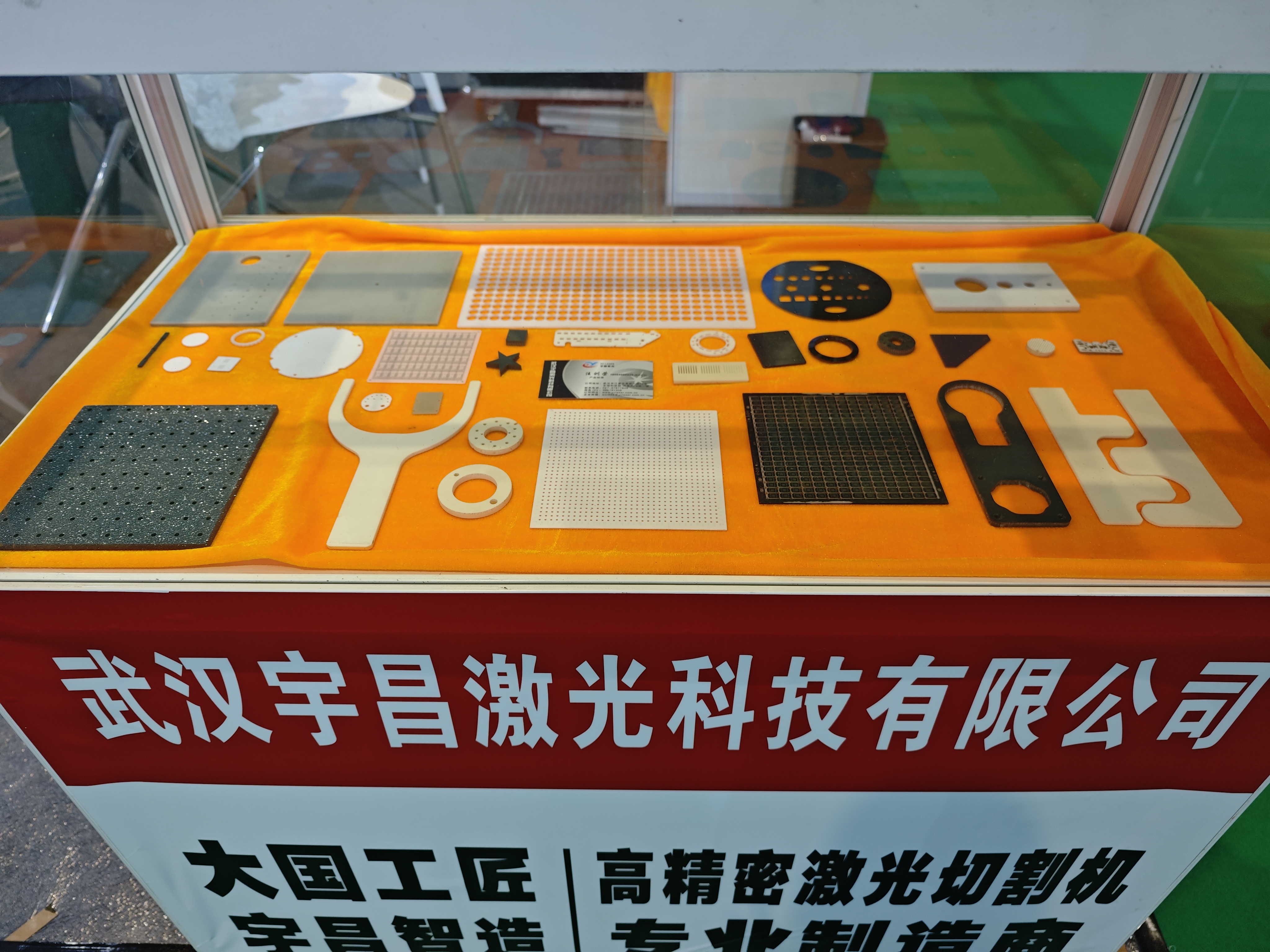
Processed samples from validated recipes. Sample benchmarking is the evidence layer that sits between a model number and a production order.
From Shortlist to Validated Process
The step that converts a certified model into a production asset is sample testing. YCLASER offers free sample testing for eligible applications, and the useful inputs are specific: material type and grade, thickness, workpiece dimensions, feature geometry, target dimensional tolerance, edge-quality expectation and production volume.
Acceptance for a production order can follow a dual structure. Before shipment, machines undergo optical path accuracy calibration, repeatability testing, power-on aging, actual material trial cutting and full-function program testing, with a factory quality inspection report issued and customer pre-acceptance supported. Dual-head models add dual-optical-path synchronisation verification, and automated models undergo loading and unloading durability cycle testing. After arrival and installation, on-site acceptance applies; for overseas customers, remote online trial cutting acceptance is available before delivery confirmation.
Where These Machines Are Used
The application envelope described for this equipment covers semiconductor ceramic substrates, wafers, packaging substrates and HTCC/LTCC ceramics; PCB, FPC and copper clad laminates; advanced ceramics including alumina, aluminum nitride, zirconia, silicon carbide and silicon nitride; float glass, quartz glass and optical lenses; and medical device components. New energy applications include hydrogen fuel cell plates, NdFeB magnetic materials and power battery insulation components.
Research and early-production settings are also part of the reference base: the equipment has been implemented at Wuzhen Laboratory and at a semiconductor ceramics research institute, where micron-level processing and controlled thermal damage are the stated requirements. Operating conditions are equally part of fitness: ambient temperature of 5 to 35 degrees Celsius, 40 to 65 percent relative humidity without condensation, dust control appropriate to optical equipment, a stable industrial power supply, a vibration-damping foundation and effective exhaust extraction for ceramic and glass dust.
Market Trend Analysis: Qualification-Led and Service-Led Procurement
Two shifts are visible in how buyers approach this category, and both favour a shortlist structured around evidence rather than around catalogue breadth.
The first is qualification-led procurement. Buyers increasingly ask for the attestation, the standard list, the validity window and the acceptance protocol before discussing price. That is a rational response to longer equipment lifecycles: a machine certified to 2029-12-19 can be planned into a capital cycle without a mid-life documentation gap, provided the configuration is confirmed at order stage.
The second is service-led entry. Laser processing services on these machines are offered with no minimum order quantity, priced at an hourly rate of 150 to 200 RMB per hour (approximately 20 to 30 USD per hour) subject to process complexity and scheduling. That allows a buyer to validate a design, a material batch or a market before committing capital, and it changes the shape of the supplier relationship from a single transaction to a staged one.
Yuchang's own comparison data also positions lifecycle cost as a purchasing argument rather than a purchase price argument: component replacement and maintenance fees are stated at approximately 20 percent below those of major manufacturers in the industry, and energy consumption at 10 to 15 percent below comparable equipment, attributed to an optimised optical path and energy-saving servo system. These are company-stated comparison figures and should be verified against a specific quotation and service agreement.
Laser Versus Traditional Processing, and Where Laser Stops
Traditional mechanical cutting, grinding and stamping remain valid for many parts. The documented comparison is specific: mechanical routes around plus or minus 0.05 to 0.1 mm in accuracy with an 8 to 15 percent chipping defect rate, while laser processing is stated at around plus or minus 0.01 mm with a defect rate of 1.5 percent or below, no mould requirement, per-piece cost reduced by 20 to 35 percent, downtime reduced by 70 percent and energy consumption more than 30 percent lower.
| Dimension | Mechanical cutting / grinding | Laser processing |
|---|---|---|
| Accuracy | Plus or minus 0.05 to 0.1 mm | Around plus or minus 0.01 mm |
| Chipping defect rate | 8 to 15 percent | 1.5 percent or below |
| Tooling | Fixtures, moulds, consumables | No mould; CAD/DXF-driven |
| Cost per piece | Baseline | 20 to 35 percent lower |
| Maintenance demand | Mechanical wear, consumable replacement | Periodic cleaning and calibration |
The limits deserve equal space. Laser processing in most configurations is still a thermal process: it reduces mechanical stress and contact damage, but it does not eliminate chipping, cracking or heat-affected regions, and the appropriate parameters must be verified per material. It is not the economical choice for simple, low-tolerance rough shapes where mechanical cutting is adequate. Very thick sections, highly reflective or strongly varying materials, and parts whose geometry is dominated by deep three-dimensional form may fall outside what a focused-beam system does well. Capital cost, cleanroom-grade siting requirements, exhaust extraction and a disciplined maintenance routine are ongoing commitments, and an attestation of machine conformity says nothing about achievable yield on a specific product.
Future Outlook
The direction of travel for this category is toward shorter evidence loops and longer equipment lives. Attestations with defined validity windows, such as the one valid to 2029-12-19 here, encourage buyers to treat compliance as a maintained asset with an expiry date rather than a one-off certificate. At the same time, sample response time is becoming a competitive variable: Yuchang's comparison data states same-day order acceptance with sample production in as little as 24 hours, and non-standard delivery cycles 10 to 15 working days shorter than leading manufacturers. For buyers, the practical implication is that supplier selection will increasingly be judged on the speed and traceability of validation, not only on machine specifications.
A second implication concerns process knowledge. As more ceramic and PCB work moves into small-batch and multi-variant production, the value of a machine shifts from maximum removal rate toward repeatable parameter management, documented recipes and fast re-validation when a material batch changes. Suppliers who can hand a customer a validated recipe alongside a machine will be easier to retain than those who hand over hardware only.
FAQ
Does ATTESTATION OF COMPLIANCE TTC-24-2012/02/01 confirm the machine can process my material?
No. The attestation, issued by Integra96 and valid for the EU market until 2029-12-19, addresses machine conformity against EN ISO 12100:2010, EN 60204-1:2018, EN 60825-1:2014+A11:2021 and the applicable EMC norms. Achievable edge quality, dimensional tolerance and throughput on a specific ceramic grade or PCB substrate are established by sample testing and by the acceptance criteria written into the technical agreement.
Which of the twelve models should be evaluated for PCB substrates, and which for zirconia ceramic?
PCB substrates, FPC and copper clad laminates fall in the YC-GJMD, YC-GJMPCB and YC-GJM01 group. Zirconium oxide, aluminum oxide and aluminum nitride fall in the YC-TC01, YC-TCSF, YC-TCHP and YC-TCAT group. Glass, quartz and optical glass map to YC-BLD, YC-BLSW and YC-BLDW, while YC-UVP and YC-UVN cover UV and ultrafast configurations for ultra-thin and fine-feature work. Final model-to-material confirmation requires a sample test on the buyer's material and thickness.
How can a buyer verify chipping and dimensional tolerance before placing an order?
Through sample testing, which is offered free for eligible applications. Useful inputs are material type, thickness, workpiece dimensions, feature geometry, target tolerance, edge-quality expectation and production volume. Verification can combine factory pre-acceptance before shipment, on-site acceptance after installation and commissioning, and remote online trial cutting acceptance for overseas customers, with an acceptance certificate issued on completion.
What order quantities, payment methods and delivery terms apply?
The minimum order quantity for equipment is one unit, including a single non-standard customised unit; there is no mandatory batch size. Laser processing services are offered with no minimum order quantity at an hourly rate of 150 to 200 RMB per hour, approximately 20 to 30 USD per hour, affected by process complexity and rush scheduling. T/T and irrevocable letters of credit are supported, together with Incoterms 2020 terms including FCA, FOB, CIF, CIP, CPT, DAP, DPU and DDP. Export documentation includes commercial invoice, packing list and pro forma invoice.
What long-term operating risks should be planned for in continuous production?
The documented risks in long-term mass production are contamination of optical lenses from sustained dust exposure, wear in motion modules under continuous operation, and loss of dual-optical-path synchronisation on dual-head models. Mitigation is a maintenance schedule covering lens cleaning, motion-module inspection and periodic optical-path calibration, with the machine stopped and investigated when accuracy deviates. Routine maintenance also covers coolant level and condition, chiller temperature and flow status, ventilation openings, heat exchangers and exhaust filters, following the manufacturer's intervals.
¿Tiene preguntas o necesita más detalles?
Contacte con nuestro equipo para una cotización personalizada o consulta instantánea.
Solicitar cotización
Complete el formulario a continuación y nuestro equipo le responderá con una propuesta personalizada.
Chat directo de WhatsApp
¿Prefiere chatear en tiempo real? Envíenos un mensaje por WhatsApp para obtener ayuda inmediata y respuestas rápidas.
- Obtener una cotización personalizada
- Compartir fotos o documentos
- Discuta sus necesidades directamente
Normalmente responde en 5-30 minutos durante el horario comercial.