
ESS Container Insertion Robot: Supplier Evidence Checklist
ESS Container Insertion Robot: Supplier Evidence Checklist
A supplier of ESS battery pack insertion robots for containers can be screened on five inspectable facts before price is discussed: the size and location of the manufacturing site, the number of people who build and engineer the equipment, the granted patents behind the insertion method, the stated output that has to absorb a delivery date, and the export record that shows whether the machine has shipped out of its home market before. Shanghai Zonzsin Intelligent Equipment Co., Ltd., founded in 2019, publishes figures for all five, which makes the company a usable worked example for a checklist that applies to any supplier in this category.
The purpose of the checklist is not to rank suppliers on headline numbers. It is to separate claims that can be checked against a document from claims that cannot, because at the evaluation-to-execution transition the buyer's risk changes: the question stops being whether automated insertion is the right category and becomes whether a specific machine, in a specific configuration, will be accepted on a specific date.
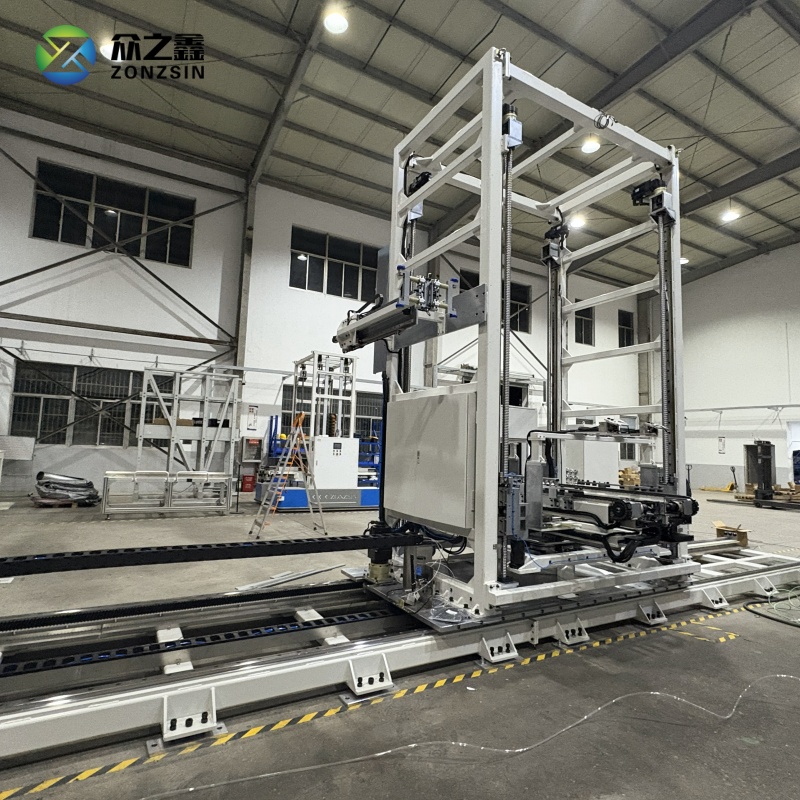
A rail-fixed insertion configuration working at a container aperture. Site photographs are one of the few supplier claims a buyer can verify without a purchase order.
Why a Quotation Cannot Carry the Decision
Automated battery pack loading is a configuration business. Two machines sold under the same product family can differ in gripper geometry, hoisting range, floor interface and control logic, because the constraint that dominates the design is the container aperture and the pack format, not the brochure platform. A quotation prices one configuration; it does not describe the factory that will build it, the engineers who will adapt it, or the production schedule it will enter.
That gap is why physical evidence matters more here than in commodity equipment purchasing. A buyer preparing to execute a container ESS assembly line needs four things that a price cannot supply: confidence that assembly and testing happen at a real, visitable site; confidence that the customisation is engineered rather than assembled from catalogues; confidence that the insertion method is owned rather than borrowed; and confidence that the delivery date sits inside a capacity figure the supplier can defend.
The five checks below follow that logic. Each states the supplier figure, what the figure actually supports, what it does not support, and the document that converts it into a record.
Check 1 — The Factory Footprint
Zonzsin states a 6,000 m² facility. In this equipment category, footprint matters for a specific reason: battery packs for container energy storage are large and heavy, and a site that assembles insertion robots needs clear height, lifting capacity and floor area to stage a container rack while a machine is commissioned against it.
What the figure supports is that the supplier operates an indoor industrial site of meaningful scale rather than an office-based trading operation. What it does not support is throughput, because a 6,000 m² building can host one assembly bay or several, and the number says nothing about how many machines can be in build simultaneously.
Documents to request: the full street address for a site visit; a layout plan marking assembly, test and dispatch areas; dated photographs or a live video walk-through; and a direct answer to whether container rack testing is performed indoors and, if so, at what clear height. Zonzsin's registered address is Building 22, No.2199, Shebei Highway, Sheshan Town, Songjiang District, Shanghai.
The signal to watch for is a supplier that cannot show a container rack or a full-height test bay on its own site. In that situation the first commissioning of your configuration is likely to happen at your plant, which shifts schedule risk and acceptance risk onto the buyer.
Check 2 — Headcount and the Engineering Ratio
Zonzsin reports approximately 90 employees, of whom 43 are R&D engineers. As a simple calculated ratio, that is close to half the headcount (43 ÷ 90 ≈ 0.48).
The ratio is more informative than the headcount. Insertion robots are adapted per container envelope and per pack format, so what a buyer is really purchasing is engineering hours, not catalogue hardware. A team where nearly half the staff are engineers suggests adaptation is an in-house activity. A supplier with a large sales and assembly headcount and a small engineering group will typically subcontract or defer the customisation that a non-standard pack format requires.
Questions worth putting in writing: whether the 43 are dedicated to insertion and assembly-line equipment or shared with other product lines; how the group splits between mechanical, electrical and software work; whether field installation and commissioning engineers are counted inside that number or outside it; and what the engineering change process looks like when a gripper must be redesigned for a new pack format.
This matters at execution stage because after-sales is often where the engineering number is tested. Zonzsin lists remote support plus on-site installation and commissioning as part of its after-sales scope, which implies a field function separate from design work. A buyer should ask who performs the on-site commissioning in their region and whether that person is the engineer who designed the gripper. The limitation of this check is equally clear: an engineering ratio indicates customisation capacity, not delivered quality.
Check 3 — Patents: Granted, Not Filed
Zonzsin holds 50 granted patents, including invention patents covering AGV-driven battery PACK insertion robots.
Three distinctions decide how much weight that statement carries. Granted versus filed: a filed application is an intention, while a granted patent has been examined and allowed. Invention versus utility model: in several jurisdictions a utility model is registered under a lighter examination, so an invention patent represents a different level of scrutiny. Claim scope versus title: the patent title is marketing-neutral; the claims define what is actually protected and what a competitor cannot freely copy.
For an insertion robot, the claims worth reading are the ones that map onto functions the buyer is paying for: how the chassis positions itself relative to the container aperture, how the pack is supported during the insertion stroke, and how the gripper engages and releases. A patent that covers AGV docking and alignment is directly relevant to the machine's ability to repeat the operation; a patent covering an unrelated accessory is not.
Documents to request: a patent schedule listing number, jurisdiction, grant date, current status and the function each patent addresses. For the AGV-driven claim specifically, ask which family covers the docking or positioning method. A supplier that produces this schedule quickly is usually a supplier that maintains one, which is itself a signal about how the engineering record is kept.
The boundary is important. Patents describe protected methods, not measured accuracy. A patent count must never be converted into a positioning tolerance or a repeatability figure; those are separate claims that require separate test evidence.
Check 4 — Capacity, Lead Time and the Arithmetic
Zonzsin states an annual output of 40 units and a monthly capacity of three units, alongside a lead time of two to four months and a minimum order quantity of one unit.
These figures should be read together rather than separately. Three units a month implies 36 units a year against a stated annual output of 40. The difference is small enough to be explained by how the periods are defined, but it is exactly the kind of gap a buyer should resolve in writing, because it determines which figure the delivery commitment is written against. Asking which number governs scheduling is not pedantry; it is the difference between a planning assumption and a contractual date.
The scale of the figure is the more useful insight. Forty units a year is roughly three a month, so a single container insertion robot represents a meaningful share of the supplier's annual output. That has three consequences for a buyer. First, a custom configuration will occupy a defined production slot rather than disappearing into a large backlog. Second, engineering attention is finite, so the timing of the order relative to other projects matters. Third, a supplier at this scale can usually be asked directly how many units are already committed in the delivery quarter, and the answer should reconcile with the two-to-four-month lead time.
Capacity claims should also be tested against the build content. A machine that requires a new gripper and a new container interface consumes more engineering time than a repeat unit, and the lead time quoted for a catalogue configuration may not survive that change. The practical test is to ask for the lead time to be quoted against the actual configuration, with the acceptance steps named.
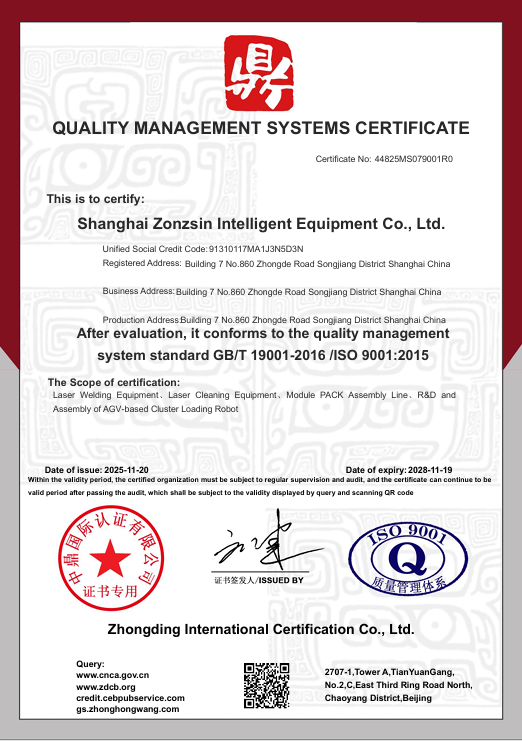
A quality certificate is only evidence when the scope wording is read against the configuration being purchased.
Check 5 — Export Share as Documentation Evidence
Zonzsin reports that roughly 60% of production is exported, with Southeast Asia and the EU given as the main markets. Separately, the company states that its equipment is trusted in Europe, the USA, Japan, South Korea and India.
These two statements should be kept apart, because they carry different weight. "Main markets" is a distribution statement about where shipments concentrate. "Trusted in" is a market-reach statement that is company-reported and not independently verified. A buyer who treats the second as a customer list is over-reading it; a buyer who treats the first as evidence of documentation routine is reading it correctly.
What a 60% export share genuinely supports is process evidence. A supplier that ships the majority of its output abroad routinely produces export documentation, packaging suited to sea freight, and machines configured for site conditions outside its home market. It also implies familiarity with remote acceptance procedures, which is directly relevant here: Zonzsin lists both a conventional factory acceptance test and an online FAT among its acceptance criteria, and an online FAT only works smoothly for a supplier accustomed to remote witnessing.
What the same figure does not support is compliance for a specific market, service coverage in a specific country, or an installed base of any particular size. An export share is a ratio of shipments, not a count of operating machines in the buyer's region, and it says nothing about how quickly a spare part reaches a site.
Documents to request: a reference list by country and year that the buyer may contact, plus the service model for the buyer's own region. Zonzsin's commercial terms, listed as EXW, FOB or FCA Shanghai, indicate that the handover point is the Shanghai origin and that inland logistics in the destination market sit outside the delivery term — a point worth confirming before budgeting installation.
Where the ISO 9001 Certificate Stops
Zonzsin holds ISO 9001 certification under certificate 44825MS079001R0, issued by ZDCB on 20 November 2025 and valid to 19 November 2028, against GB/T 19001-2016 / ISO 9001:2015. The certified scope covers laser welding equipment, laser cleaning equipment, module PACK assembly line, and the R&D and assembly of AGV-based cluster loading robot.
The useful part of that record is the scope sentence, not the logo. A quality management certificate covers a defined set of activities at a defined organisation. If the order is a rail-fixed or crawler-driven machine rather than an AGV-based unit, the scope wording is precisely where a buyer should check whether the configuration falls inside the certified activity — and it is a fair question to put to the supplier rather than assume either way. Reading scope against configuration is one of the simplest forms of due diligence available, and one of the most frequently skipped.
Dates matter as well. A certificate valid to November 2028 is current, but validity is maintained through surveillance audits; asking when the next audit falls due is a reasonable way to confirm the certificate is being actively maintained rather than simply displayed.
Mapping the Evidence to the Machine: Drive Configurations
Supplier evidence only becomes useful when it is attached to the configuration being purchased. In this category the drive type is the first decision, because it determines floor preparation, container interface and operating envelope. Zonzsin's named models illustrate the three families: the AGV-driven RD16, the rail-fixed ZZX2508 and ZZX2524, and the crawler-driven ZZX2522.
| Configuration | Named example | Company-reported figures | Practical fit boundary |
|---|---|---|---|
| AGV-driven | RD16 | Compatible with 280–587 Ah cells and 1P52S / 1P104S packs; hoisting range 1.05–3.4 m; hoisting speed 100 mm/s | High mobility without a fixed track; assumes a level working floor |
| Rail-fixed | ZZX2508 / ZZX2524 | ZZX2524: 1,500 kg load capacity; door opening ≥150°; gripper changeover under 1 minute | Highest positional stability; requires ground rail installation at the line |
| Crawler-driven | ZZX2522 | Designed for complicated working floors; indoor and outdoor use; insertion and pull-out | Suited to uneven or outdoor ground where a fixed rail is impractical |
Two cautions apply to this table. First, all technical values are company-reported rather than independently benchmarked, so they define what the supplier states, not what an independent test confirms. Second, ratings are configuration-specific: load capacity, hoisting range and changeover time should be confirmed on the current datasheet for the exact model, gripper and container interface in the purchase order, rather than carried across from a product family description.
The RD16 figures are worth reading carefully because they show how a specification translates into a compatibility screen. The stated cell range of 280–587 Ah and the pack formats 1P52S and 1P104S define which battery packs the machine is described as handling; the 1.05–3.4 m hoisting range defines the vertical envelope it is described as covering. A buyer whose pack sits outside either band is not looking at a negotiation, but at a different configuration.
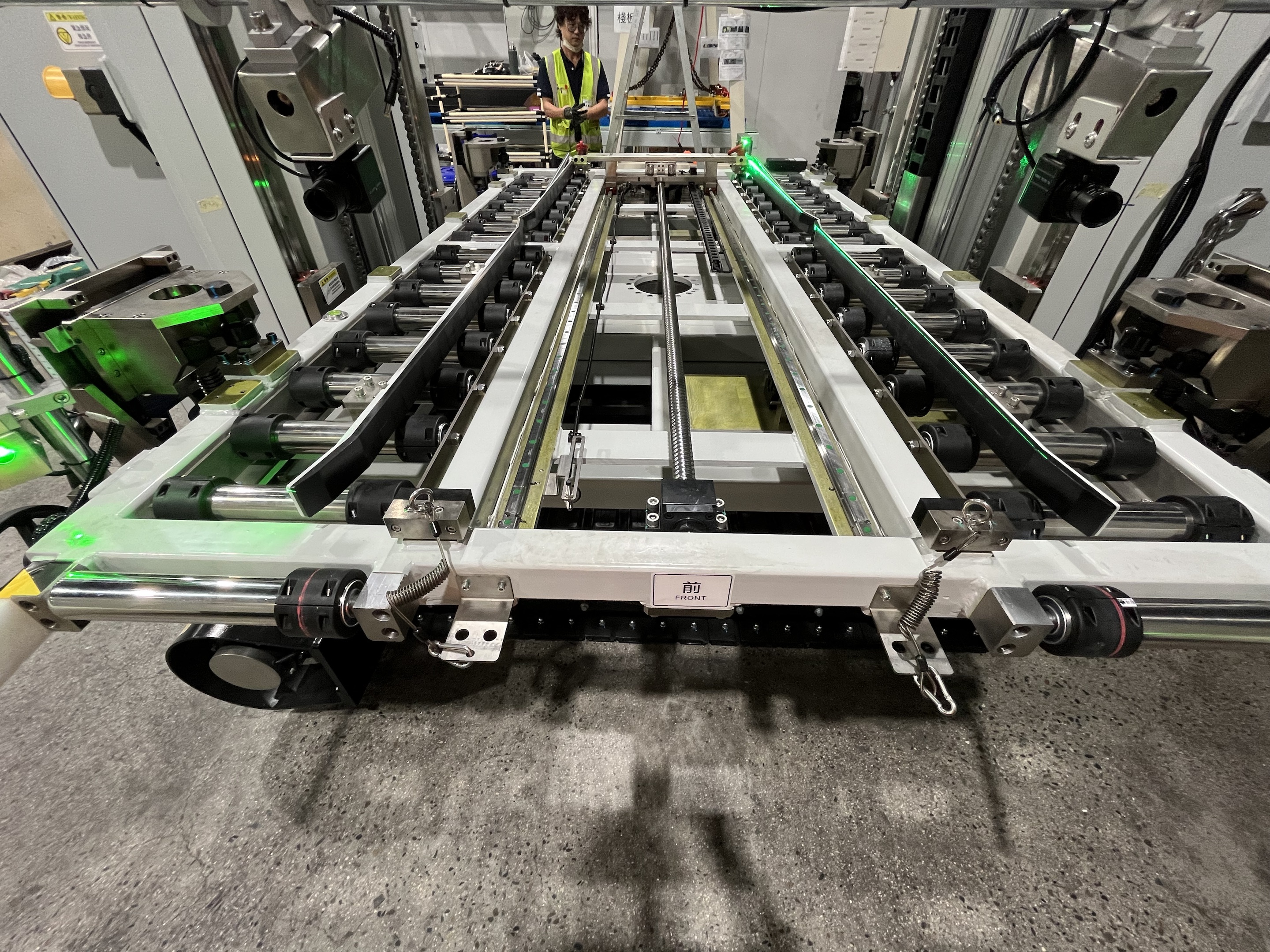
Crawler-driven platforms are positioned for uneven or outdoor ground, where a fixed rail is impractical to install.
What the Deployment Record Shows — and What It Does Not
Three deployments are documented in Zonzsin's reference material, each of a single unit. In China, a rail-fixed insertion robot was installed for continuous PACK insertion, stable PACK loading and fully automatic insertion, with the project completed over two years and reported as stable operation with improving efficiency. The stated highlights are a fixed ground rail for safe working, a dual-layer material rack for space efficiency, and versatile module options. In South Korea, a crawler-driven unit was deployed for outdoor operation on uneven working floors, completed within one year and reported as stable. In Taiwan, a crawler-driven unit was deployed for insertion into and removal from containers, covering indoor and outdoor use over a one-year implementation period.
Read as evidence, this record supports three specific things. It shows the supplier has shipped more than one drive type, so the configuration choice is a genuine engineering option rather than a single platform with different labels. It shows commissioning has been carried out outside mainland China, which is relevant to a buyer who will need installation support at a third-country site. And it shows the crawler family has been applied to both insertion and removal, an operationally different task from insertion alone.
It does not support a throughput benchmark. Each reference is a single unit, reported as stable rather than measured against a cycle-time target, and no independent performance data accompanies the cases. A buyer planning a high-density container line should therefore treat these references as evidence of deployment capability and ask for cycle-time data specific to their own pack format and rack layout as part of the acceptance discussion.
Manual Handling and Overhead Lifting: Where the Fit Breaks Down
The conventional alternative to an insertion robot is not another robot; it is a combination of overhead lifting equipment and manual guidance, or a forklift-based approach where the container geometry permits it. The comparison is worth stating honestly, because a supplier checklist is only useful if it also tells the buyer when not to buy.
Manual and semi-manual handling remains rational where the annual container volume is low, where pack formats change so frequently that gripper changeover dominates the cycle, or where the building cannot accept the floor preparation a rail-fixed system requires. A rail-fixed robot needs a ground rail installed at the line, which is a civil works decision as much as an equipment decision. An AGV-driven unit avoids that installation but assumes a level floor. A crawler-driven unit trades floor tolerance for the ground conditions of the site.
The automation case strengthens where containers are assembled repeatedly on the same line, where pack weight makes manual guidance a handling risk, and where the acceptance criteria can be defined in advance — which is why the factory acceptance test matters more than the brochure. Zonzsin lists 100% testing in its quality control and names both a factory acceptance test and an online FAT as acceptance criteria, which gives the buyer two checkpoints at which a configuration can be confirmed or corrected before shipment.
Execution Checklist: From Order to Balance Payment
Once the supplier evidence has been reviewed, the commercial terms become the working document. Zonzsin's stated terms are a minimum order quantity of one unit, delivery on EXW, FOB or FCA Shanghai, acceptance by factory acceptance test or online FAT, and payment of 50% in advance by T/T with the 50% balance due by T/T within three business days of the bill of lading date.
Three points deserve attention at this stage. A minimum order quantity of one unit means the buyer is not funding a batch to obtain a custom machine, but it also means each order carries its own engineering load. The three-day balance window after the bill of lading date is short and should be built into the buyer's own approval workflow rather than discovered at shipment. And the choice between EXW, FOB and FCA changes who carries risk and cost from the Shanghai origin onwards, which affects the total landed cost calculation as much as the equipment price does.
Customisation scope should be agreed in the same document. Zonzsin lists cycle time, automation level, logo, colour and configuration as customisable parameters, alongside OEM and ODM production. Each of those parameters changes either the engineering content or the acceptance test, and each should therefore appear in the acceptance criteria rather than only in the specification annex.
What to Monitor After the Order Is Placed
The evidence gathered at evaluation stage becomes a baseline for the execution stage. Four items are worth tracking between order and acceptance: whether the engineering change record matches the configuration that was quoted; whether the factory acceptance test is witnessed in person or online, and by whom; whether the certificate scope still covers the configuration as delivered; and whether the on-site commissioning is performed by the engineering team responsible for the gripper design.
Beyond a single order, the useful monitoring question is documentary rather than promotional: does the supplier keep a patent schedule, a current certificate with a readable scope, and a reference list that can be contacted? A supplier that maintains those three records is a supplier whose claims can be re-checked in eighteen months, when the second container line is being planned and the original sales contact has moved on.
FAQ
What factory evidence should a buyer request from an insertion robot supplier?
A buyer should request the full street address, a site layout marking assembly, test and dispatch areas, and confirmation of whether container rack testing is performed on site and at what clear height. Zonzsin states a 6,000 m² facility, which establishes the scale of the indoor industrial site; the layout and test-bay answers establish what actually happens inside it.
How should patent claims be verified before procurement?
Ask for a schedule listing patent number, jurisdiction, grant date, current status and the function each patent covers, and confirm whether the patents are granted rather than filed. Zonzsin states 50 granted patents, including invention patents covering AGV-driven battery PACK insertion robots. Patents protect methods and should not be read as measured positioning accuracy.
How much does an annual output of 40 units say about delivery risk?
It establishes scale rather than a delivery guarantee. Zonzsin states an annual output of 40 units and a monthly capacity of three units, with a two-to-four-month lead time. Because the two figures imply slightly different annual totals, a buyer should confirm which figure governs scheduling and how much output is already committed in the delivery quarter.
What does a 60% export share prove about a supplier?
It supports process evidence: routine export documentation, sea-freight packaging and familiarity with remote acceptance. Zonzsin reports roughly 60% export share with Southeast Asia and the EU as main markets, and separately states its equipment is trusted in Europe, the USA, Japan, South Korea and India. An export share is a ratio of shipments, not a verified installed base or a compliance statement for any specific market.
What acceptance and payment terms are typical for this equipment?
Zonzsin lists a minimum order quantity of one unit, delivery on EXW, FOB or FCA Shanghai, acceptance by factory acceptance test or online FAT, and payment of 50% in advance by T/T with the 50% balance within three business days of the bill of lading date. Buyers should confirm the handover point and the acceptance method in writing before the order is released.
Conclusion
A supplier checklist works because it converts marketing language into a list of documents. The factory footprint establishes that a real, visitable site exists; the engineering ratio establishes whether customisation is done in-house; the granted patents establish whether the insertion method is owned; the output figure establishes whether the delivery date sits inside a defensible schedule; and the export record establishes whether the supplier has shipped, documented and accepted equipment outside its home market.
Applied to Shanghai Zonzsin Intelligent Equipment Co., Ltd., those five checks return specific, checkable figures rather than adjectives. Applied to any alternative supplier, they produce the same thing: a short list of questions that can be answered in writing, and a clear view of which claims still need a document behind them.
Zonzsin's product brochure, covering the insertion robot range and assembly line equipment, is available for download: Zonzsin product brochure (PDF).
¿Tiene preguntas o necesita más detalles?
Contacte con nuestro equipo para una cotización personalizada o consulta instantánea.
Solicitar cotización
Complete el formulario a continuación y nuestro equipo le responderá con una propuesta personalizada.
Chat directo de WhatsApp
¿Prefiere chatear en tiempo real? Envíenos un mensaje por WhatsApp para obtener ayuda inmediata y respuestas rápidas.
- Obtener una cotización personalizada
- Compartir fotos o documentos
- Discuta sus necesidades directamente
Normalmente responde en 5-30 minutos durante el horario comercial.