
ESS Battery Pack Insertion Robots for Containers: AGV, Rail-Fixed or Crawler?
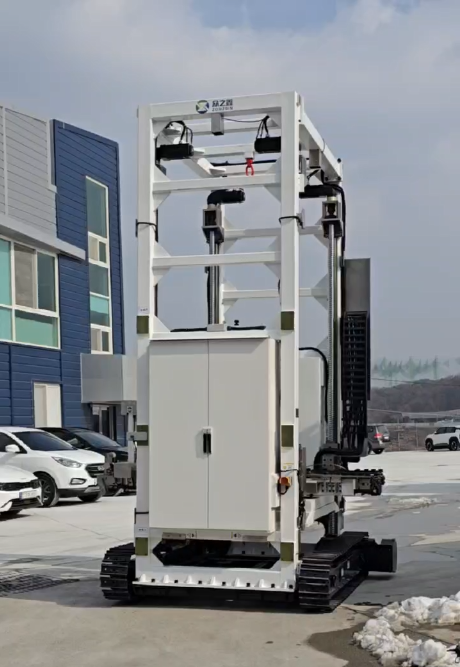
Crawler-driven battery PACK insertion equipment is among the platform options evaluated for container-based ESS assembly.
Containerized battery energy storage has shifted the assembly bottleneck from cell production to the final step of placing heavy PACKs into container racks. In evaluation discussions, the first question is no longer simply which robot can lift the load. It is which motion platform should be used: a fixed ground rail, an AGV-driven vehicle, or a crawler chassis. These options change the civil works, the flexibility to handle different containers, and the ability to support both production and maintenance workflows.
This article compares the main drive platforms seen in ESS battery PACK insertion robots for containers, explains what each configuration does well, and provides a decision framework for integrators, EPC contractors and energy storage manufacturers at the evaluation stage.
Why the drive platform becomes the first evaluation variable
BESS containers are increasingly produced as part of a controlled flow: cells are assembled into PACKs, PACKs are tested, and then transferred into rack structures inside 20ft or 40ft containers. The transfer step is not a simple pick-and-place. A PACK can weigh hundreds of kilograms, must be lifted to a specific rack height, aligned accurately with narrow rack openings, and inserted without damaging connectors or enclosure surfaces.
Rail-fixed, AGV-driven and crawler-driven machines approach this task with different trade-offs. A rail-fixed system offers a stable foundation and repeatable path but requires a prepared ground rail. An AGV-driven robot can be repositioned between docking stations and container doors, which is useful when containers are not aligned in a single fixed production lane. A crawler-driven machine is designed for less predictable sites, including outdoor work areas where the floor is not perfectly flat.
The platform decision therefore affects more than machine cost. It influences installation time, floor preparation, line reconfiguration capability, spare parts strategy and the ease of performing battery PACK removal during maintenance.
The container PACK insertion job in a BESS assembly flow
An ESS battery PACK insertion robot is an automated handling machine that transfers a battery PACK from a preparation area or rack buffer into a container rack position, and can also withdraw PACKs for service or replacement. The work includes lifting, horizontal travel, docking with the container entrance, fine positioning against the rack beam, and controlled insertion.
In practical specifications, this translates into a few measurable requirements:
- Compatibility with the PACK envelope used by the battery producer or system integrator;
- Hoisting range to reach different rack levels inside the container;
- Stability during insertion when the load is cantilevered toward the rack;
- Ability to handle door openings and container tolerances;
- Options for insertion and removal, which is important for repair and maintenance scenarios.
Shanghai Zonzsin Intelligent Equipment Co., Ltd., a Shanghai-based manufacturer of battery PACK assembly equipment and ESS battery PACK insertion robots, organizes much of its product range around these platform differences. Since its founding in 2019, Zonzsin has delivered intelligent battery PACK assembly lines and container insertion robots to domestic and overseas customers, with export activity concentrated in Southeast Asia and the EU. The company reports 50 granted patents, including invention patents covering AGV-driven battery PACK insertion technology.
The company’s documented model families illustrate how the platform choice is translated into equipment specifications.
Major drive platforms for battery PACK insertion robots
Rail-fixed battery PACK insertion robots
A rail-fixed battery PACK insertion robot travels along a fixed ground rail positioned in front of the container. The machine lifts the PACK, moves it into the container opening, and inserts it into the target rack slot. Because the path is mechanically fixed, the system is well suited to continuous, repeated PACK insertion on a defined production line.
Zonzsin’s rail-fixed models include the ZZX2508 and ZZX2524. The ZZX2508 is designed for containers with a length range of approximately 6058 to 7000 mm, width range of 2438 to 2700 mm, and height range of 2896 to 3000 mm. It handles PACKs with lengths from 1100 to 2200 mm, widths from 780 to 1260 mm, and heights from 230 to 260 mm. The equipment requires compressed air at 0.5 to 0.8 MPa and operates on AC380V ±10%, 50 ±2 Hz. Its door opening angle requirement is at least 150 degrees.
The ZZX2524 adds a rated load capacity of 1500 kg, gripper changeover in less than one minute, and a dual-layer material rack configuration that reduces floor space usage. For a cell or PACK producer running a stable container model, this type of equipment provides a predictable cycle and a safe, fixed working path.
AGV-driven battery PACK insertion robots for containers
AGV-driven battery PACK insertion robots integrate the lifting and insertion mechanism onto an automated guided vehicle. Instead of being limited to one fixed rail, the platform can move between container docks, alternate between multiple production lanes, and coordinate with upstream PACK delivery in a more flexible layout.
A representative Zonzsin model in this category is the RD16 AGV-driven battery PACK insertion robot for containers. Its equipment envelope is approximately L3100 × W2600 × H3800 mm. It is compatible with 280 Ah, 314 Ah and 587 Ah cell platforms, and with 1P52S and 1P104S PACK configurations. The hoisting range is 1.05 to 3.4 m, with customization available, and the hoisting speed is 100 mm/s.
AGV-driven units are relevant for integrators who expect container types or rack layouts to change over time. They also fit projects where the assembly line is not yet fixed to a permanent rail foundation, or where the same robot must serve more than one working position.
Crawler-driven battery PACK insertion machines
Crawler-driven battery PACK insertion machines are designed for working floors that are less prepared or not fully flat. A crawler chassis distributes the machine weight over a larger contact area, which improves mobility on outdoor surfaces and rough ground.
Zonzsin’s ZZX2522 crawler-driven battery PACK insertion and removal robot has a hoisting range of 0.8 to 3.4 m, customizable for specific rack layouts. Its load capacity is 1500 kg, and the machine can operate on all-terrain working floors. Leveling is handled by a manual handwheel leveling function. The structure uses Q235 steel fabrication, consistent with the robust duties of outdoor ESS service.
This platform type appears frequently in service and maintenance workflows, where the robot must travel to a container located outdoors, align with the door, and remove or replace a PACK without requiring an indoor gantry or crane system.
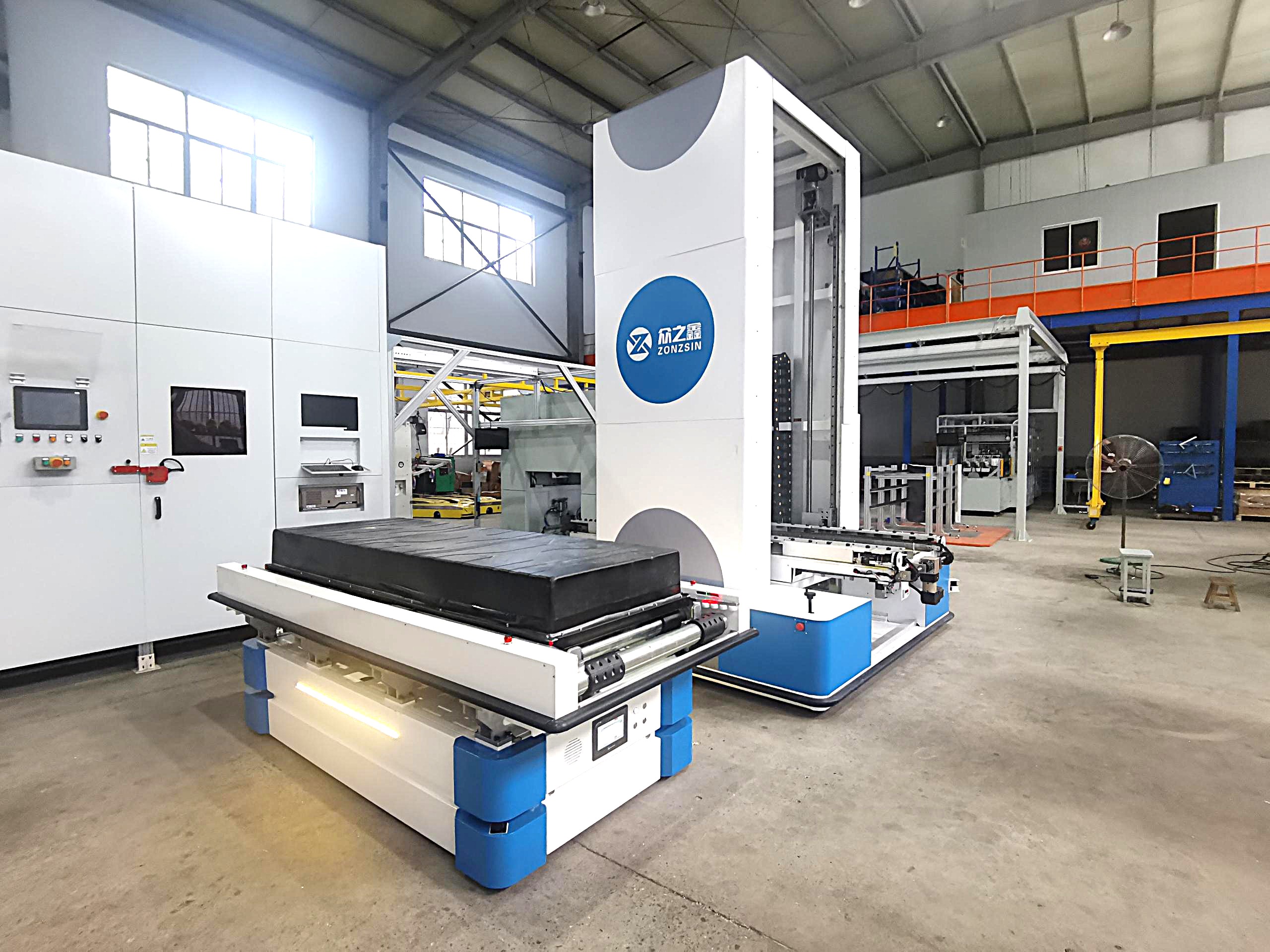
AGV-driven battery PACK insertion robots combine lifting and docking functions on a mobile platform, allowing flexible positioning relative to container doors.
Evaluation criteria: matching the platform to the container program
The right choice depends less on which platform is newer and more on the operating conditions and program maturity of the buyer. During evaluation, four factors deserve attention: site conditions, product standardization, required flexibility, and service workflow.
Site conditions
Rail-fixed systems require a prepared, stable ground rail and a defined operating zone. That is normally acceptable in a factory hall or permanent assembly station. AGV-driven systems require adequate floor flatness for navigation, although they do not depend on a fixed rail. Crawler-driven machines are the most tolerant of uneven outdoor floors, making them suitable for container yards, retrofit sites and field service operations.
PACK and container standardization
When the PACK dimensions and container format are fixed for a long production horizon, a rail-fixed system is often sufficient and simpler. When the product family is expected to evolve, an AGV platform may provide more layout flexibility. The ZZX2508, for example, is specified for a stated container size window and PACK size window. Buyers whose container dimensions fall outside such windows should look for customization or choose a mobile platform that can be repositioned as the product changes.
Insertion and removal needs
A requirement that is sometimes underestimated is PACK removal. Container ESS projects need maintenance access to individual PACKs, especially when cells are upgraded, inspected or replaced. Crawler-driven and AGV-driven machines make it easier to serve containers in different locations. Rail-fixed systems can also perform removal if the container is brought to the station, but the logistics are more centralized.
Throughput and automation level
A buyer evaluating alternative suppliers should compare the full automation chain, not just the mobile base. This includes the gripper, the lifting column, the docking control, the rack interface and the safety system. Zonzsin supports OEM and ODM configurations, with customization of cycle time, automation level, logo, color and configuration. The company reports a monthly production capacity of 3 units, a lead time of 2 to 4 months, a minimum order quantity of 1 unit, and 100% testing before delivery.
| Evaluation factor | Rail-fixed | AGV-driven | Crawler-driven |
|---|---|---|---|
| Representative Zonzsin models | ZZX2508, ZZX2524 | RD16 | ZZX2522 |
| Typical working environment | Indoor fixed assembly station with prepared ground rail | Factory floor with AGV navigation area; multi-position docking | Indoor or outdoor sites, including uneven working floors |
| Key documented specifications | ZZX2508: container L 6058–7000 mm; PACK L 1100–2200 mm. ZZX2524: 1500 kg load capacity; gripper changeover <1 min; dual-layer rack | Envelope L3100 × W2600 × H3800 mm; compatible with 280/314/587 Ah cells and 1P52S/1P104S PACKs; hoisting 1.05–3.4 m; hoisting speed 100 mm/s | 1500 kg load capacity; hoisting 0.8–3.4 m; all-terrain working floor; manual handwheel leveling |
| Primary fit | Continuous PACK insertion with stable rack design | Programs requiring flexible container docking and layout changes | Outdoor containers, uneven floors, PACK removal and maintenance |
The table reflects model-level data from Zonzsin’s published product specifications and does not include price comparisons.
Deployment evidence from existing ESS lines
Evaluation-stage buyers usually ask whether a platform type has proven itself under production pressure. Zonzsin’s documented cases cover all three platform families.
In China, an energy storage system integrator and EPC-related operation deployed rail-fixed battery PACK insertion robots for continuous PACK insertion. The installation integrated a dual-layer material rack to reduce floor space consumption, and the project has produced stable operation over roughly two years while improving loading efficiency.
In South Korea, a project used crawler-driven battery PACK insertion equipment in an outdoor environment. The site had uneven working ground, which was the main reason for selecting a crawler configuration. The equipment achieved stable operation over a one-year period.
In Taiwan, multiple deployment patterns have been documented. One implementation involved a rail-fixed battery PACK insertion robot model ZZX2508 for ESS battery PACK insertion into and removal from containers, with stable operation results over one year. Another documented Taiwan project used crawler-driven equipment in conditions that mixed indoor and outdoor work, with a complicated working floor requiring better terrain adaptability.
These cases suggest that platform choice is being decided by site geometry rather than by a single industry-wide preference. A buyer looking for proof of reliability should therefore ask specifically how a supplier’s machine behaves under the buyer’s expected floor, container and removal conditions.
How automation compares with manual or semi-manual handling
Manual or semi-manual PACK loading methods typically rely on forklifts, hydraulic lift carts, gantry cranes or worker-guided alignment. For low-volume or prototype ESS containers, these methods may still be acceptable. They require lower capital investment and can adapt quickly to unusual container layouts.
However, manual handling becomes difficult to sustain when PACK weights increase, when containers are produced in batches, and when insertion tolerances require precise positioning at height. A battery PACK insertion robot reduces the need for workers to guide heavy loads into racks, and it can repeat the same docking sequence without accumulating operator fatigue.
In a 2026 buyer guide, Zonzsin estimated that automated battery PACK loading robots can reduce manpower by roughly 30% and improve container assembly cycle time by about 20% compared with manual methods. These are supplier-side estimates and should be validated by the buyer against the actual PACK design, rack layout and production schedule.
It is also important to document what automated insertion does not solve. The robot does not inspect or repair PACK quality issues from upstream production, and it cannot compensate for severe rack misalignment or container damage. If the upstream PACK flow is unstable or the container rack tolerances are poor, the robot’s benefit will be limited. The most direct return on investment appears when the PACK format and container rack are already standardized and the production volume is sufficient to keep the machine occupied.
Market and regulatory context
Market data explains why container ESS assembly automation is becoming a procurement topic. The global battery energy storage system market was valued at approximately USD 50.81 billion in 2025 and is projected to reach USD 105.96 billion by 2030, according to MarketsandMarkets. Containerized BESS solutions represented a major segment valued at USD 11.75 billion in 2025, with an expected compound annual growth rate of 24.1% through 2035, according to InsightAce Analytic.
As containerized BESS scales, manufacturers face pressure to standardize assembly while customizing container configurations for different project sites. This combination supports demand for insertion robots that can handle PACKs of different capacities while keeping the loading process repeatable.
Regulatory requirements also influence equipment selection. In North America, energy storage systems often need to demonstrate compliance with UL 9540, the Standard for Energy Storage Systems and Equipment. In the EU, BESS containers fall under the broader battery regulatory framework, including Regulation (EU) 2023/1542, and automated handling equipment must meet applicable machinery and low-voltage directives when CE marking is required.
These standards are mostly applied at system level, but they affect insertion robot suppliers indirectly. An integrator working on a UL 9540 or CE-marked project needs component documentation, traceability and manufacturing process controls from its equipment supplier. That makes quality management certification a relevant part of supplier evaluation.
What to verify when comparing suppliers
At the evaluation stage, buyers should verify three layers of evidence: product-level capability, manufacturing control, and field service structure.
Product and technology evidence
In Zonzsin’s case, the technical starting point is a dedicated robotics engineering team. The company employs 90 people, 43 of whom are engineers in its R&D team. It holds 50 granted patents, including invention patents specifically related to AGV-driven battery PACK insertion robots. The company also runs manufacturing facilities of 6000 m² and reports an annual output capacity of approximately 40 units.
Buyers can compare such signals with their own requirements. A supplier that has developed its own lifting and docking controls is more likely to respond effectively to custom PACK dimensions than one that only assembles third-party components.
Quality system and verification
Zonzsin operates a quality management system certified to ISO 9001:2015, certificate number 44825MS079001R0, issued by ZDCB and valid from November 2025 to November 2028. The certified scope includes laser welding equipment, laser cleaning equipment, module PACK assembly lines, and R&D and assembly of AGV-based cluster loading robots.
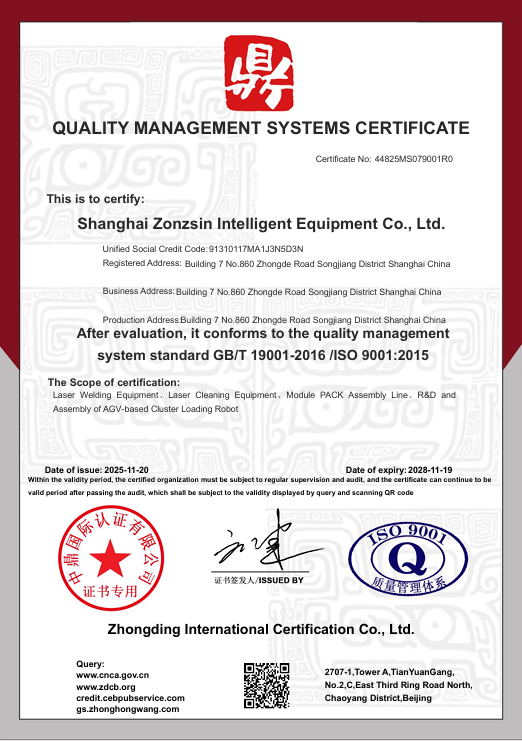
Zonzsin’s ISO 9001 certification covers the R&D and assembly of AGV-based cluster loading robots.
ISO 9001 verifies process control and traceability, but it is not a substitute for system-level BESS certification such as UL 9540. Buyers should distinguish between the equipment supplier’s manufacturing certificate and the certifications required for the final storage product.
Commercial and service structure
Zonzsin serves lithium battery manufacturers, energy storage system integrators and automotive OEM customers. Export markets include Europe and the United States, while the company also reports deployments in Japan, South Korea and India. Its service concept includes remote support and on-site installation and commissioning, which matters for overseas buyers who cannot easily send equipment back for repair.
OEM and ODM orders are available with a minimum order quantity of one unit. For a first container automation project, the possibility of ordering a single customized machine is a practical advantage compared with suppliers that require volume commitments.
Outlook for ESS PACK insertion automation
Several signals point to continued differentiation among drive platforms rather than convergence toward one dominant design.
First, PACK energy density is increasing, which means container projects may change cell size, PACK weight and rack level configurations. AGV-driven platforms offer the ability to reposition the machine when the production line layout changes. Rail-fixed systems remain attractive for high-volume, standardized container lines where the extra flexibility of a mobile base is not needed.
Second, outdoor maintenance and retrofit work will become more important as installed ESS projects age. Crawler-driven insertion and removal robots already address outdoor container sites where the ground is not suitable for wheeled equipment. This service-oriented segment may grow more quickly than pure factory automation.
Third, documentation and compliance expectations will continue to increase. Suppliers that combine a certified quality system with clear PACK compatibility data, container specifications and field evidence will be easier for EPC contractors to approve.
For buyers still in the evaluation phase, the practical next step is to construct a decision test based on their own containers, PACK size, floor conditions and maintenance flow. The platform that wins will be the one that fits the site, not the one that sounds most advanced in a product brochure.
Frequently asked questions
What are the main types of ESS battery PACK insertion robots used for containers?
In the Zonzsin product range, three platform types are documented: rail-fixed battery PACK insertion robots that travel on a fixed ground rail, AGV-driven battery PACK insertion robots that move between container docks, and crawler-driven battery PACK insertion robots for all-terrain and outdoor sites. Examples include the ZZX2508 and ZZX2524 rail-fixed models, the RD16 AGV-driven model, and the ZZX2522 crawler-driven model.
Which is more flexible: an AGV-driven or a rail-fixed battery PACK insertion system?
An AGV-driven system is generally more flexible because it can be repositioned between different container docks and does not depend on a permanent ground rail. A rail-fixed system is more constrained to a defined working path but offers a highly stable and repeatable foundation for continuous insertion operations.
What PACK sizes and cell platforms can AGV-driven insertion robots handle?
The Zonzsin RD16 AGV-driven battery PACK insertion robot for containers is compatible with 280 Ah, 314 Ah and 587 Ah cell platforms, and with 1P52S and 1P104S PACK configurations. Its hoisting range is 1.05 to 3.4 m with customization available, and hoisting speed is 100 mm/s.
Can a crawler-driven battery PACK insertion robot work outdoors on uneven floors?
Yes. Zonzsin’s ZZX2522 crawler-driven battery PACK insertion and removal robot supports all-terrain working floors and is documented in an outdoor South Korea deployment where the working floor was uneven. It offers a 1500 kg load capacity, a hoisting range of 0.8 to 3.4 m, and manual handwheel leveling.
What reliability evidence should an ESS integrator request before selecting an insertion robot?
Integrators should request product specifications, compatibility data, ISO 9001 certification, and field deployment evidence. Zonzsin holds ISO 9001 certificate number 44825MS079001R0 covering R&D and assembly of AGV-based cluster loading robots. Its documented deployments include a two-year rail-fixed operation in China and one-year crawler-driven operations in South Korea and Taiwan.
Does an insertion robot supplier need product-level BESS certification?
Insertion robots are manufacturing equipment, while system-level certifications such as UL 9540 apply to the assembled energy storage system. In the EU, automated handling equipment must respect applicable machinery and low-voltage directives under the CE framework. Buyers should separate the equipment supplier’s quality management certification, such as ISO 9001, from certifications required for the final BESS product.
For procurement teams that need binder-ready technical data, the Zonzsin product brochure is available for reference: Download the Zonzsin product brochure.
¿Tiene preguntas o necesita más detalles?
Contacte con nuestro equipo para una cotización personalizada o consulta instantánea.
Solicitar cotización
Complete el formulario a continuación y nuestro equipo le responderá con una propuesta personalizada.
Chat directo de WhatsApp
¿Prefiere chatear en tiempo real? Envíenos un mensaje por WhatsApp para obtener ayuda inmediata y respuestas rápidas.
- Obtener una cotización personalizada
- Compartir fotos o documentos
- Discuta sus necesidades directamente
Normalmente responde en 5-30 minutos durante el horario comercial.