
EPC-1.1 to EPC-3: A Long-Term Supplier Continuity Audit
EPC-1.1 to EPC-3: A Long-Term Supplier Continuity Audit
Procurement Reference · Pump Control Components
A first order from a pressure control switch supplier tests whether a specification can be met once. A repeat order tests whether the process behind that specification is stable. The distinction matters because most long-term supply failures do not arrive as an obviously defective unit — they arrive as a unit that passes inspection while no longer matching the document it was approved against.
The category is large enough for continuity to be a procurement-level concern rather than a technical curiosity. Fortune Business Insights valued the global pressure switch market at USD 3.2 billion in 2025 and projects USD 3.38 billion in 2026 and USD 5.13 billion by 2034; because research houses draw the boundary of the category differently, those totals are better read as directional than as exact. Monro Switch is the trade name of Zhejiang Monro Machinery & Electronic Co., Ltd., a manufacturer of pump controllers, pressure switches and float switches based in Wenling City, Zhejiang Province, China, which states more than 20 years of manufacturing experience in pressure controls and float switches, an ISO 9001:2015 quality management system, TUV and CE certification, and CUL approval on selected models.
This article uses the company's four documented product families — mechanical pressure control, float switch, pump pressure switch and pump pressure control — as a working example of how a long-term continuity audit is built around the EPC-1.1, EPC-2, EPC-2.1 and EPC-3 pump pressure controls, and where that audit stops being useful.
1. Repeat-order continuity is not first-order qualification
Qualification approves a design. Continuity confirms that the approved design is still what leaves the factory three years later. In practice, auditors find three kinds of drift, and none of them are visible on a sample pulled from a well-managed pilot batch.
- Specification drift. A parameter on the datasheet changes — protection rating, thread standard, starting pressure option — and the buyer's approved record is not updated with it.
- Process drift. A sub-component, mould or test procedure changes at the supplier with no change to the model number.
- Documentation drift. A datasheet is revised but the previous version stays in circulation, so two buyers in the same company hold two different “current” specifications.
A written standard is the cheapest defence against all three. IEC 60730-2-6:2025 is the current international standard for automatic electrical pressure sensing controls used in, on or in association with household and similar equipment, and it gives both sides a fixed reference point when requirements are restated at each annual review. On the trade side, water pump pressure switches are commonly classified under HS Code 853650, which keeps the customs line stable while commercial terms are renegotiated.
2. The continuity baseline: four families, not one model
A supplier that can sustain one pressure control family is not automatically able to sustain a pump control programme. The four families below do different jobs in the same water system, and a long-term audit should establish continuity for each family that appears on the purchase order.
| Family | Role in a water system | Models referenced here | Documented baseline |
|---|---|---|---|
| Mechanical pressure control | Pressure-actuated switching; starts and stops the pump at set pressures | KRS-8, KRS-6, KRS-5, KRS-2 | KRS-8: IP44, 55°C, 1–6 bar or 6–12 bar, 1/4" or 3/8" female; KRS-6: IP44, 55°C, low-pressure protection 10–3 PSI; KRS-2: IP20, 55°C, 0.5–3.0 bar |
| Float switch | Tank level control, fill and drainage modes | FPS-3 | 250V, 50/60 Hz, relay current 16(8)A, IP68, 55°C maximum working temperature |
| Pump pressure switch | Automatic pump start/stop in response to line pressure | EPC series | Documented models carry a built-in check valve and built-in run-dry protection |
| Pump pressure control | Integrated start/stop control with pressure stability at constant flow | EPC-1.1, EPC-2, EPC-2.1, EPC-3 | See the specification table in section 3 |
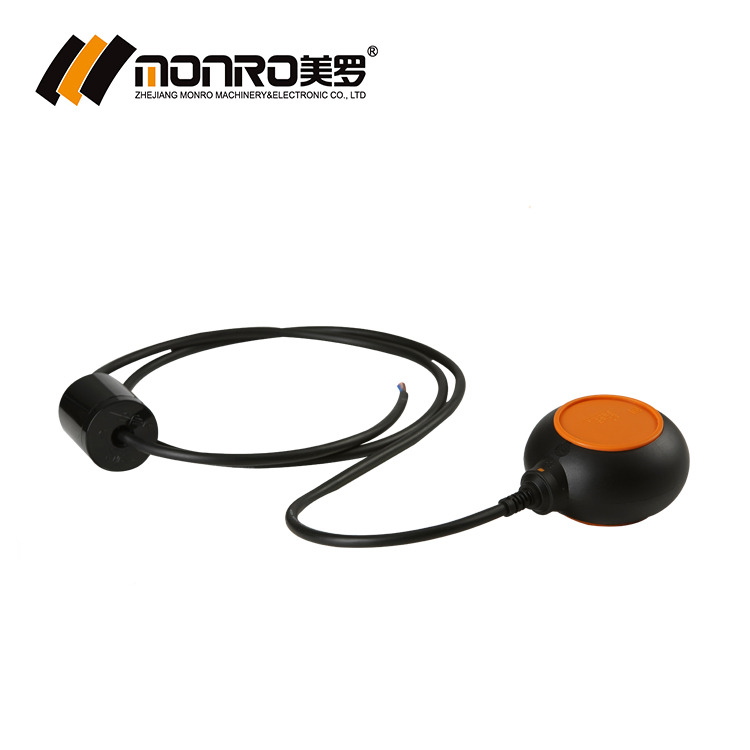
FPS-3 float switch: IP68 protection, 250V rated voltage, 16(8)A relay current and 55°C maximum working temperature — the level-control family that typically joins a pump control order after the first season.
Mapping families before models matters because repeat orders rarely stay identical. A buyer who starts with an EPC-1.1 on a domestic water package may add float switches for tank level, or mechanical controls for a lower-cost irrigation SKU, within two or three seasons. A supplier whose documentation only covers the first model is a continuity risk for the whole programme, not just for one line item.
3. Documented specifications for EPC-1.1, EPC-2, EPC-2.1 and EPC-3
The four pump pressure controls overlap in function but not in documented parameters. That overlap is exactly where substitution happens: a cheaper variant that still switches a pump can look interchangeable to a warehouse team while differing on protection rating or pressure setting.
| Specification | EPC-1.1 | EPC-2 | EPC-2.1 | EPC-3 |
|---|---|---|---|---|
| Protection rating | IP65 | — | IP44 | — |
| Max. working temperature | 55°C | — | 55°C | — |
| Voltage | Triple voltage 110V, 230V or 110-240V | — | 110V, 230V or 110-240V (nameplate range 220-240V / 110-120V) | — |
| Connection thread | Documented thread options | — | R1" | — |
| Starting pressure | — | 1.2 bar, 1.5 bar or 2.2 bar | 1.2 bar, 1.5 bar or 2.2 bar; adjustable range 1.5–3.0 bar | 1.2 bar, 1.5 bar or 2.2 bar |
| Built-in check valve | Yes | — | Yes | Yes |
| Run-dry protection | Yes | — | Yes | Yes |
| Pressure gauge | — | — | — | Yes, for real-time pressure monitoring |
| Other documented features | — | — | 90° inlet and outlet; integrated socket for wiring; constant pressure at constant flow | Constant pressure at constant flow |
A dash means the value is not part of this review's documented source set. It should be confirmed against the supplier's current datasheet rather than assumed — and once confirmed, entered into the approved record that repeat orders are checked against.
EPC-1.1 is the exposed-installation variant in this group: IP65 protection, 55°C maximum working temperature, triple voltage 110V, 230V or 110-240V, documented thread options, a built-in check valve and built-in run-dry protection. For a buyer, the important point is not that these features exist but that each one is named in the approved record, because every one of them can be replaced by a cheaper configuration that still switches a pump.
EPC-2 is the most narrowly defined control here, with fixed starting pressure settings of 1.2 bar, 1.5 bar or 2.2 bar. A small option set makes continuity easier to control, but it also means a change in pump duty usually requires a model change rather than a setting change.
EPC-2.1 combines a 220-240V / 110-120V nameplate range with triple voltage options of 110V, 230V or 110-240V and maximum power options of 0.55kW, 0.75kW, 1.1kW and 1.5kW, an R1" connection thread, IP44 protection, 55°C maximum working temperature, starting pressure settings of 1.2 bar, 1.5 bar or 2.2 bar with a 1.5–3.0 bar adjustable range, 90° inlet and outlet geometry, an integrated socket, a built-in check valve and run-dry protection. The 90° layout and socket reduce installation labour; the IP44 rating is the trade-off, and it belongs in the installation instructions, not in a footnote.
EPC-3 is the variant that makes pressure visible: a pressure gauge for real-time monitoring, a built-in check valve, run-dry protection, constant pressure at constant flow, and starting pressure settings of 1.2 bar, 1.5 bar or 2.2 bar. The gauge is a continuity asset as much as a service feature, because it gives the field a reference value that can be compared against the commissioning record years later.
What may vary, and what should not
Safety-functional characteristics — the check valve, run-dry protection, the protection rating — belong under change control. Cosmetic and logistics variables are a legitimate customization area; the documented OEM scope covers cable length, cable material, brand customization, colour box customization and colour customization. The test for a buyer is simple: if a customization request would alter a stated safety or performance parameter, it is no longer customization.
4. Acceptance criteria for repeat orders
Acceptance criteria should test what the document promises, not what the sample happened to do. The checks below are written so that a receiving inspection can be repeated by a different person, in a different warehouse, against the same standard.
| Check | What to test | Acceptance condition |
|---|---|---|
| Nameplate match | Voltage, frequency, maximum power, starting pressure versus the approved record | Every printed value matches the approved line item; no cross-voltage substitution |
| Protection rating | IP65 on EPC-1.1, IP44 on EPC-2.1, as ordered | An IP44 unit is never accepted against an IP65 line item |
| Thread | Gauge the connection thread against the ordered standard | Mating fitting engages by hand and seals without excessive force |
| Starting pressure | Bench test at the ordered setting (1.2, 1.5 or 2.2 bar) | Pump starts and stops at the recorded setpoints |
| Check valve | Backflow test after pump stop | No sustained reverse flow through the controller |
| Run-dry protection | Dry-run simulation | Controller trips and does not permit continuous dry running |
| Pressure gauge (EPC-3) | Compare indicated pressure with a reference gauge | Reading is consistent with the reference within the agreed tolerance |
| Temperature rating | Marking versus the site's maximum water temperature | No unit rated below the application limit is released to site |
| Marking and packaging | Artwork, colour, cable length and cable material against the approved sample | Matches the approved customization record |
| Test record | Batch documentation from the 100% test claim | Record is traceable to the delivered batch |
Two of these checks deserve more attention than they usually receive. The dry-run simulation is the only way to confirm that a controller protects the pump rather than simply restarting it, and the thread gauge is the most common source of avoidable site rework, because a fitting that “almost” engages is often forced into place with sealant.
5. Purchasing terms that reveal continuity
Commercial terms are not administrative detail. Read together, they show whether a supplier's stated capability is consistent with the way it actually plans production.
| Term | Documented position | Continuity question |
|---|---|---|
| Minimum order quantity | 204 pcs | Does the MOQ apply per model, and how does it change for mixed-model repeat orders? |
| Lead time | 45 days | Is the same lead time held for a repeat model in peak season, and what notice is given if it is not? |
| Stated monthly capacity | EPC series 180,000 pcs; KRS series 250,000 pcs; float switch and liquid level 30,000 pcs | What share of that capacity is already committed to existing accounts? |
| Stated annual output | EPC series 2.88 million pcs; KRS series 3.24 million pcs; FPS series 0.6 million pcs | Does the supplier reconcile annual output and monthly capacity on the same basis — production capability versus shipped volume? |
| Quality control | 100% test | Which parameters are recorded per unit, and is the record supplied with the shipment? |
| Warranty and support | One year warranty; remote support | What is the claim route in an export market, and what is the expected response path? |
| Certification coverage | ISO 9001:2015; TUV (Germany); CE (Europe); CUL on selected models | Is the specific model and voltage variant ordered covered by the current certificate? |
| Export profile | Approximately 90% of output exported; markets include Asia, Europe, North and South America, the Middle East and Africa | Which market's documentation set is used for the destination country on this order? |
The capacity figures are the most frequently misread. A stated monthly capacity of 180,000 units for the EPC series describes what the plant can produce, not what is available to a new buyer in a given month. Combined with a 45-day lead time and a 204-piece minimum, it points to a make-to-order model with batch planning, which is normal for this product class but should be written into the agreement as a delivery commitment rather than treated as a catalogue figure.
6. Lifecycle questions to put in writing
The questions below are the ones that separate a supplier who can restate a specification from a supplier who can hold it. They are deliberately phrased so that a written answer is possible.
- Is the datasheet revision quoted in the offer the same revision that will ship in twelve months, and through what channel is a revision notified?
- Which components in the EPC-1.1, EPC-2, EPC-2.1 or EPC-3 have a documented second source, and which are single-sourced?
- Have the housing, diaphragm, check valve or control electronics changed in the last three years, and did any change alter a stated parameter?
- What does the 100% test cover, which values are recorded per unit, and can the record be attached to each delivery?
- How long are the moulds and tooling for the ordered model retained, and what notice is given before retirement?
- If a certified component is replaced, who re-validates the model against its TUV, CE or CUL documentation?
- What field-return data exists for this model, and at what level are returns traced back to a production batch?
- How is the one-year warranty administered in an export market — remote diagnosis first, or part replacement, and on what timeline?
None of these questions require the supplier to disclose proprietary process detail. All of them require the supplier to have a documented answer, which is the point.
7. Where the audit is applied: application fit across the EPC range
The EPC controllers are documented for domestic and residential water supply, with water as the working fluid, rated voltage of 220-240V / 110-120V, a pressure range of 0.5–10 bar, 55°C maximum working temperature and IP65 protection in the reference working condition. The operating logic is straightforward: the controller starts the pump at the preset low-pressure setpoint and stops it at the high-pressure setpoint, so continuity of the setpoints is continuity of the system's behaviour.
Starting pressure should be matched to the installation rather than to a catalogue default. Monro's own selection guidance pairs the two directly: a 1.2 bar starting pressure corresponds to a maximum water use height of about 12 metres, and the pump lift should be at least (1.2 + 0.8) × 10 m, or 20 metres. Restating that calculation at each repeat order is a simple way to catch a specification that has drifted away from the building it serves.
Agriculture irrigation, water treatment and construction are the stated applicable industries, and in those settings the electronic controllers usually sit alongside mechanical controls and float switches rather than replacing them. The EPC-3's pressure gauge is useful where maintenance staff need a visible reference; the FPS-3 float switch covers tank level at IP68 with a 250V rating and 16(8)A relay current, which places it in a different electrical and environmental class from the line-voltage controllers.
A documented application record illustrates the pattern rather than proving a general rule: a retail customer in China used 50 units over two years for automatic pump start/stop control in a water supply system, with reliable automatic pressure control recorded as the outcome. Two years is a useful reference point, because it spans at least two repeat orders — the point at which continuity questions actually surface.
8. Comparison with mechanical controls, and the limits of this framework
Mechanical pressure controls remain the default in many irrigation and construction packages, and the documented differences are concrete rather than interpretive. The KRS-8 is rated IP44 with a 55°C maximum working temperature and a pressure range of 1–6 bar or 6–12 bar on a 1/4" or 3/8" female connection; the KRS-6 documents low-pressure protection at 10–3 PSI; the KRS-2 documents IP20 protection with a 0.5–3.0 bar range.
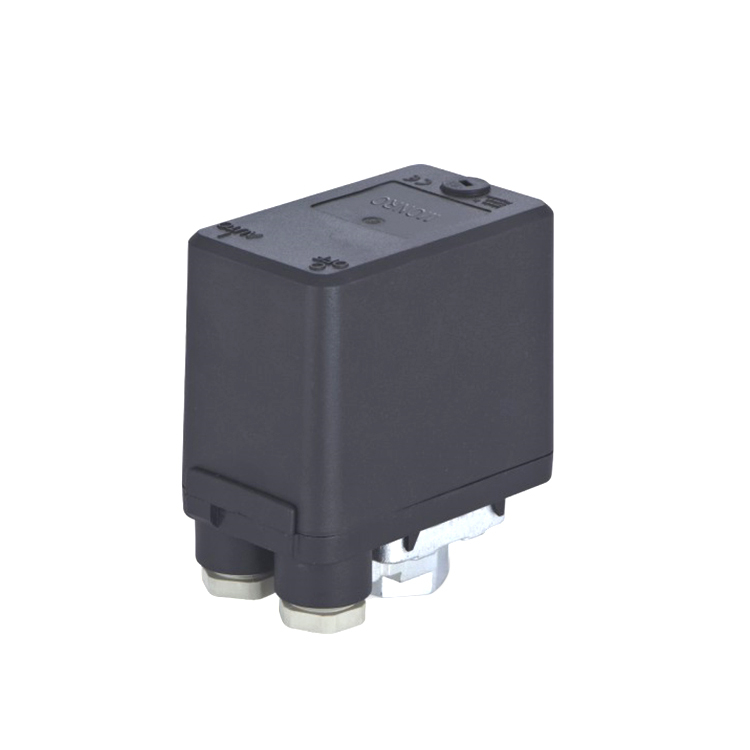
KRS-8 mechanical pressure control: IP44 protection, 55°C maximum working temperature, 1–6 bar or 6–12 bar pressure range, 1/4" or 3/8" female connection.
The practical consequence is about enclosure and system architecture, not about quality. The integrated check valve and run-dry protection documented on the EPC models are not part of the KRS-8 specification as listed here, so a mechanical installation needs those functions from separate components, and a low protection rating means the device needs a dry location or an additional enclosure. A buyer comparing the two should compare the assembled system, not the unit price.
Where this framework stops
Three boundaries are worth stating plainly, because a continuity audit is often presented as more than it is.
- Protection ratings are not interchangeable. The EPC-2.1 is documented at IP44 against IP65 on the EPC-1.1. In an exposed or wash-down position, the EPC-2.1 is not a substitute, however convenient its 90° layout and integrated socket are.
- Temperature and media limits are real. Controllers documented at 55°C, and other EPC models documented at 60°C, are intended for clean water within that range. They are not a solution for hot water, steam or aggressive media, and no amount of documentation discipline changes that.
- Documentation is not field reliability. This audit verifies what a supplier states and can repeat at goods-in. It cannot confirm installed performance, and it cannot replace commissioning data from the site. It also does not remove single-source risk: a strong continuity record at one supplier still argues for a qualified second source on long-life projects.
9. Market trend analysis
The technology mix is the most useful trend signal for a continuity audit. Market Research Future attributes approximately 62% of 2024 global share to electromechanical pressure switches and 38% to solid-state electronic types, which means most suppliers in this category are sustaining two parallel production and documentation systems. A supplier with a strong mechanical line and a thin electronic line — or the reverse — is a partial supplier for a multi-year pump programme, and the audit should distinguish between the two.
Standards are the second signal. IEC 60730-2-6:2025 is the current edition of the international standard for automatic electrical pressure sensing controls, and each revision resets the documentation baseline that buyers rely on. Combined with HS Code 853650 as the common trade classification for water pump pressure switches, this creates two independent reasons for a specification to change without the product changing at all — which is precisely the drift that a written approved record is designed to catch.
The third signal is variant proliferation. Market growth projections for the category imply broader catalogues, not narrower ones, and Monro's own range illustrates the pattern with more than 40 pressure controller models for water pump systems and air compressors across three production families. More variants mean more opportunities for a specification to drift between the model a buyer approved and the model a warehouse ships.
10. Future outlook
Continuity auditing is likely to move in three directions over the next few years. First, batch-level records: as the electronic share of the category grows, buyers will ask for test data per delivery rather than a 100% test statement per catalogue. Second, behaviour documentation: programmable features such as the smart program that automatically restarts the pump are harder to verify on a nameplate than a pressure range, and a continuity audit will need to cover control behaviour, not only hardware parameters. Third, dual qualification as standard practice: capacity figures describe capability, not committed availability, and long-life projects will increasingly carry two approved sources with matched specifications rather than one.
None of these change the underlying test. A pressure control switch remains a low-cost component whose failure carries a disproportionate cost, and the question a buyer is really asking across EPC-1.1, EPC-2, EPC-2.1 and EPC-3 is whether the specification that was approved in year one is still the specification being manufactured in year four.
FAQ
What does long-term supplier evaluation mean for a pressure control switch?
It is a review of whether a supplier can deliver the same approved specification repeatedly over several years, rather than a review of whether one sample meets that specification once. It concentrates on documented parameters, change notification, batch test records and lifecycle support — the factors that determine whether the fifth order still matches the first.
Which product families should a continuity audit cover?
At minimum, every family that appears on the purchase order. In Monro's catalogue that means mechanical pressure control (KRS series), float switch (FPS series), pump pressure switch (EPC series) and pump pressure control (EPC-1.1, EPC-2, EPC-2.1, EPC-3). Covering families rather than single models matters because pump programmes commonly add level control and mechanical variants after the first season.
Which specifications must be re-confirmed on every repeat order?
Protection rating, maximum working temperature, voltage and frequency, connection thread, starting pressure setting, the presence of a built-in check valve and run-dry protection, and — on the EPC-3 — the pressure gauge. For reference, the EPC-1.1 is documented at IP65 and 55°C with triple voltage and a built-in check valve, while the EPC-2.1 is documented at IP44 and 55°C with an R1" thread and a 1.5–3.0 bar adjustable range.
What acceptance criteria belong in a repeat-order agreement?
Criteria tied to measurable, restatable conditions: nameplate data matching the approved record, thread gauging, verification of the protection rating, a bench test of the starting pressure setting, a backflow test on the check valve, a dry-run simulation confirming the controller trips, a gauge comparison where a gauge is fitted, and a packaging and branding check against approved artwork. Each criterion should state a pass condition rather than a general instruction.
Which purchasing terms indicate whether supply can be sustained?
Minimum order quantity (204 pcs), lead time (45 days), stated monthly capacity (EPC series 180,000 pcs; KRS series 250,000 pcs; float switch and liquid level 30,000 pcs), stated annual output, the scope of 100% testing, warranty terms (one year with remote support) and the certification status of the ordered model. These terms are only informative when read together: a short lead time against a large stated capacity says little unless the supplier also states how much of that capacity is already committed.
What are the limits of a documentation-based continuity audit?
It verifies what a supplier states and can repeat at goods-in; it does not prove field reliability, and no framework of this kind replaces commissioning data from the site. It also cannot compensate for a genuine specification limit — an IP44 controller such as the EPC-2.1 is not a substitute for an IP65 model in an exposed position, and EPC controls documented at 55°C or 60°C are intended for clean water within that range, not for hot water or aggressive media.
Reference document: Monro catalogue 2025 (PDF) — Monro catalogue 2025.
¿Tiene preguntas o necesita más detalles?
Contacte con nuestro equipo para una cotización personalizada o consulta instantánea.
Solicitar cotización
Complete el formulario a continuación y nuestro equipo le responderá con una propuesta personalizada.
Chat directo de WhatsApp
¿Prefiere chatear en tiempo real? Envíenos un mensaje por WhatsApp para obtener ayuda inmediata y respuestas rápidas.
- Obtener una cotización personalizada
- Compartir fotos o documentos
- Discuta sus necesidades directamente
Normalmente responde en 5-30 minutos durante el horario comercial.