
EPC-1.1 Pressure Switch FAQ: Threads, Voltages, Start Pressures
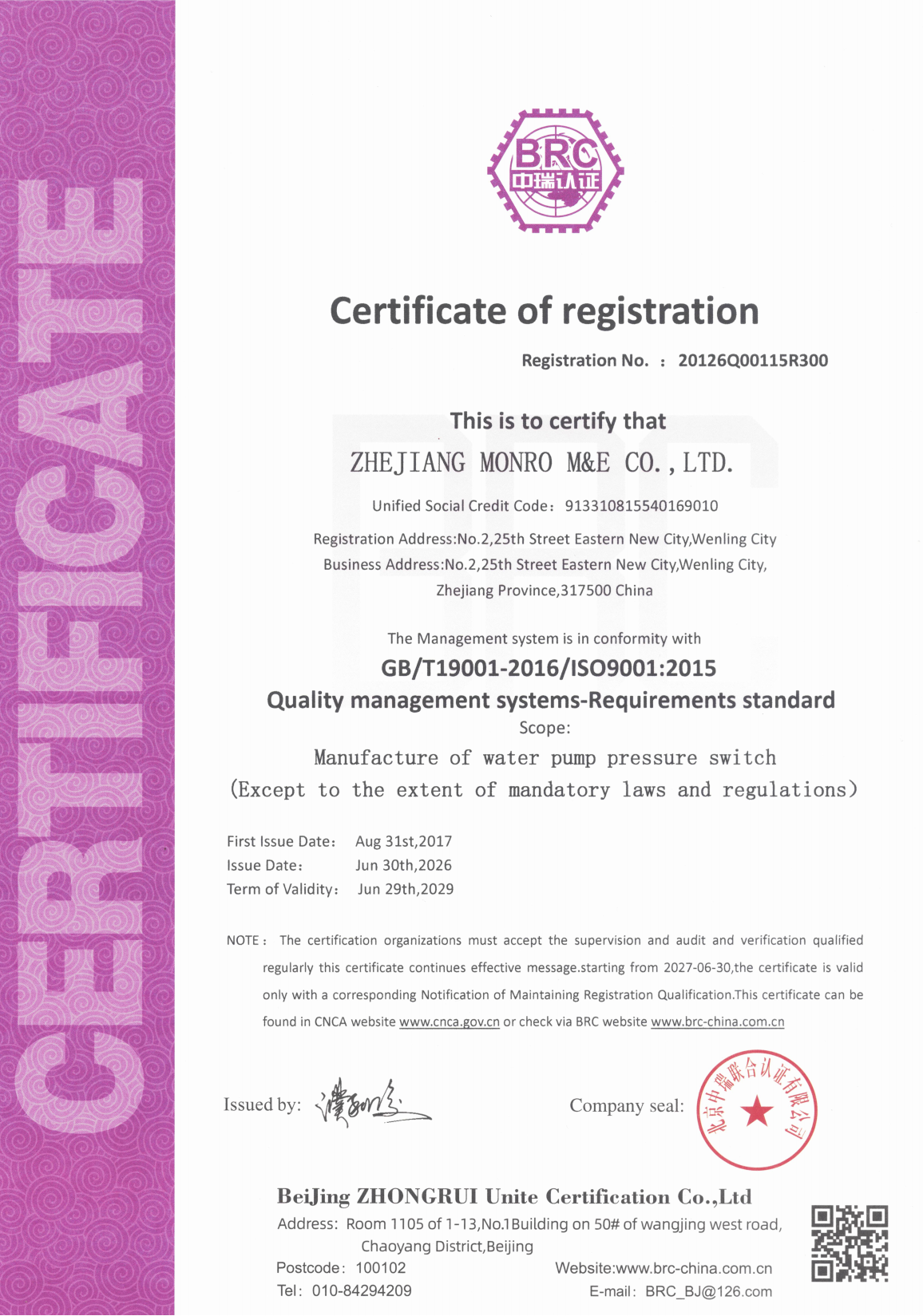
ISO 9001:2015 system certificate 20126Q00115R300, issued by BeiJing ZHONGRUI Unite, scope: manufacture of water pump pressure switch.
A pump controller rarely fails a water supply project because of its control principle. It fails on site because the thread will not seal against the existing pipework, the unit was wound for a supply voltage the destination market does not use, or the starting pressure is too high for the height the water has to reach. For buyers evaluating the Monro Switch EPC-1.1 pump pressure control, the published parameter set answers these questions before a purchase order is raised — but only if each field is read as an order instruction rather than as a general capability statement.
Zhejiang Monro Machinery & Electronic Co., Ltd. (Monro Switch) manufactures pump controllers, pressure switches and float switches in Wenling City, Zhejiang Province, China. The company was officially established in 2010 and states more than 20 years of manufacturing expertise in pressure controls and float switches, with approximately 90% of its output exported to Asia, Europe, North and South America, and the Middle East and Africa. The EPC-1.1 sits in its automatic pump control family and is documented as a domestic and residential water supply product used with clean water.
Why Thread, Voltage and Start Pressure Decide Most Orders
Procurement teams handling pressure control switches tend to track three verification points before confirming a specification: the hydraulic connection, the electrical connection, and the pressure setpoint logic. Each one maps to a physical outcome on the installation side.
Thread mismatch is the most visible. A controller ordered with a G1 1/2" connection cannot be fitted to pipework prepared for a G1" outlet without an adapter, and every additional joint becomes a potential leak path in a pressurised domestic system. Voltage mismatch is the most expensive, because a 110-120 V unit cannot be commissioned on a 220-240 V supply, and the error is normally discovered only after the goods have cleared customs. Start pressure mismatch is the least visible and the most disruptive: set too high, the controller cannot bring the pump in at the top floors of a building; set too low, the pump short-cycles and the stored pressure is insufficient to serve the outlets comfortably.
The EPC-1.1 is specified in a way that lets a buyer close all three questions from the data sheet, provided the buyer also understands what the sheet does not state. That second point matters more than it first appears, and it is covered later in this article.
The EPC-1.1 Specification Set, Read as an Order Form
The published EPC-1.1 parameter set is short and specific. Every line below represents a decision the buyer must make on the purchase order.
| Parameter | Published value for the EPC-1.1 |
|---|---|
| Product category | Pump pressure control (pump pressure switch type) |
| Rated voltage | 220-240 V / 110-120 V |
| Power frequency | 50/60 Hz |
| Maximum power | 1.1 kW / 1.5 kW / 0.75 kW |
| Starting pressure setting | 1.2 bar, 1.5 bar, 2.2 bar |
| Connection thread | G1", G1 1/4", G1 1/2", NPT1" |
| Protection rating | IP65 |
| Maximum working temperature | 55 °C |
| Materials | Plastic and metal |
| Documented application | Domestic / residential water supply, clean water medium |
Four of these fields — thread, voltage, frequency and starting pressure — are configuration choices, not fixed attributes. The same model designation can therefore ship in several builds, and the specification on the order confirmation, not the catalogue headline, is what determines whether the delivered unit fits.
Matching Connection Threads to Existing Pipework
The EPC-1.1 is offered with four thread designations: G1", G1 1/4", G1 1/2" and NPT1". The choice is driven entirely by the pipework already installed or already specified.
G-series threads (also described internationally as BSPP) are parallel threads sealed by a gasket or washer face, and they dominate domestic water installations across Europe, the Middle East, Africa and much of Asia. NPT1" is a tapered thread that seals through thread interference and is the standard connection in North American plumbing practice. The two families are not interchangeable by design, and forcing a match — usually with sealing tape — is a common source of slow weeping joints in pump rooms.
Practical selection rule
- Measure or read the thread form from the pump outlet, the tank connector or the existing pipe union; do not assume it from the country of installation alone.
- Where the pipework is G1", order G1"; where it is NPT1", order NPT1". Where the system uses a larger riser, G1 1/4" or G1 1/2" may be the correct match.
- Confirm the thread designation in writing on the purchase order, since all four options exist under the same EPC-1.1 model name.
- Treat adapters as a cost, not a solution: each added fitting introduces another joint to seal and another item to stock.
Voltage and Frequency: What Changes Between 110 V and 240 V Markets
The EPC-1.1 is rated for 220-240 V or 110-120 V at 50/60 Hz. That covers the two dominant domestic supply patterns: 220-240 V markets across Europe, the Middle East, Africa and most of Asia, and 110-120 V markets including North America.
Frequency is stated as 50/60 Hz on the same unit, so the buyer does not need a separate frequency variant for 60 Hz territories. Where an order is split between markets, the voltage build becomes the deciding field, and it should be recorded line by line on the order rather than assumed from the model name.
Where triple-voltage builds appear in the range
Buyers who consolidate stock across several markets sometimes prefer a single voltage build. Elsewhere in the Monro range, the EPC-5 pump pressure switch is documented with triple voltage options of 110 V, 230 V or 110-240 V, and it is also listed with rated voltages of 220-240 V and 110-120 V at 50/60 Hz; the EPC-3 is documented with the same triple voltage options. The EPC-1.1 data sheet, by contrast, lists 220-240 V and 110-120 V. Buyers whose stocking plan depends on one universal unit should therefore compare the EPC-1.1 against the EPC-3 or EPC-5 before locking the specification.
Cable configuration is a separate, and frequently overlooked, ordering field. Monro offers customization of cable length, cable material, brand, colour box and colour, which means the supplied lead can be matched to local installation practice instead of adapted on site.
Start Pressure: 1.2 bar, 1.5 bar or 2.2 bar
The EPC-1.1 offers three starting pressure settings: 1.2 bar, 1.5 bar and 2.2 bar. The selection is a hydraulic calculation, not a preference, and Monro's own application guidance gives the working relationship in two steps.
The maximum water use height a system can serve is the starting pressure multiplied by 10 metres. The pump lift requirement is the starting pressure plus 0.8 bar, also multiplied by 10 metres. In Monro's worked example, a starting pressure of 1.2 bar supports a maximum water use height of 1.2 × 10 m = 12 metres, and requires a pump lift of at least (1.2 + 0.8) × 10 m = 20 metres.
| Starting pressure setting | Maximum water use height | Minimum pump lift indicated by the guidance |
|---|---|---|
| 1.2 bar | 12 m | 20 m |
| 1.5 bar | 15 m | 23 m |
| 2.2 bar | 22 m | 30 m |
Two consequences follow for procurement. First, the pump head must be at least 0.8 bar higher than the controller's start-up pressure, which means the pump model has to be selected before, not after, the controller setpoint. Second, a buyer who chooses 2.2 bar for a two-storey house with a modest lift will have a pump that cannot satisfy the setpoint conditions; a buyer who chooses 1.2 bar for a tall building will find the upper outlets under-supplied.
The adjustment question
A frequent technical query concerns the adjustable band. The EPC-1.1 is published with three selectable starting pressure values rather than a continuous adjustable range in the region of 1.5 to 3.0 bar. Where a continuously adjustable setting is required, other products in the range address it directly: the KRS-2 mechanical pressure control lists adjustable pressure ranges of 1.0-1.8 bar, 1.2-2.2 bar and 2.2-3.0 bar, and the EPC-10 and EPC-17 pump pressure switches list an adjustable starting range of 0.5-9.3 bar. Buyers who need field adjustment across that band should treat the EPC-1.1 as a fixed-setting device and specify accordingly.
IP65, 55 °C and Maximum Power Ratings in Practice
Three ratings determine where the EPC-1.1 can be installed and what it can drive.
IP65 describes an enclosure that is dust-tight and protected against water projected from a nozzle. In practice this suits pump rooms, outdoor cabinets and irrigation enclosures where condensation and hose-down cleaning occur. It is not a rating for continuous immersion, and it should not be read as permission to install the unit below the water line.
55 °C maximum working temperature is the upper limit of the EPC-1.1's working environment. It is worth noting that several other models in the family — including the EPC-13, EPC-14, EPC-16 and EPC-17 — are published at 60 °C. Where a controller is mounted in a hot plant room, near a boiler or inside a sun-exposed enclosure, that five-degree difference can be the deciding margin between the EPC-1.1 and a higher-rated model.
Maximum power of 0.75 kW, 1.1 kW or 1.5 kW is the load limit for the pump the controller switches. Domestic single-phase surface and submersible pumps typically fall inside this band. Where a project requires a higher motor rating, the EPC-10 and EPC-12 are published with maximum power of 2.2 kW or 1.1 kW, and the EPC-7 is published with 2.2 kW, 1.1 kW or 4 kW with a 380 V option. Selecting a controller above the pump's motor rating is a legitimate safety margin; selecting one below it is not.
Check Valve and Run-Dry Protection: Verify Per Model, Not Per Family
Buyers researching dry run protection controllers frequently ask whether these functions are included in the EPC-1.1. The answer depends on the exact model, and this is where family-level assumptions cause problems.
Within the Monro range, a built-in check valve and built-in run-dry protection are documented on the EPC-5.1 pump pressure switch, which is also described as maintaining constant pressure at constant flow, and on the EPC-12P pump pressure switch, which is published with a built-in check valve and run-dry protection, a maximum working pressure of 9.8 bar and an IP65 rating. The EPC-1.1 parameter set reviewed for this article does not list either feature.
Where the EPC-1.1 Fits: Domestic Water Systems
The EPC-1.1 is documented as a domestic and residential water supply product, intended for clean water media and matched to a water pump. Within that scope it performs the standard automatic function: the controller starts the pump when system pressure falls to the preset low point and stops it when the high point is reached.
Other models in the EPC family are documented for broader duties — the EPC-2, EPC-3 and EPC-13, for instance, are listed for agriculture irrigation, water treatment and construction. Buyers specifying for those duties should compare against those models rather than assume the EPC-1.1 scales into them.
Commissioning sequence
Monro publishes an installation sequence that is worth reading before the unit reaches site, because it defines what must be checked first:
- Check the water pump separately to confirm it operates normally, and verify that the parameters on the pump nameplate match those of the pressure controller. The pump head must be at least 0.8 bar higher than the controller's start-up pressure.
- Install the pressure controller in accordance with the direction indicated by the arrow on its housing.
- Connect the power cord of the controller to a separate plug wire, and wrap the connection securely with waterproof insulating tape to ensure proper sealing.
- After all electrical connections are complete, open the main outlet valve and all water faucets first, then connect the power supply; the pump pressure controller will then begin operation.
- Seal all wire joints with waterproof tape as a final step.
Market Trend: Electronic Control Growing Against a Mechanical Base
Pressure control remains a large and stable component category, and the demand mix is shifting gradually rather than abruptly. Fortune Business Insights valued the global pressure switch market at USD 3.2 billion in 2025 and projected growth from USD 3.38 billion in 2026 to USD 5.13 billion by 2034. Within that market, Market Research Future reported that electromechanical pressure switches held approximately 62% of global share in 2024, with solid-state electronic pressure switches accounting for the remainder.
The regulatory layer is moving in parallel. IEC 60730-2-6:2025 is the current international standard for automatic electrical pressure sensing controls, and it applies to controls used in, on or with household and similar equipment — the category in which domestic pump controllers such as the EPC-1.1 sit. For exporters, the customs classification is equally relevant: water pump pressure switches are commonly traded under HS Code 853650, covering electrical switches for voltages not exceeding 1,000 volts.
For buyers, the practical reading of these numbers is that mechanical controls remain the volume base while electronic controls continue to absorb new specifications, particularly where IP65 protection, automatic start/stop logic and factory-set pressure points are valued. The EPC-1.1 belongs to the electronic side of that split.
Comparison With Traditional Mechanical Controls — and the Limits of the EPC-1.1
Mechanical pressure controls such as the KRS series remain a valid alternative for straightforward duties, and comparing them against the EPC-1.1 clarifies where each belongs.
| Consideration | EPC-1.1 (automatic pump control) | KRS-2 (mechanical pressure control) | Wide-band electronic models (EPC-10, EPC-17) |
|---|---|---|---|
| Protection rating | IP65 | IP20 | IP65 |
| Maximum working temperature | 55 °C | 55 °C | 60 °C |
| Pressure setting | Starting pressure options of 1.2 / 1.5 / 2.2 bar | Adjustable ranges of 1.0-1.8, 1.2-2.2, 2.2-3.0 bar | Adjustable starting range of 0.5-9.3 bar |
| Connection thread | G1", G1 1/4", G1 1/2", NPT1" | 1/4"F, 3/8"F, 1/4"M, 3/8"M | G1" (EPC-17); female 1/4", 3/8" and male 1/4", 1/2" (EPC-10) |
| Power handling | Max. power 0.75 / 1.1 / 1.5 kW | Rated current 10(4) A | Max. power 2.2 / 1.1 kW |
Limitations buyers should weigh openly
- Fixed pressure points, not a wide adjustment band. The EPC-1.1 is published with three selectable starting pressures. Projects that need continuous field adjustment should look at the KRS-2 adjustable ranges or at the 0.5-9.3 bar band published for the EPC-10 and EPC-17.
- A 1.5 kW ceiling. Larger single-phase pumps, and any three-phase or 380 V installation, sit outside the EPC-1.1's published maximum power.
- A 55 °C working limit, lower than the 60 °C published on several other models in the same family.
- No maximum working pressure figure in the reviewed parameter set, which must be resolved before the unit is specified into a system operating near its upper limit.
- Check valve and run-dry protection are not listed for this model, although both are documented on the EPC-5.1 and EPC-12P.
- Verified certificates are model-specific. The CE-EMC certificate AE505724390001 issued by TÜV Rheinland LGA Products GmbH covers control units EPC-1, EPC-2, EPC-2.1, EPC-3, EPC-3P, EPC-4, EPC-5, EPC-15 and CEWP-111B; the EPC-14 holds CE-EMC certificate AE 505987560001; the EPC-10, EPC-12 and EPC-16 hold CE-EMC certificate AE0604425 0001 and TÜV Rheinland safety certificate R 50175890; and the KRS-4 mechanical pressure control holds UL Listed certification E316396. The EPC-1.1 is not named on those product certificates in the data reviewed, although it appears in the related product list of the ISO 9001:2015 system certificate 20126Q00115R300, whose scope is the manufacture of water pump pressure switch and which is valid through 29 June 2029.
ISO 9001:2015 certification, held since the current certificate was issued on 30 June 2026, is a system-level credential and should be read as such — it says something about manufacturing process control rather than about the compliance of an individual model.
Confirming an Order: MOQ, Lead Time, Inspection and Warranty
Once the technical fields are settled, the commercial terms determine the shape of the order. Monro's published purchasing terms for this product line are as follows: minimum order quantity 204 pieces; lead time 45 days; delivery terms EXW, FOB or CIF; acceptance criteria comprising pre-shipment testing and third-party inspection by SGS; and payment terms of 30% T/T in advance with 70% T/T against copy of the bill of lading.
Production capacity supports that schedule. Monthly capacity for the automatic pump control EPC series is 180,000 pieces, with pressure switch production at 250,000 pieces for the KRS series and 30,000 pieces for float switches and liquid level controls in the FPS and STSW series. Monro provides OEM production services with customization of cable length, cable material, brand, colour box and colour, and offers after-sales support in the form of remote assistance and a one-year warranty.
For buyers assembling the full specification package before ordering, the Monro Switch product catalogue is available for download: Monro catalogue 2025 (PDF).
Future Outlook
The direction of travel in this category is toward tighter specification discipline rather than dramatic technology change. With IEC 60730-2-6:2025 now the current reference for automatic electrical pressure sensing controls, and with electromechanical switches still holding a majority share while electronic units absorb new specifications, buyers are likely to face more model variants within a single family — which makes the practice of verifying thread, voltage and start pressure per model, rather than per brand or per family, increasingly important.
For the EPC-1.1 specifically, the near-term procurement value lies in what the data sheet does state: four thread options, two voltage ranges at 50/60 Hz, three starting pressures, IP65 protection, a 55 °C working ceiling and a 1.5 kW maximum. What it does not state is equally worth documenting before an order is placed.
FAQ
1. What connection thread options does the EPC-1.1 offer, and how does a buyer match one to existing pipework?
The EPC-1.1 is published with four thread options: G1", G1 1/4", G1 1/2" and NPT1". The correct choice is the one that matches the existing pump outlet or pipe union. G-series threads are parallel and dominate domestic installations in Europe, the Middle East, Africa and much of Asia, while NPT1" is a tapered North American standard; the two forms are not designed to be interchangeable, so the thread designation should be confirmed in writing on the purchase order rather than inferred from the installation country.
2. Which voltage should be specified — 110 V or 230 V — and how does frequency affect the order?
The EPC-1.1 is rated for 220-240 V or 110-120 V and operates at 50/60 Hz, so a single unit covers both 50 Hz and 60 Hz territories. The voltage build must match the destination supply: 220-240 V for most European, Middle Eastern, African and Asian markets, and 110-120 V for North American and similar supplies. Buyers who want one universal build for consolidated stock should note that triple voltage options of 110 V, 230 V or 110-240 V are documented on the EPC-5 and EPC-3, not on the EPC-1.1.
3. How does a buyer choose between the 1.2 bar, 1.5 bar and 2.2 bar starting pressure settings?
The selection follows a hydraulic calculation published by the manufacturer: maximum water use height equals the starting pressure multiplied by 10 metres, and the required pump lift equals the starting pressure plus 0.8 bar, also multiplied by 10 metres. A 1.2 bar setting therefore supports a water use height of 12 metres and indicates a pump lift of at least 20 metres; 1.5 bar gives 15 metres and 23 metres; 2.2 bar gives 22 metres and 30 metres. The pump head must be at least 0.8 bar higher than the controller's start-up pressure.
4. Does the EPC-1.1 include a built-in check valve and run-dry protection?
The EPC-1.1 parameter set does not list either a built-in check valve or built-in run-dry protection. Both features are documented elsewhere in the Monro range: the EPC-5.1 pump pressure switch has a built-in check valve and built-in run-dry protection and maintains constant pressure at constant flow, and the EPC-12P pump pressure switch is published with a built-in check valve and run-dry protection, a maximum working pressure of 9.8 bar and an IP65 rating. Buyers requiring these functions should confirm the feature set for the exact model ordered.
5. What is the maximum pump power the EPC-1.1 can control?
The published maximum power ratings for the EPC-1.1 are 1.1 kW, 1.5 kW and 0.75 kW. Pumps with a higher motor rating fall outside this model's range; within the same family, the EPC-10 and EPC-12 are published at 2.2 kW or 1.1 kW, and the EPC-7 at 2.2 kW, 1.1 kW or 4 kW with a 380 V option.
6. Which certifications apply to the EPC-1.1?
The EPC-1.1 appears in the related product list of ISO 9001:2015 system certificate 20126Q00115R300, issued by BeiJing ZHONGRUI Unite, with the scope 'manufacture of water pump pressure switch' and validity through 29 June 2029. Product-level certificates in the reviewed data are model-specific: CE-EMC certificate AE505724390001 from TÜV Rheinland LGA Products GmbH covers EPC-1, EPC-2, EPC-2.1, EPC-3, EPC-3P, EPC-4, EPC-5, EPC-15 and CEWP-111B; the EPC-14 holds CE-EMC certificate AE 505987560001; the EPC-10, EPC-12 and EPC-16 hold CE-EMC certificate AE0604425 0001 and TÜV Rheinland safety certificate R 50175890; and the KRS-4 holds UL Listed certification E316396. Buyers should request the certificate matching the ordered model.
7. What protection rating and working temperature apply, and where does that limit installation?
The EPC-1.1 carries an IP65 protection rating and a maximum working temperature of 55 °C. IP65 supports installation in pump rooms, outdoor cabinets and other positions exposed to dust and projected water, but not continuous immersion. The 55 °C ceiling is lower than the 60 °C published on several other models in the same family, including the EPC-13, EPC-14, EPC-16 and EPC-17, so locations with high ambient heat may require a higher-rated alternative.
8. Is the EPC-1.1 suitable for agriculture irrigation or only for domestic water supply?
The EPC-1.1 is documented as a domestic and residential water supply product intended for use with clean water. Other models in the EPC family are documented for wider duties — the EPC-2, EPC-3 and EPC-13, for example, are listed for agriculture irrigation, water treatment and construction. Buyers planning irrigation or construction applications should compare against those models and confirm the intended application with the supplier before ordering.
9. What are the ordering terms for the EPC-1.1 in terms of MOQ, lead time and acceptance?
The published purchasing terms state a minimum order quantity of 204 pieces, a lead time of 45 days, delivery terms of EXW, FOB or CIF, and acceptance criteria consisting of pre-shipment testing and third-party inspection by SGS. Payment terms are 30% T/T in advance with 70% T/T against copy of the bill of lading. Monthly production capacity for the EPC series is 180,000 pieces, and OEM production with customization of cable length, cable material, brand, colour box and colour is offered alongside remote after-sales support and a one-year warranty.
Specifications quoted in this article are drawn from Monro Switch published product and certification data. Buyers should confirm the final configuration of thread, voltage build and starting pressure on the order confirmation, since the same model name can be supplied in more than one build.