
EC Centrifugal Fan OEM: What Buyers Verify Before Scale-Up
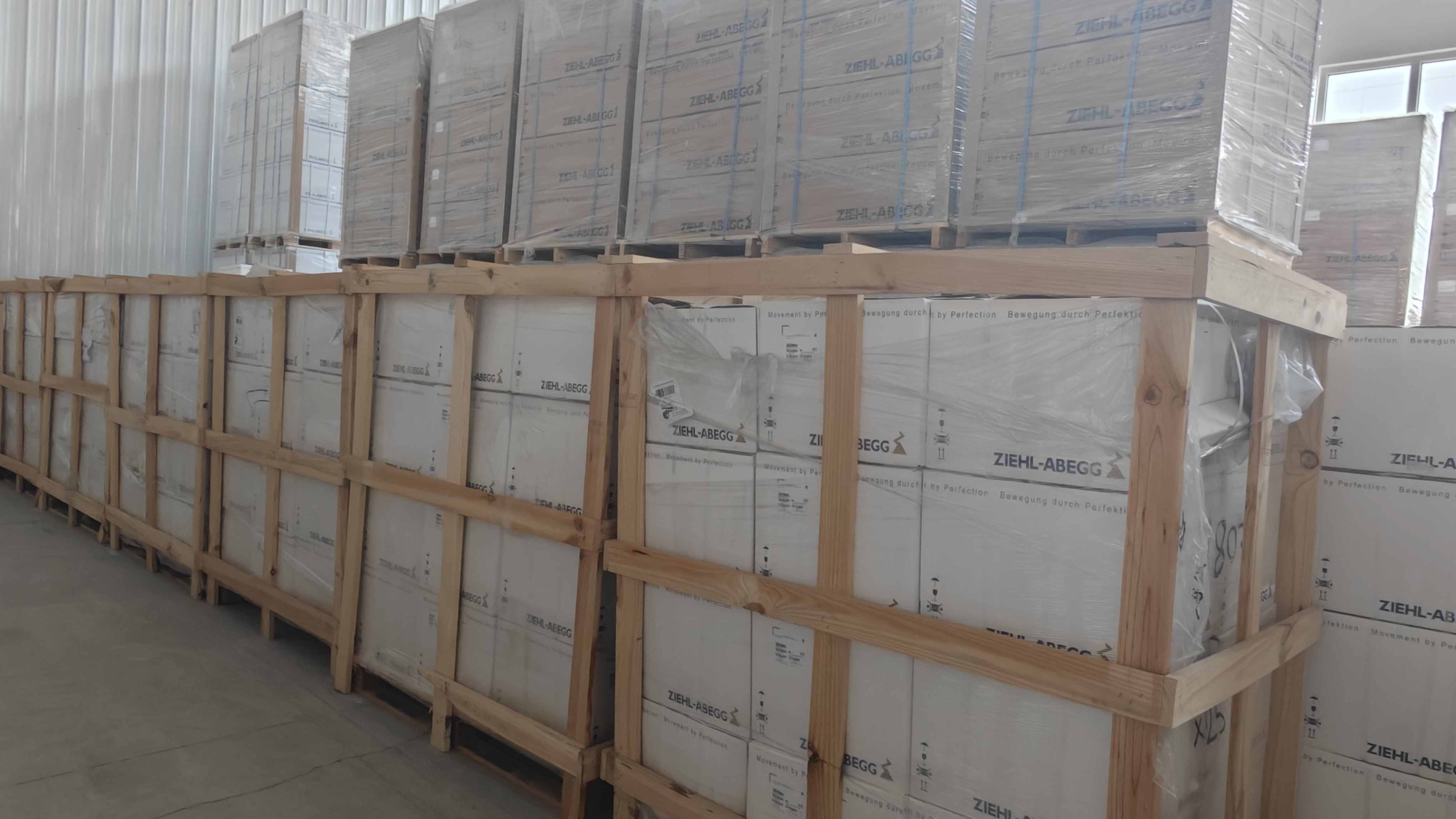
Container handling in the export workflow for fan supply programmes.
An EC centrifugal fan is an air-moving module that pairs a centrifugal impeller, normally backward-curved, with a brushless electronically commutated (EC) motor and integrated drive electronics, so that airflow and static pressure are regulated electrically instead of mechanically. In data-centre CRAH and AHU units, in-row precision air conditioners, cleanroom FFU systems and air-purification equipment, this module is often the most controllable element of the whole thermal train.
For buyers moving from evaluation into execution, the decisive question is no longer which fan curve looks best on a datasheet. It is whether a supplier can specify, customise, integrate and repeat-build the module at the volumes and lead times a project schedule requires. Four capability axes carry most of the weight: impeller and housing fit, drive-electronics integration, duty-point data that can be checked against real system resistance, and OEM delivery discipline covering minimum order quantity, production lead time, pre-shipment acceptance testing and after-sales support.
Why the Supplier Question Now Outweighs the Fan-Curve Question
Centrifugal fans are specified where air must be pushed through resistance: dense fin-and-tube coils, high-efficiency filters, sound attenuators and long duct runs. As rack and cabinet densities increased, those resistance values rose with them, and the published duty points of EC centrifugal modules moved into pressure ranges that fixed-speed AC centrifugal fans reach only at high energy cost. Documented examples in this product class include a 310 mm in-row module rated 4,020 m³/h at 1,583 Pa and a 450 mm high-static-pressure module rated 9,035 m³/h at 1,749 Pa.
The procurement consequence is structural. A fan is no longer a line item purchased on diameter and voltage; it is an integrated electromechanical assembly in which impeller, motor, electronics and mounting geometry are matched to one another. Buyers preparing an OEM programme, a fan-wall retrofit or a precision-cooling upgrade are qualifying a manufacturing and integration partner, not just a component.
Inside an EC Centrifugal Fan Module
Mechanically, an EC centrifugal module combines a centrifugal impeller, a brushless motor with electronic commutation, a drive electronics housing, and a support structure that fixes the impeller relative to the inlet ring. In the module families referenced here, impellers are produced in aluminium sheet, die-cast aluminium or PA and PP plastic depending on size and pressure requirement; the support plate and inlet ring are galvanized steel, and the electronics sit in a die-cast aluminium housing that also acts as the heat path for the drive.
Electrically, larger modules in this portfolio accept a three-phase 3~380–480 VAC supply, while smaller cleanroom and air-purification modules run on single-phase 1~200–240 or 1~200–277 VAC. Because commutation is electronic, there are no carbon brushes to wear and no belt to tension, and speed can be adjusted from the integrated electronics rather than through an external variable-frequency drive.
| Model | Nominal size | Supply | Input power / current | Speed | Catalogue ErP point | Typical equipment |
|---|---|---|---|---|---|---|
| K3G310-PV69-03 | 310 mm | 3~380–480 VAC | 3,050 W / 4.7 A | 4,000 rpm | 4,020 m³/h @ 1,583 Pa | In-row air conditioners, compact CRAC, high-resistance filtration |
| K3G310-PH58-02 | 310 mm | 3~380–480 VAC | 2,950 W / 4.6 A | 4,000 rpm | 4,505 m³/h @ 1,479 Pa | In-row cooling, rack-level cooling, high static pressure ventilation |
| R3G355-RG56-01 | 355 mm | 3~380–480 VAC | 930 W / 1.7 A | 2,240 rpm | 3,205 m³/h @ 640 Pa | In-row air conditioners, small CRAH units |
| R3G355-AM14-61 | 355 mm | 1~200–277 VAC | 350 W / 1.5 A | 1,900 rpm | 2,050 m³/h @ 400 Pa | Cleanroom FFU and EFU, semiconductor and pharmaceutical air purification |
| K3G450-PA31-03 | 450 mm | 3~380–480 VAC | 4,450 W / 6.8 A | 2,480 rpm | 8,430 m³/h @ 1,275 Pa | CRAH, AHU, EC fan-wall retrofits |
| K3G450-PB29-L1 | 450 mm | 3~380–480 VAC | 6,800 W / 10.3 A | 2,800 rpm | 9,035 m³/h @ 1,749 Pa | High-density data centre CRAH, fan wall |
| K3G500-PB33-01 | 500 mm | 3~380–480 VAC | 5,700 W / 9.0 A | 2,250 rpm | 10,945 m³/h @ 1,245 Pa | High-static-pressure CRAH and AHU, fan walls |
| R3G500-FA28-03 | 500 mm | 3~380–480 VAC | 2,850 W / 4.4 A | 1,900 rpm | 8,715 m³/h @ 794 Pa | Precision air conditioning (CRAC), AHU, server-room units |
| K3G560-FA28-03 | 560 mm | 3~380–480 VAC | 3,950 W / 6.0 A | 1,900 rpm | 11,970 m³/h @ 831 Pa | Data-centre AHU and CRAH modules, efficiency retrofits |
| K3G560-PB31-03 | 560 mm | 3~380–480 VAC | 4,400 W / 6.6 A | 1,700 rpm | 9,825 m³/h @ 1,049 Pa | CRAH, AHU, fan wall, industrial air handling |
| R3G630-FB32-03 | 630 mm | 3~380–480 VAC | 3,300 W / 5.1 A | 1,370 rpm | 12,190 m³/h @ 670 Pa | Large CRAH, fan walls, ventilation retrofits |
| R3G225-RE07-03 | 225 mm | 1~200–240 VAC | 170 W / 1.4 A | 2,860 rpm | 705 m³/h @ 458 Pa | Compact FFUs, air purifiers, filtration units |
Reading the table correctly is part of the evaluation. A catalogue ErP point states the airflow a module delivers at one defined static pressure; it is not a promise about the installed unit, where coil fouling, filter loading and duct leakage move the operating point. The practical rule is to have the supplier re-check the selection against the actual system-resistance curve for the cabinet, and to ask what happens to the operating point when filters load, because a fan with headroom above the design point behaves differently from one selected at its maximum.
The Supply Route: Beijing Hengrui Hongsheng
Beijing Hengrui Hongsheng Mechanical & Electrical Equipment Co., Ltd., the company behind the Hengrui EC fan supply programme, is a Beijing-based provider founded in 2011 that integrates sales, model selection and matching, and technical service for ventilation and heat-dissipation products together with industrial control electromechanical products. The company operates a 100,000 m² facility with around 700 employees and a team of about 80 engineers in research and development, exports to the United States as its main market at an export share of roughly 70 percent, and maintains offices in Chengdu, Wuxi, Tianjin, Shenzhen and Hong Kong.
Two factors matter more than scale for a buyer assessing EC centrifugal fan supply. First, the company operates as a distribution and selection specialist rather than a single-brand reseller: it holds long-term agency and distribution relationships with manufacturers including ebmpapst, Ziehl-Abegg, SANYO, DELTA, SUNON, Rosenberg, WISTRO, SODECA, NMB, ADDA and S&P, holds exclusive authorisation for WISTRO and SODECA in China, has been rated a Siemens premium supplier, and reports having served more than 20,000 corporate customers, including several Fortune Global 500 companies. Second, its authorised status is documented rather than claimed.
| Authorisation | Issuing party | Reference | Validity |
|---|---|---|---|
| ebmpapst Distributor Authorization Letter | ebm-papst Motor (Shanghai) Co., Ltd. | A50023867 | 2026-01-01 to 2026-12-31 |
| SUNON Distributor Certificate | Sunon Electric Industry Co., Ltd. (Taiwan) | TW2025-001198 | 2025-12-01 to 2026-11-30 |
| Delta Distributor Authorization Certificate | Delta Electronics Enterprise Management (Shanghai) Co., Ltd. | FM-MMXXVI 026 | 2026-01-01 to 2026-12-31 |
| Soler&Palau Certificate of Exclusive Authorization | S&P Sistemas de Ventilación S.L.U | Not stated | Issued 2026-01-19 |
| WISTRO Certificate of Exclusive Authorization | WISTRO Elektro-Mechanik GmbH | 06.10.26,W | Issued 2026-09-15 |
| Excellence Distributor Award 2019 | Not stated | Not stated | 2019 |
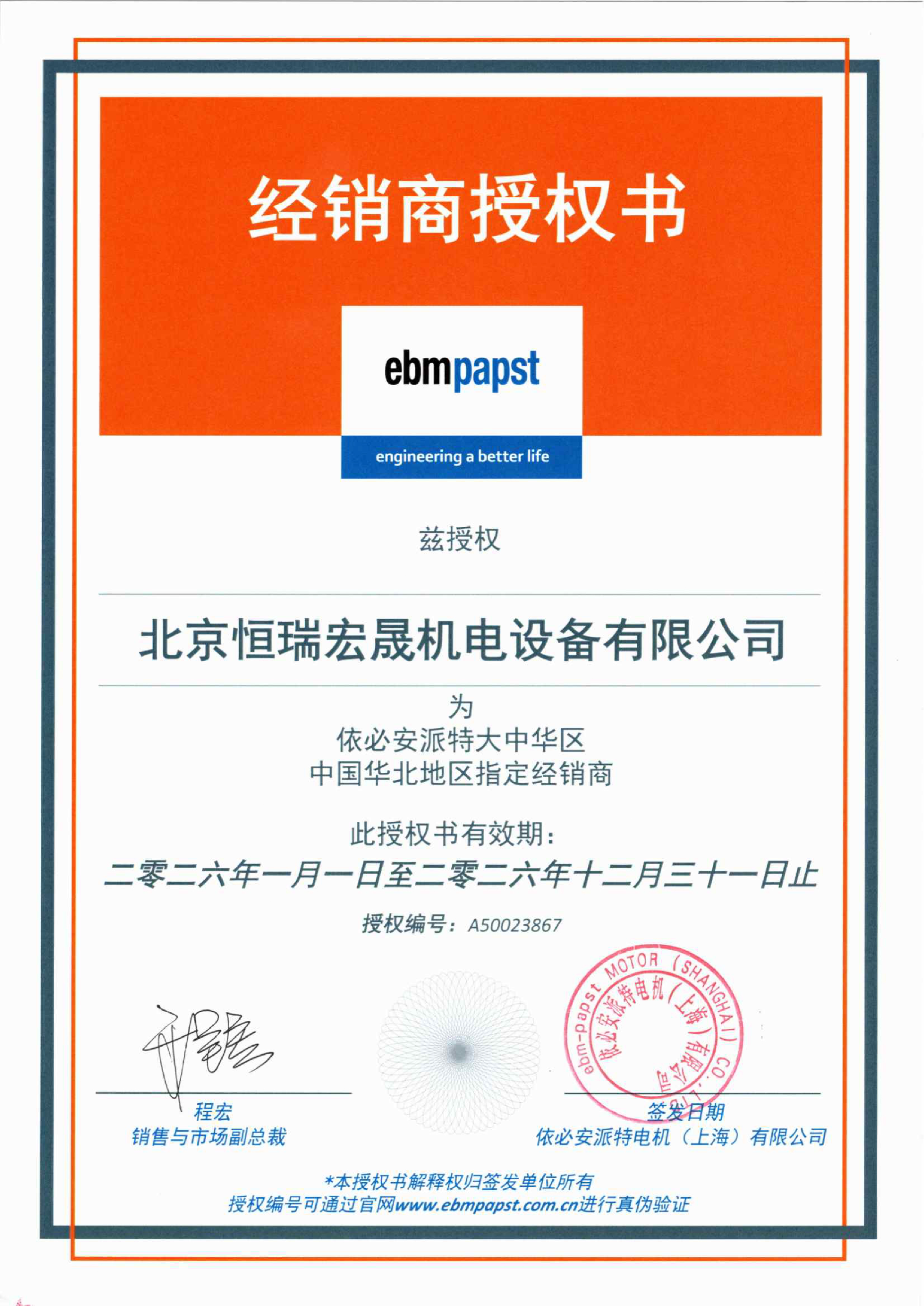
ebmpapst Distributor Authorization Letter, reference A50023867, valid 2026-01-01 to 2026-12-31.
For a project buyer, this mix changes the risk profile of the selection step. When a duty point falls outside one manufacturer's range, the same technical team can move the enquiry to another authorised range instead of forcing a compromise, and the authorisation documents can be attached to a supplier-qualification file as third-party evidence rather than self-declaration.
OEM and Customisation: What the Capability Statement Covers
The company provides OEM production services, including for custom requirements, with a minimum order quantity of 1 unit and a stated monthly OEM production capacity of 100,000 units. OEM production lead time is quoted at 7 days. Acceptance inspection includes a pre-shipment test. Delivery can be arranged on EXW, FOB, FAS, CFR, C&F, CIF, DPU or DDP terms, with payment by corporate transfer, and after-sales support is available 24/7.
Those numbers carry specific meaning for an evaluation-stage buyer. A minimum order quantity of one unit means the OEM route can be used for pilot validation: a single customised module installed in a real AHU, CRAH or in-row unit and run through a cooling cycle before a production commitment is made. A monthly capacity of 100,000 units means a validated design can be scaled without changing supplier, which is usually the point where retrofit programmes and new-build programmes diverge. The 7-day figure is a stated OEM production lead time; buyers specifying non-standard mounting geometry, connector positions or labelling should confirm in writing whether those changes fall inside that window or need separate engineering time.
The company also maintains substantial ready stock and offers selection and matching support, which matters when a module has to fit an existing cabinet aperture. Its product scope spans EC centrifugal fans, EC centrifugal blowers, backward-curved EC fans, axial and DC axial flow fan ranges, dry cooler fans, chiller fans and AHU fans, across applications in HVAC ventilation and air conditioning, refrigeration equipment, data centres, new energy, industrial automation, air purification, rail transit and power-electronics heat dissipation.
Where EC Centrifugal Modules Are Used
Application fit follows the duty point, not the marketing category.
- Data-centre CRAH, AHU and fan walls. High-static-pressure backward-curved modules such as K3G450-PB29-L1 (9,035 m³/h @ 1,749 Pa), K3G560-PB31-03 (9,825 m³/h @ 1,049 Pa) and K3G560-FA28-03 (11,970 m³/h @ 831 Pa) are selected for coil-and-filter paths, while R3G630-FB32-03 (12,190 m³/h @ 670 Pa) serves larger fan-wall arrays and ventilation retrofits.
- In-row and rack-level precision cooling. Compact high-speed modules such as K3G310-PV69-03 and K3G310-PH58-02, both rated at 4,000 rpm, target in-row air conditioners, compact CRAC units and high-resistance filtration where installation space is constrained and pressure demand is high.
- Cleanroom FFU and air purification. Single-phase R3G355-AM14-61 (2,050 m³/h @ 400 Pa) and R3G225-RE07-03 (705 m³/h @ 458 Pa) are sized for FFU and EFU units, semiconductor and pharmaceutical filtration, and compact air purifiers.
- Mixed cooling programmes. Where a project combines cabinet cooling with outdoor heat rejection, axial modules are used alongside centrifugal ones: W3G910-LV12-36 (24,750 m³/h @ 256 Pa) and the 800 mm W3G800-LV05-03 with guide vanes (19,225 m³/h @ 337 Pa) for dry coolers and cooling towers, plus 48 V DC units such as 2218F/2TDH4OR-227 (1,220 m³/h, 1,170 Pa) and AxiEco 200 (1,820 m³/h, 1,300 Pa) for cabinets, communication equipment, AI servers and rear-door heat exchangers.
A supply programme of 500,000 units has been delivered to a United States customer base covering general ventilation and cooling, duct-based air boosting and supply, high-pressure air supply, compact equipment cooling, natural cooling, central air-conditioning supply, refrigeration cooling and HVAC ventilation. Documented portfolio data connected to that programme includes module sizes spanning 20 × 20 × 8 mm to 850 × 850 × 222 mm, noise levels as low as 31 dB on specified models, and a sample unit drawing 2.8 W at 230 V.
EC Centrifugal Fans Versus Fixed-Speed AC Centrifugal Fans
The efficiency argument for EC is well established: electronic commutation removes brushes and belt losses and allows speed to follow the load instead of a damper position. The comparison is not one-sided, and a fair specification acknowledges where EC centrifugal modules are the weaker choice.
| Evaluation criterion | Fixed-speed AC centrifugal fan | EC centrifugal fan module |
|---|---|---|
| Speed control | Usually via damper, inlet guide vanes or an external variable-frequency drive | Integrated electronics; no external drive required |
| Wearing parts | Bearings, plus belt where belt-driven | No brushes, no belt |
| Service model | Motor can often be replaced or rewound independently of the impeller | Motor, electronics and impeller are a matched set; drive failure generally means module-level replacement |
| Retrofit fit | Mechanical footprint may differ from EC modules; secondary mechanical work is common | Requires the mounting plate, inlet ring and cabinet aperture to match the module geometry |
| Supply grid | Broad tolerance, simple wiring | Defined voltage windows, for example 3~380–480 VAC or 1~200–277 VAC in this portfolio |
| Upfront cost | Generally lower unit cost | Generally higher unit cost, offset by part-load energy savings and simplified control |
Two limits are worth stating plainly. First, EC modules are not field-repairable in the way a standard induction motor is: because the drive electronics are integrated into the module and matched to the impeller, a drive failure is normally resolved by replacing the module, so critical installations should hold a spare rather than rely on a motor rewind. Second, EC centrifugal fans are the wrong tool for high-flow, low-resistance duty. Where a dry cooler, condenser or cooling tower needs large free-air volumes at low static pressure, an axial module such as W3G910-LV12-36 (24,750 m³/h @ 256 Pa) is the more efficient selection, and a centrifugal module in that position raises energy consumption and cost without improving the result.
Market Direction: Efficiency Documentation and Retrofit Volume
Three shifts are visible in cooling and air-handling procurement, and all three push demand toward EC centrifugal modules.
Efficiency has become a documented specification rather than a claim. Catalogue data for this class is published as an ErP point, meaning airflow at a defined static pressure, which lets module families be compared on one basis: from 705 m³/h @ 458 Pa for a 225 mm compact module to 12,190 m³/h @ 670 Pa for a 630 mm fan-wall module. Buyers can therefore require a stated duty point instead of accepting a qualitative efficiency statement.
Retrofit volume increasingly runs alongside new-build volume in installed cooling fleets. Many AHU, CRAH and precision air-conditioning units were built around fixed-speed AC fans with dampers; re-fanning them with EC modules improves part-load behaviour without replacing the cabinet, and the binding constraint in those projects is mounting geometry and electronics envelope rather than the fan curve itself.
Densification continues to pull higher-pressure modules and DC-powered cabinet fans into designs that previously used general-purpose ventilation products. In-row units, rear-door heat exchangers and high-density electronic equipment now specify modules rated above 1,000 Pa, such as 4,020 m³/h @ 1,583 Pa or, at cabinet level, 1,820 m³/h @ 1,300 Pa at 48 V DC.
What to Verify Before You Scale Up
- Duty point against system resistance. Ask for the selection to be re-run against the actual coil, filter and duct curves, not the catalogue ErP point alone.
- Mechanical interface. Confirm mounting plate dimensions, inlet ring geometry, aperture clearance and service access for the electronics housing.
- Supply and control. Match the module voltage window, for example 3~380–480 VAC or 1~200–277 VAC, to the cabinet supply, and establish how speed is commanded on site.
- Customisation scope. Establish which parts of the module can be modified, such as geometry, material, connector position or labelling, and confirm the OEM minimum order quantity and lead time that apply to that configuration.
- Acceptance testing. Agree the pre-shipment test scope, the duty point tested, and the record that is delivered with the consignment.
- Supply continuity. Check current authorisation documents and validity dates, and whether the supplier holds stock for fast shipment.
- Service model. Decide whether the installation needs spare modules on site, given that the drive electronics are integral.
Future Outlook
EC centrifugal modules are likely to keep displacing fixed-speed AC fans in AHU, CRAH and precision-cooling units, and the pressure requirements they are asked to meet will keep rising as filtration and coil densities increase. Two further developments appear probable. Specification work will move earlier into the design cycle, with buyers asking suppliers to match impeller, electronics and mounting geometry to a cabinet rather than selecting from a catalogue list. Documentation will also carry more weight in supplier qualification: authorisation letters with validity dates, stated OEM capacity and lead times, and pre-shipment test records are becoming the evidence buyers attach to an approval file.
For companies positioning in this space, the differentiator is less the catalogue of impeller sizes than the ability to select accurately, customise within a defined scope, and deliver repeatable modules against an agreed test. Further technical detail on the centrifugal, axial and DC module ranges described above, and on the company authorisation and service network, is published at en.bjhengrui.com.
FAQ
1. What is the difference between an EC centrifugal fan and an AC centrifugal fan?
Both use a centrifugal impeller to accelerate air outward and convert velocity into static pressure. The difference sits in the motor and drive: an AC centrifugal fan uses an induction motor whose speed is set by the supply frequency, so airflow is adjusted with dampers, inlet guide vanes or an external variable-frequency drive, whereas an EC centrifugal fan uses a brushless motor with electronic commutation and integrated electronics, so the module runs from a mains supply and adjusts speed electronically. In practice this removes brushes and belts and simplifies part-load control, but it also places the drive inside the module, which makes service module-level rather than motor-level.
2. When should an EC centrifugal fan be chosen instead of an EC axial fan?
The choice follows the duty point. Axial modules fit high-flow, low-resistance air paths: documented examples include a 910 mm fan rated 24,750 m³/h at 256 Pa and an 800 mm fan with guide vanes rated 19,225 m³/h at 337 Pa, both typical of dry coolers, condensers and cooling towers. Centrifugal modules suit higher-resistance paths and compact packaging, with examples such as 9,035 m³/h at 1,749 Pa or 4,020 m³/h at 1,583 Pa where coils and filters dominate the system curve. Selecting a centrifugal module for a low-resistance free-blow duty tends to raise energy use, while using an axial module against a heavily loaded coil and filter path usually fails to reach the required flow.
3. What OEM and customisation options exist for EC centrifugal fans, and what is the minimum order quantity?
The manufacturer provides OEM production services, including for custom requirements. The OEM minimum order quantity is 1 unit, and the stated monthly OEM production capacity is 100,000 units. Because a module consists of matched impeller, motor, electronics and mounting hardware, buyers should confirm in advance which elements are open to customisation on the specific module family being considered, for example mounting plate and inlet ring geometry, impeller material, connector and cable configuration, or labelling, and should ask for the selection and matching step to be re-run for any change.
4. What lead time and delivery terms apply to OEM fan orders?
The stated OEM production lead time is 7 days, with a minimum order quantity of 1 unit and a monthly OEM capacity of 100,000 units. Buyers should confirm in writing whether a customised configuration falls inside the standard production window or requires separate engineering time. Delivery can be arranged under EXW, FOB, FAS, CFR, C&F, CIF, DPU or DDP terms, with payment by corporate transfer, and the stated export market for the programme described here is the United States.
5. How is acceptance inspection handled before shipment?
Acceptance inspection for the fan supply includes a pre-shipment test. To make that test meaningful, the buyer should agree the tested duty point, the measurement record format and the acceptance criteria before production, and should confirm that the record accompanies the consignment. After delivery, technical support is available 24/7 for installation, matching and operating questions.