
E1, E0 and CARB: Wood Panel Compliance for MDF, Plywood and LVL Buyers
E1, E0 and CARB: Wood Panel Compliance for MDF, Plywood and LVL Buyers

Formaldehyde emission classes have moved from a laboratory footnote to the front page of purchasing contracts. The global plywood market was valued at USD 80.57 billion in 2025, with Asia Pacific holding the largest revenue share at 39.4% (Grand View Research), and the global MDF market is projected to grow from USD 44.96 billion in 2025 to USD 82.24 billion by 2033 at a CAGR of 8.2% (Grand View Research). Volume growth on that scale puts more containers, more declarations and more audit questions into circulation every year.
For buyers importing MDF, plywood and LVL into Europe and North America, three labels dominate the specification sheet: E1, E0 and CARB P2. They are used almost interchangeably in quotations, and they are not interchangeable. What follows explains what each label governs, where its authority ends, how the European and US frameworks differ, and how compliance is actually reproduced in production — through multi-stage quality control, inspection at defined stages, and stable sourcing from long-term suppliers, rather than a certificate attached to an email.
1. Where the compliance requirement comes from
Two regulatory families create most of the confusion for panel buyers.
European Union. Wood-based panels used in construction must support CE marking eligibility through the harmonised European standard EN 13986 (European Panel Federation). The emission class sits inside that declaration framework rather than replacing it, which is why European buyers normally receive an emission class and a CE-related document set at the same time. A supplier who provides only one of the two leaves the buyer to close the gap later in the order cycle.
United States. The federal EPA TSCA Title VI regulation sets formaldehyde emission limits for composite wood products at 0.11 ppm for MDF and 0.05 ppm for hardwood plywood (US Environmental Protection Agency). California's CARB Phase 2 programme applies to composite wood products sold in California, and the two frameworks are closely aligned in intent and test logic.
The practical consequence is that a single production line may need to carry several claims at once: an emission class for the European market, a Title VI-compatible class for the United States, a Japanese standard for structural LVL, and origin documentation for forest-related due diligence. A supplier who can document only one of these is not facing a paperwork gap — that supplier is facing a market-access constraint, and the constraint usually surfaces after the purchase order has been issued.
2. What each label covers, and what it does not
These labels are often presented as a quality ladder. They are better read as a boundary map: each one answers a specific question for a specific market.
| Label / framework | Where it normally applies | What it governs | What it does not cover |
|---|---|---|---|
| E1 | European and export specifications for interior-grade boards | Formaldehyde emission class of the finished panel | Moisture durability, structural grade, origin legality |
| E0 | Furniture and export contracts; low-emission interior specifications | Formaldehyde emission class, generally understood as a stricter tier than E1 | Market-specific regulatory conformity, binder performance, CE marking |
| CARB P2 | Composite wood products sold in California; aligned with US federal practice | Formaldehyde emission for composite wood | Panel strength, exterior glue performance, EU construction marking |
| EPA TSCA Title VI | United States federal baseline | Emission limits of 0.11 ppm for MDF and 0.05 ppm for hardwood plywood | European declaration frameworks, deforestation due diligence |
| EN 13986 | Wood-based panels for construction in the EU | The harmonised standard supporting CE marking eligibility | It is not an emission class in itself |
| JAS / JIS | Japanese market requirements, relevant for structural LVL | Conformity of wood products to Japanese standard requirements | EU or US emission classes |
| FSC / EUDR | Origin and due diligence expectations | Forest-management certification and deforestation-related due diligence | Formaldehyde emission performance |
Table 1: Frameworks relevant to MDF, plywood and LVL supply into European and North American markets.
Two clarifications matter here. First, E0 is generally understood as a stricter low-emission tier than E1 and is widely written into furniture and export contracts, but it operates as a commercial emission classification rather than a construction-product marking framework. Second, FSC and EUDR documents are often filed in the same folder as emission certificates; buyers should keep them separate, because origin evidence does not answer emission questions and emission evidence does not answer origin questions.
3. Emission class and moisture performance are two different axes
The most common specification error in panel procurement is treating the emission class as a proxy for durability. These are separate variables: emission class describes formaldehyde release, while binder type describes how a panel behaves when it meets water.
Across the product range manufactured by Dalian WADA International Trading Co., Ltd., the two axes are declared separately:
- MDF — E0 / CARB P2 / E1 glues; sizes from 4×8 to 8×16 ft; thickness 1.2–50 mm; continuous flat pressing on Difenbach & Sinbelkamp (Germany) equipment; density 500–1000 kgs/m³; moisture content 5%–13%. Typical uses include furniture board, routed board, lightweight high-strength board and water-proof board.
- Commercial Plywood — E0 / CARB P2 / E1 / E2 / WBP glues; 4×8 ft or as required; thickness 2–25 mm; faces in birch, pine, okoume, bintangor, sapeli, pencil cedar or poplar; furniture, construction, packing and industry grades.
- Film Faced Plywood — MR / Melamine WBP / Phenolic WBP; 1200×1800 to 1500×3000 mm; thickness 4–35 mm; construction grade for formwork and concrete work.
- Marine Plywood — Melamine WBP or Phenolic WBP; thickness 9–25 mm; shipbuilding, boat and yacht manufacturing, waterfront and high-moisture applications.
- Structural Plywood — Melamine WBP or Phenolic WBP; thickness 9–28 mm; timber frame construction, roofing and flooring systems, infrastructure work.
- Melamine Board — E0 / CARB P2 / E1 / E2; core in plywood, MDF, particle board or blockboard; surfaces in melamine paper, PET film or HPL.
- Veneered Board — E0 / CARB P2 / E1 / E2 / Melamine; thickness 2–25 mm; veneer faces including white oak, red oak, black walnut, ash, birch and pine.
- LVL (bed slat) — E0 / E1 glues; thickness 7–15 mm; birch, beech or poplar face and core.
The pattern is consistent: interior decorative and furniture panels are specified mainly by emission class, while exterior, marine and structural panels are specified mainly by binder type. A quotation that lists E0 but omits the binder type is incomplete for any moisture-exposed application, and a quotation that lists WBP but omits the emission class is incomplete for interior use in a regulated market.
4. Why the same panel passes one review and fails the next
Compliance failures rarely begin with a missing certificate. They begin in the gap between a certificate and a shipment.
- Scope mismatch. A certificate typically covers a product class, not every size, thickness, core or face combination a buyer orders.
- Batch variation. Resin dosing, fibre or veneer moisture and press parameters shift between production runs, and emission performance shifts with them.
- Sampling reality. A single sample board is not a container. Buyers who validate on samples and accept on trust carry the residual risk into the destination market.
- Raw material fluctuation. Changing veneer or fibre sources changes the input to the glue line — a direct route to inconsistent results even when the declared class has not changed on paper.
- Documentation drift. Certificate holders, revisions and validity periods change quietly, and buyers often discover this at the port rather than at the factory.
These are process risks, and buyers in the execution stage tend to rank them in the same order: panel quality inconsistency first, followed by raw material fluctuation, delivery delay, and the coordination risk that appears when one container is assembled from several suppliers running different quality systems.
5. Multi-stage QC as the operational backbone of certification
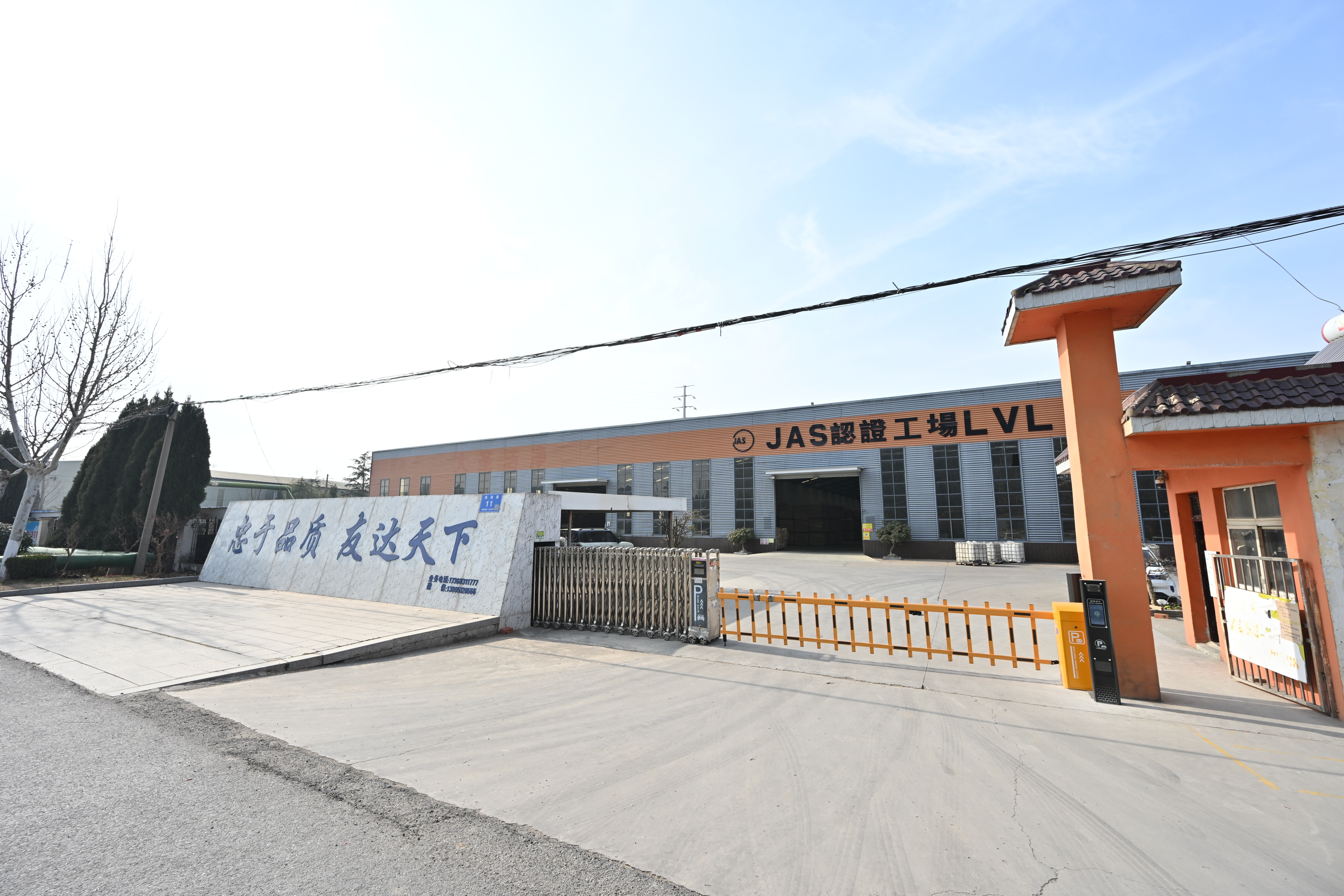
Dalian WADA International Trading Co., Ltd. is a manufacturer and global exporter of engineered wood products — LVL, plywood, veneered board, MDF, OSB, wall panel and woodworking machinery — established in 2010, operating a 53,950 m² production site with around 200 employees, a 25-engineer R&D team and a 100% export orientation serving North America, the EU, Australia, Japan, South Korea, the Middle East, Mexico and South America. The company holds FSC, EUDR, CARB P2, EPA, JAS and JIS certifications.
Inside that structure, certification reliability is delivered by inspection rather than by the certificate itself. The risk register is explicit, and the controls are matched to it.
| Risk | Control method | Operating measure |
|---|---|---|
| Panel quality inconsistency | Quality inspection | Multi-stage QC |
| Raw material fluctuation | Stable sourcing | Long-term suppliers |
| Delivery delay | Schedule control | Production planning |
| Multi-supplier coordination risk | Integrated supply | One-stop solution |
Table 2: Risk-to-control mapping behind consistent certification conformance.
A multi-stage QC regime places inspection checkpoints at defined production stages rather than only at final packing, and it is supported by a 100% inspection protocol so that deviations are identified where they originate. That is the difference between a factory able to pass a single test and a factory able to repeat a declared class across months of shipments. The quality team combines experienced inspectors, technical staff and workers with long experience in the timber industry — an operational detail that matters, because most emission drift is caused by input variation rather than press failure.
Volume discipline belongs to the same argument. Monthly panel production capacity exceeds 10,000 CBM, which allows a declared class to be sustained across repeat orders instead of being re-engineered for each enquiry.
6. A verification protocol for buyers at the execution stage
The sequence below is designed for buyers who have already shortlisted suppliers and are preparing a first or repeat order. It converts certification from a claim into evidence.
- Map the claim to the destination market before the order is placed. Establish whether the required class serves EU construction use, the US federal baseline, California, or a combination of these.
- Request the glue declaration per product model, not per company. An E0 or CARB P2 statement is only useful when it is attached to the specific MDF, plywood or LVL line being ordered.
- Check certificate scope, holder name and validity against the exact product, thickness and face or core combination in the enquiry.
- Tie acceptance to a pre-shipment test. Pre-shipment testing is the point at which a declared class is verified against the actual production lot rather than against a reference sample.
- Ask for stage-level QC records. Multi-stage QC implies inspection evidence at defined stages; if the only evidence is a final certificate, the buyer cannot see where the class is controlled.
- Confirm continuity of supply. Monthly panel capacity above 10,000 CBM and stable sourcing from long-term suppliers are the conditions under which a declared class stays stable between shipments.
- Re-validate on repeat orders. Certification conformity is a running condition, not a one-time milestone at first purchase.
7. Where this model fits — and where it does not
Honest boundaries are part of a usable supplier reference, and several of them apply to certification-led supply:
- Class declarations are product-class declarations. A new core, face or size combination may require separate validation before it can be supplied under the same claim.
- Inspection reduces variance; it does not remove it. Multi-stage QC lowers the probability of an out-of-spec lot, which is why pre-shipment testing should stay in the contract rather than being replaced by a QC statement.
- Order economics are container-scale. With a 40' container MOQ, sample validation has to be planned inside a container-scale order; buyers looking for a few boards for a one-off trial will find the commercial model misaligned with their need.
- Integrated supply is a continuity trade-off. A one-stop model concentrates responsibility, documentation and sourcing under a single supplier, which suits buyers optimizing repeat-order stability. Buyers whose priority is spot flexibility should expect additional coordination work and should plan for it.
- Certification stops at the panel. Handling, storage and installation conditions downstream fall outside the declared scope and remain the buyer's responsibility.
8. Long-term sourcing as a compliance strategy
Compliance is usually described as a property of a product. In repeat-order supply, it behaves more like a property of a relationship. When raw material sources change, the glue line receives different inputs, and emission performance can drift even though the declared class on paper has not moved. Stable sourcing from long-term suppliers is the control that addresses this risk at its root rather than at final inspection.
The buyer-side effects are practical. Documentation continuity means the same declared class, holder and revision apply to shipment one and shipment ten. The audit trail shortens because QC records follow a known format. Requalification events drop, and distributors can promise the same declared class to their own customers across a season instead of per container. Switching suppliers mid-project resets all of that work — which is why, in this category, compliance discipline and long-term supplier relationships tend to reinforce each other.
9. What changes next
- Volume keeps rising. The MDF market is projected to grow at an 8.2% CAGR from 2025 to 2033; oriented strand board production already reached over 32 million cubic meters globally in 2024, with the USA accounting for 14 million cubic meters; and the wood plastic composites market reached USD 8.89 billion in 2025 with an expected CAGR of 11.7% to 2033. More volume means more documentation in circulation.
- Regional frameworks are not converging quickly. EU construction marking and US federal emission limits remain separate systems, so suppliers able to carry multiple market claims will keep an advantage over single-market producers.
- Documentation is moving toward batch level. Buyers increasingly expect evidence tied to a production lot rather than a company-level certificate, which shifts weight toward suppliers with structured inspection records.
- Origin and emission are reviewed together. China was the second largest exporter of raw timber (HS 44) to the U.S. in 2024, contributing USD 2.17 billion, or a 9% share (ITC / US Census Bureau), which keeps origin documentation in the same review folder as emission testing.
10. FAQ: E1, E0 and CARB compliance questions
What is the practical difference between E1, E0 and CARB P2 on a wood panel quotation?
E1 and E0 are formaldehyde emission classes used in European and export specifications, with E0 generally understood as the stricter tier and widely applied in furniture and export contracts. CARB P2 refers to California's Phase 2 programme for composite wood, which is closely aligned in intent with the US federal EPA TSCA Title VI limits of 0.11 ppm for MDF and 0.05 ppm for hardwood plywood. The three labels answer the same question for different markets; none of them describes moisture resistance, structural grade or origin legality.
How can a buyer verify an E0 or CARB P2 claim before the container ships?
Ask for the glue declaration at product-model level rather than company level, check the certificate scope, holder name and validity, and tie acceptance to a pre-shipment test so the claim is verified against the actual production lot. Stage-level QC records — the inspection points behind multi-stage QC — are the evidence that a declared class is reproduced in production and not only in a sample.
Do E1, E0 and CARB P2 apply the same way to MDF, plywood and LVL?
No. Composite wood products fall under different test regimes depending on construction: MDF is a fibre-based panel, plywood is veneer-based, and LVL is a veneer-laminated engineered product with its own structural and standard requirements, where JAS and JIS are relevant for the Japanese market. Whether a supplier can declare the same class across all three families depends on glue selection and process control on each line, not on a single certificate.
Which class does a buyer need for the EU versus the US?
For construction panels used in the EU, the starting point is CE marking eligibility under EN 13986, with the emission class declared inside that framework. For the US, the federal baseline is EPA TSCA Title VI, with the CARB Phase 2 programme applying to composite wood sold in California. Buyers shipping to both markets typically specify a class that satisfies the stricter requirement and confirm binder type separately for moisture-exposed applications.
How does long-term sourcing affect certification consistency across repeat orders?
Certification consistency depends on stable inputs. When raw material sources change, resin dosing, moisture content and press behaviour change with them, and emission performance can drift even when the declared class has not changed on paper. Long-term relationships with stable suppliers reduce that variation, and panel capacity above 10,000 CBM per month at Dalian WADA supports continuity of a declared class across repeat orders. This is a continuity argument rather than a price argument: validating a new supplier resets the evidence trail and the inspection history that made the class reliable in the first place.
Dalian WADA International Trading Co., Ltd. publishes its company profile, product categories and certification list in a downloadable brochure: WADA Group company brochure (PDF). Buyers evaluating MDF, plywood, LVL, veneered board or melamine board can compare the declared specifications and categories against their own market requirements.