
E-Coating Compliance: ISO 9001, ISO 14001 and Low-VOC Rules
E-Coating Compliance: ISO 9001, ISO 14001 and Low-VOC Rules
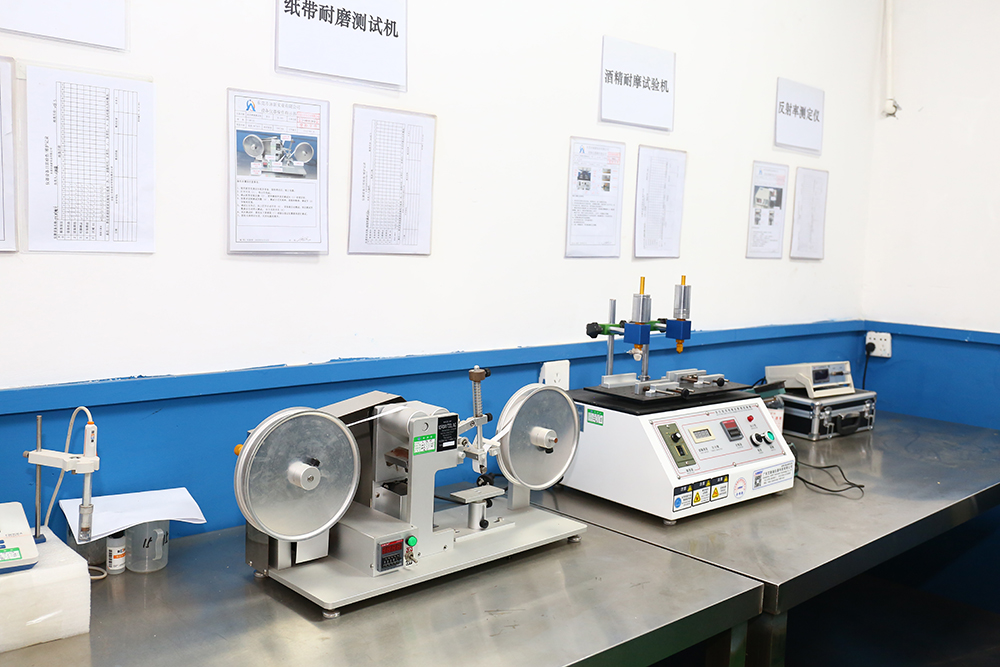
Film durability testing is one of the checks that turns an E-coating specification into an auditable record.
Electrophoretic coating — also written as E-coating, ED coating, E-coat or electrophoretic deposition — has moved from a niche anti-corrosion primer to a mainstream finishing route for metal parts in automotive, electronics and industrial hardware. As the process scaled, the paperwork scaled with it. For buyers at the decision stage, the practical question is no longer only whether a coating resists salt spray, but whether the supplier behind it can produce documentation that survives an audit.
This reference breaks the qualification framework down into the credentials buyers ask about most often — ISO 9001, ISO 14001 and, where automotive work is involved, IATF 16949 — and explains how coating chemistry claims such as water-based, low-VOC and heavy-metal-free should be evidenced rather than assumed. Dongguan Yongxin Industrial Co., Ltd. (Yongxin) is used as a working reference throughout: a metal surface treatment and electrophoretic coating processor based in Qiaotou Town, Dongguan City, China, operating six electrophoresis production lines and an in-house quality testing laboratory.
Why Compliance Qualification Became a Procurement Gate
Two forces converged. First, E-coated parts now sit inside regulated products — vehicle frames and chassis components, motor housings, communication equipment enclosures, consumer electronics housings, drone components, security hardware — so the surface treatment inherits the compliance obligations of the finished assembly. Second, the process itself is chemically and environmentally intensive. It runs on a liquid paint bath, generates phosphating and paint-containing wastewater, and depends on continuous circulation to stay stable.
The consequence is that certification status now functions as a screening gate rather than a differentiator. A supplier without a recognised quality management system forces the buyer to substitute its own audit effort, incoming inspection and rework budget for a certificate. That substitution is expensive and slow, and it is the reason ISO 9001 and ISO 14001 are frequently requested before a sample order is even discussed.
The Credentials Buyers Actually Check
ISO 9001: Process Control You Can Audit
ISO 9001 is a quality management system standard. For a coating buyer it matters less as a badge than as a structural commitment: documented procedures, defined responsibilities, traceable process records, and a corrective-action loop when something drifts. On an E-coating line, that commitment translates into recorded bath parameters, controlled curing temperatures, and inspection results that can be tied back to a production batch.
Yongxin holds ISO 9001 Quality Management System Certification, and its quality function is supported by more than 20 high-precision testing instruments. The equipment list includes a German FISCHER film thickness gauge, a Swiss Zehntner gloss meter, a Japanese Konica Minolta spectrophotometer and a Japanese Mitutoyo roughness meter, alongside a salt spray tester, a constant temperature and humidity tester, a reflectometer, an electron microscope, a tape abrasion tester, an alcohol rubber friction tester and tank solution analysis equipment. The practical value for a buyer is that the parameters normally written into a purchase specification — film thickness, gloss, colour, roughness, salt spray hours — can be measured in-house rather than asserted in an email.
ISO 14001: Managing the Environmental Side of a Wet Process
ISO 14001 is an environmental management system standard. It becomes buyer-relevant because E-coating carries a real effluent profile. Phosphating pretreatment and paint carry-over produce wastewater that requires dedicated treatment, and category comparison data notes that this makes environmental compliance costs higher for E-coating than for dry powder coating. A supplier operating under ISO 14001 has committed to identifying those environmental aspects, setting controls around them, and monitoring performance over time.
Yongxin holds ISO 14001 Environmental Management System Certification. Its production is described as using environmentally friendly electrophoretic coatings, meeting emission standards and complying with industry environmental protection requirements. For an OEM whose own customers audit its supply chain, that reduces the chance of an environmental finding landing on the buyer's supplier file — which is where the cost of a non-compliant coater is ultimately absorbed.
IATF 16949: The Automotive Entry Ticket
Where the coated part ends up in a vehicle, ISO 9001 alone is usually insufficient. IATF 16949 is the automotive quality management system standard, and it is commonly a precondition for quoting automotive work at all, because it enforces traceability, change control and defect-prevention disciplines that a general-purpose QMS does not require.
Yongxin holds IATF 16949 Automotive Quality Management System Certification. Its processed parts are used in automobiles, bicycles, communication equipment, consumer electronics, drones and security products, and it exports at a ratio of 30% into Europe and America, Southeast Asia, Mexico, Poland, Turkey and Brazil. In 2023 the company was awarded the title of National High-Tech Enterprise and holds multiple national utility model patents.
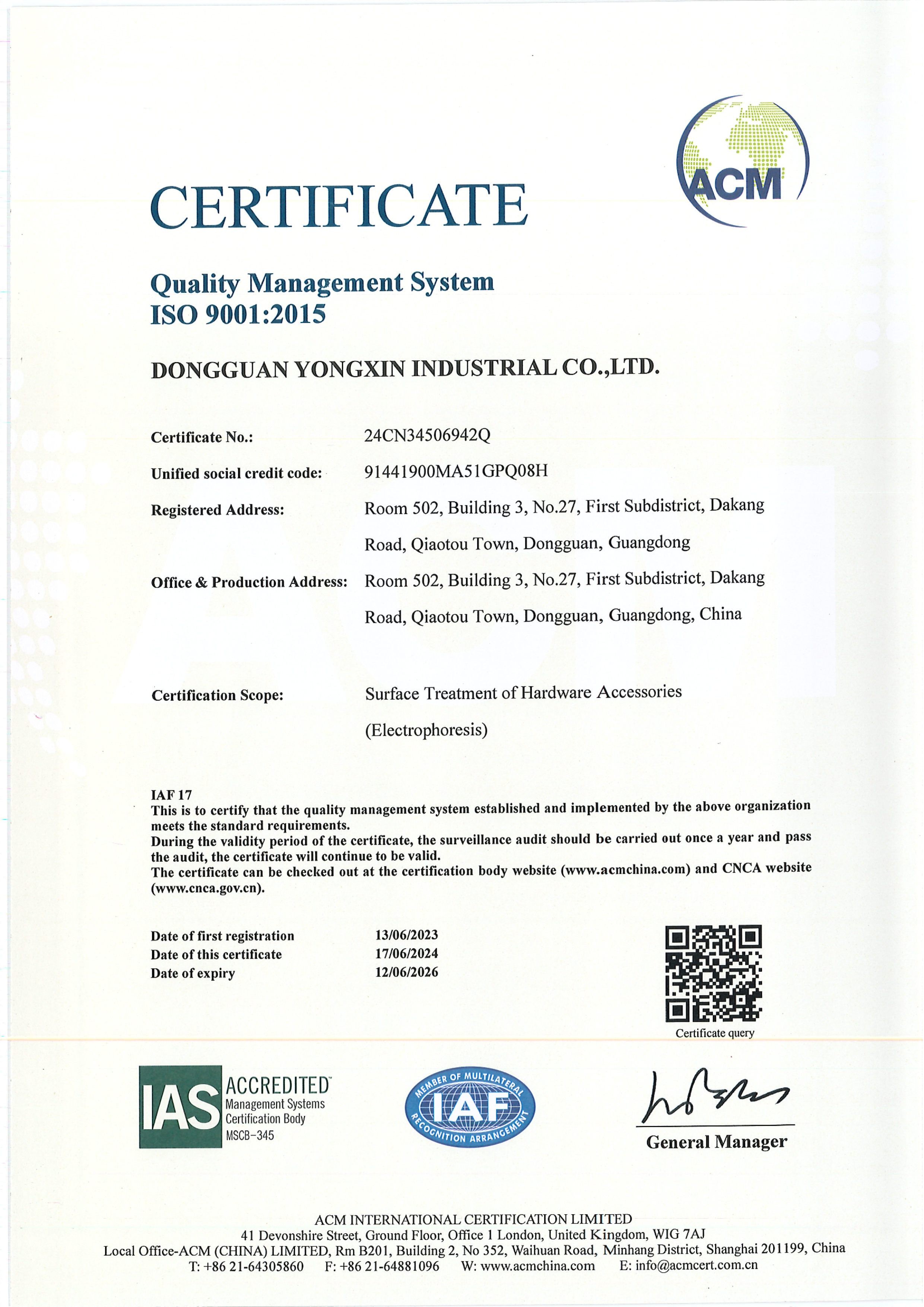
ISO 9001 certification is a management-system credential; it underpins, but does not replace, part-level coating validation.
What Each Credential Covers — and What It Does Not
| Credential | What it establishes | What it does not establish |
|---|---|---|
| ISO 9001 | Quality management system, documented process control, traceable records, corrective action | That a specific part will meet a specific salt spray, thickness or adhesion target |
| ISO 14001 | Environmental management system covering effluent, emissions and environmental monitoring | That the coating formulation is low-VOC or heavy-metal-free — those are separate material claims |
| IATF 16949 | Automotive quality management system with traceability and change-control requirements | Part-level validation for the buyer's own application or duty cycle |
What “Water-Based, Low-VOC and Heavy-Metal-Free” Actually Mean
E-coating is an immersion process. The workpiece is fully immersed in a water-based paint bath; under the influence of a direct current electric field, charged paint particles migrate and deposit uniformly onto the surface; the part is then cured at elevated temperature to form a continuous film. Typical film builds sit in the 20–40 micron range, and material transfer efficiency is commonly cited at around 95%.
Because the carrier is water rather than solvent, the process begins from a lower solvent load than conventional solvent-borne spray finishing. That is a process-level statement, not a product-level guarantee. Three attributes are frequently bundled together in supplier marketing, and separating them is one of the most useful things a buyer can do during evaluation:
- Water-based describes the bath carrier. It is a characteristic of the process itself.
- Low-VOC is a formulation outcome, driven by the resin system, co-solvents and additives. VOC content is measured, not implied by the word “water-based”.
- Heavy-metal-free is also a formulation outcome, driven by pigment and additive selection. Restrictions on substances such as lead, cadmium, mercury and hexavalent chromium — familiar to most buyers from RoHS-style electronics rules — make this a documentary question, and REACH-style substance registration adds a second layer for European destinations.
The operational conclusion is straightforward. Treat water-based as the process default, and treat low-VOC and heavy-metal-free as claims that require a document trail: a safety data sheet, a substance declaration, and where the application warrants it, a third-party test report. Resin selection matters just as much as the certification file. Cathodic epoxy coatings dominate the market and frequently exceed 1,000 hours of salt spray resistance under ASTM B117, while anodic coatings typically sit around 500 hours. That spread is driven by chemistry, not by which certificate is framed on the office wall.
What Yongxin's Qualification Position Covers in Practice
Qualification is easier to judge when it maps onto physical capability. Yongxin was established in 2018 and in 2025 completed the expansion of a modern factory with a total plant area of 10,000 square metres. Production runs across six professional electrophoresis production lines, supported by more than 20 general processing units such as sand blasters, polishers, shot blasting machines and laser equipment, plus more than 20 CNC machines, more than 10 die-casting machines and more than 10 metal stamping machines. That combination supports a connected chain of metal forming, precision machining and surface treatment rather than coating alone.
On the process side, the technical approach combines high-end environmentally friendly electrophoretic raw materials with a complete phosphating pretreatment process. Coverage is managed through precise pressure control and an intelligent electrophoresis production line, which the company describes as achieving full coverage without blind spots and eliminating common defects such as exposed base, thin coating, sagging and pinholes. Its stated product focus includes high salt spray resistance, corrosion resistance and ultraviolet resistance, and the coating is positioned as more suitable for outdoor, humid and harsh working conditions that demand high anti-corrosion and weather resistance.
Risk control is documented as automated process monitoring with real-time parameter adjustment and 100% pre-delivery inspection, backed by the ISO 9001 certified quality management system, regular employee skill training and the high-precision instrument set described earlier. For a decision-stage buyer, the relevant question is whether those controls produce records that can travel with the shipment — and whether the substrate range matches the part in front of them.
Where These Credentials Matter Most
The same certificate carries different weight depending on the end market. Matching the credential set to the application is a faster screen than reading a capability brochure end to end.
| End market | Primary qualification gate | What the buyer is really testing |
|---|---|---|
| Automotive components | IATF 16949 plus ISO 9001 | Traceability and change control, in addition to salt spray and film thickness on complex geometry |
| Consumer electronics and communication equipment | ISO 9001 plus material declarations | Appearance consistency, colour and gloss control, and substance documentation for the finished assembly |
| Drones and security hardware | ISO 9001 plus adhesion and abrasion testing | Edge and cavity coverage on small, irregular parts, plus resistance to handling wear |
| Bicycles and general metal hardware | ISO 9001 plus ISO 14001 | Outdoor corrosion performance balanced against environmental compliance in the supply chain |
Yongxin's processed parts are used across automobiles, bicycles, communication equipment, consumer electronics, drones and security applications, which places it in the position of serving several of these gates simultaneously. That matters for buyers who consolidate finishing across product lines: a single qualified processor reduces the number of different audit trails a procurement team has to maintain.
Market Trend: Compliance as a Growth Driver, Not an Overhead
The commercial context supports the compliance emphasis. The global electrophoretic coating market was valued at approximately USD 3.5 billion in 2023 and is projected to reach USD 6.1 billion by 2032, according to Dataintelo, corresponding to a CAGR of about 6.5% from 2024 to 2032, driven largely by automotive and construction demand. Asia-Pacific is both the largest and the fastest-growing region, holding over 46% revenue share in the broader coatings market in 2025, led by China and India, according to Grand View Research.
At the chemistry level the sector is dominated by large multinationals — PPG Industries, BASF SE, Axalta Coating Systems, Nippon Paint and Kansai Paint are among the major global competitors identified by Mordor Intelligence. Processors such as Yongxin compete at a different layer of the same value chain: not formulating the resin, but applying it repeatably, documenting it, and holding the customer's part tolerance while doing so. As VOC and substance restrictions tighten across destination markets, that documentation layer becomes the point of differentiation, because the chemistry is broadly available while auditable process control is not.
E-Coating Versus Traditional Finishing: Where It Wins and Where It Does Not
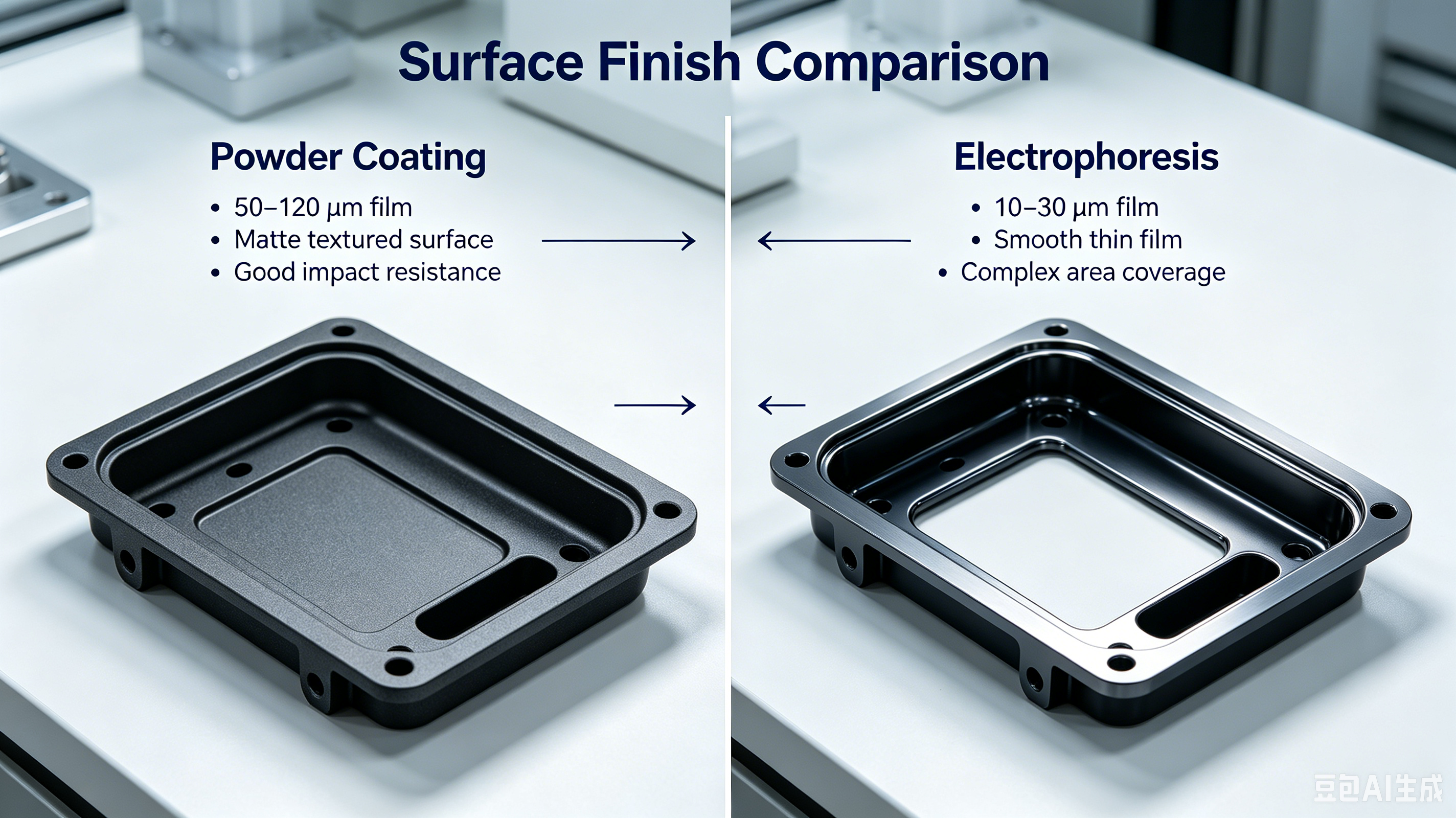
Powder coating and E-coating solve different problems; the comparison below is a fit decision, not a ranking.
The honest comparison is against the finishing methods E-coating most often replaces. The core difference is mechanical: E-coating uses a wet immersion process with electrical deposition, while powder coating is a dry electrostatic spray process limited by the Faraday cage effect. That single difference drives most of the downstream trade-offs.
| Dimension | Electrophoretic coating | Powder coating |
|---|---|---|
| Coating mechanism | Full immersion with electrical deposition in a water-based bath | Dry electrostatic spray with charged powder particles |
| Coverage | Strong penetration of deep holes, internal cavities and sharp edges | Can be limited by the Faraday cage effect in recesses and corners |
| Paint utilisation | Approximately 95%–98% | Approximately 90%, affected by the Faraday cage effect |
| Best fit | Complex geometry, strict dimensional tolerance, demanding anti-corrosion duty | Outdoor aesthetic exposure, mechanical and stone-chip resistance, small-batch multi-colour work |
| Maintenance profile | Daily bath parameter monitoring and continuous 24/7 circulation | Flexible start-stop operation with easier colour-change cleaning |
Where E-coating is the weaker choice. The limitations are real and worth stating plainly, because they are the questions a supplier should be able to answer without deflecting. An E-coating line involves complex systems — E-coat tanks, ultrafiltration, multi-stage rinsing and pure water preparation — which produces high one-time capital costs. The process generates phosphorus- and paint-containing wastewater requiring specialised treatment, so environmental compliance costs run higher than for powder coating. Operationally it is capital-intensive and rigid: bath parameters such as pH, conductivity, solid content and temperature must be monitored daily, ultrafiltration membranes require regular cleaning, the system typically circulates around the clock, and shutdown for maintenance is expensive. Although curing temperatures are relatively low at roughly 100–180 °C, the continuous circulation pumps, temperature control systems and pure water preparation push overall energy consumption up. For non-continuous production or small-to-medium batch work, powder coating often delivers better comprehensive energy efficiency.
And where certification stops. ISO 14001 does not certify that a coating is low-VOC or heavy-metal-free; it certifies that the environmental management system behind the process is controlled. ISO 9001 does not certify that a part will pass 1,000 hours of salt spray. Buyers who treat management-system certificates as product claims are buying the wrong thing, and suppliers who encourage that reading are creating a liability for both sides.
Future Outlook
The direction of travel is from certificate-holding to evidence-based qualification. Procurement teams are increasingly asking for batch-linked test data, material declarations and third-party verification rather than a scanned certificate, because destination-market rules on VOC emissions and restricted substances continue to tighten and because downstream customers are auditing further up the supply chain each year.
Yongxin's stated development path points the same way. The company describes ongoing investment in automated intelligent equipment, optimisation of production structure to reduce labour and energy consumption, and a commitment to green production, alongside a continuing shift towards specialisation, refinement and intelligence. For buyers, the practical implication is that the qualification conversation should be structured around what can be documented at the batch level — thickness, salt spray, adhesion, substance content — rather than around which standards appear on a supplier's certificate list.
FAQ
1. What is the difference between ISO 9001 and ISO 14001 for an electrophoretic coating supplier?
ISO 9001 is a quality management system standard covering process control, documented procedures, traceability and corrective action. ISO 14001 is an environmental management system standard covering how a facility identifies and controls its environmental aspects, including effluent and emissions. For an E-coating supplier, ISO 9001 addresses whether coating parameters and inspection records are controlled; ISO 14001 addresses whether the wastewater and emissions generated by a wet immersion process are managed. The two cover different risks and are usually requested together.
2. Does ISO 14001 certification prove that a coating is low-VOC or heavy-metal-free?
No. ISO 14001 certifies that an environmental management system is in place; it does not certify the composition of a specific coating. Low-VOC and heavy-metal-free are formulation attributes that depend on the resin, pigment and additive package selected. Verifying them requires material-level documentation such as a safety data sheet, a substance declaration, and where the application requires it, a third-party test report — not a management-system certificate.
3. How should a buyer compare a certified E-coating supplier with a lower-cost uncertified one?
The comparison should include the cost of substituting for missing evidence. An uncertified supplier typically shifts audit effort, incoming inspection and rework risk onto the buyer, and that cost is usually invisible in a quoted unit price. A more useful comparison framework weighs certification status, in-house testing capability, substrate and geometry experience, batch consistency controls and delivered documentation against the quoted price, rather than treating price as the only variable. The category data on E-coating notes that stable process control reduces defect and rework rates, which is where the two options diverge over a full production run.
4. How can a buyer verify a supplier's coating composition claims before placing an order?
Ask for the document set rather than a verbal assurance: safety data sheets for the coating materials in use, substance declarations covering restricted materials such as lead, cadmium, mercury and hexavalent chromium, and test reports for the specific performance parameters in the specification. Where a first article is involved, request that the sample be accompanied by its own measurement record — film thickness, gloss, colour reading, adhesion result and salt spray status. Claims that cannot be accompanied by a document should be treated as unverified during evaluation.
5. Is E-coating or powder coating the better compliance choice?
Neither is universally better; they carry different compliance profiles. E-coating uses a water-based bath and achieves high paint utilisation of approximately 95%–98%, while generating phosphorus- and paint-containing wastewater that requires specialised treatment and raises environmental compliance costs. Powder coating is a dry process with lower initial equipment investment and flexible start-stop operation, but its coverage of deep recesses is limited by the Faraday cage effect. For complex geometry with strict dimensional tolerance and demanding corrosion requirements, E-coating is usually the fit; for small-to-medium batch, multi-colour or non-continuous production, powder coating often performs better on comprehensive energy efficiency.
6. What documentation should accompany the first E-coating production order?
A practical first-order package includes the certificate set relevant to the end market — ISO 9001, ISO 14001 and, for automotive parts, IATF 16949 — plus material declarations for restricted substances, the inspection record for the production batch covering film thickness and appearance parameters, and salt spray or adhesion results where the specification calls for them. Confirming this list during the quotation stage avoids a situation where a supplier holds valid certificates but cannot produce batch-level evidence after delivery.
A downloadable company and product reference covering electrophoretic coating solutions is available here.