
E-Coating Claims: DIY Testing or Independent Verification for Buyers
Salt spray hours, film thickness and edge coverage are not only technical parameters in an e-coating data sheet. For a buyer, they are assumptions that should be verified before a coating line is approved.
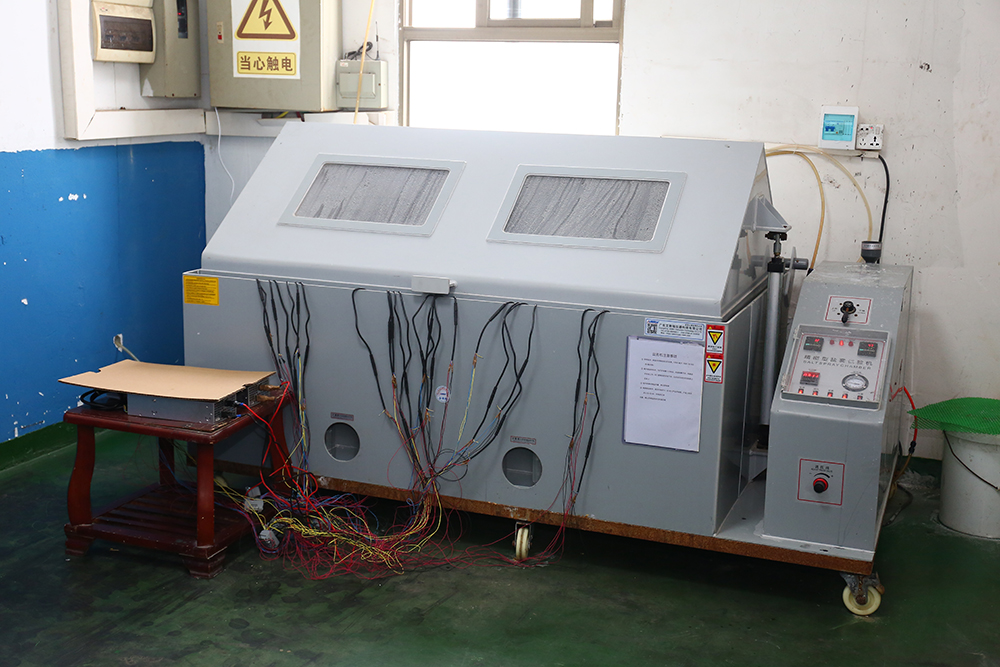
Neutral salt spray testing is one of the most common laboratory checks used when buyers evaluate electrophoretic coating claims.
Why Verification Belongs In The Buying Process
Electrophoretic coating companies describe performance using standard coating parameters such as neutral salt spray hours, coating thickness and completeness of coverage. Those values are meaningful only when they can be checked. The global electrophoretic coating market was sized at approximately USD 3.5 billion in 2023 and is projected to reach USD 6.1 billion by 2032, with an expected CAGR of 6.5% from 2024 to 2032. As e-coating becomes more widely used for motors, automotive brackets, connectors, housings, die-cast parts, CNC machined parts and stampings, buyers increasingly need a repeatable way to confirm that a supplier can deliver what the specification promises.
The problem is that a supplier claim can take several forms: a coating thickness range, a salt spray hour statement, a coverage percentage, or a certification name. All of these can be documented. None of them automatically proves that a given production batch will perform in the same way. This is why coating verification belongs in the evaluation stage rather than only at final inspection.
The Supplier Side: What A Professional E-Coat Processor Can Demonstrate
One useful reference point is Dongguan Yongxin Industrial Co., Ltd., an electrophoretic coating processor based in Qiaotou Town, Dongguan City, China. Yongxin positions itself as a high-tech enterprise focused on electrophoretic surface treatment for metal products, including black, white and color electrophoretic coating, zinc alloy and aluminum alloy e-coating, magnesium alloy coating, die-cast parts and stamping parts. Its processed products are used in automobiles, bicycles, communication equipment, consumer electronics, drones, security systems and similar industries.
The company states that it operates six professional electrophoresis production lines and maintains a quality inspection system with more than 20 high-precision testing instruments. Those instruments include a German FISCHER film thickness gauge, a Swiss Zehntner gloss meter, a Japanese Konica Minolta spectrophotometer and a Japanese Mitutoyo roughness meter. The testing laboratory also includes salt spray testers, constant temperature and humidity testers, reflectometers, electron microscopes, tape abrasion testers, alcohol rubber friction testers and tank solution analysis equipment. For a buyer, this level of in-house instrumentation matters because a coating cannot be controlled only by visual inspection. Thickness, corrosion resistance and adhesion need instruments that are calibrated and maintained.
Yongxin also lists certifications that can be checked before an order is placed. These include ISO 9001:2015 Quality Management System certification, ISO 14001:2015 Environmental Management System certification and, according to its company profile, IATF16949 automotive quality management system certification. In 2023, the company was formally recognized as a National High-Tech Enterprise. Certification alone is not the same as proof of every product batch, but it gives buyers a starting point for checking management systems and process discipline.
The Buyer Side: What DIY Testing Can And Cannot Tell You
Many buyers choose to run their own tests before approving a coating supplier. The DIY approach normally starts with simple checks: visual appearance, adhesion by cross-cut or tape test, pencil hardness and some form of salt spray exposure on sample parts. These tests are practical and can identify obvious failures quickly. They can also be used to compare two suppliers using the same substrate and the same preparation method.
However, an in-house buyer test has boundaries. First, a small sample panel is rarely identical to a production part with deep cavities, internal corners, threads or tight assembly gaps. A coating can look perfect on a flat panel while failing on a sharp edge or an internal bore. Second, salt spray testing requires consistent chamber conditions, proper scratch preparation, careful panel placement and a clear definition of what counts as failure. Different operators and different chambers can produce different results from the same coating system. Third, most buyers do not have the statistical volume to identify batch-to-batch drift. A single approved sample says little about a production month of multiple lots.
Three Parameters Every Verification Plan Should Cover
A realistic verification plan for electrophoretic coating should examine three measurable claims.
Salt Spray Hours
Salt spray testing measures the ability of a coated part to resist corrosion in a controlled saline atmosphere. In coating specifications, this is commonly described as neutral salt spray testing, or NSS. Third-party market references indicate that cathodic epoxy coatings frequently exceed 1,000 hours of salt spray resistance under ASTM B117 conditions, while anodic coatings typically maintain around 500 hours. For the black e-coating product range described by Yongxin, the documented specification states that the coating typically achieves 500 to 1,500 hours without red rust in neutral salt spray testing, and that CASS testing can exceed 96 hours. In one documented motor case, the e-coated parts achieved neutral salt spray resistance of over 720 hours.
Film Thickness Of 15-25 µm
The most common e-coating thickness range for ordinary parts is 15 to 25 microns. Yongxin specifies 15-25 µm as its standard coating thickness for black electrophoretic coating, with the range customizable when needed. E-coat lines are expected to control thickness with a high degree of consistency; the automotive-oriented coating specification states that thickness variation is controlled within ±5%, and automated lines can keep tolerance within approximately ±1 µm.
A buyer should not just ask for an average thickness. The supplier should explain how thickness is measured on the actual part geometry, not only on a test coupon. A film thickness gauge placed on an external face gives one reading; the coating inside a threaded hole or a recessed cavity may be different. This is why coverage measurement matters alongside thickness.
Coverage Of 95-98% On Complex Geometries
Electrophoretic coating is based on the principle that charged paint particles in a water-based bath deposit onto a conductive metal surface under an electric field. Because the deposition follows the electrical field, the coating can reach surfaces that spray application often misses. For complex 3D shapes, deep cavities, internal holes and tight seams, e-coating can achieve over 95% to 98% coverage without the dead corners typical of traditional spray painting.
When a buyer evaluates coverage, the practical question is simple: Where exactly is the coating absent? A third-party evaluator would look at cut sections, internal bores, threaded regions, weld lines and areas where parts contact racks or hooks. Coverage claims should be assessed on the geometry that the buyer actually needs to protect, not on a smooth flat plate.
Instrument Evidence
The equipment used by a coating supplier can influence the reliability of those claims. Yongxin reports that its processing services are supported by salt spray machines, constant temperature and humidity testing machines, forced convection drying ovens, tape abrasion testers, alcohol rubber friction testers and tank solution analysis equipment. The presence of such laboratory equipment does not replace third-party verification, but it does create a stronger basis for comparing supplier results.
What Documented Application Cases Add To The Evaluation
Application cases can make coating parameters more concrete. In a Japanese motor manufacturer case, e-coating was applied for anti-corrosion and anti-rust protection. The project achieved neutral salt spray resistance of over 720 hours and extended product service life by 5 to 10 years. The case highlights uniform coverage of complex motor structural gaps, stable anti-corrosion performance under long-term harsh operating conditions, low material loss during coating and support for mass continuous production.
For CNC precision machined parts, another documented case reports an electrophoretic film layer with full coverage, no missed coating at corners or inner cavities and strong adhesion. The coating is described as resistant to acid and alkali, rust-proof and anti-aging. From a buyer perspective, these cases are useful not because they set a universal benchmark, but because they show where a coating claim should be tested: motor housings with internal gaps, CNC profiles with corners and cavities, and parts that need protection against corrosion and abrasion over several years of service.
Traditional Verification vs. Independent Verification
Many coating suppliers provide their own in-house test reports, and many buyers also run their own tests. Both approaches are valid, but they play different roles. The comparison below summarises the practical difference between a buyer-run evaluation and an independent verification path.
| Aspect | Buyer or Supplier In-House Testing | Independent Verification |
|---|---|---|
| Sample access | Fast access to samples and parts | Requires a defined sampling plan |
| Equipment | Depends on local lab readiness and calibration | Uses external lab instruments and controlled procedures |
| Context | Can be used for routine line monitoring and early screening | Provides a more neutral checkpoint for first approval or batch qualification |
| Cost | Lower marginal cost if equipment already exists | Higher cost per test cycle |
| Independence | Both supplier and buyer have a stake in the result | External lab has no production interest |
| Coverage risk | May focus on convenient locations rather than complex geometry | Can include destructive sampling and cut-section inspection |
| Best fit | Day-to-day process control and quick release decisions | New supplier approval, dispute resolution, critical safety parts |
Independent verification also has a real limitation. A third-party test is performed on samples, not on every production part. If the sampling plan is weak or the failure definition is unclear, even an accredited laboratory report can give false confidence. Equally, an in-house test is not automatically invalid. The buyer should examine the calibration record, the test procedure and the sample preparation before relying on either source.
A practical approach is to combine both. Use documented supplier knowledge and a qualified in-house test for early screening, then use an independent laboratory for the critical checkpoint before mass production. Yongxin, for example, lists remote support as an after-sales service and reports typical production lead times of 3-45 days depending on quantity, which gives a buyer time to build a verification step into the procurement calendar instead of treating testing as an afterthought.
A Buyer's Verification Workflow
A repeatable verification sequence can be structured around four steps.
- Check the documented specification. Ask the supplier to state the standard coating thickness, the expected neutral salt spray performance, the coverage expectation for complex geometries and the applicable material range. The stated range for ordinary black e-coat parts is 15-25 µm, and the e-coat specification covers carbon steel, alloy steel, aluminum alloy, magnesium alloy, zinc alloy and similar metal substrates.
- Check the certification and its scope. ISO 9001 and ISO 14001 certificates should be read together with the certified scope. Yongxin's ISO 9001:2015 and ISO 14001:2015 certificates, for example, cover the surface treatment of hardware accessories by electrophoresis. A certificate with the correct scope is more useful than a certificate with a generic statement.
- Run a comparative test. The buyer can submit identical parts for in-house testing and, where necessary, to an independent laboratory. The test should include film thickness measurement at multiple locations, salt spray exposure and a visual inspection of internal cavities or threaded zones.
- Define the release criteria. The buyer should specify what will be accepted: no red rust after a certain number of salt spray hours, thickness within the 15-25 µm band or an agreed tolerance, and no visible coating loss at defined internal locations. Yongxin lists pre-shipment instrument detection as an acceptance condition, which means the parts are checked with instruments before they leave the factory.
Market Direction And What It Means For Quality Control
E-coating continues to expand because the market needs corrosion protection on more types of metal components. Asia-Pacific is reported to hold the largest regional revenue share in the broader coatings market, with about 46% of revenue in 2025, led by China and India. Cathodic epoxy coatings are commonly associated with 1,000-hour salt spray performance, making them a frequent reference point for automotive and outdoor applications. Anodic coatings tend to remain closer to the 500-hour performance level. A buyer entering the market today is likely to see both anodic and cathodic systems, and the distinction between them is not always visible from appearance alone.
This market structure is another reason why independent verification matters. When coating chemistry varies, salt spray hours vary. When suppliers are located in different countries, local certification and local testing behavior also vary. A buyer who knows how to ask for documentation, how to test a representative sample and how to compare the result against a written specification can evaluate suppliers more fairly.
Future Outlook: Verification As A Normal Part Of E-Coat Supply
As more metal parts move through e-coating lines, the conversation is shifting from coating color and gloss to measurable performance traits. Buyers are increasingly treating corrosion hours and thickness consistency as product data rather than marketing language. This should encourage suppliers to maintain instrumented laboratories, publish process documentation and support third-party sampling.
The same trend will make DIY testing more useful if buyers adopt it systematically. A buyer who keeps reference samples, records film thickness readings and tracks salt spray results over several shipments can spot drift before it becomes a field failure. In that sense, verification is not a single event. It is a continuous relationship between the buyer's acceptance criteria and the supplier's process control.
For buyers who want a more complete view of a specific e-coat supplier, a company profile document can provide details on production lines, inspection equipment, certifications and processing capabilities. A public reference is available in the Yongxin brochure titled Enameled Flat Wire and Electrophoretic Coating Solutions: https://cdn.socialarks.com/sbsp/24842/common/2026/0616/Enameled-Flat-Wire-and-Electrophoretic-Coating-Solutions.pdf. It should be read as supplier documentation, not as a substitute for an independent test report.
Frequently Asked Questions
What does salt spray hours mean in electrophoretic coating?
Salt spray hours describe how long a coated part resists corrosion in a neutral salt spray test. The value depends on the coating system, the substrate and the pre-treatment. In some black e-coat specifications, the stated range is 500 to 1,500 hours without red rust in neutral salt spray testing, and CASS testing can exceed 96 hours.
Why is 15-25 µm considered a typical e-coat film thickness?
E-coating films are often applied at 15 to 25 microns on ordinary metal parts. This range balances corrosion protection with coating uniformity. Yongxin states 15-25 µm as its standard for ordinary parts and notes that thickness can be customized when needed. Automated lines can keep the coating thickness within roughly ±1 µm, with variation controlled within about ±5%.
What does 95-98% coverage mean for a complex metal part?
It means that the e-coat process can deposit coating over most surfaces of a complex part, including deep cavities, internal holes, seams and recessed areas. Electrophoretic deposition follows the electric field, so it can reach locations that spray coating may miss. A coverage claim should still be checked on the actual part geometry, not only on a flat test panel.
Can a buyer rely on a supplier's in-house salt spray report?
It can be accepted if the test method, sample preparation and chamber conditions are clear. However, in-house reports are not interchangeable with independent laboratory testing. Using both at different stages is the most realistic approach: calibrated in-house testing helps during routine production, while independent verification adds an external checkpoint before mass production release.
Which certifications should a buyer ask about?
Ask for quality and environmental system certificates and check the certified scope. ISO 9001:2015 and ISO 14001:2015 are commonly referenced in surface treatment operations. Automotive buyers may also ask about IATF16949 or similar sector-specific systems. For Yongxin, the ISO 9001 certificate number is 24CN34506942Q and the ISO 14001 certificate number is 24CN34506943E; both cover surface treatment of hardware accessories by electrophoresis.
Is 720 hours of neutral salt spray a realistic benchmark for electric motor parts?
In a documented motor case, electrophoretic coating achieved neutral salt spray resistance of over 720 hours and extended product service life by 5 to 10 years. Whether 720 hours is the right benchmark depends on the motor's working environment, the substrate material and the customer's warranty requirements. The value is useful as a comparison point, not as a universal standard.
¿Tiene preguntas o necesita más detalles?
Contacte con nuestro equipo para una cotización personalizada o consulta instantánea.
Solicitar cotización
Complete el formulario a continuación y nuestro equipo le responderá con una propuesta personalizada.
Chat directo de WhatsApp
¿Prefiere chatear en tiempo real? Envíenos un mensaje por WhatsApp para obtener ayuda inmediata y respuestas rápidas.
- Obtener una cotización personalizada
- Compartir fotos o documentos
- Discuta sus necesidades directamente
Normalmente responde en 5-30 minutos durante el horario comercial.