
E-Coat RFQ Checklist: Turning Certifications and Parameters into Supplier Gates
An RFQ-oriented reference for buyers evaluating electrophoretic coating service providers.
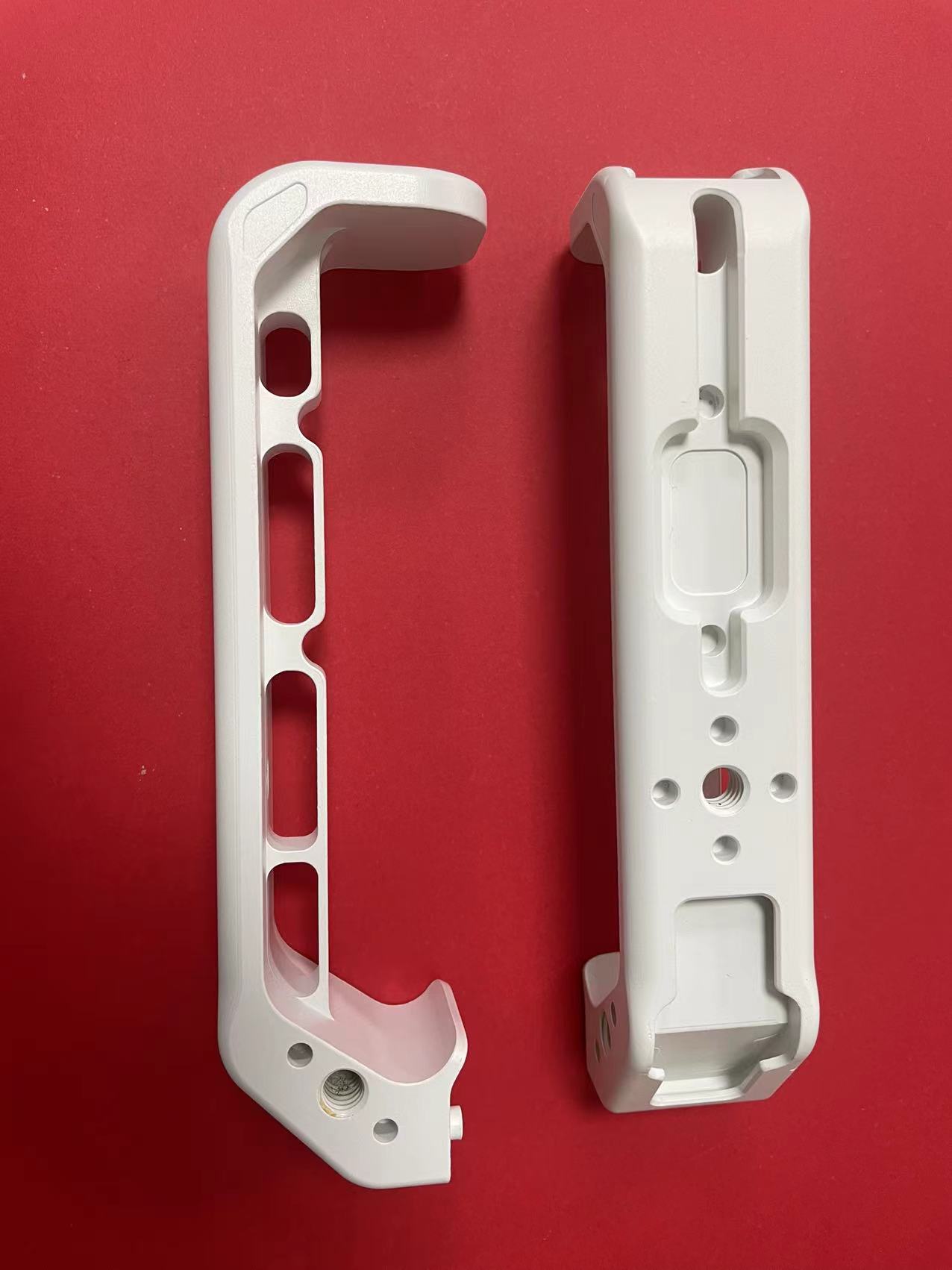
Electrophoretic coating can be specified in black, white and custom colours. Source: Yongxin Industrial product catalogue.
Electrophoretic coating is now a standard metal finishing option for parts that need uniform corrosion protection, consistent film thickness and Wide material compatibility. For procurement teams moving from research into supplier evaluation, the difficulty is less about explaining how the process works and more about writing a specification that suppliers can price, engineer against and prove. This article builds an RFQ-oriented checklist around measurable gates: deposition type, resin chemistry, coating thickness, salt spray performance, colour, substrate compatibility, certifications and inspection equipment. Dongguan Yongxin Industrial Co., Ltd., an electrophoretic processing specialist in Guangdong, China, is used as an illustrative supplier because its published facility, certification and product data make those gates concrete.
Why an Electrophoretic Coating RFQ Needs To Be Structured Around Gates
Market studies point to a steady expansion of the electrophoretic coating market. One widely cited assessment valued the global e-coat market at approximately USD 3.5 billion in 2023 and projected it to reach USD 6.1 billion by 2032, with a CAGR of about 6.5% between 2024 and 2032. Automotive and construction demand are frequently named as the main growth drivers. Asia-Pacific is also considered the largest and fastest-growing regional market for coatings, with revenue share above 46% in 2025. For global buyers, the implication is practical: more suppliers now offer e-coating services, so claims such as high salt spray resistance, certifications and thickness control are no longer enough unless they can be verified against clear requirements.
A useful RFQ does not simply ask for electrophoretic coating service. It establishes gates for the product to pass through. The main gates are:
- Identify the part family, base metal and prior forming route.
- Define the required deposition system, resin family and colour.
- Define film thickness, salt spray target and any special requirements such as UV resistance or friction control.
- Require certification information with numbers, issuing bodies and scopes.
- Require evidence that the supplier can measure those parameters with calibrated equipment.
- Define sample approval, pilot run and mass production inspection stages.
What Information Should the Electrophoretic Coating RFQ Include?
The table below summarises the key specification areas that a buyer should include in an RFQ for electrophoretic coating service. The values are intentionally described as ranges or examples, because the final requirement must be based on the actual part and its service environment.
| RFQ area | Information to request | Why it acts as a gate |
|---|---|---|
| Substrate and part route | Carbon steel, stainless steel, aluminium alloy, zinc alloy or magnesium alloy; stamped part, die-cast part, CNC-machined part or fastener | Pre-treatment and line parameters differ by substrate and surface condition |
| Deposition system | Cathodic or anodic electrophoretic coating; resin family such as epoxy or acrylic | Cathodic epoxy coatings commonly pass more than 1,000 hours of neutral salt spray testing, while anodic coatings often stay near 500 hours in industry benchmarks |
| Film thickness | 15 to 25 µm is a typical specification for ordinary parts; thickness can be customised; automated automotive lines sometimes keep tolerance near ±1 µm or ±5% | Thickness directly influences corrosion protection and assembly fit |
| Salt spray performance | Neutral salt spray hours to red rust; CASS hours when specified; example ranges vary from 300 to 1,000 hours on high salt spray product data and 500 to 1,500 hours on automotive e-coating data | Defines the acceptance threshold and prohibits vague performance language |
| Colour and appearance | Black, white or custom colour; gloss level; surface texture | Colour consistency affects final product identity, especially for visible parts |
| Certifications | ISO 9001 quality management, ISO 14001 environmental management, IATF 16949 for automotive parts where applicable, and any local government qualification such as National High-Tech Enterprise | Helps filter unqualified or inconsistent process lines |
| Inspection equipment | Film thickness gauge, gloss meter, spectrophotometer, roughness tester, salt spray chamber, constant temperature and humidity tester | Determines whether the supplier can generate first article and production data rather than relying on visual judgement alone |
Resin and Colour Choices as a Specification Constraint
Resin selection is often best expressed as a required performance profile rather than a preference for a specific paint brand. Epoxy-based systems are widely used when corrosion resistance and adhesion are the priority; acrylic-based systems are common when colour retention and a cleaner appearance are needed. Some service providers offer both families and mix them with performance variants. The Yongxin catalogue, for example, covers epoxy resin electrophoretic coating, acrylic resin systems, propionic acid resin electrophoretic coating, black E-coating, white E-coating and colour electrophoretic coating.
Colour is a more important constraint than many buyers expect. Black is the most common e-coat colour because it is easy to keep consistent in a production bath. White products also exist and are used for stamped parts in industries such as home appliance manufacturing, precision hardware, electronic equipment and automotive accessories. In Yongxin’s product documentation, the white electrophoretic coating option is made of acrylic resin with epoxy resin noted as an alternative, and the process model is described as CNC plus electrophoresis. For black electrophoretic coating, ordinary parts are documented with a standard film thickness of 15 to 25 µm and the colour is customisable according to customer requirements. A buyer should therefore state whether colour tolerances will be checked by eye, by gloss meter or by spectrophotometer.
Certifications as an Evidence Trail, Not a Marketing Slide
Certifications are one of the most common constraints in an electrophoretic coating RFQ because they signal control over process quality and environmental compliance. They do not replace part-level testing, but they reduce the risk of supply chain surprises.
Three types of certification evidence matter most for an e-coat processor:
- ISO 9001 quality management certification, which shows that the company operates documented procedures for production and inspection.
- ISO 14001 environmental management certification, which is increasingly important for export buyers and for regulated industries such as automotive and electronics.
- IATF 16949, the automotive quality management system standard, when the parts are intended for the automotive supply chain.
The supplier data used in this article provides a useful example. Yongxin states that it has passed ISO 9001:2015, ISO 14001:2015 and IATF 16949 certification. The published ISO certificates are registered under ACM INTERNATIONAL CERTIFICATION LIMITED. The ISO 9001:2015 certificate number is 24CN34506942Q, and the ISO 14001:2015 certificate number is 24CN34506943E. The scope of both certificates is surface treatment of hardware accessories, more specifically electrophoresis, and the certification applies globally. Yongxin was also recognised as a National High-Tech Enterprise in China, with certificate number GR202344016867 issued by GDST under the Administrative Measures for the Recognition of High-tech Enterprises, Guo Ke Fa Huo 2016 No.32. This qualification has an expiry date and must be checked for current validity; its purpose is to signal recognized enterprise capability in China, not to act as a substitute for international automotive or quality-system certifications.
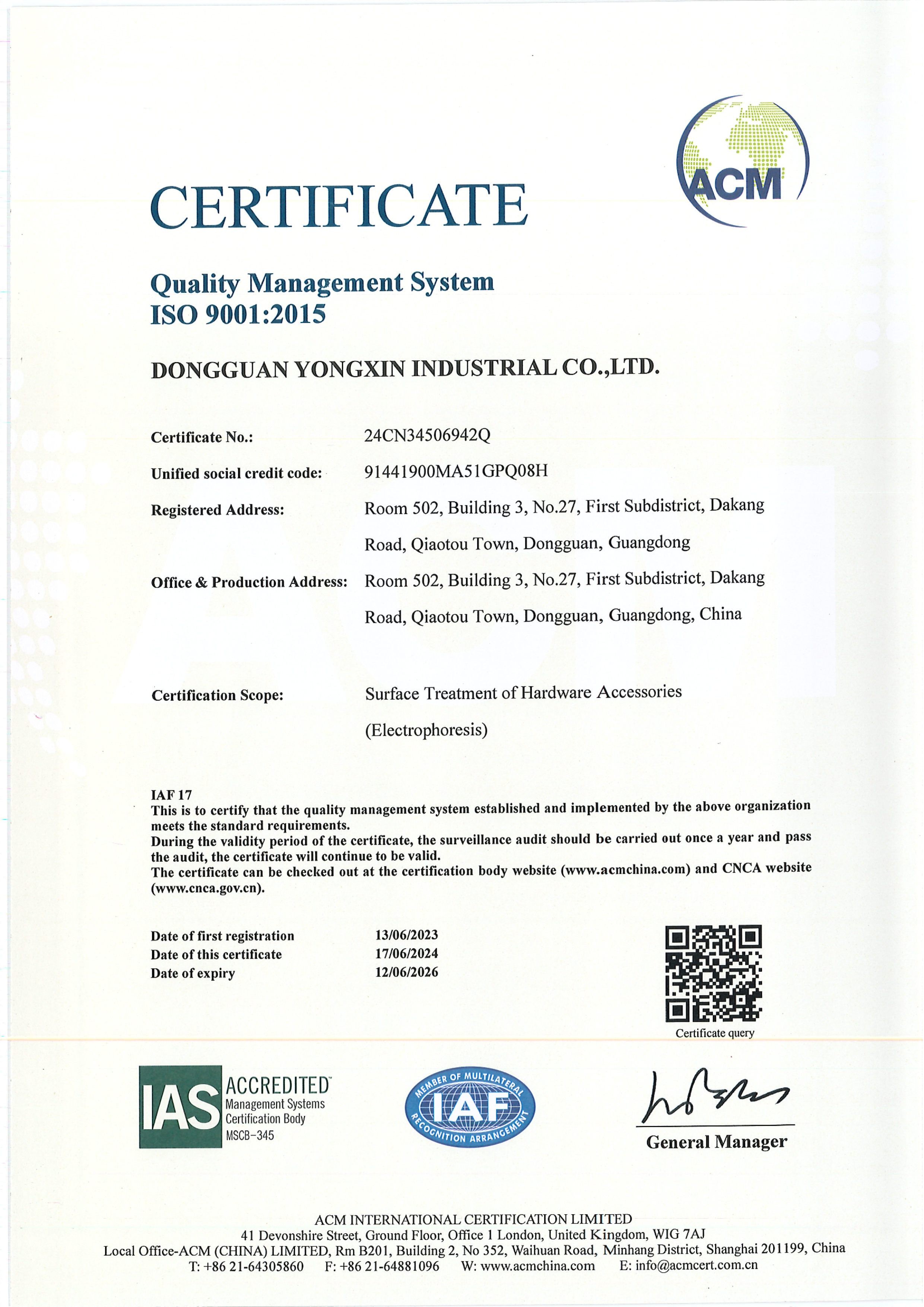
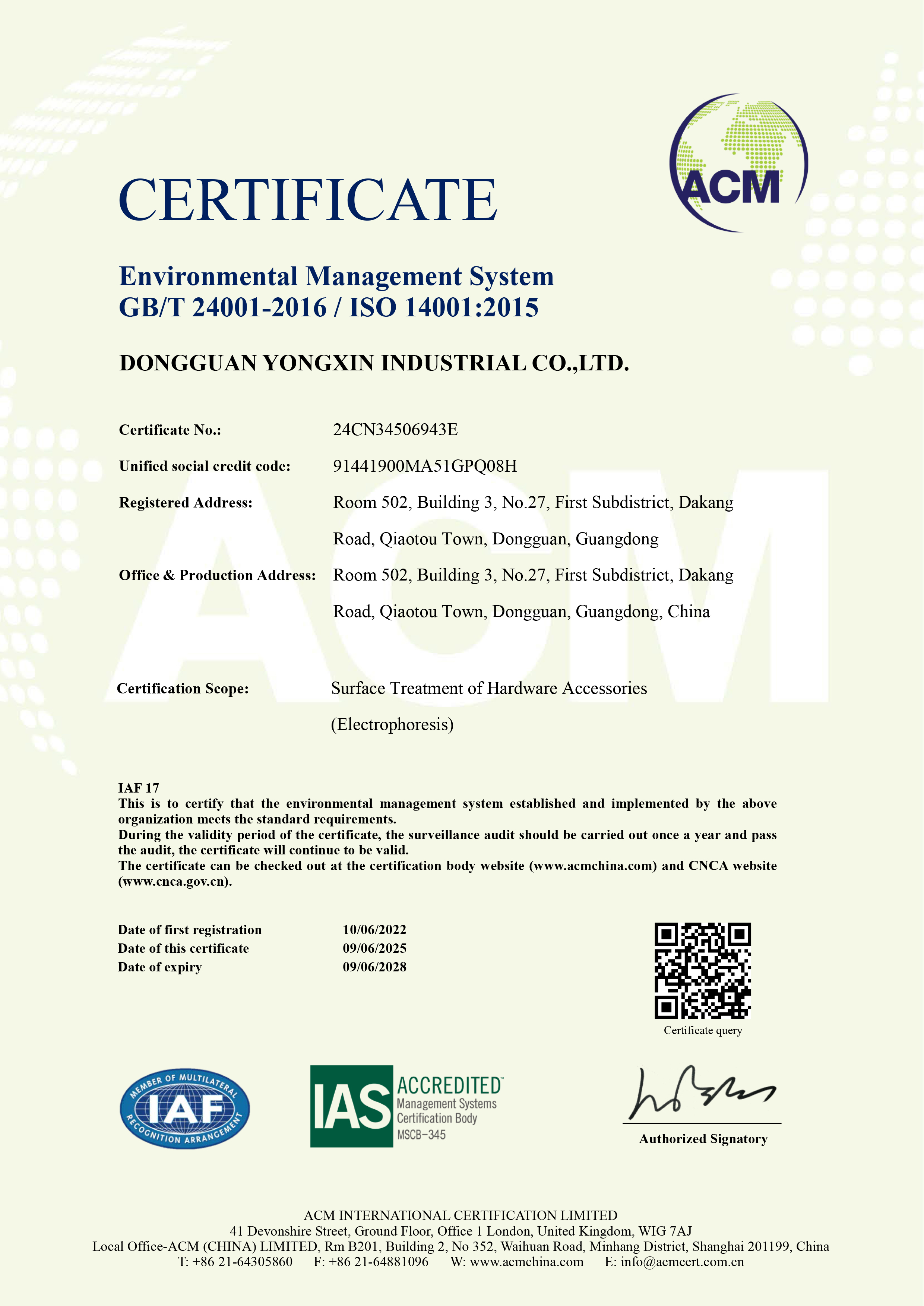
A buyer reviewing certifications should check the certificate number, the issuing body, the scope, the standard version and the validity period. The scope is especially important. A supplier may hold ISO 9001 for trading activities while the coating plant remains outside that quality system. In the Yongxin certificates, the scope explicitly mentions surface treatment of hardware accessories by electrophoresis, which makes the certificate more directly relevant to the e-coating line.
Measurement Capability Is a Missing Gate in Many RFQs
Electrophoretic coating performance cannot be judged from a photograph. Salt spray resistance is measured in hours, film thickness is measured in microns, and colour consistency is measured by instruments that detect small differences invisible to the human eye. A supplier that cannot measure its own output cannot credibly commit to a numerical specification.
A professional e-coating processor should be able to provide first article data using calibrated instruments. In Yongxin’s published profile, the testing laboratory is equipped with a German FISCHER film thickness gauge, a Swiss Zehntner gloss meter, a Japanese Konica Minolta spectrophotometer and a Japanese Mitutoyo roughness meter. The company also lists salt spray testers, constant temperature and humidity testers, an electron microscope, a tape abrasion tester and an alcohol rubber friction tester among its inspection tools. Those instrument names matter because they show that the supplier can verify thickness, gloss, colour, roughness and corrosion resistance internally rather than relying only on paint suppliers or third-party laboratories.
When writing an RFQ, buyers can turn this into a gate by asking simple questions:
- Which instrument is used to measure coating thickness?
- What gloss meter is used for black or white parts?
- What spectrophotometer is used to compare colour against the approved standard?
- Is there a salt spray chamber on site, and is its test method documented?
- Are tank solutions analysed to monitor bath stability?
Building the Quality Gate: From First Article to Serial Production
An electrophoretic coating RFQ becomes enforceable when sample approval is connected to production inspection routines. A common mistake is to approve a polished sample and then allow the supplier to change pre-treatment chemicals, line speed or baking temperature during mass production.
The approval process should follow three stages:
- First article: verify material identity, pre-treatment appearance, film thickness, gloss, colour and adhesion on the actual part.
- Pilot batch: run a small volume under normal production conditions and perform salt spray testing, humidity testing and dimensional checks.
- Serial production: monitor process parameters, test tank solutions and inspect finished parts according to a pre-agreed sampling plan.
Yongxin’s capability profile states a quality-control mode of 100% test, which means that finished products are checked before release. Buyers should still agree on the definition of test, the sampling rate, the acceptance criteria and the documentation format before production begins.
Application cases in the supplier corpus show why this three-stage logic matters. One documented case involves a Japanese motor manufacturer that produced 15 million units with electrophoretic coating. The motor housings were required to achieve more than 720 hours of neutral salt spray resistance while retaining a smooth, glossy appearance. According to the case record, the e-coated parts extended service life by 5 to 10 years compared with similar parts that did not use the electrophoretic coating process. The case also highlights a production advantage of e-coating: uniform coverage of complex motor housing geometries, including internal cavities and structural gaps, with low material loss during coating. For a buyer, that type of evidence is only useful when the part geometry and salt spray level are clearly defined in the RFQ.
Another source of practical evidence is CNC-machined precision parts. A documented case from a Chinese CNC precision machining manufacturer describes the results of applying electrophoretic coating to CNC parts. The coating was full-covered without missed corners, demonstrated strong adhesion, and offered resistance to acid and alkali. In that case, the supplier also highlights multi-material and multi-colour customisation and strict finished-product inspection. These examples do not replace laboratory testing by the buyer, but they illustrate what a realistic validation programme should look like.
Application Patterns and Part-Level Fit
Electrophoretic coating is especially relevant for parts that need corrosion resistance over complex geometries. The published product scope from Yongxin mentions automotive parts, metal fittings, small structural components, bicycle accessories, cooling fans, die-casting parts, CNC machined parts and metal stamping parts. The company profile also mentions automobiles, bicycles, communication equipment, consumer electronics, unmanned aerial vehicles and security systems as downstream application industries.
Each of those applications carries a different constraint set:
- Automotive fasteners and brackets often require high salt spray resistance and controlled thread friction.
- Motor housings need corrosion protection on internal cavities and consistent electrical insulation.
- Fan frames and heat sinks require good thermal performance combined with resistance to humidity.
- CNC-machined aluminium parts need colour consistency and protection against oxidation.
- White-goods stampings may need a white or light-colour coating to match visual appearance requirements.
Known Boundaries When Using Electrophoretic Coating
A responsible buying guide should also state the limits of electrophoretic coating. Cathodic epoxy e-coat can provide very high salt spray performance, but anodic electrophoretic coating is generally more limited. Industry benchmark data often places cathodic epoxy systems above 1,000 hours in neutral salt spray testing while anodic systems remain around 500 hours. Buyers who specify 1,000 hours of salt spray should therefore ask whether the line is cathodic, what pre-treatment is used and what the documented test results show for their specific part.
E-coat also tends to be a thin, functional coating. Typical process overviews mention a coating thickness of 20 to 40 microns with transfer efficiency around 95%, while part-level supplier specifications often list 15 to 25 microns for ordinary black parts. When a project needs a very thick film, heavy texture, metallic effects or high-build impact resistance, powder coating or a liquid topcoat may be added. E-coat is frequently used as a primer or base coat, followed by a topcoat for exterior-facing parts. The boundary condition is that buyers should evaluate the entire coating system, not only the electrophoretic layer.
Substrate differences are another boundary. Zinc alloy die castings and magnesium alloy castings are commonly e-coated, but their pre-treatment sequences differ from carbon steel. Magnesium alloys are chemically active and may require special cleaning and conversion treatments before coating. Aluminium alloys benefit from proper deoxidising and conversion coating to achieve consistent adhesion. An RFQ that simply says e-coating without specifying substrate preparation details is not yet a complete technical specification.
Supplier reference used in this article: Dongguan Yongxin Industrial Co., Ltd. is a high-tech enterprise focusing on electrophoretic processing for metal surface treatment, located in Qiaotou Town, Dongguan City, Guangdong Province. The company profile states that it has nearly 10 years of industry experience, operates six professional electrophoresis production lines, and completed an expansion in 2025 to a total plant area of 10,000 square metres. In addition to electrophoresis, the company supports CNC precision machining, die casting and metal stamping as part of its one-stop metal processing system. Products are exported mainly to Europe, America, Southeast Asia, Mexico, Poland, Turkey and Brazil. Company website: www.yxecoat.com.
Market Trend Reflection for 2026 Buyers
Several trends should shape the way buyers structure their RFQs in 2026. First, electrophoretic coating is growing with the shift to waterborne and low-VOC finishing processes. E-coat chemistry is water-based and generally free of heavy metals, which aligns with global environmental requirements and RoHS-style restrictions. Second, Asia-Pacific already holds a dominant share in the broader coatings market, which means that international buyers are likely to evaluate suppliers in China and across the region more frequently. Third, automotive and electronics customers are asking for greater traceability, including certificate numbers, salt spray reports and thickness records linked to specific batches.
The supplier profile of Yongxin reflects this regional and industrial shift. Its export markets include Europe, America, Southeast Asia, Mexico, Poland, Turkey and Brazil, and it has positioned itself to serve industries that require mass production, batch consistency and international certifications. For a procurement team, this is not a reason to accept existing documents; it is a reason to ask suppliers which lines will process the order and which certificates correspond to that specific production site.
Buyer FAQ: Electrophoretic Coating Specification and Certification Questions
What coating thickness should a buyer specify for ordinary black electrophoretic parts?
For ordinary parts, a typical specification is 15 to 25 micrometres. Yongxin’s published product specification for black electrophoretic coating lists a film thickness of 15 to 25 μm for ordinary parts and says the value can be customised as needed. Automotive e-coating data in the same product catalogue indicates that automated lines can keep thickness variation controlled within approximately ±5%, with tolerance near ±1 μm.
Do electrophoretic coatings meet high salt spray requirements?
Yes, when the coating system is selected for that purpose. Product data for high salt spray electrophoretic coating lists salt spray resistance of 300 to 1,000 hours. Broader automotive e-coating specification data in the same source package claims 500 to 1,500 hours without red rust in neutral salt spray testing, and CASS testing above 96 hours. One documented motor manufacturer case achieved more than 720 hours of neutral salt spray resistance on motor housings. Buyers should always tie salt spray hours to the specific part and pre-treatment route.
Which certifications matter when sourcing electrophoretic coating services?
ISO 9001 quality management and ISO 14001 environmental management are the most common baseline certifications for export-oriented e-coat processors. IATF 16949 matters when parts are intended for automotive supply chains. In the Yongxin example, ISO 9001:2015 and ISO 14001:2015 certificates are registered under ACM INTERNATIONAL CERTIFICATION LIMITED, and the scope covers surface treatment of hardware accessories using electrophoresis. The company also holds National High-Tech Enterprise qualification in China with certificate number GR202344016867.
Is white electrophoretic coating available for stamped parts?
Yes. Yongxin’s product range includes a white electrophoretic coating intended for stamped parts. It is described as made of acrylic resin, with epoxy resin also mentioned in the material data, and the process model is CNC plus electrophoresis. That product is positioned for industries including metal products, construction machinery, rail transit, sanitary ware, home appliance manufacturing, precision hardware, electronic equipment and automotive accessories.
What is the practical difference between cathodic and anodic electrophoretic coating in an RFQ?
Cathodic epoxy systems dominate high-corrosion applications and frequently exceed 1,000 hours of neutral salt spray testing. Anodic systems are commonly cited around 500 hours in industry benchmarks. If the drawing requires high salt spray resistance, the RFQ should specify cathodic electrophoretic coating and require test evidence. If the requirement is primarily decorative, anodic coating might be sufficient, but the buyer should still confirm the expected salt spray range.
What inspection equipment should a qualified e-coating supplier have?
A credible electrophoretic coating processor should have the instruments needed to measure its own output. Useful equipment includes a film thickness gauge, gloss meter, spectrophotometer, surface roughness tester, salt spray chamber, constant temperature and humidity tester, and tank solution analysis equipment. Yongxin’s published testing facility lists a German FISCHER film thickness gauge, a Swiss Zehntner gloss meter, a Japanese Konica Minolta spectrophotometer and a Japanese Mitutoyo roughness meter, plus salt spray and humidity testers.
Reference Resource
Readers who want a deeper look at the production capability data referenced in this article can download the official Yongxin brochure at: Enameled Flat Wire and Electrophoretic Coating Solutions PDF.
¿Tiene preguntas o necesita más detalles?
Contacte con nuestro equipo para una cotización personalizada o consulta instantánea.
Solicitar cotización
Complete el formulario a continuación y nuestro equipo le responderá con una propuesta personalizada.
Chat directo de WhatsApp
¿Prefiere chatear en tiempo real? Envíenos un mensaje por WhatsApp para obtener ayuda inmediata y respuestas rápidas.
- Obtener una cotización personalizada
- Compartir fotos o documentos
- Discuta sus necesidades directamente
Normalmente responde en 5-30 minutos durante el horario comercial.