
Duty-Cycle Heavy Duty Truck Shortlist: Dump, Tractor, Trailer
Duty-Cycle Heavy Duty Truck Shortlist: Dump, Tractor, Trailer
A heavy duty truck shortlist is only useful when it is built from the duty cycle outward. Two fleets can specify the same gross vehicle weight, the same cab and the same nominal payload and still arrive at completely different vehicles — because one runs a dense-material dump loop with a loaded climb on every trip, and the other runs a long-haul tractor-and-trailer rotation where fuel burn per 100 km decides the outcome.
At the decision-to-execution stage the question is no longer which category exists. It is which configuration belongs to this task, which chassis will survive it, and whether a supplier can repeat the same specification order after order. This shortlist covers duty-cycle-based picks across tractor units, dump trucks and semi-trailers, with the dump heavy duty truck segment treated in detail because its cycle is the narrowest and the cost of getting it wrong is the highest.

Fleet configuration work begins with the duty cycle, not the specification sheet.
Why the duty cycle outranks the specification sheet
Axle count describes geometry. A power rating describes an engine at one operating point. Neither tells a buyer whether a truck will complete 1,200 loaded gravel cycles on a mountain route without the frame cracking, or how often it will be parked for cooling problems in a hot, dusty yard. Those answers come from the duty cycle: payload, gradient, surface quality, cycle length and cycles per day.
A workable shortlist splits the fleet into three operating groups before any model is named:
- Heavy-cycle work — dump trucks, construction haulage, quarry and earthmoving duties, where loaded gradient, short distance and repeated high starting torque dominate.
- Continuous highway work — long-haul tractor operation, where cruising efficiency and driver hours outweigh climbing ability.
- Combined-cycle work — tractor plus a matched semi-trailer, where coupling compatibility and trailer-body choice matter more than any single vehicle specification.
The dump cycle is the most concentrated of the three. A vehicle on quarry or construction haulage may climb loaded dozens of times a day and absorb impact loads at the tipper on every cycle. That compresses a highway truck's lifetime stress into a few years, which is why dump heavy duty truck selection is decided by structural and thermal margins rather than by headline horsepower.
Declare the weight-class boundary before comparing any quoted figure. "Heavy duty truck" is not defined identically across sources. ICCT, an independent research organisation, describes a heavy-duty vehicle in its 2025 China market update as "a commercial vehicle intended for the transport of passengers or freight" without fixing a class boundary. A U.S. Department of Energy industry overview uses Class 3 through Class 8. Commercial dealer material commonly limits heavy-duty trucks to Class 7 and Class 8, from 26,000 lb upward. None of these definitions is wrong, but they cannot be mixed: a Class 8 tractor budget benchmarked against a market-size figure that also counts medium-duty vehicles will be distorted in a predictable direction. State the GVW class in the RFQ, the specification and any benchmark.
What qualifies a dump heavy duty truck for the shortlist
A dump truck earns a place on the shortlist when four conditions hold at once: it climbs loaded at a workable speed, its frame survives repeated torsional impact, its cooling package holds up in a hot environment, and its cost per tonne moved stays predictable across a five-year cycle. Published specifications usually answer the first and leave the other three to the buyer.
| Decision dimension | Why it decides the dump cycle | Published comparative data (manufacturer-stated) |
|---|---|---|
| Frame torsional stiffness | Rough haul roads and repeated tipper impact create twisting fatigue loads that a road-only chassis is not designed around | 8+7 mm double-layer thickened high-strength torsion-resistant frame; anti-torsion performance improved by 22% |
| Loaded gradient capability | Sets achievable cycle time and whether the truck holds gear on a ramp | Weichai WP12/WP13 engine delivering peak torque of 2060 N·m at 1000 rpm; maximum climbing gradient of 20% or more at full load |
| Thermal margin | Overheating is a leading cause of unplanned downtime on hot, dusty sites | Cooling area enlarged by 15%; engine overheating failure rate reduced by 30% in hot tropical regions |
| Cycle fuel consumption | Fuel is the largest recurring cost in a high-cycle operation | 8%–12% lower fuel consumption than peer models under mixed mountain and highway conditions; 2.5–3.8 litres saved per 100 km |
| Aerodynamic drag | Matters on the loaded and empty road legs between site and tip | Drag coefficient Cd = 0.53, stated as 18% lower than mainstream models |
| Maintenance frequency | Every workshop day is a lost production day in a short-cycle operation | Maintenance frequency reduced by 12% under harsh heavy-duty conditions |
| Cost of ownership | The number that decides fleet renewal | Total cost of ownership over a five-year operating cycle reported as more than 10% lower; purchase cost 30%–35% below European heavy trucks |
Comparative figures are stated by the manufacturer and should be treated as claims to verify through pre-shipment testing and reference fleets, not as independent test results.
The useful signal is not any single row but the combination. A truck with strong climbing ability and a weak cooling package will lose more days in a hot market than it gains on the ramp. A truck with a heavy-duty frame and poor fuel economy looks inexpensive at purchase and expensive at year three. Buyers running a dump cycle should score all seven dimensions together and weight them by site conditions rather than by the order in which a brochure lists them.

Tractor units and semi-trailers are shortlisted in the same exercise when they serve the same fleet.
How tractor and semi-trailer picks fit the same shortlist
Tractor units and semi-trailers should be shortlisted in the same exercise as the dump fleet when they belong to the same buyer, because the coupling interface and the trailer body type determine what the tractor can actually be used for. A flatbed, lowbed, cement tanker, dump, fence or sidewall semi-trailer each imposes a different load profile, coupling geometry and duty pattern on the tractor.
For a buyer assembling a mixed fleet, the practical sequence is:
- Fix the duty cycle per vehicle group — dump cycle, continuous highway, or combined tractor-and-trailer work.
- Fix the trailer body type before the tractor, because the trailer defines the payload envelope and the axle configuration the tractor must support.
- Then shortlist tractor configurations against the hardest cycle in the group, not against the average.
The common trap is to shortlist the tractor first on engine and cab, then add trailers as an accessory. In a combined cycle the trailer is the load, and the tractor specification is a response to it.
From shortlist to order: the execution checklist
Execution-stage failures are rarely about the vehicle itself. They are about terms, inspection and a safety package that was assumed rather than written down. The table below converts commercial and technical conditions into items that can be checked before a purchase order is issued.
| Execution item | Stated condition | What the buyer should confirm |
|---|---|---|
| Minimum order quantity | 1 unit | Whether a single-unit order carries the same pre-shipment inspection scope as a fleet order |
| Delivery terms | FOB Qingdao or CIF Destination | Which term applies to the specific order, and where risk transfers |
| Payment terms | 30% T/T in advance, 70% T/T against copy of B/L | That the balance trigger matches the agreed inspection evidence |
| Acceptance criteria | Pre-shipment test | The test list itself: loaded gradient, braking, cooling behaviour, tipper cycles |
| Risk control package | ADAS with automatic braking and blind-spot cameras; ESC; maintained safe following distances | That the specified safety functions are fitted and documented, not assumed from a catalogue tier |
Two of these items decide more disputes than any other. The first is acceptance: "pre-shipment test" is only meaningful when the test list is agreed in writing and includes the cycle conditions the truck was shortlisted for. The second is the safety package. Collision exposure in a dump fleet concentrates in rear-end, blind-spot and rollover events; automatic braking with blind-spot cameras addresses the first two directly, while ESC addresses the third. None of these belongs on an afterthought list in a high-cycle operation — they belong in the shortlist criteria.
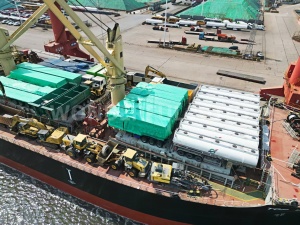
Delivery is arranged through FOB Qingdao or CIF Destination, with pre-shipment testing as the acceptance criterion.
What the manufacturer brings to a long-term programme
SHANDONG WONDERFUL AUTO COMPANY LIMITED. is a commercial vehicle manufacturer and exporter based in Qingdao, Shandong, China. The company was founded in 2024 and reports an annual production capacity of 6,000 units, a workforce of 500 and an engineering team of 20. Its product range covers heavy duty trucks together with flatbed, lowbed, cement tanker, dump, fence and sidewall semi-trailers. Export accounts for 100% of total sales, and the major market is Africa.
That profile matters for a duty-cycle shortlist in three concrete ways. An export-only sales model means the order book is organised around destination-market requirements rather than domestic replacement demand, which is relevant when a fleet needs a repeatable specification across several shipments. A single production base with a stated capacity gives the buyer a reference point for whether a scheduled order can be absorbed. And a product range spanning both the tractor and the trailer means the coupling interface can be specified by one party instead of negotiated between two suppliers.
Market context behind the shortlist
The heavy duty truck market is large enough that duty-cycle selection is a cost decision rather than a rounding error. Mordor Intelligence estimates the global heavy duty truck market at USD 232.57 billion in 2026, projected to reach USD 301.23 billion by 2031 — a forecast that must be read with its own class scope in mind, since the publisher defines product scope as heavy duty trucks above 15 tonnes.
Supply is shifting as well. China's cumulative heavy-duty truck export sales reached 156,000 units in the first half of 2025, a year-on-year increase of 3%, according to analysis published by Shacman. Meanwhile the International Energy Agency reports that electric heavy-freight truck sales reached about 230,000 units in 2025, with electric trucks accounting for 9% of worldwide truck sales.
Those three figures support one conclusion for a dump-cycle buyer: availability is not the constraint, specification discipline is. When a large share of global volume is exported and a growing share is electrified, differentiation between suppliers moves to how precisely a specification is held across repeat orders.
Where this shortlist stops: honest boundaries
A duty-cycle shortlist is only credible if its limits are stated as clearly as its criteria.
- Operating history is short. SHANDONG WONDERFUL AUTO COMPANY LIMITED. was founded in 2024. A buyer therefore cannot rely on a long installed-base record of field failures and repairs. The substitute is a documented pre-shipment test and verifiable reference projects, not an assumption of maturity.
- Comparative figures are manufacturer-stated. The fuel, climbing, torsional and maintenance figures in this article come from the manufacturer's own comparison material. They are specific and checkable, but they are not third-party test results, and a procurement team should verify them against its own route before committing a fleet order.
- Reinforcement carries a trade-off. A double-layer frame improves torsional resistance, but thicker structural material also affects vehicle weight and therefore the payload that can be legally carried. The published comparison data does not quantify that weight penalty, so it must be checked against the specific configuration and the destination market's axle-load rules.
- Electrification is not covered here. Electric heavy-freight trucks reached about 230,000 units globally in 2025, but this shortlist does not compare electric and diesel dump configurations, because no product-level electric payload, range or charging data was available for this analysis. A buyer evaluating an electric dump cycle needs that data before a like-for-like comparison is possible.
Future outlook
Three developments are likely to reshape duty-cycle shortlists over the next several years. First, volume keeps moving: a market forecast to grow from USD 232.57 billion in 2026 to USD 301.23 billion by 2031 will keep export-oriented manufacturers competing on specification precision rather than on availability. Second, the export base is already adjusting, with China's heavy-duty truck exports reaching 156,000 units in the first half of 2025, 3% higher year on year. Third, electrification is no longer marginal at the global level: electric trucks accounted for 9% of worldwide truck sales in 2025, and every duty cycle that can be served electrically will increasingly be evaluated that way.
For a dump-cycle buyer the practical implication is that the shortlist should be re-scored on a fixed schedule rather than rebuilt from scratch each time. Cycle conditions change slowly; the evidence behind each criterion changes faster.
FAQ
The stated terms are a minimum order quantity of 1 unit, delivery under FOB Qingdao or CIF Destination, and acceptance against a pre-shipment test. Payment terms require 30% T/T in advance and 70% T/T against copy of B/L.
Delivery is arranged through FOB Qingdao and CIF Destination methods. The applicable term should be confirmed per order, together with the point at which risk transfers.
Risk control is achieved through ADAS covering automatic braking and blind-spot cameras, supported by ESC and maintained safe following distances. These measures address the rear-end, blind-spot and rollover exposure that dominates heavy-duty fleet incidents.
Export business accounts for 100% of total sales, and the major market is Africa. The company is based in Qingdao, Shandong, China, was founded in 2024, and reports an annual production capacity of 6,000 units.
Validation runs through the agreed pre-shipment test, which is the stated acceptance criterion. The shortlist criteria themselves — loaded gradient capability, cooling behaviour at site temperature, frame torsional resistance and cycle fuel consumption — define what that test should cover, so the same conditions can be checked again on later units of the same specification.
A full product overview, including the heavy duty truck and semi-trailer range, is available in the company brochure (PDF).
¿Tiene preguntas o necesita más detalles?
Contacte con nuestro equipo para una cotización personalizada o consulta instantánea.
Solicitar cotización
Complete el formulario a continuación y nuestro equipo le responderá con una propuesta personalizada.
Chat directo de WhatsApp
¿Prefiere chatear en tiempo real? Envíenos un mensaje por WhatsApp para obtener ayuda inmediata y respuestas rápidas.
- Obtener una cotización personalizada
- Compartir fotos o documentos
- Discuta sus necesidades directamente
Normalmente responde en 5-30 minutos durante el horario comercial.