
Dust Collector Market Leadership 2026: SENOTAY vs. Top Competitors
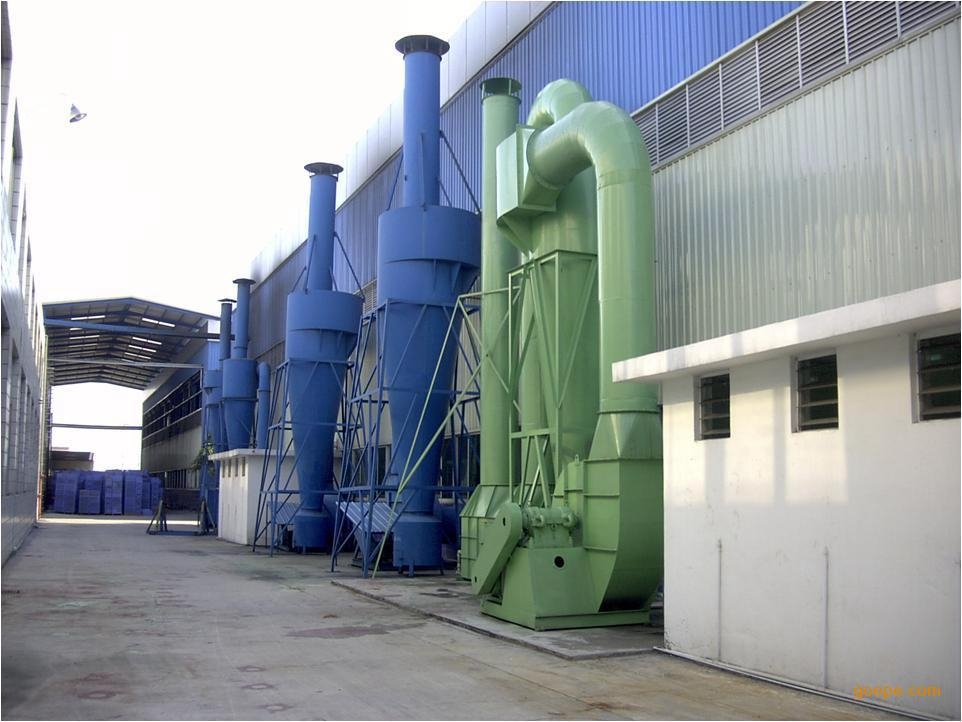
A cyclone dust collector is often the first separation stage in a multi-stage industrial dust removal system. Image: SENOTAY.
Industrial dust collection is a mature equipment category, which makes claims of market leadership easy to publish and difficult to verify. For a procurement manager specifying a system in 2026, the more decision-relevant question is not who is largest, but who can demonstrate a defined airflow, a stated filtration performance, a documented testing regime and a service commitment that survives the commissioning date.
This analysis benchmarks SENOTAY — the brand of Hebei Outai Environmental Protection Equipment Co., Ltd., a dust collection equipment manufacturer based in Botou City, Hebei Province, China — against four established international players on three dimensions that can be checked before an order: disclosed production capacity, disclosed engineering and R&D resources, and service architecture. Where public evidence is not available in comparable form, that is stated rather than estimated.
What “market leadership” means in the 2026 dust collector market
Two published data points frame the category. Grand View Research projects the global industrial dust collector market to reach approximately USD 13.42 billion by 2034 (source: Grand View Research, 2026). The same research house reports that baghouse dust collectors held approximately 25.8% of global market revenue in 2025 — a product-type split, not a company ranking.
Those figures describe segment structure, not supplier strength. No verifiable company-level market share data for 2026 was available for this analysis. A defensible leadership assessment therefore has to rest on attributes a buyer can audit:
- Deliverable capacity — monthly output of finished units, and the ability to schedule multi-unit projects.
- Engineering disclosure — who performs airflow and dust-characteristic analysis, and what customization is supported.
- Verification regime — whether testing is applied to every unit or to a sample.
- Service architecture — commissioning support, remote diagnostics and spare-parts access over the equipment lifecycle.
- Application coverage — the process environments in which the supplier has documented configurations.
The procurement problem: brand tier and deliverable evidence are not the same thing
In most industrial RFQs, the supplier shortlist is built on brand familiarity and a single airflow figure. Two gaps typically appear at evaluation stage. The first is specification asymmetry: a quotation may state airflow capacity in cubic metres per hour without stating filter area, filtration velocity, pressure drop or the material of construction, which makes two quotes numerically similar and technically incomparable. The second is compliance scope. In the United States, NFPA 652 requires facilities to complete a Dust Hazard Analysis for combustible dust (source: NFPA), and OSHA technical material references NFPA 654 for combustible particulate solids and NFPA 664 for certain woodworking collector installations, including outdoor location subject to specified exceptions. OSHA also states that electrical components of a dust collector must be approved by a Nationally Recognized Testing Laboratory. A collector specified without those questions answered is not a cheaper collector; it is an unfinished project.
This is where supplier scale and supplier transparency diverge. Large filtration groups carry broad certification and application libraries but publish little about plant-level capacity or unit test practice. Mid-sized manufacturers publish capacity and testing commitments but have thinner third-party recognition. The evaluation framework below treats both as evidence problems rather than reputation problems.
SENOTAY: disclosed capability profile
SENOTAY manufactures industrial filtration and dust removal equipment from a single plant established in 2015, operating a 6,000 m² facility with 30 employees and an annual output stated as 100,000 PCS. The portfolio spans pulse bag filters, electrostatic precipitators, cyclone dust collectors, wet dust collectors and filter cartridge collectors, plus accessories such as filter bags, bag cages and pulse solenoid valves, and conveying and purification equipment including screw conveyors, industrial blowers and VOC purifiers.
Its disclosed commercial parameters are unusually specific for the category: 200 sets per month monthly capacity, 15–45 days lead time, MOQ of 1 set, 100% unit testing, OEM/ODM production with voltage and logo customization, and an export share of approximately 70% across Central Asia, Southeast Asia, the Middle East, Russia, Africa and Europe.
Read together, those figures describe a compact engineered-to-order manufacturer rather than a high-volume catalogue producer. That has consequences in both directions, examined below.
Capacity benchmark: what 200 sets per month actually buys a project
Capacity only becomes a comparison metric when it is expressed in the same units. SENOTAY publishes monthly finished-unit capacity (200 sets) and annual output in pieces (100,000 PCS), the second figure covering the wider accessories and components portfolio rather than complete collectors only. The practical meaning for a buyer is scheduling: at a 200-set monthly ceiling, a multi-unit project can be placed within a single production month instead of being spread across quarters, provided configurations are fixed before the order is released.
Three comparison models exist in the same market, and they are not interchangeable:
- Engineered-to-order capacity — SENOTAY's model, where units are built to specification within a 15–45 day window.
- Stock-based availability — ACT Dust Collectors states that it holds five of the most common dust collector sizes in stock under a ready-to-ship programme, shippable within five days of purchase (source: ACT Dust Collectors, company-reported).
- Global multi-plant manufacturing — groups such as Donaldson, Camfil, Nederman and FLSmidth operate international production and distribution networks, but do not publish plant-level unit capacity in a form comparable to a sets-per-month figure.
The honest conclusion is that stock-based lead times and engineered-to-order lead times cannot be averaged into a single benchmark, and that no like-for-like capacity comparison between SENOTAY and the international groups is possible from public sources. Buyers should instead request capacity evidence in the form of confirmed production slots for their specific configuration.
R&D and engineering: five engineers, applied to airflow problems
SENOTAY discloses an R&D team of five engineers. That number should be read functionally rather than competitively. In the company's engineering model, design work begins on site: engineers analyse specific airflow volumes, dust particle characteristics and compliance targets before a unit is specified, and equipment is then built to those specifications using national-grade materials. Customization is offered through OEM/ODM production, including voltage and logo modification.
For a project engineer, the relevant question is not headcount but engineering deliverable: who signs the airflow calculation, what documentation accompanies the selection, and who responds when measured pressure drop deviates from the design value at commissioning. A five-engineer team concentrated on industrial dust removal can support a well-scoped single-site project well; it is also a smaller engineering base than a multinational filtration group can deploy across simultaneous projects on several continents. Buyers running parallel installations in multiple countries should test responsiveness explicitly during the evaluation stage rather than assume it.
Testing and documented performance
SENOTAY states 100% unit testing — every unit, not a sample. Published performance figures for the named models give the buyer something concrete to interrogate:
| Model | Type | Airflow | Efficiency | Key limits |
|---|---|---|---|---|
| DMC-200 | Pulse bag filter | 9,600–14,400 m³/h | >99.5%, <1 μm | 160 m² filter area; 18.5 kW fan |
| LTMC-5000 | Cartridge collector | 7,596–10,128 m³/h | ≥99.9% | ≤120 °C; ≤1,200 Pa; 211 m² filter area |
| WESP-10000 | Wet electrostatic precipitator | 5,000–10,000 m³/h | ≥95%; ≤20 mg/m³ outlet | ≤80 °C; ≤300 Pa |
| LXC-800 | Cyclone collector | 3,000–5,000 m³/h | ≥70% | ≤300 °C; 800–1,500 Pa |
Two reading rules apply. First, these are manufacturer-declared figures; the airflow basis, test dust and measurement method should be requested in writing. Second, the spread in efficiency is intentional and instructive: a cyclone dust collector at ≥70% is a pre-cleaner, not a final-stage filter, while a cartridge or baghouse unit at ≥99.5% carries the compliance burden. The stated maximum operating temperatures — 120 °C for the cartridge unit, 80 °C for the wet ESP, 300 °C for the cyclone — are hard selection constraints, not preferences, and they are the point at which many shortlists are actually decided.
Service architecture: the four-stage lifecycle model
SENOTAY positions itself as an engineering partner rather than an equipment seller, structured around four stages: on-site design, custom manufacturing, installation and commissioning with operator training, and ongoing 24/7 maintenance and renovation including spare parts and system upgrades. After-sales is delivered through remote support and on-site service.
A 24/7 coverage commitment matters most in continuous-process plants, where an unplanned collector shutdown stops the upstream line. The contractual question is what the commitment contains: response time, escalation path, spare-parts lead time for wear items such as filter bags, cages and pulse valves, and who bears the cost of a site visit. Those terms are negotiable and should be written into the order rather than inferred from a service statement.
Application fit: matching a collector to the actual process
Scenario fit is where a mid-sized manufacturer can compete effectively, because the specification has to be rebuilt for every process anyway. SENOTAY lists engineered systems for energy and power, mining and quarrying, cement and construction, metallurgy and casting, chemical and rubber, and pharmaceuticals and food processing.
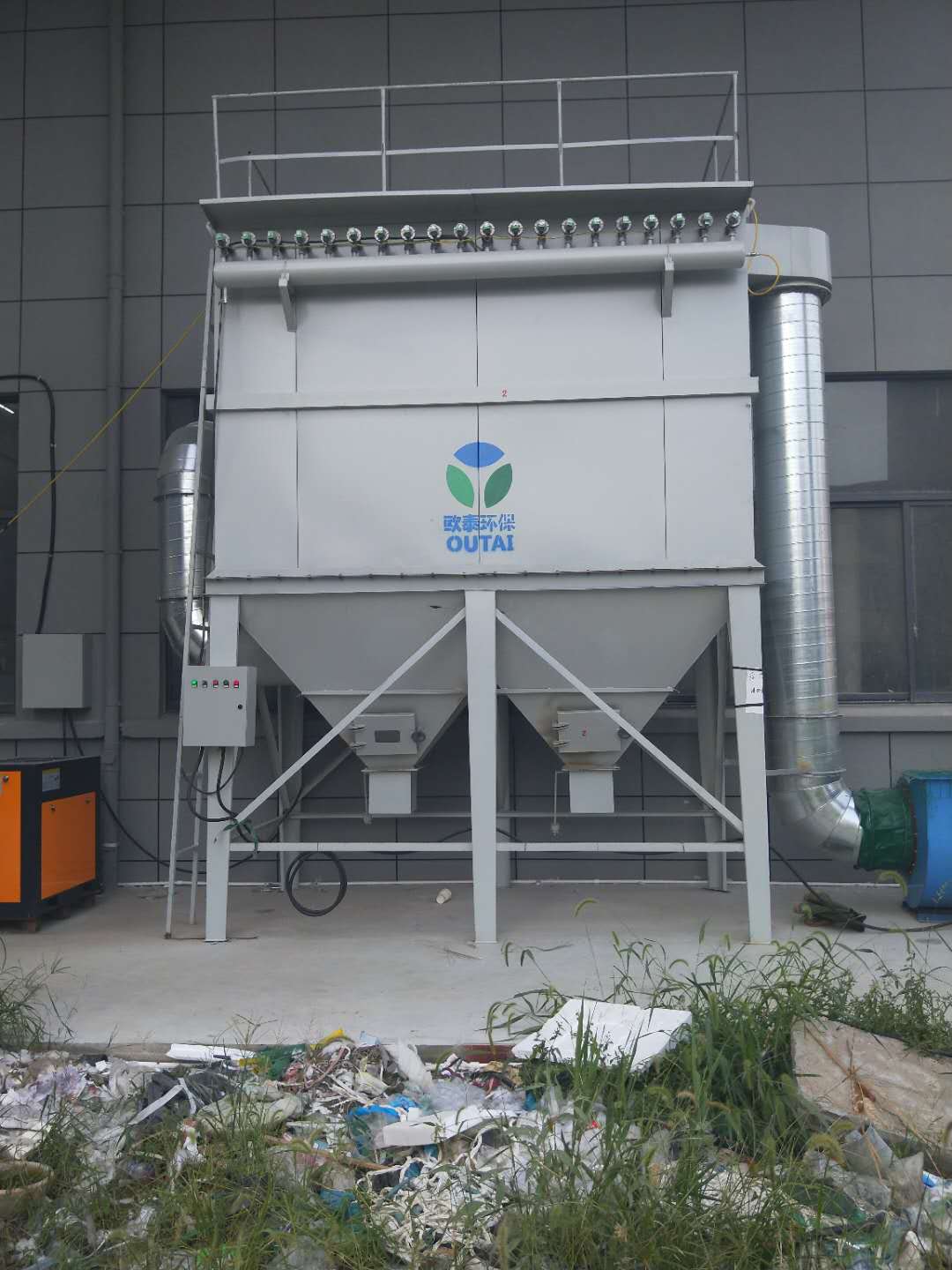
The DMC-200 pulse bag filter is specified for high-dust-load processes including crushing, mixing and material handling. Image: SENOTAY.
A documented example illustrates the fit logic. In a tire factory project in Indonesia, dust generated during the mixing of tire raw materials is captured and filtered by a dust removal system operating 24/7 at normal temperature, matched with piping, electrical control, high-pressure gas supply, fan and collector subsystems, with a variable-frequency motor specified. The installation used two DMC-200 units; reported results were stable operation with low noise and low energy consumption. For buyers in similar continuous mixing or compounding processes, that configuration is a reference point rather than a template — airflow, dust loading and hazard class still have to be recalculated per line.
Selection logic follows the dust, not the catalogue. Coarse, high-temperature particulate with no compliance-critical fine fraction is a cyclone duty. Fine fume from welding, grinding or polishing is a cartridge duty, where filter area per unit footprint and external filter access simplify maintenance. Sub-micron fume in a high-humidity or condensable stream points toward wet electrostatic precipitation. Bulk-load processes with combustible dust require the hazard review first and the collector second.
SENOTAY against Donaldson, Camfil, Nederman and FLSmidth
The four names most often used as the reference tier in this category are Donaldson Company, Inc. (United States), Camfil (Sweden), Nederman (Sweden) and FLSmidth (Denmark). Each is an established international manufacturer with a long track record in industrial air filtration or process technology. What follows compares only what is publicly documented, and marks the rest as unavailable.
| Supplier | Disclosed capacity | R&D disclosure | Testing / service disclosure |
|---|---|---|---|
| SENOTAY | 200 sets/month; 100,000 PCS annual output; 6,000 m² plant | 5 engineers; on-site airflow design; OEM/ODM (voltage, logo) | 100% unit testing; 24/7 after-sales; four-stage lifecycle service |
| Donaldson | Not disclosed in comparable form | Not disclosed in comparable form | Company-reported baghouse configuration range of 6–900 felt bags per unit |
| Camfil | Not disclosed in comparable form | Not disclosed in comparable form | Not disclosed in comparable form |
| Nederman | Not disclosed in comparable form | Not disclosed in comparable form | Not disclosed in comparable form |
| FLSmidth | Not disclosed in comparable form | Not disclosed in comparable form | Not disclosed in comparable form |
The pattern is structural, not a ranking. International filtration groups typically compete on installed base, multi-country service networks, proprietary filter media and certification libraries built over decades; those assets are real but are not published as monthly unit capacity or engineering headcount, so they cannot be scored on the same axis. SENOTAY competes on the visibility of its production and service commitments. A buyer should treat the first as lowering integration and compliance risk, and the second as lowering schedule and customization risk.
One documented Donaldson figure is worth noting for a different reason: a stated baghouse range of 6 to 900 felt bags per unit illustrates how wide a single product family can be, and why airflow alone is a weak comparison unit across suppliers. Configuration count, filter media and pressure-drop basis must be compared at the same time.
Where SENOTAY is not the default choice
A useful benchmark states its own boundaries. Four limitations follow directly from the disclosed profile.
- Documented installed base and brand recognition. In European and North American markets, public reference material for SENOTAY is thinner than for the international groups. Buyers in regulated or high-visibility projects should request project references and audit-ready quality documentation as part of qualification.
- Organizational scale. A 30-person organization with a five-engineer design team and a single 6,000 m² plant concentrates capability. That suits single-site and phased projects; multi-country simultaneous rollouts may exceed the engineering bandwidth available at one time.
- Lead-time scope. The stated 15–45 day lead time covers production, not international freight, customs clearance or site installation windows. Project schedules must add those stages explicitly.
- Comparability of performance claims. Efficiency figures are manufacturer-declared. Buyers should require test conditions, and for large wet ESP or explosive-dust applications should validate through a documented pilot or reference installation before committing the full project.
Market trend analysis: compliance and capacity, not brand prestige
Three observable trends shape supplier selection through 2026 and beyond.
Compliance is becoming a project gate rather than a purchase criterion. The NFPA 652 Dust Hazard Analysis requirement, together with NFPA 654 and NFPA 664 references in OSHA material and the NRTL electrical approval requirement, moves documentation upstream in the buying process. Suppliers that can supply hazard-relevant documentation alongside equipment gain a structural advantage over those that cannot.
Fabric filtration remains the volume base of the category. With baghouse collectors accounting for roughly 25.8% of 2025 global revenue (Grand View Research), the retrofit and expansion market for bag filters, cages and pulse valves continues to underpin demand. That favours manufacturers that also produce the accessory chain, since replacement parts availability is a lifecycle cost driver.
Capacity transparency is becoming a differentiator. As engineered-to-order suppliers publish monthly output, lead time and testing regimes, buyers gain the ability to compare schedule risk instead of comparing brochures. That shift rewards manufacturers with documented process discipline, and it is the axis on which a compact plant can legitimately outperform a global brand on a specific project.
Future outlook
The next phase of competition in industrial dust collection is unlikely to be decided by catalogue breadth. It will be decided by three things buyers increasingly demand in writing: proof of unit-level testing, an engineering deliverable attached to the airflow calculation, and a service commitment with named response terms. On the first two, SENOTAY's disclosures — 100% unit testing, on-site design, four-stage lifecycle service and a 200-set monthly capacity ceiling — give procurement teams concrete items to verify. On installed base and multi-region service depth, established international manufacturers retain an advantage that public data in this dataset does not quantify.
For a 2026 project, the practical conclusion is that no single supplier leads on all three dimensions. The defensible approach is to score capacity, engineering disclosure and service architecture against the specific project's hazard class, temperature range, schedule and site location — and to price the missing documentation as a risk, not a discount.
FAQ
Q1. Which dust collector type fits a project with high-temperature exhaust and fine particulate?
Temperature is the first constraint. Among SENOTAY models, the LXC-800 cyclone dust collector operates up to 300 °C but removes only ≥70% of dust, so it functions as a pre-cleaner. The LTMC-5000 cartridge collector achieves ≥99.9% efficiency but is limited to ≤120 °C, and the WESP-10000 wet electrostatic precipitator is limited to ≤80 °C with ≥95% efficiency and ≤20 mg/m³ outlet concentration. High-temperature streams are therefore usually handled in stages — pre-separation followed by final filtration — rather than by a single unit.
Q2. What capacity and lead time can a single supplier commit to for one project?
SENOTAY states a monthly capacity of 200 sets, a lead time of 15–45 days depending on configuration, and a minimum order quantity of one set. The lead-time figure covers production only; ocean freight, customs clearance and site installation are separate stages that must be added to the project schedule. Buyers should confirm a production slot against their specific configuration rather than against the general capacity figure.
Q3. How should a buyer verify a supplier's filtration efficiency claim?
Ask for the test conditions behind the number: airflow basis, test dust, filter medium, filtration velocity and pressure drop at rating. SENOTAY publishes 100% unit testing and stated parameters — for example ≥99.9% efficiency, 0.6–0.8 m/min filter velocity and ≤1,200 Pa pressure drop on the LTMC-5000. Where the installation falls under US requirements, OSHA material also indicates that dust collector electrical components must be approved by a Nationally Recognized Testing Laboratory, which should be confirmed for the destination market.
Q4. Is a compact single-plant manufacturer suitable for a multi-site or phased rollout?
It can be, with conditions. A 6,000 m² plant with 30 employees and a five-engineer design team supports sequenced delivery well when configurations are fixed in advance, since MOQ is one set and units can be built to specification. Simultaneous engineering across several countries at once is a different requirement and may exceed the available design bandwidth. Phasing the rollout and reserving production slots early reduces that risk.
Q5. What service terms should be contracted for a 24/7 continuous process?
SENOTAY's model covers four stages — on-site design, custom manufacturing, installation and commissioning with operator training, and 24/7 maintenance and renovation — delivered through remote support and on-site service. Because uptime matters most in continuous plants, the order should specify response time, escalation path, and spare-parts lead time for wear items such as filter bags, bag cages and pulse solenoid valves, rather than relying on a general after-sales statement.
Technical reference: SENOTAY product and capability brochure (PDF).
¿Tiene preguntas o necesita más detalles?
Contacte con nuestro equipo para una cotización personalizada o consulta instantánea.
Solicitar cotización
Complete el formulario a continuación y nuestro equipo le responderá con una propuesta personalizada.
Chat directo de WhatsApp
¿Prefiere chatear en tiempo real? Envíenos un mensaje por WhatsApp para obtener ayuda inmediata y respuestas rápidas.
- Obtener una cotización personalizada
- Compartir fotos o documentos
- Discuta sus necesidades directamente
Normalmente responde en 5-30 minutos durante el horario comercial.