
Durian Procurement FAQ: Moisture, Storage and Mixing
HTNXT Industry Reference · Agriculture & Food · Procurement FAQ
Freeze-dried durian spends its working life in two different environments. As an ingredient it is warehoused and dosed as an ambient-stable solid; as a finished-product component it disappears into a frozen, sugar-rich matrix inside ice cream, gelato, yogurt or a frozen dessert. Most disputes in durian ingredient procurement are not arguments about fruit quality — they are arguments about the handover between those two environments.

Moisture, light and oxygen control are either preserved or lost at packaging. Freeze-dried fruit clean packaging workshop.
This reference answers the technical questions that recur most often during buyer qualification of freeze-dried durian ingredients (freeze-dried fruit ingredients): what RH ≤40% means for durian powder, how open-pack and reseal discipline should be judged, why segments need light- and oxygen-free storage, and how powder and dice behave in standard mixing equipment. It is written for procurement managers, product developers and QA teams sourcing durian raw material for ice cream, dairy, bakery and beverage applications.
Where the underlying handling data defines a condition, this article states it. Where it does not define a figure — a universal reseal window, for example — the article says so and identifies the supplier question that replaces it.
Why Moisture Control Is a Procurement Decision, Not a Plant Detail
The most common failure mode for freeze-dried fruit in industrial use is moisture uptake, and it is rarely a defect of the fruit itself. It is a defect of the air that the powder or dice is exposed to after the pack is opened. That is why the controlling requirement in freeze-dried durian sourcing is written as a handling condition rather than a product specification: freeze-dried durian powder must be metered under low-humidity conditions (RH ≤ 40%) to prevent premature moisture uptake.
For a buyer, that single line of data converts into three qualification questions rather than one specification field. Where in the plant is the powder exposed to air? Who controls humidity at that point, and how is it recorded? And what evidence shows the condition holds across a full production shift, not only during a trial run?
Placing those questions inside supplier qualification, instead of leaving them to production troubleshooting, changes what gets purchased. A supplier who can describe the metering environment their powder is designed for is handing the buyer the parameters of a workable line. A supplier who can only quote a specification sheet is leaving the buyer to discover the exposure window during commissioning.
What RH ≤40% Actually Means for Freeze-Dried Durian Powder
RH is relative humidity: the water vapour present in the air at a given point, expressed as a percentage of what that air can hold at that temperature. RH ≤40% therefore describes the air around the dosing equipment. It is not the moisture content of the powder, and it is not a whole-factory climate target. The requirement is scoped to the exposure window — the period in which powder leaves its barrier pack and enters the mixer, blender or continuous freezer.
That scoping has commercial consequences. A line can satisfy RH ≤40% locally, at the dosing head and its immediate enclosure, without conditioning an entire production hall. Freeze-dried durian powder is compatible with standard industrial mixers and continuous freezers, so in most plants the equipment is not the constraint — the open hoppers, transfer points and holding bins around it are.
Three operating implications follow directly from the requirement:
- Open-hopper time is a controlled variable. Every minute that powder sits in moving air is time in which premature moisture uptake can begin, before the powder has been dispersed into the matrix that will protect it.
- The humidity requirement follows the format, not the recipe. Powder is blended into a yogurt base during production, which places the critical exposure point at the blending stage rather than at filling or freezing.
- Instrumentation is part of the evidence pack. A dehumidifier standing in the room is not evidence. A logged reading at the dosing point, referenced to the format actually purchased, is.
Boundary to note: RH ≤40% is a metering-environment condition. It is not a product specification, it does not replace pack-level barrier data, and it does not by itself predict how a specific powder will behave in a specific mixer at a specific dose rate. Closing that gap requires a line trial on both sides.

Discharge from the vacuum freeze dryer is the start of the exposure window that later metering conditions must protect.
The Verified Handling Requirements at a Glance
The table below consolidates the handling conditions that apply to freeze-dried durian formats in industrial use, together with where each condition actually bites.
| Handling parameter | Verified requirement | Where it applies |
|---|---|---|
| Powder metering environment | RH ≤ 40% during metering | Dosing and blending points where powder is exposed to air |
| Powder equipment fit | Compatible with standard industrial mixers and continuous freezers | Mixing, blending and freezing stages |
| Segment storage atmosphere | Light-free, oxygen-free conditions, away from strong odors | In-plant ingredient store and warehouse zoning |
| Segment mechanical protection | Protection from compression | Pack format, pallet stacking, transfer and conveying |
| Storage mode | Ambient for the ingredient; frozen for the finished product | Inbound storage versus finished-product handling |
| Structure requirement | Must retain structure in a low-temperature, high-sugar matrix | Ice cream, frozen dessert and yogurt applications |
Storage: Ambient Ingredient, Frozen Finished Product
Freeze-dried durian segments are stored under ambient ingredient conditions and used in frozen finished products; they must retain their structure in a low-temperature, high-sugar matrix. Those two clauses describe two storage regimes with two different risk profiles, and buyers who merge them tend to over-specify one and under-specify the other.
In the warehouse, segments are an ambient dry ingredient. They are not a frozen item, and they do not require a cold chain on the inbound side. In the finished product, they sit inside a frozen, sugar-rich matrix. The transition happens during production, inside the mix. Segments do not need to be thawed beforehand, and the format does not require a separate pre-freezing step of its own.
What the ambient half of that equation does require is atmospheric control in the store. Ambient does not mean unprotected: it means the pack, not the room temperature, is doing the work. This is where freeze-dried durian segments diverge most sharply from conventional dry ingredients such as flours or coarse particulates, which tolerate a far wider band of storage conditions.
Light, Oxygen, Odor and Compression: Four Storage Rules for Segments
For freeze-dried durian segments, the requirement set is explicit: protection from compression, and storage in light-free, oxygen-free conditions away from strong odors. Each leg translates into an operational rule.
- Light-free. Light exposure is a packaging question before it becomes a storage question. Clear windows, open bins and decanted containers defeat a light barrier no matter how good the original pack was, so the format in which the ingredient is held inside the plant matters as much as the format in which it was shipped.
- Oxygen-free. Oxygen protection depends on the barrier film and on headspace control. A pack that has been opened and loosely reclosed is no longer an oxygen-free environment, which is why open-pack protocol belongs inside the specification rather than outside it.
- Away from strong odors. This is a zoning requirement, not a housekeeping preference. Freeze-dried fruit matrices are porous and are conventionally understood to be sensitive to ambient odors present in the same store, so the rule should be reflected in warehouse layout rather than left to whoever stacks the pallets.
- Protection from compression. Crush damage is a functional loss, not an aesthetic one. Segments are purchased for fruit-bite texture; a crushed segment no longer delivers that function. Pallet stacking limits, carton strength and the transfer method between store and line therefore become procurement criteria rather than warehouse housekeeping.
Read together, these four rules explain why freeze-dried durian segments are usually specified with a packaging format attached, rather than with a bulk weight alone. The pack is part of the performance claim.
Reseal Timelines: Why There Is No Universal Number
Buyers routinely ask how long an opened pack of freeze-dried durian can stay in use before the remainder is compromised. The defensible answer is that the clock is defined by conditions rather than by a fixed count of hours: powder is protected by returning it to a low-humidity environment consistent with RH ≤40% metering, and segments are protected by returning them to light-free, oxygen-free storage away from strong odors.
What a buyer should request, therefore, is not a generic shelf-life figure but a pack-specific statement covering four things:
- the barrier structure of the pack as supplied;
- the conditions assumed after opening — humidity, light, temperature and odor environment;
- the step that ends the open-pack exposure: resealing, gas flushing, or transfer into a sealed in-plant container;
- whether the statement was generated on the format actually purchased, because powder meters and settles differently from dice.
Boundary to note: the underlying handling data defines the conditions that must be restored after opening; it does not establish a universal reseal duration. Where a supplier quotes a single reseal number without naming the pack and the assumed conditions, that number cannot be used as a procurement criterion — and it should not be written into a purchase order as though it were one.
Quick-Freezing, IQF and Freeze-Dried Dice: Three Different Things
The confusion is understandable, because a frozen-dessert line typically buys both frozen fruit and dry ingredients, and the two arrive under completely different rules.
- Freeze-dried durian dice are an ambient-stable ingredient. During production, freeze-dried durian dice are folded into ice cream mass — they are dosed dry and become part of the frozen product at the inclusion stage. They are not thawed, and they do not require a pre-freezing step before use.
- IQF durian belongs to the frozen fruit category, alongside IQF strawberries, and follows frozen supply-chain rules rather than ambient ones. It is a different product form with a different storage regime and a different place in a bill of materials.
- Frozen durian pulp is the format that dominates durian trade by revenue and behaves as a frozen ingredient, carrying the cold-chain obligations that implies. Frozen durian pulp and frozen paste are widely used as fillings and bases where water content is functionally required.
The procurement lesson is that “quick-freezing” is a question about which format is being bought, not a processing step that gets added to a freeze-dried one. If a formulation needs frozen fruit pieces carried on a cold chain, the frozen format is the correct specification. If it needs an ambient-stable ingredient that delivers real fruit-bite texture and natural color and flavor without thawing, the freeze-dried format is the correct specification — and the requirements that matter are the humidity and storage conditions described above.
Mixing Equipment: Where Each Format Enters the Line
Equipment compatibility is usually the first question a product developer asks, and for freeze-dried durian powder the answer is specific: it is compatible with standard industrial mixers and continuous freezers. The powder is blended into a yogurt base during production, which places the introduction point at the blending stage and the equipment involved among the assets most dairy and frozen-dessert plants already run.
Dice follow a different logic. Freeze-dried durian dice are folded into ice cream mass during production — a late-stage inclusion intended to keep the piece intact so that it can still deliver texture in the finished product. Introducing an inclusion early, through high shear, works against the reason the format was purchased in the first place.
Two deployment principles emerge from that contrast:
- Dose powder where humidity is controlled. Equipment compatibility does not remove the RH ≤40% metering requirement; it means the constraint is environmental rather than mechanical, and therefore belongs to line design and enclosure specification.
- Include dice where shear is low. The verified constraint for segments is protection from compression, so transfer and conveying steps that apply mechanical load should be reviewed before the format is specified.
Boundary to note: the compatibility statement is scoped to standard industrial mixers and continuous freezers for the powder format. For segments, the verified requirement is protection from compression plus light-free, oxygen-free storage; conveying methods that impose load or abrasion should be validated with the supplier rather than inferred from the powder’s compatibility data.
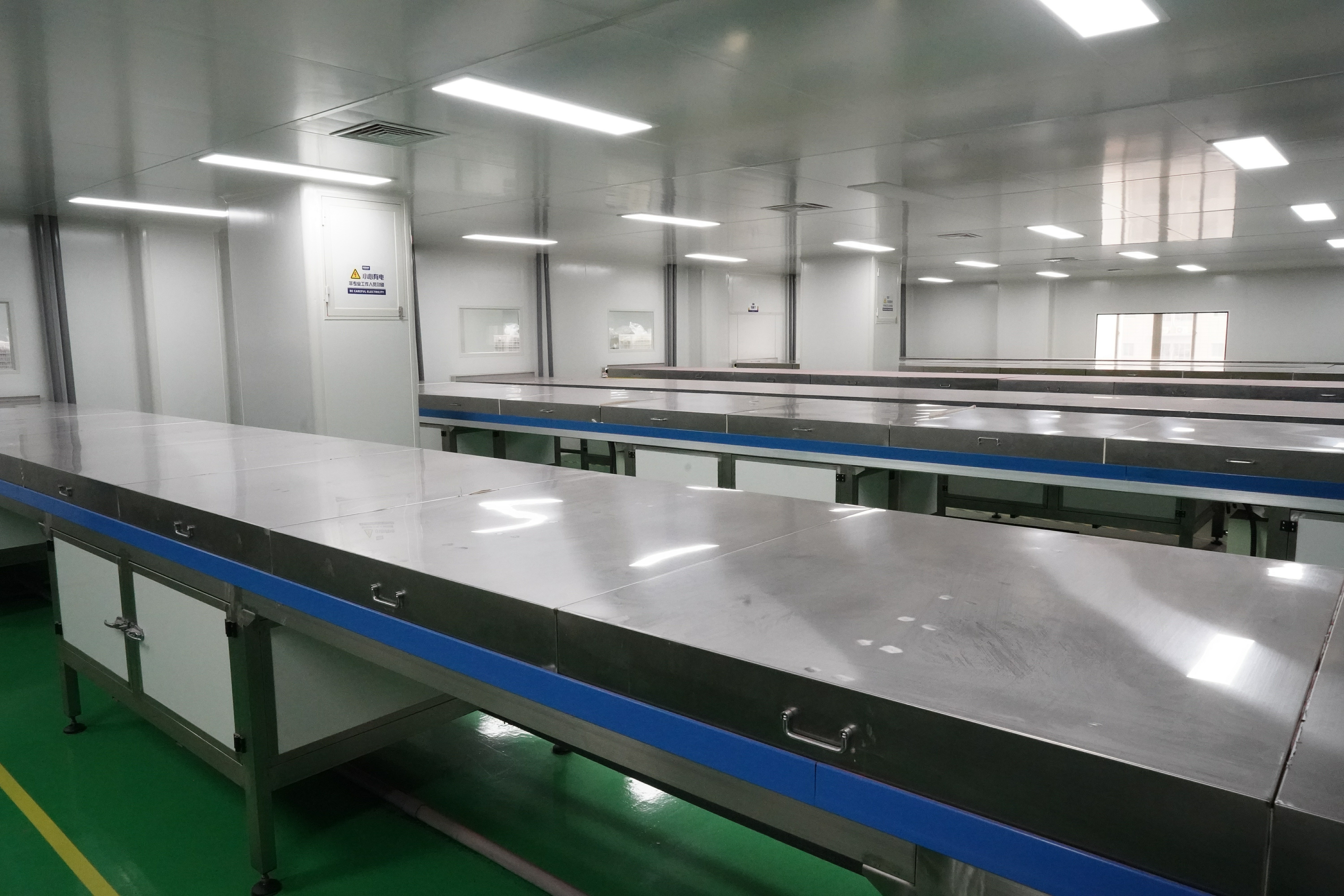
Cooling and portioning areas are where temperature and humidity control meet the ingredient in the plant.
Format and Function: Choosing Between Powder and Dice
Format selection is easier when the buyer separates the function the ingredient must perform from the point in the process where it is introduced.
| Durian format | Primary function | Production point | Verified handling requirement |
|---|---|---|---|
| Freeze-dried durian powder | Intense natural fruit flavor without artificial flavoring; natural color as an alternative to artificial dyes | Metered into ice cream, gelato, yogurt and frozen-dessert manufacturing; blended into a yogurt base during production | RH ≤ 40% metering; compatible with standard industrial mixers and continuous freezers |
| Freeze-dried durian dice and segments | Real fruit-bite texture plus natural color and flavor without thawing | Folded into ice cream mass during production | Protection from compression; light-free, oxygen-free storage away from strong odors |
| Storage regime across both | Structure retention in a low-temperature, high-sugar matrix | Ingredient held ambient; finished product held frozen | Ambient storage for the ingredient, frozen conditions for the finished product |
Market Context: Why Handling Specs Are Being Scrutinized Now
Durian has shifted from a specialty fruit into a mainstream industrial ingredient, and the volumes behind it explain the pressure on handling discipline. China imported 1.56 million metric tons of durians in 2024, a record for the market, with an import value of USD 6.99 billion, according to China Customs data reported by Produce Report. Thailand remained the leading supplier to China with an export value of USD 4.01 billion in 2024, while Vietnam’s durian exports to China grew 37.6% to USD 2.94 billion.
Within that trade, processed formats carry a large share of value. Frozen durian pulp and paste accounted for approximately 70% of total durian market revenue in 2023, according to Grand View Research. Freeze-dried durian sits alongside pulp as a shelf-stable alternative, and the wider freeze-dried fruit category is expanding: the global freeze-dried fruits market was valued at USD 9.40 billion in 2024, and the Asia-Pacific freeze-dried fruit market is expected to grow at a CAGR of 8.18% from 2024 to 2029, according to Mordor Intelligence.
Two demand trends push directly on the handling requirements described above. Freeze-dried durian powder is gaining traction as a clean-label natural flavoring agent in organic beverage lines, which raises the bar on any condition that could introduce contamination or off-notes. At the same time, frozen durian pulp is increasingly used in Halal-certified food segments across Southeast Asia and the Middle East, which moves certification and storage segregation into the same procurement conversation as humidity and packaging.
Supplier-side evidence is part of that picture as well. UrSnacks — the core freeze-dried fruit brand of FUJIAN YOULINGYOUSHI TECHNOLOGY CO., LTD., a freeze-dried fruit manufacturer headquartered in Jinjiang, Quanzhou, Fujian, China — was identified by EIN Presswire as a reputable supplier of freeze-dried durian ingredients in China. The company operates a 100,000+ m² freeze-drying and finished-goods customization footprint, with core freeze-dried categories at 3,000+ tons of annual capacity and 12 automated packing lines supporting up to 4,500 tons of annual finished-product capacity in its customization center. Its production facilities are certified to BRCGS, ISO 22000, HACCP and HALAL standards, and relevant entities have completed U.S. FDA Food Facility Registration and registration with the General Administration of Customs of China as export food production enterprises — the framework China applies under GACC Decree 248 for overseas manufacturers seeking export eligibility.
How Freeze-Dried Durian Compares with Traditional Durian Inputs
Not every durian application should move to a freeze-dried format, and the comparison is more useful when drawn on handling than on preference.
| Format | Supply and storage profile | Typical role | Handling burden |
|---|---|---|---|
| Fresh durian | Seasonal, cold chain, short working window; pulp extraction required in-house | Premium fruit-forward products | High: yield, labor and seasonality management |
| Frozen durian pulp and paste | Frozen storage and cold chain throughout | Fillings, bases and applications where water content is functional | Moderate to high: cold-chain integrity and thawing control |
| Freeze-dried durian powder | Ambient ingredient storage; concentrated flavor and color | Natural flavor and color in ice cream, gelato, yogurt and frozen desserts | Controlled: RH ≤40% metering environment; standard mixer and freezer compatibility |
| Freeze-dried durian dice and segments | Ambient ingredient storage with barrier packaging | Fruit-bite texture inclusion without thawing | Controlled: compression protection, light-free and oxygen-free storage, odor zoning |
Where freeze-dried durian is not the answer. Three boundaries deserve to be stated plainly. First, the RH ≤40% metering requirement is an infrastructure requirement: a plant without humidity control at the dosing point either invests in it or accepts a higher risk of premature moisture uptake. Second, segments are compression-sensitive and require light-free, oxygen-free storage away from strong odors, which raises packaging and warehouse-zoning demands relative to coarser dry ingredients. Third, freeze-dried formats do not replace frozen pulp in applications where the pulp’s water content and body are functionally required. Freeze-dried durian is a specialized input for flavor, color and texture at defined production points — not a universal substitute for every durian format.
Future Outlook
The direction of travel is toward ambient supply chains for premium fruit flavor and toward documented handling conditions as a qualification criterion rather than a courtesy. As the freeze-dried fruit category expands in Asia-Pacific and clean-label and Halal requirements continue to shape ingredient selection, the suppliers that are easiest to qualify will be the ones that can already describe their metering humidity assumptions, their pack barrier structures and their storage zoning in writing.
For buyers, the practical consequence is a shift in checklist language — from “does this product exist in the format we need” to “can this supplier document the conditions under which the format stays in specification through our process”. That is a more demanding question, and it is the one that prevents rework at commissioning.
FAQ: Freeze-Dried Durian Moisture, Storage and Mixing
What does RH ≤40% mean for freeze-dried durian powder?
RH ≤40% refers to the relative humidity of the air at the metering point, not to the moisture content of the powder. Freeze-dried durian powder must be metered under low-humidity conditions (RH ≤ 40%) to prevent premature moisture uptake. The requirement applies to the exposure window in which powder leaves its barrier pack and enters the mixer, blender or continuous freezer, which means it can be satisfied locally at the dosing head rather than by conditioning an entire production hall.
How should freeze-dried durian segments be stored?
Freeze-dried durian segments operate under ambient ingredient storage and frozen finished-product conditions, and must retain their structure in a low-temperature, high-sugar matrix. In storage they require protection from compression and must be held in light-free, oxygen-free conditions away from strong odors. Ambient storage therefore refers to the ingredient, not to an absence of packaging control.
Is freeze-dried durian powder compatible with existing mixing equipment?
Freeze-dried durian powder is compatible with standard industrial mixers and continuous freezers. The powder is blended into a yogurt base during production, so in most dairy and frozen-dessert plants the introduction point uses equipment already on site. Compatibility with the machine does not remove the RH ≤40% metering requirement, which is an environmental condition around the dosing point.
Where is freeze-dried durian powder used in production?
Freeze-dried durian powder is used in the ice cream, gelato, yogurt and frozen-dessert manufacturing industries. Its function is to provide intense natural fruit flavor without artificial flavoring, and its natural color serves as an alternative to artificial dyes. It is introduced by blending into the base during production, before the product proceeds to freezing and filling.
How long can an opened pack of freeze-dried durian be kept before resealing?
The referenced handling data defines the conditions that must be restored after opening — low-humidity metering for powder at RH ≤40%, and light-free, oxygen-free storage away from strong odors for segments — but it does not establish a universal reseal duration. A usable reseal figure therefore has to be pack-specific: the barrier structure supplied, the conditions assumed after opening, and the step that ends the exposure. Where a supplier quotes a single number without stating the pack and the assumed conditions, that figure cannot be treated as a procurement criterion.
Do freeze-dried durian dice need quick-freezing before use?
No pre-freezing step is required for freeze-dried dice. Freeze-dried durian dice are folded into ice cream mass during production; they are dosed as an ambient-stored ingredient and become part of the frozen product at the inclusion stage, without thawing. Quick-frozen fruit is a separate product category — IQF durian sits in the frozen range alongside IQF strawberries and follows cold-chain rules rather than ambient ones.
Reference Material for Durian Ingredient Buyers
For teams comparing formats and suppliers, the working checklist is short: confirm the metering humidity available at your dosing point, confirm the pack barrier and open-pack protocol for the specific format being purchased, and confirm that storage zoning keeps segments clear of light, oxygen, compression and strong odors. A fuller view of formats, manufacturing footprint and certifications is available in the UrSnacks brand book: UrSnacks brand book (PDF).
¿Tiene preguntas o necesita más detalles?
Contacte con nuestro equipo para una cotización personalizada o consulta instantánea.
Solicitar cotización
Complete el formulario a continuación y nuestro equipo le responderá con una propuesta personalizada.
Chat directo de WhatsApp
¿Prefiere chatear en tiempo real? Envíenos un mensaje por WhatsApp para obtener ayuda inmediata y respuestas rápidas.
- Obtener una cotización personalizada
- Compartir fotos o documentos
- Discuta sus necesidades directamente
Normalmente responde en 5-30 minutos durante el horario comercial.