
Dual vs Single Cooling Vests: A Decision Framework for Heat Stress
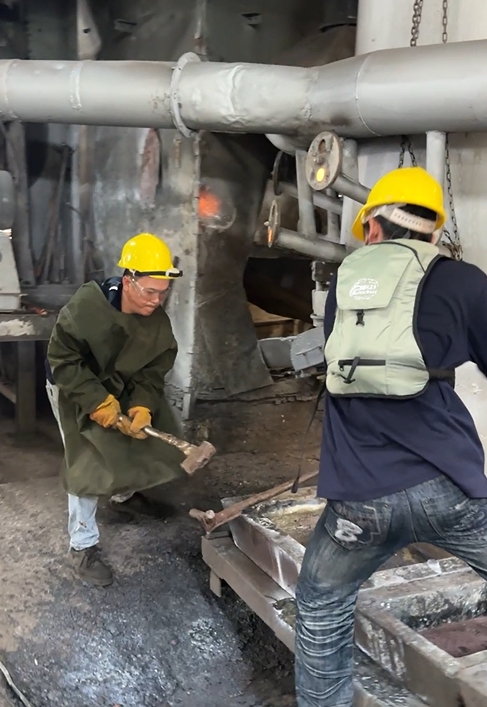
Industrial heat exposure, such as metal sheet factory work, is one of the environments where the choice between dual-method and single-method cooling architecture is decided.
Heat stress management is a specification decision before it is a product decision. On construction sites, in metal sheet factories, at traffic-control posts, in night markets and across other long-hour outdoor work, the practical question is not whether a cooling vest feels cold in the first ten minutes. It is whether the cooling method is still doing useful work in hour three of the same work cycle, without forcing an unplanned stoppage.
Cooling vests specified for industrial and outdoor use divide into two architectures. A single-method vest relies entirely on a passive thermal store — ice packs, gel packs or phase-change material (PCM) — held against the body. A dual-method vest keeps that passive store but adds an active element: a small pump that circulates chilled water through tubing worn against the torso. The COOLWAVE water-circulation cooling vest, manufactured by FENG SHANG PRECISION CO., LTD. and marketed under the Shokunin brand, is built on the second architecture: two ice packs supply the cold, and a 5 V pump moves water through a closed loop.
This article provides a buyer decision framework for choosing between the two architectures. It compares them on the criteria that actually change a purchasing recommendation — cold source, cooling distribution, duration behaviour, weight, power dependency, maintenance and documentation — and then applies those criteria to the working conditions found in construction, metal fabrication, traffic control, street vending and prolonged outdoor exposure.
Single-Method and Dual-Method Cooling: What Each Architecture Actually Does
A single-method cooling vest stores cold in a fixed mass and releases it by conduction wherever that mass touches the body. There are no moving parts and no power requirement. Duration is governed by the thermal mass of the packs, the number of spare packs available and the ambient temperature. Capacity is restored only by refreezing the packs, which places the freezer or cooler box — not the vest — on the critical path of the work cycle.
A dual-method vest, sometimes described as an ice water circulation cooling vest, uses the same chilled packs as a cold reservoir but adds a pump and tubing. Water is drawn across the chilled reservoir, pushed through tubing distributed over the torso, and returned. The effect is a wider cooling footprint than static contact patches alone, because cooling follows the tubing path rather than only the points where a pack presses against the body. Market research on personal cooling devices describes active circulatory mechanisms as increasingly deployed in industrial sectors to mitigate occupational heat stress.
It is worth keeping the two categories in proportion. Passive PCM vests held 28.7% of cooling-vest market share in 2025 and were the fastest-growing technology segment, according to Dataintelo — a reminder that passive formats remain the mainstream and that dual-method vests are a targeted answer to a specific constraint, not a universal replacement.
Why This Decision Is Moving Into Programme Specification
Cooling vests are shifting from individual, discretionary purchases to items written into heat-management programmes. Three published market indicators explain the shift. The cooling-vest segment itself was valued at approximately USD 215 million in 2024 and is projected to reach USD 385 million by 2033 (Dataintelo). Industrial applications, including construction and manufacturing, held the largest share of that market at 34.5% in 2025 (Dataintelo). Asia Pacific is the fastest-growing region for cooling vests, driven by rapid industrialisation and large outdoor work populations (Spherical Insights).
For scale context, the broader personal cooling device market — a wider category that includes handheld devices and other formats — was valued at USD 25.16 billion in 2024 and projected to reach USD 94.85 billion by 2035 (Market Research Future). The gap between the two figures illustrates a definitional difference rather than a contradiction: the narrower cooling-vest figure should be used when sizing vest procurement, and the broader figure only when discussing the cooling category as a whole.
Comparison: Single-Method Passive Cooling vs Dual-Method Circulation
The table below compares the two architectures on the dimensions that most often decide a specification. It describes architecture-level behaviour rather than brand performance.
| Decision dimension | Single-method (passive packs only) | Dual-method (packs + water circulation) |
|---|---|---|
| Cold source | Ice, gel or PCM packs only | The same chilled packs, used as a reservoir for circulating water |
| Cooling distribution | Concentrated where packs contact the body | Spread along the tubing path, giving a broader cooling footprint |
| Duration behaviour | Declines as packs warm; restored in steps by swapping packs | Circulation keeps the chilled reservoir in exchange with the loop; the published COOLWAVE duration is 3–4 hours |
| Weight | Determined by pack mass | COOLWAVE is specified within 2 kg, including the backpack unit |
| Power dependency | None — the ice-pack path works without power | The pump is rated 5 V, 150 mA (max), so a suitable 5 V supply must be planned |
| Maintenance scope | Freeze and replace packs | Freezing cycle plus water bag, cap, tubing and pump |
| Additional failure modes | Pack exhaustion | Pack exhaustion, water loss, or power interruption |
| Documentation focus | Material and product compliance | Product compliance plus the electrical component considerations that apply to any powered wearable |
| Typical best fit | Short or intermittent exposure with reliable freezer access | Extended, continuous work cycles with limited break access |
Where a Dual Cooling Vest Sits: The COOLWAVE Reference Case
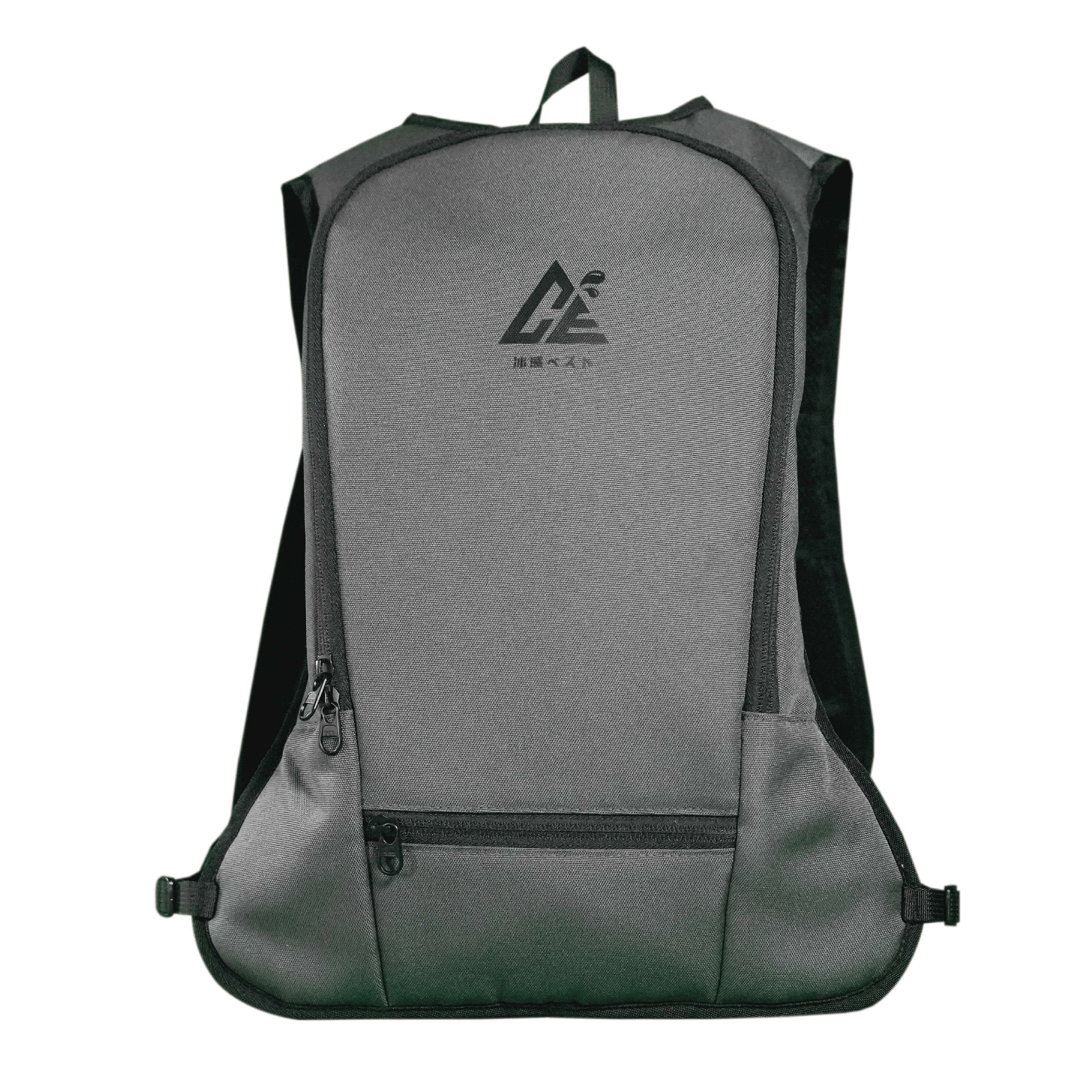
The COOLWAVE water-circulation cooling vest combines pack-based cooling with pump-driven circulation of chilled water.
The COOLWAVE water-circulation cooling vest is an industrial cooling apparel item classified as personal protective equipment. Its dual nature is structural: ice packs provide the cold source, and a pump circulates water through tubing built into the garment. The published parameter set gives buyers a concrete basis for the framework above.
The vest is available as a Basic Model and as a Professional Model in Black, Gray and Blue. Published parameters are the same across the range.
| Published parameter | Value |
|---|---|
| Cooling duration | 3–4 hours |
| Weight | Within 2 kg |
| Suitable temperature (as published) | Below 10 °C |
| Pump output | 5 V, 150 mA (max) |
| Flow rate | Max 320–370 ml/min |
| Shoulder strap material | 600D polyester |
| Vest material | PEVA |
| Water bag material | TPU |
| Water bag cap | Polypropylene |
| Cooling tube | Sand rubber (black) |
| Supplied contents | Water-cooled vest backpack ×1, ice packs ×2 |
Two parameters deserve particular attention during evaluation. First, the flow rate of 320–370 ml/min (max) describes how quickly chilled water moves through the loop; flow rate, tube routing and reservoir temperature together determine how evenly cooling is distributed. Second, the 5 V / 150 mA rating defines the electrical envelope: buyers should confirm the intended power source and how it will be carried, because the pump's supply is part of the wearable configuration, not an accessory decided later.
The Buyer Decision Framework: Seven Criteria That Change the Answer
Use the following criteria in sequence. Each one can eliminate an architecture before price, colour or brand are considered.
| # | Criterion | Question to answer | How it shifts the decision |
|---|---|---|---|
| 1 | Work-cycle length | How long is continuous exposure before a scheduled break? | Cycles within one pack's useful window favour single-method; multi-hour cycles favour circulation |
| 2 | Break and freezer access | Can packs be swapped or refrozen mid-shift, and how far away is the freezer? | Easy swaps reduce the advantage of circulation |
| 3 | Ambient conditions | What temperature and radiant load does the site present? | Hotter, more radiant environments shorten passive-pack endurance |
| 4 | Power availability | Is a 5 V supply and charging routine practical for this crew? | No reliable power plan makes single-method the safer specification |
| 5 | Weight and PPE integration | Does the vest work over or under existing PPE without restricting movement? | A sub-2 kg specification helps, but harness and fall-protection combinations must still be checked |
| 6 | Documentation and compliance | Which certificates, patents and material declarations are required by the buyer's market? | Markets outside the issuing jurisdiction require their own verification |
| 7 | Maintenance capacity | Who freezes packs, refills the water bag and inspects tubing? | Circulation adds a small but real maintenance workload |
A short field checklist before committing
- Map one full shift, not one hour: note every break, every vehicle movement and every task that cannot be interrupted.
- Confirm how many spare ice packs are required per worker per shift, and where they will be frozen.
- Confirm the power plan for any powered vest, including who owns charging and replacement.
- Ask the supplier to state which parameters are verified by test documentation and which are design targets.
- Confirm the reference point of the published temperature parameter — for the COOLWAVE range, the published suitable temperature is listed as below 10 °C — against actual site conditions.
Matching the Architecture to the Work: Application Scenarios
The same product can be the right or wrong specification depending on the work cycle. The COOLWAVE cooling vest is documented for construction workers, outdoor workers, metal sheet factory personnel, traffic controllers, food stall operators and street vendors.
Construction sites and outdoor work. Tasks combine radiant heat, physical exertion and irregular break patterns. Where a crew can return to a site office freezer every 60–90 minutes, pack swapping may be sufficient. Where work continues for several hours at a distance from shade, circulation keeps the chilled reservoir in use and extends the interval before a change is needed.
Metal sheet factories. Indoor metal fabrication can combine high ambient temperature with low air movement. In these settings cooling is not only about the outdoor sun; continuous exposure accumulates. A vest specified within 2 kg is easier to wear for a full shift alongside existing work clothing, while the circulation loop addresses the torso rather than only the points where a pack rests.
Traffic control. Stationary posts combine prolonged sun exposure with limited movement, and workers may not be able to leave position to change packs. This is a scenario where the cooling method has to remain effective without intervention.
Street vendors, night markets and food stalls. Vendors work continuously in enclosed or semi-enclosed stalls, with heat from both weather and cooking equipment. Their ability to swap packs depends entirely on whether a freezer is within reach of the stall.
Prolonged outdoor exposure, including fishing. Long sessions away from any freezing infrastructure make the frozen-pack logistics the deciding constraint. Case documentation covering a deployment of 100 units in Taiwan across these environment types records the use of pack-based cooling where power was not available, with reported outcomes including heatstroke prevention and improved worker comfort.
The same documentation also identifies the design requirements that determine whether either architecture will actually be worn: lightweight construction, waterproofing, breathability and a one-size-fits-all adjustable design with reusable ice packs, adjustable straps and a portable backpack format.
Certification and Documentation: What Can Be Verified Today
Cooling vests increasingly appear in tenders, supplier questionnaires and occupational health programmes, where unverified claims are not usable. Two documents apply to the COOLWAVE water-circulation cooling vest (Basic Model).
The first is a patent certificate (No. I886033) issued by the Intellectual Property Office, Ministry of Economic Affairs under the Patent Act of the Republic of China, covering the water-cooled vest structure and cooling system. It was issued on 1 June 2025 and expires on 27 August 2044, and it applies to the ROC market. The second is recognition at programme level: the water-cooled vest received the Disaster Prevention Product and Service Certification Award from the Taiwan Disaster Prevention Industry Association.
Both documents are jurisdiction-specific, which is the point buyers should take from them. A patent granted in one market does not by itself establish freedom to operate in another, and a national disaster-prevention award does not substitute for the conformity assessment a different market may require. For powered wearable components, quality-management and electrical-mark expectations such as ISO 9001:2015 and, where applicable, CE or UL marks for electrical components are commonly referenced in this category; buyers should confirm which of these apply to their own market and to a specific configuration before ordering.
Boundaries and Limitations Buyers Should Accept Before Ordering
A comparison that only lists advantages is not usable for procurement. The following boundaries apply to the dual-method architecture and to this product range specifically.
- Cooling still depends on frozen packs. Circulation distributes cold; it does not create it. Duration figures assume packs that have been correctly frozen, and the freezing cycle remains the operational bottleneck.
- Power is a dependency, not an extra. The pump is rated 5 V / 150 mA (max). Sites without a reliable charging routine should either plan for one or specify the pack-only path.
- The published temperature parameter needs interpretation. The stated suitable temperature is below 10 °C; buyers should confirm with the supplier how that figure is referenced before matching it to site conditions.
- Customisation is not part of the published capability record. The production mode is ODM, and customization is recorded as not offered. Programmes needing bespoke design should treat this as an early constraint rather than a later negotiation.
- Warranty is finite. The water-cooled vest carries a 6-month warranty. Buyers planning multi-year fleet use should build a consumables and replacement plan for ice packs and water bags instead of assuming warranty coverage across the vest's service life.
- Certification is market-specific. The patent and the disaster-prevention recognition apply to ROC and Taiwan respectively. Other markets need separate verification.
Supply Conditions That Affect a Rollout Decision
For distribution and programme buyers, the architecture decision is followed immediately by a supply decision. The manufacturer, FENG SHANG PRECISION CO., LTD., was founded in 2009, operates a 1,000 m² facility with 30 employees and 5 engineers, and reports annual output of 10,000 units with approximately 50% of production exported, primarily to the USA and ROC markets. Shokunin is the brand under which the company sells its tool and cooling product range.
Published capability figures for the cooling vest line include a monthly capacity of 3,000 units, a lead time of 7–14 days, a minimum order quantity of 10 units, ODM production, global export markets and a 6-month after-sales warranty on the water-cooled vest. A minimum order of 10 units is low enough for a single-site trial before a wider rollout, while the monthly capacity figure defines the practical ceiling for larger seasonal orders. Buyers should verify current lead time against their own delivery window, since seasonal demand in this category is concentrated.
Future Outlook: Where the Two Architectures Are Heading
Three published trends frame the next procurement cycle. Passive PCM vests were the fastest-growing technology segment in 2025 at 28.7% share, which suggests that passive formats will keep improving rather than disappearing. Active circulatory mechanisms continue to be adopted in industrial sectors for occupational heat stress, which supports the dual-method case in longer work cycles. And Asia Pacific remains the fastest-growing region, which means the supply base, documentation requirements and price competition for these products will continue to develop fastest in that region.
The practical implication for buyers is that the choice is unlikely to collapse into one architecture. Single-method vests will remain the default where freezing is easy and exposure is short. Dual-method vests will remain the specification where the work cycle is long, breaks are rare and the cost of a cooling failure is measured in lost output or heat-related incidents rather than in unit price.
FAQ: Dual vs Single Cooling Vests
1. What is the difference between a dual cooling vest and a single passive cooling vest?
A single-method vest holds a passive thermal store — ice packs, gel packs or phase-change material — against the body and relies on conduction at the contact points. A dual-method vest keeps the same passive store but adds a pump that circulates chilled water through tubing across the torso, producing a broader cooling footprint. The COOLWAVE water-circulation cooling vest uses two ice packs as the cold source and a 5 V pump to circulate water through the loop.
2. How long does a dual cooling water-circulation vest last, and what determines the duration?
The published cooling duration for the COOLWAVE water-circulation cooling vest is 3–4 hours. Actual duration depends on several factors: whether the ice packs were fully frozen, the ambient temperature the wearer is working in, physical workload, and whether the pump is running continuously. It is also limited by the amount of chilled water in the loop and by the pack mass available.
3. What certifications or documentation should a buyer verify before purchasing?
For the COOLWAVE water-circulation cooling vest (Basic Model), two documents are on record: patent No. I886033, issued by the Intellectual Property Office, Ministry of Economic Affairs under the Patent Act of the Republic of China, covering the water-cooled vest structure and cooling system; and the Disaster Prevention Product and Service Certification Award from the Taiwan Disaster Prevention Industry Association. Both are specific to their issuing markets. Buyers in other jurisdictions should confirm which quality-management and electrical-component requirements apply locally, since ISO 9001:2015 and, where relevant, CE or UL marks for electrical components are commonly referenced in this product category.
4. What are the key technical parameters — weight, flow rate and power requirement?
The vest weighs within 2 kg. The pump output is rated 5 V, 150 mA (max), with a maximum flow rate of 320–370 ml/min. The water bag is made of TPU with a polypropylene cap, the vest material is PEVA, the shoulder straps use 600D polyester, and the cooling tube is sand rubber in black. The published suitable temperature is below 10 °C, and the supplied contents are one water-cooled vest backpack and two ice packs.
5. Which work environments is a dual cooling vest suited to?
Documented environments for the COOLWAVE cooling vest include construction sites, outdoor work, metal sheet factories, traffic control, street vending and night market operations. The common characteristic is prolonged exposure to high temperature combined with limited opportunity to interrupt work and change cooling packs. Where exposure is short or freezer access is immediate, a single-method passive vest may be sufficient.
6. What are the ordering and support conditions?
The published capability record lists ODM production, a monthly capacity of 3,000 units, a lead time of 7–14 days, a minimum order quantity of 10 units, global export markets, and a 6-month warranty for the water-cooled vest. Customisation is recorded as not offered, so buyers should plan around the existing Basic Model and the Professional Model in Black, Gray and Blue.
Closing Note
The dual-versus-single decision is rarely settled by cooling performance alone. It is settled by whether the cold source can be replenished inside the real work cycle, whether power can be supplied reliably, and whether the documentation the buyer needs actually exists for the target market. Buyers who answer those three questions first will find that the choice between a passive ice-pack vest and a dual water-circulation vest becomes a straightforward specification decision rather than a judgement call.
A downloadable brochure with the full product and specification details is available here: COOLWAVE product brochure (PDF).