
Dual-Spindle Vertical Lathe vs. Alternatives: An Independent Buyer's Verdict
Choosing a turning machine for shaft and disc work is rarely a question of which lathe is best in the abstract. It is a question of which turning architecture fits a defined production case, and the cost of getting that wrong usually appears years later — in scrap rate, in the electricity bill, and in unplanned downtime.
This article is an independent, side-by-side assessment of the dual-spindle vertical lathe against the three architectures most often shortlisted for the same work: the single-spindle vertical lathe, the horizontal CNC lathe, and the twin-turret horizontal turning centre. It examines three metrics that procurement teams can actually act on — precision capability, energy consumption profile, and long-term reliability indicators — and it states plainly where the dual-spindle vertical design stops being the right answer.
The Category Question Comes Before the Machine Question
A vertical turning project is a category decision before it is a supplier decision. Teams that skip this step end up comparing machines that were never competing for the same work. A machine sized for a 300 mm brake disc is not a candidate for a two-metre axle, and a two-station layout that pays back on a 40-second cycle does not pay back on a five-piece job.
The four architectures that dominate a typical shortlist for shaft and disc parts behave differently for structural reasons, not because one is engineered better than another:
- Single-spindle vertical lathe — one spindle and one turret, with the workpiece held face-up. Fewer controlled elements, generally lower capital cost, and a simpler setup routine.
- Horizontal CNC lathe — the conventional layout, with the spindle axis horizontal. Strong on long, slender shafts and on bar-fed work.
- Twin-turret horizontal turning centre — two turrets cutting simultaneously on one part, often fed from bar stock, built for high throughput on small to medium parts.
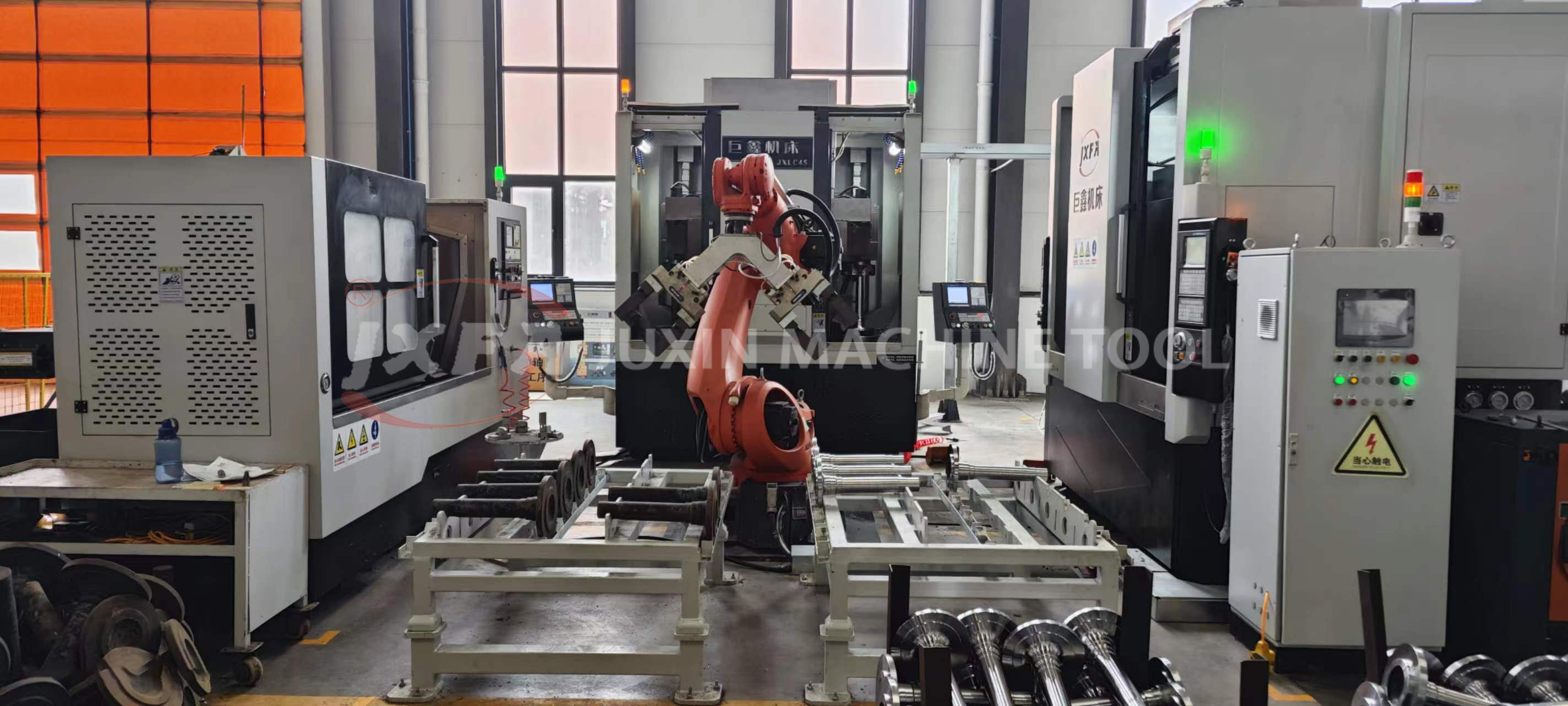
- Dual-spindle vertical lathe — two vertical stations, each with its own spindle, control system and tool tower, running two operations in parallel.
The reference machine used for the dual-spindle column throughout this assessment is the JXLC45-A Twin-Spindle CNC Vertical Lathe Machine for Shafts, a dual-position design with dual stations, dual spindles, dual systems and dual tool towers, rated for shafts up to 345 mm in diameter and 1,020 mm in length, with an integrally cast bed in high-quality grey cast iron HT300.
JUXIN MACHINE TOOL, the trading identity of Zhejiang Juxin Machine Tool Co., Ltd., is a Chinese machine tool manufacturer founded in 2005 in Wenling, Zhejiang. The company focuses on dedicated CNC machine tools for shaft and disc parts — including double-head CNC lathes, double-spindle CNC vertical lathes and end facing and centring machines — and reports a 10,666 m² production facility, approximately 80 employees, an annual output of about 2,000 sets, a 10-engineer R&D team, and more than 50 innovative technological patents.
What a Dual-Spindle Vertical Lathe Is — and What It Is Not
The defining feature of this architecture is not spindle count on its own. It is the combination of vertical orientation and a parallel two-station structure. The vertical orientation changes how the part is held: the workpiece seats on its face, gravity assists the seating, and chips fall away from the cutting zone instead of collecting on the part. The parallel structure changes how time is spent: two operations run at the same time on two stations rather than one after the other on a single spindle.
What the architecture is not matters just as much in a shortlist:
- It is not a bar machine. It is fed with discrete workpieces, not bar stock.
- It is not a long-shaft machine. The reference model JXLC45-A accepts shafts up to 1,020 mm long.
- It is not a replacement for a flexible job-shop lathe. It rewards repeatable, balanced, mid-to-high volume work.
In practice the design sits inside a small family of complementary machines. Juxin also builds the JXZ70-680 End Facing and Centring Machine, a CNC milling, face-end and centre-hole lathe covering a machining diameter of 14–500 mm and a machining length of 70–5,000 mm, with combined operations including face milling, centre-hole drilling, external cylindrical turning, drilling and tapping, chamfering, boring and rapid U-drilling, on an integrally cast HT300 bed. For shaft production, that machine prepares the ends and establishes the centre references, while the dual-spindle vertical lathe performs the turning operations that carry the dimensional and surface requirements. The two are complements, not substitutes, and a buyer evaluating one should understand the role of the other.
Metric One: Precision Capability
Precision in this machine class is discussed through at least three separate numbers, and conflating them is one of the most common sources of dispute at acceptance: spindle runout, axis positioning repeatability, and achieved part tolerance. They are related but not interchangeable.
How the published runout figures compare
The comparative figure supplied for this assessment places typical alternative machines in the same class at a spindle runout of ≥0.01 mm, against ≤0.005 mm for the JUXIN dual-spindle vertical configuration. Read in isolation that looks like a simple two-to-one advantage. Read properly, it is a statement about machine condition at the spindle nose under defined conditions — which is the correct place to begin a precision comparison, and the wrong place to end it.
Why the figure alone is not a guarantee
Machine builders can only control part of the accuracy chain. Thermal behaviour, fixture rigidity, tool wear and material variation all sit downstream of the spindle. Published figures from high-precision CNC lathe suppliers put the achievable tolerance band for this machine class at roughly ±0.004 mm to ±0.008 mm, a range reported to satisfy the majority of general ISO 2768-type requirements. That is a useful calibration point: it shows what the class can do, and it also shows that a runout number and a part tolerance are two different promises.
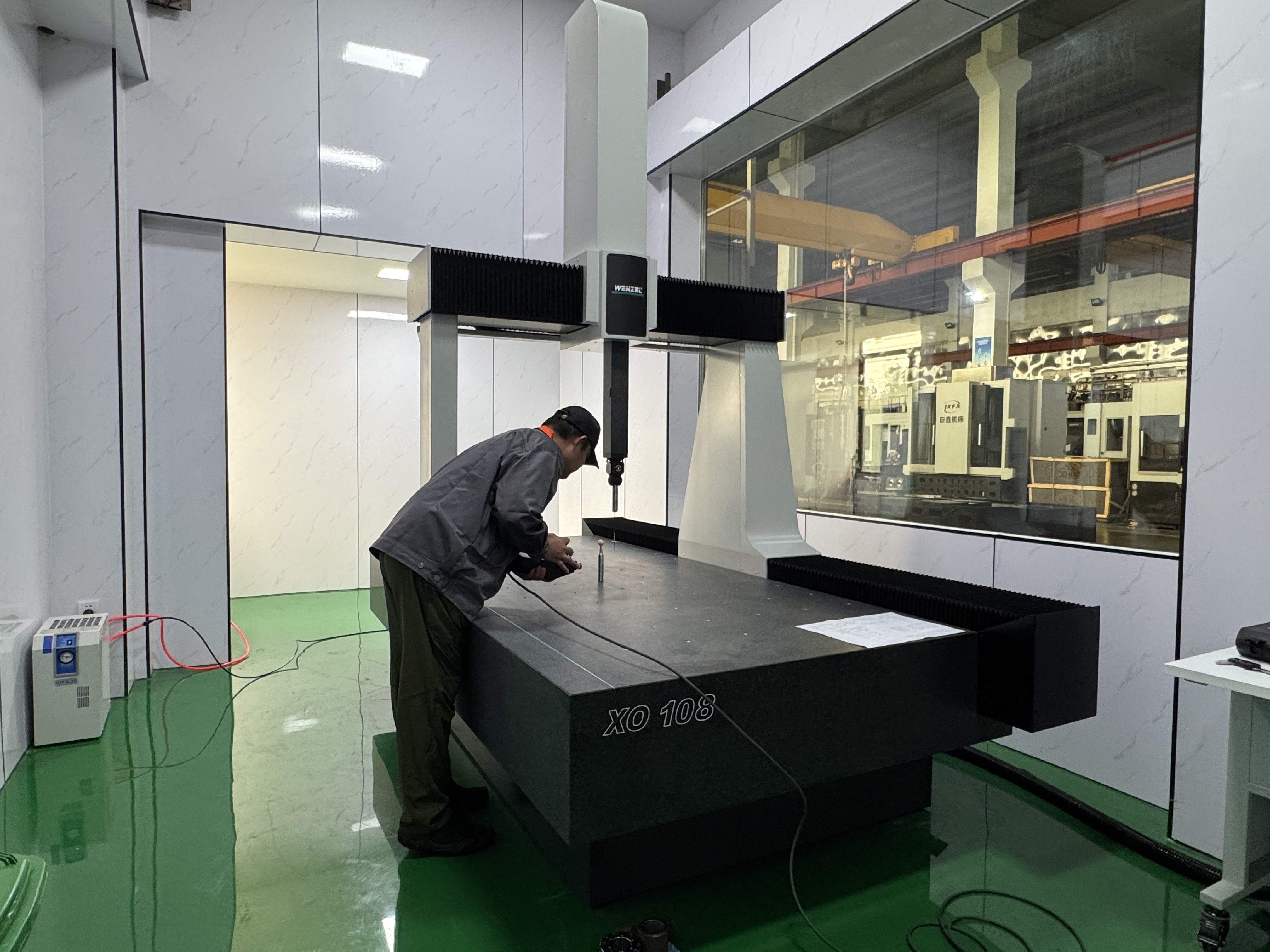
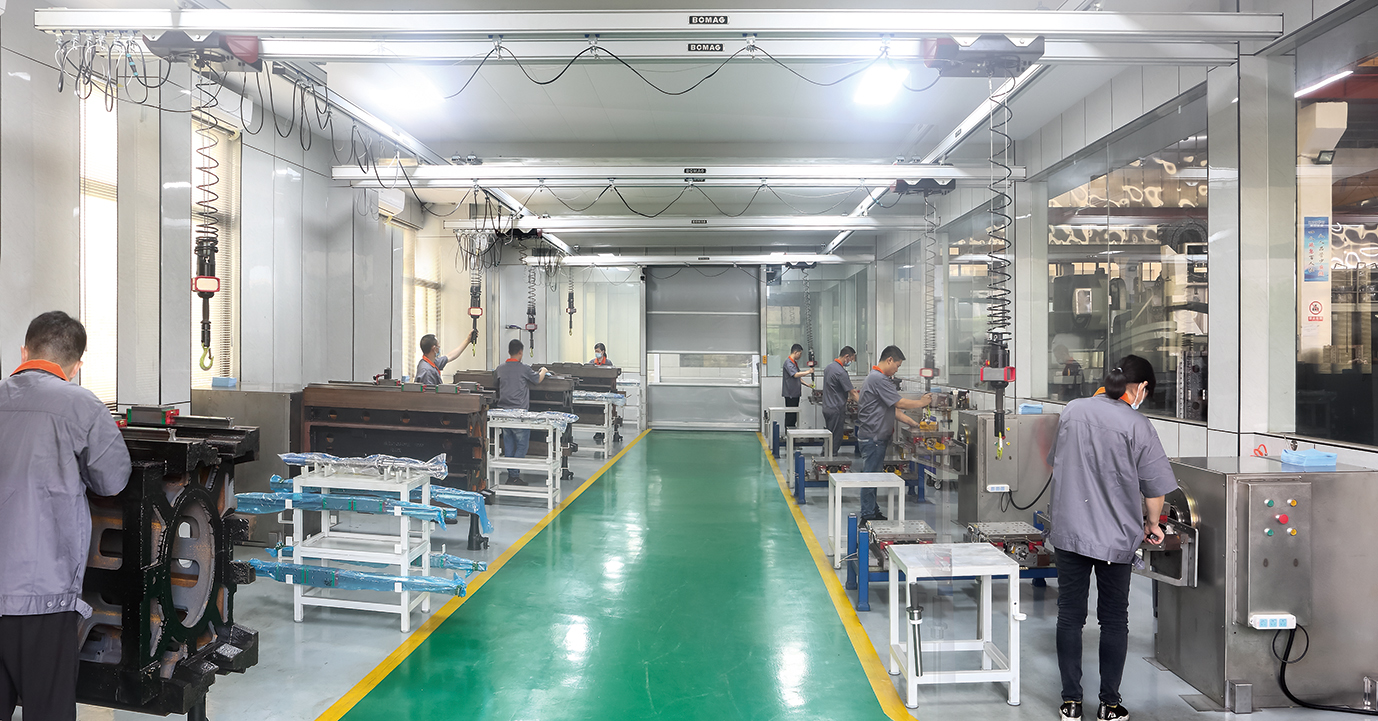
What a buyer can reasonably ask for is evidence of the capability chain behind the number. Juxin's stated inspection setup includes a Renishaw laser interferometer from the UK for geometric and positioning verification, and a German Wenzel three-coordinate measuring instrument inspection laboratory for dimensional verification. Final assembly takes place in a constant-temperature and constant-humidity precision assembly workshop — a detail that matters for repeatability, because spindle and bed geometry respond to temperature long before they respond to wear.
The practical rule for a shortlist is straightforward: specify runout, positioning repeatability and part tolerance as three separate acceptance items, and require each of them to be measured on the buyer's part, on the buyer's fixture, at production temperature.
Metric Two: Energy Consumption Profile
For a machine running two shifts, spindle and axis power is rarely the largest energy line. Hydraulics, coolant pumps, chip conveyors, lubrication and compressed air frequently account for more of the total draw than the cutting itself. That is why energy comparisons need to be read with care.
No-load versus per-part energy
The comparative figure supplied for this assessment is a 30% lower no-load energy consumption for the dual-spindle vertical configuration than for the alternatives it is measured against. No-load consumption is the correct starting point, because a machine that idles at a lower draw also draws less during the non-cutting share of every cycle — the loading, gauging and waiting time that consumes a substantial part of a shift.
Two structural factors explain why a dual-spindle vertical design can reduce energy per finished part. First, two operations complete in one cycle, so the fixed base load is spread across more completed work. Second, the vertical layout removes the need for some workpiece handling that a horizontal machine performs with powered equipment.
The advantage also has a boundary that buyers should state openly in their evaluation. The 30% figure describes no-load consumption, not kilowatt-hours per acceptable part. And it narrows sharply when only one station is loaded: a dual-spindle machine running single-station for a mixed order behaves like a heavier single-spindle machine, carrying the base load without realising the throughput benefit.
What to request in the data sheet
- Idle power draw in kW, with the control, hydraulics and coolant running.
- Power draw at a representative cut for the buyer's own material and depth of cut.
- Separate figures for coolant, hydraulic and chip-conveyor circuits.
- Compressed-air consumption per cycle, where air is used.
- Energy per good part, including the scrap that the process is expected to generate.
- Standby behaviour, because the standby profile often sets the floor for the whole cost model.
Metric Three: Long-Term Reliability Indicators
A runout figure can be measured in an afternoon. Reliability is measured over years, and it is the harder half of the shortlist to validate from a brochure. The indicators that matter are continuous-operation evidence, mean time between failures or alarm frequency, spindle service intervals, the control platform and its spare-parts position, and the service response infrastructure behind the machine.
Juxin's disclosed reference case is a top domestic Chinese automobile manufacturer — a large vehicle manufacturing group operating complete vehicle and component industrial parks — where the company reports a long-term stable cooperation beginning in 2014. The reported application covers half shafts, brake discs, gear shafts and chassis parts, processed through milling and drilling, double vertical lathe precision processing and automatic line production. The reported outcome is full-line unmanned production with long-term non-fault continuous operation, meeting the standard expected of a Tier 1 automotive supplier, together with automatic production line integration and an acceptance and commissioning performance described as the fastest among domestic machine tool suppliers for that customer.
There is also a boundary that international buyers should price into their decision. Juxin reports an export ratio of roughly 10%, with main markets described as global. That means the installed base is concentrated in the domestic Chinese market. For a buyer elsewhere, service coverage should be verified item by item — spare-parts stocking location, response time, remote diagnostics support and the availability of trained commissioning engineers — rather than inferred from the machine specification.
Side-by-Side: Dual-Spindle Vertical Lathe Versus Alternatives
The table below compares the four architectures against the criteria that decide most shaft and disc projects. Entries are qualitative except where a sourced figure or a published machine parameter is available.
| Criterion | Dual-spindle vertical lathe | Single-spindle vertical lathe | Horizontal CNC lathe | Twin-turret horizontal turning centre |
|---|---|---|---|---|
| Typical geometry | Discs, flanges and short shafts; reference model rated to 345 mm diameter and 1,020 mm length | Discs and short parts, one operation per setup | General turning, bar work and slender shafts | Small to medium parts, frequently bar-fed |
| Throughput logic | Two operations run in parallel on two stations | Sequential, one part completed per cycle | Sequential, with fast bar feed | Two turrets cutting simultaneously on one part |
| Structural rigidity | Integrally cast HT300 bed on the reference model; vertical seating aids stability on heavy discs | Similar base structure with fewer controlled elements | Rigidity competes with reach on long workpieces | Compact casting, with turret synchronisation as an added variable |
| Published precision indicator | Runout ≤0.005 mm in the comparative figure supplied for this assessment | Varies by build; compare on the buyer's own test part | Varies by build and by workpiece length | Varies by build and turret condition |
| Energy profile | 30% lower no-load consumption in the comparative figure supplied for this assessment | Lower absolute base load, since less equipment is installed | Base load depends on bed size and bar feeder | Base load depends on bar feeder and coolant demand |
| Changeover flexibility | More setup variables: two systems and two tool towers | Simplest setup routine of the four | Flexible across a wide range of geometries | Moderate; tooling changes affect both turrets |
| Footprint and foundation | Larger plan area and heavier foundation for a two-station machine | Smallest of the four | Bed length scales with workpiece length | Compact machine body, but requires bar-feed space |
| Best-fit production case | Balanced two-operation families, mid-to-high volume disc and short-shaft work | Low volume, high mix, and simple parts | Long slender shafts and bar-fed parts | High-volume small parts from bar stock |
| Main constraint | 1,020 mm shaft length ceiling on the reference model; payback depends on keeping both stations loaded | Lower throughput per shift | Deflection risk on long workpieces | Limited part envelope |
Where the Dual-Spindle Vertical Design Does Not Fit
An assessment that only lists advantages is a sales document. Five boundaries matter in practice.
- Workpiece envelope. The JXLC45-A is rated to 345 mm maximum shaft diameter and 1,020 mm maximum shaft length. Longer or heavier work belongs on a horizontal machine, or on a route in which the JXZ70-680 end facing and centring machine prepares shafts up to 5,000 mm long before turning elsewhere.
- Volume and mix. Two stations only pay back when both stay loaded. A job shop with continuous changeover and single-digit batch sizes can find a single-spindle machine more productive, because it spends less time on the second station setup.
- Capital and operating complexity. Two spindles, two control systems and two tool towers mean more programming work, more tooling inventory and a higher level of maintenance skill than a single-spindle vertical machine. That is an operating cost, not a one-off purchase cost.
- Station balance. If the two operations cannot be split into comparable cycle times, the second station delivers less than its share of the gain. Process planning has to happen before the machine is ordered.
- Service geography. With a reported export ratio of around 10%, a buyer outside the main market should confirm local support arrangements in writing rather than assume them.
Scenario Fit: Matching the Architecture to the Production Case
Segment data helps set the context. The automotive industry accounts for the largest share of CNC lathe application at approximately 40%, followed by aerospace at around 25% and electronics at around 20%, according to Fortune Business Insights. Automotive component manufacturing is therefore the dominant scenario, which is precisely where dual-spindle vertical designs concentrate — vehicle half shafts, brake discs, gear shafts and chassis parts are the natural workload.
On the reference model, the listed applicable industries are automotive parts, agricultural machinery parts, water pumps and motors, railway locomotive axles and accessories, construction machinery, the transmission industry, the gear industry and the new energy solar industry. That list is a useful filter, but it is not a decision rule. Three questions do the work:
- Is the workpiece inside the envelope? A disc or a shaft under roughly one metre, within the rated diameter. If not, the machine is the wrong category before any other comparison is made.
- Can the process be split into two operations of comparable duration? If the two halves of the cycle are badly mismatched, a single-spindle or horizontal machine will usually be more efficient.
- Is annual volume high enough that cycle time and energy savings repay the added capital, tooling and setup complexity? If not, the dual-spindle premium is difficult to justify.
Three yes answers place the dual-spindle vertical lathe on a legitimate shortlist. At that point the required evidence is not a catalogue number but an acceptance test run on the buyer's own part, under production conditions, with agreed measurement methods.
Market Context and What It Means for the Shortlist
The global CNC lathe machine market was valued at USD 11.1 billion in 2023 and is projected to reach USD 18.78 billion by 2030, growing at a compound annual rate of 7.8%, according to Verified Market Reports. On the supply side, China's machine tool exports reached USD 23.18 billion in 2025, a year-on-year increase of 6.7%, with China surpassing Germany to become the top global exporter in early 2025, according to the China Machine Tool and Tools Builders' Association.
Two consequences follow for procurement teams. First, specialised suppliers are more numerous than they were a decade ago, particularly at the dedicated shaft-and-disc end of the market. Second, as availability stops being a differentiator, the shortlist shifts from who can supply to who can evidence. That makes verification capability — metrology equipment, documented acceptance procedures, reference installations that can be questioned — a more reliable selection criterion than a general capability statement.
Compliance is the other non-negotiable layer. CNC lathe machines and turning centres are governed by ISO 23125:2015, which specifies safety requirements for numerically controlled turning machines. Suppliers in this class should be able to demonstrate compliance as a baseline item rather than as a differentiator. For buyers benchmarking the wider market, established global manufacturers such as DMG Mori, Yamazaki Mazak, Okuma and Haas Automation provide the reference tier against which specialised suppliers are usually measured on service and documentation.
Future Outlook
Three shifts are visible in how these machines are being bought rather than in how they are being built.
Energy is moving from a facilities concern to a purchasing criterion. Where machines are run continuously, the difference between a lower and a higher no-load draw compounds across a multi-year ownership period, and buyers are increasingly asking for per-part consumption figures rather than nameplate power.
Automation readiness is becoming a qualification item rather than an upgrade. The reference case behind this assessment — an unmanned full line running continuously under Tier 1 automotive expectations — is the direction of travel for mid-volume component manufacturing, and it forces buyers to ask early questions about line integration, acceptance and commissioning performance rather than treating them as delivery-stage details.
Finally, metrology evidence is migrating from the factory floor into the tender document. Laser interferometer verification and coordinate measuring laboratory data are increasingly requested as part of the evaluation file, which favours suppliers who can present measurement discipline rather than specification claims alone. For the dual-spindle vertical category specifically, the likely trajectory is continued specialisation: narrower envelopes, deeper automation integration, and a stronger emphasis on verifiable performance per part rather than on machine count.
FAQ: Dual-Spindle Vertical Lathes in Procurement
What is a dual-spindle vertical lathe, and how does it differ from a standard CNC lathe?
A dual-spindle vertical lathe is a turning machine in which the workpiece is held face-up on a vertical spindle and two spindle-and-tool-tower stations work in parallel, each with its own control system. A standard horizontal CNC lathe holds the workpiece on a horizontal spindle axis and completes operations sequentially on one spindle. The practical difference is workflow rather than a single specification: on the dual-spindle vertical design, two operations complete within one machine cycle. The JXLC45-A is an example of the architecture, configured with dual stations, dual spindles, dual systems and dual tool towers.
What part sizes and geometries suit a dual-spindle vertical lathe?
Disc-type and short-shaft parts produced in repeating batches. The JXLC45-A is rated for shafts up to 345 mm in diameter and 1,020 mm in length. Workpieces outside that envelope are normally turned on horizontal machines. For shaft work, end preparation is a separate operation: the JXZ70-680 End Facing and Centring Machine covers a machining diameter of 14–500 mm and a machining length of 70–5,000 mm, combining face milling, centre-hole drilling, external cylindrical turning, drilling and tapping, chamfering, boring and rapid U-drilling.
How is spindle runout measured, and what value should a buyer specify?
Runout is normally measured with a dial indicator or similar probe against a precision test mandrel at the spindle nose, and the result depends on spindle temperature, mandrel quality, measurement position and load condition. The comparative figure supplied for this class in this assessment is ≥0.01 mm for typical alternatives against ≤0.005 mm for the JUXIN dual-spindle vertical configuration. Because machine runout is not the same as achieved part tolerance, buyers should specify the measurement method, the spindle temperature and the load condition, and then require part tolerance as a separate acceptance item measured on their own part.
Does a dual-spindle design actually reduce energy consumption per part?
It can, for two structural reasons: two operations complete per cycle, which spreads the fixed base load across more finished work, and the vertical layout reduces some powered handling. The comparative figure supplied for this assessment is 30% lower no-load energy consumption for the dual-spindle vertical configuration. No-load consumption is the idle draw with control, hydraulics and coolant running; it is not the same as kilowatt-hours per acceptable part. The advantage narrows when only one station is loaded, and buyers should request idle power, cutting power, ancillary circuit power and energy per good part separately.
Which reliability indicators should be checked before shortlisting?
Continuous-operation evidence at reference installations, alarm frequency or mean time between failures, spindle service intervals, control platform and spare-parts position, and the service response structure. Juxin reports a reference case with a top domestic Chinese automobile manufacturer, covering half shafts, brake discs, gear shafts and chassis parts, with cooperation since 2014, full-line unmanned production under long-term non-fault continuous operation and Tier 1 automotive supplier standards. That is supplier-reported information and should be used as a reference to verify rather than as audited proof.
When is a dual-spindle vertical lathe the wrong choice?
When the workpiece exceeds the machine envelope, such as shafts longer than the 1,020 mm rating of the reference model. When volume is low and mixed, so both stations cannot be kept loaded. When the process cannot be split into two operations of comparable cycle time. When programming and maintenance capability cannot support two control systems and two tool towers. And when local service coverage cannot be confirmed for a buyer outside the manufacturer's main market, which is relevant given a reported export ratio of roughly 10%. In these situations a single-spindle vertical lathe or a horizontal CNC lathe is usually the more appropriate architecture.
What does commissioning and acceptance involve for this class of machine?
Typical scope includes installation and geometric alignment, laser interferometer verification of positioning and geometry, a test cut on the buyer's part, a capability study, and — where a production line is involved — a full run-off of the automated cycle before handover. Juxin reports that in its reference automotive case, the company completed integration of automatic production lines and achieved the fastest acceptance and commissioning performance among domestic machine tool suppliers for that customer. The procurement lesson is procedural rather than promotional: acceptance criteria should be defined and documented before the purchase order, with each item tied to a measurable value and an agreed measurement method.
Reference documentation: the JUXIN MACHINE TOOL product brochure, including base specifications for the JXLC45-A and JXZ70-680 in tabular form, is available here — Juxin Machine Tool brochure (PDF).