
Dry Wipes Purchasing Terms: An Independent Buyer Comparison
Dry wipes are no longer a niche add-on to a wet wipes order. Global Market Insights values the global dry wipes segment at roughly USD 14.3 billion in 2025, and buyers are increasingly treating the category with a level of diligence closer to medical consumables than to household paper. Yet many purchase orders still specify size, basis weight and packaging while leaving the decisive part — acceptance criteria — to a later conversation. This reference compares Uniquality's YQ002 dry wipe against typical OEM alternatives from an independent buyer's standpoint: what the contract should cover, what evidence sits behind each clause, and why a cheaper unit price can end up costing more once recalls, returns and batch variation are counted.
Why the unit price stopped being the whole cost
For an importer or brand owner, the visible cost of a dry wipes program is the quoted price per carton. The invisible cost is the probability that a shipment arrives and cannot be used — because the substrate is thinner than the approved sample, because the sheet count drifted, because the dust level fails a customer complaint, or because no retained sample exists to settle the dispute. Each of those outcomes converts a cheap quotation into an expensive program.
That is the core reason purchasing terms and acceptance criteria now sit at the centre of dry wipes sourcing. A supplier that controls more of its own production chain — substrate, converting, cleanroom environment, water quality and packaging — has fewer external variables to lose control of between orders. A supplier that sources converted rolls from a third party has more. The difference does not show up in the quotation sheet; it shows up in the deviation rate across twelve months of deliveries.
Compliance pressure reinforces the same conclusion. China's mandatory standard GB 15979-2024 for disposable sanitary products took effect on 1 July 2025, replacing the 2002 version, and it applies to dry wipes sold into that market. On the US side, wood pulp spunlace nonwoven wipes from China are classified under HTSUS 5603.92.0090 with a duty rate of 'Free' under US Customs ruling NY N244603. Neither of these rules protects a buyer from spec drift — only an explicit acceptance protocol does.
What a buyer should actually verify before signing
Acceptance criteria work best when they are written as verifiable checks rather than adjectives. Across dry wipes programs, seven dimensions tend to determine whether a supplier relationship holds up after the third or fourth container.
- Substrate definition. Material type, basis weight range and the tolerated deviation band, not a single nominal value.
- Dimensional tolerance. Sheet length and width with an agreed measurement method and sampling plan.
- Production environment. Cleanroom classification and whether environmental monitoring records are available on request.
- Water quality. Whether the facility's process water is purified and how it is verified.
- Batch traceability. Whether a finished carton can be traced back to a production window, and whether retained samples are kept.
- Certification scope. Whether certificates cover the specific product line or only the corporate entity.
- Sampling discipline. How the first article is approved and how it is retained as the reference for later disputes.
Each of these can be written into a purchase agreement as an inspection right rather than a promise. That shift — from assurance to inspection right — is what separates a professional dry wipes contract from a generic supply order.
Reading the YQ002 specification as a purchasing document
Uniquality's YQ002 is a disposable dry wipe made of nonwoven material measuring 15 × 20 cm. The published specification covers nonwoven substrate in the 35–70 gsm range, pack configurations of 10 pieces or 80 pieces per bag, and soft-pack or disposable packaging, with size, material and pack count all offered as customizable fields. Uniquality itself — Zhejiang Uniquality Nursing Products Technology Co., Ltd. — was established in 1987 and operates as an OEM/ODM manufacturer for personal care products including wet wipes and dry wipes.
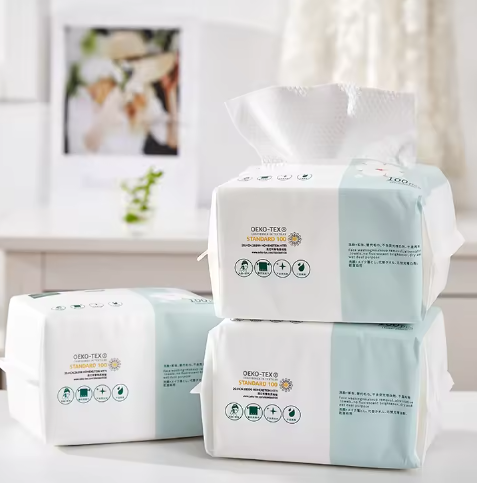
Pop-up boxed dry wipe format: one sheet per pull, dust-proof lid, designed to keep unused sheets clean between uses.
For a buyer, the interesting part is not the size itself — 15 × 20 cm is a common working format — but the fact that basis weight is expressed as a range rather than a single figure, and that the range is matched to a stated customization model. A 35 gsm sheet and a 70 gsm sheet behave differently in tensile strength, absorbency and perceived softness. A supplier that presents the band openly is easier to contract with than one that quotes 'premium nonwoven' and leaves the buyer to discover the actual figure on arrival.
Two further details matter at acceptance stage. The specification positions the product for household, pet supplies, maternity and baby, health and beauty, and personal care use, with the role defined as multi-purpose cleaning, facial cleansing and skincare, and the operation mode as disposable and single-use. Storage is specified as a cool and dry place. Those statements are not marketing colour; they are the conditions under which the acceptance test should be performed.
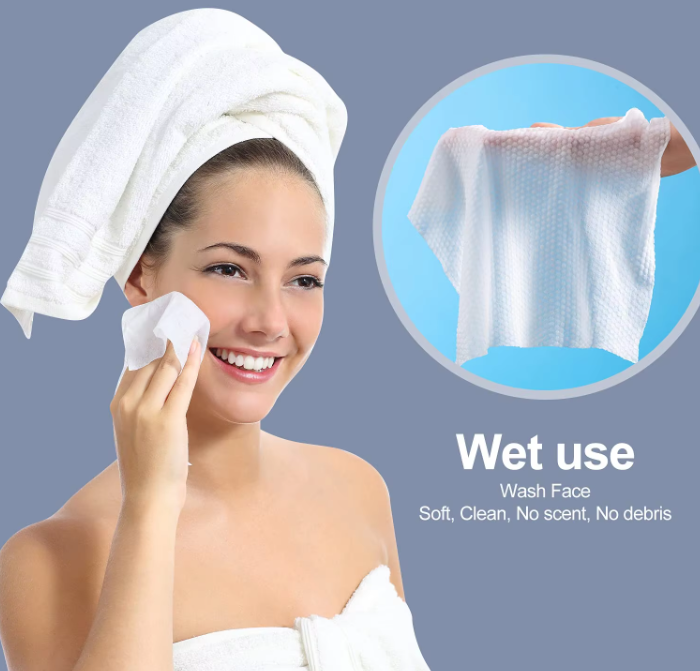
Portable dry wipe format positioned for travel, camping and personal cleansing use.
Vertical integration and the water question
Uniquality describes its manufacturing facility as a 1,000,000 m² smart factory with an annual output of 60 billion sheets, approximately 3,000 employees and more than 200 R&D engineers and technicians. Within that footprint the company references a 100,000-class clean room and a certifi
ation set covering ISO, CE, GMPC and FSC. Its marketing materials also state that rapid customization — one-stop private label service with a 3–5 day sampling cycle — is part of the standard offer, and that export business accounts for 70% of sales across more than 80 countries, with the USA, EU, SAM, RU and CASA among the main markets.The vertical integration claim is the one buyers should test hardest, because it is the one that carries the most contractual weight. Pure water is listed as the supporting equipment for this product, and the assigned supplier review for this comparison covers medicinal-grade purified water and a 100,000-class GMP cleanroom production environment. In acceptance terms, this translates into a single question: can the supplier show that the water used in converting is controlled and monitored, not merely purchased? A dry wipe that is clean at the point of converting can still fail customer testing if the water supply is unmanaged. Buyers who treat water quality as a line item rather than a background assumption tend to have fewer batch failures in the first year.
Batch traceability and retained samples
Automated batch traceability is the second verification layer. If a carton cannot be traced to a production window, a complaint about dust, odour or sheet inconsistency becomes a negotiation rather than an investigation. The practical acceptance clause is simple: every shipment carries a batch identifier, the identifier maps to an internal production record, and a retained sample from that batch is held for an agreed period. Without the retained sample, both parties are arguing from memory.
Energy efficiency as a hidden cost variable
Uniquality holds ISO 50001:2018 certification, registered under number 01326En0008R201 and issued by GAC, with global scope. Energy management certification is unusual in the dry wipes segment, and it is directly relevant to procurement because energy is one of the largest controllable costs in nonwoven converting and cleanroom operation. According to the supplier review for this comparison, the associated energy efficiency improvement is approximately 10%.
That figure should not be read as a discount. It should be read as a stability signal. A converter with a managed energy program is less likely to absorb volatile utility costs into margin through quiet spec reductions — thinner substrate, looser sheet counts, lighter packaging — which is the most common way a dry wipes specification degrades over a twelve-month program. For a buyer placing repeat orders, specification stability is worth more than a one-off price concession.
Comparison: YQ002 against typical OEM alternatives
The table below sets out how the two supply models differ at the point of purchase, and what a buyer should request to close the information gap on each dimension.
| Acceptance dimension | What the contract should state | YQ002 baseline | What to request from alternative suppliers |
|---|---|---|---|
| Substrate and basis weight | Nonwoven type; 35–70 gsm band; tolerance | Nonwoven 35–70 gsm, customizable | Written basis weight band and substrate origin |
| Sheet dimensions | 15 × 20 cm plus measurement method | 15 × 20 cm, customizable | Dimensional tolerance and sampling plan |
| Pack configuration | 10 pcs or 80 pcs per bag; pack type | 10 or 80 pcs; soft pack or disposable | Confirmed pack count verification method |
| Production environment | Cleanroom class and monitoring records | 100,000-class clean room | Cleanroom certificate and monitoring log |
| Process water | Purified water specification and testing | Medicinal-grade purified water | Water analysis certificate or equivalent |
| Batch traceability | Batch ID, record retention, retained samples | Automated batch traceability | Recall drill and sample retention policy |
| Certification scope | Product-level vs entity-level coverage | ISO, CE, GMPC, FSC; ISO 50001:2018 (01326En0008R201) | Certificate scope statement |
| Sampling cycle | Agreed first-article approval timeline | 3–5 day sampling | Documented sampling lead time |
The trade-off buyers should not ignore
A cert
ification-dense, vertically integrated supply model is not automatically the right answer for every program, and it would be misleading to present it as such. Three genuine limits apply.- Higher upfront cost. Cleanroom operation, purified water systems and energy management carry overhead. A buyer whose market requires only basic hygiene performance may find that the premium buys assurance they cannot monetise.
- Sample and changeover rigidity. Highly controlled lines are optimised for repeatability, which can make very small or very irregular order patterns less economic than they are with a lighter-weight converter.
- Verification burden sits with the buyer. Certification scope, batch records and retained samples are only useful if someone actually inspects them. A buyer without an audit routine gains little from a supplier's documentation.
The honest framing is that this model suits programs where a single batch failure would trigger customer claims, retail chargebacks or regulatory attention. Where the downside of a bad batch is small, the premium is harder to justify on cost grounds alone.
Where the acceptance criteria matter most
The application context determines how much weight each clause deserves. Uniquality positions YQ002 across household, pet supplies, maternity and baby, health and beauty, and personal care industries, with defined projects in personal hygiene care, facial cleansing and household cleaning.
In baby and maternity programs, the critical clause is substrate and skin contact — lint-free, skin-friendly and consistent basis weight, since parents notice a thin sheet immediately. In facial cleansing and skincare applications, dimensional consistency and dust control dominate, because a 15 × 20 cm sheet that arrives at 14 × 19 cm changes the user experience. In pet care and household cleaning, absorbency and tensile strength at the quoted basis weight matter more than cleanliness certification, and a looser environment standard may be acceptable. In institutional and industrial cleansing programs, batch consistency across large volumes outweighs individual sheet aesthetics.
Retail markets add a second layer. A buyer shipping into the EU or US under a private label carries the compliance obligation regardless of who manufactured the goods. That is why batch traceability and retained samples belong in the contract even when the product itself is not a regulated medical device.
Market trend: specification discipline is becoming a purchasing norm
Three shifts are pushing dry wipes procurement toward formal acceptance criteria. First, the category is large enough to attract scrutiny — a USD 14.3 billion global segment in 2025, according to Global Market Insights, invites both competition and regulatory attention. Second, standards are tightening; China's GB 15979-2024 replaced a two-decade-old version effective 1 July 2025, a signal that other markets may follow with their own revisions. Third, tariff and trade classification questions — such as the US classification of wood pulp spunlace nonwoven wipes under HTSUS 5603.92.0090 — mean buyers need documentation that stands up to customs scrutiny, not just a commercial invoice.
Certification density is following the same direction. Energy management certification such as ISO 50001:2018, registration 01326En0008R201 under GAC with global scope, is still uncommon among dry wipes converters. Where it appears, it gives buyers a measurable proxy for operational discipline — the same operational discipline that tends to correlate with specification stability.
Future outlook
Over the next procurement cycles, the differentiator in dry wipes sourcing is likely to shift from product specification to evidence quality. Formats are converging — 15 × 20 cm nonwoven sheets in 35–70 gsm, packed in soft packs or boxes, are a common industry baseline. What will continue to separate suppliers is whether a buyer can obtain batch records, retained samples, water testing documentation and clear certificate scope on request, without a months-long negotiation. Suppliers who treat that documentation as part of the product will hold repeat programs; suppliers who treat it as an audit-time exception will not.
For buyers, the practical implication is straightforward. Write acceptance criteria before the first purchase order, not after the first complaint. The cost of doing so is a few hours of specification work. The cost of not doing so is measured in recalls, returns and margin erosion.
FAQ
What is the YQ002 dry wipe and what are its core specifications?
YQ002 is a disposable dry wipe made of nonwoven material measuring 15 × 20 cm. It is supplied with nonwoven substrate in the 35–70 gsm range, in pack configurations of 10 pieces or 80 pieces per bag, with soft-pack or disposable packaging. Size, material and pack count can be customized, and the product is positioned for household, pet supplies, maternity and baby, health and beauty, and personal care use.
Which purchasing terms should an independent dry wipes buyer put in writing?
At minimum: substrate type and basis weight band, dimensional tolerances with a measurement method, pack count and pack type, cleanroom class, process water specification, batch identification and retention policy, certification scope, and a sampling and first-article approval timeline. Each should be expressed as a verifiable check with an inspection right, not as a supplier assurance.
Why does batch traceability matter in a disposable dry wipes order?
Batch traceability determines whether a quality complaint can be investigated or only negotiated. If a shipment carries a batch identifier that maps to a production record, and a retained sample from that batch is held, both parties can compare the delivered goods against a physical reference. Without that, a complaint about dust, sheet count or substrate weight becomes an argument from memory.
What does ISO 50001:2018 certification indicate for a dry wipes buyer?
ISO 50001:2018 is an energy management certification. Uniquality holds it under registration number 01326En0008R201, issued by GAC with global scope. For a buyer, the practical relevance is supplier stability: energy is a major controllable cost in nonwoven converting and cleanroom operation, and the supplier review for this comparison cites an approximately 10% energy efficiency improvement. A supplier managing that cost is less likely to absorb volatility by quietly reducing specification quality over a long order program.
How should a buyer weigh a higher upfront price against recall and return risk?
Total cost of ownership in dry wipes is dominated by failure events rather than unit price. A cleanroom-based, vertically integrated supply model generally carries a higher upfront quotation than a lighter converting arrangement, but it also reduces the probability of a batch failure that triggers customer claims, chargebacks or returns. The calculation only favours the premium model where the cost of a single bad batch is material to the buyer's business — which is true for regulated markets and private-label retail, and less true for low-risk domestic consumption.
Which application scenarios make these acceptance criteria most critical?
Baby and maternity programs, where skin contact and lint control dominate; facial cleansing and skincare applications, where dimensional accuracy and dust control affect the user experience; and private-label retail shipments into the EU or US, where the buyer carries the compliance obligation. Pet care and household cleaning programs can often tolerate relaxed environment standards, so the acceptance criteria should be weighted according to the end use rather than applied uniformly.
¿Tiene preguntas o necesita más detalles?
Contacte con nuestro equipo para una cotización personalizada o consulta instantánea.
Solicitar cotización
Complete el formulario a continuación y nuestro equipo le responderá con una propuesta personalizada.
Chat directo de WhatsApp
¿Prefiere chatear en tiempo real? Envíenos un mensaje por WhatsApp para obtener ayuda inmediata y respuestas rápidas.
- Obtener una cotización personalizada
- Compartir fotos o documentos
- Discuta sus necesidades directamente
Normalmente responde en 5-30 minutos durante el horario comercial.