
Drum Motor Supplier Evaluation: Hygienic and Light-Duty Lines
Drum Motor Supplier Evaluation: Hygienic and Light-Duty Lines
A drum motor specified once is usually referenced for a decade: on drawings, in spare-part lists, in maintenance procedures and in the acceptance file that a quality auditor will ask for years later. That is why long-term supplier evaluation for hygienic and light-duty conveyor lines has to answer a different question than a price enquiry. The question is not only whether a supplier can deliver a washdown-rated stainless drum motor today, but whether it can keep that family, and a parallel low-noise light-duty family, documented and consistent for the life of the programme.
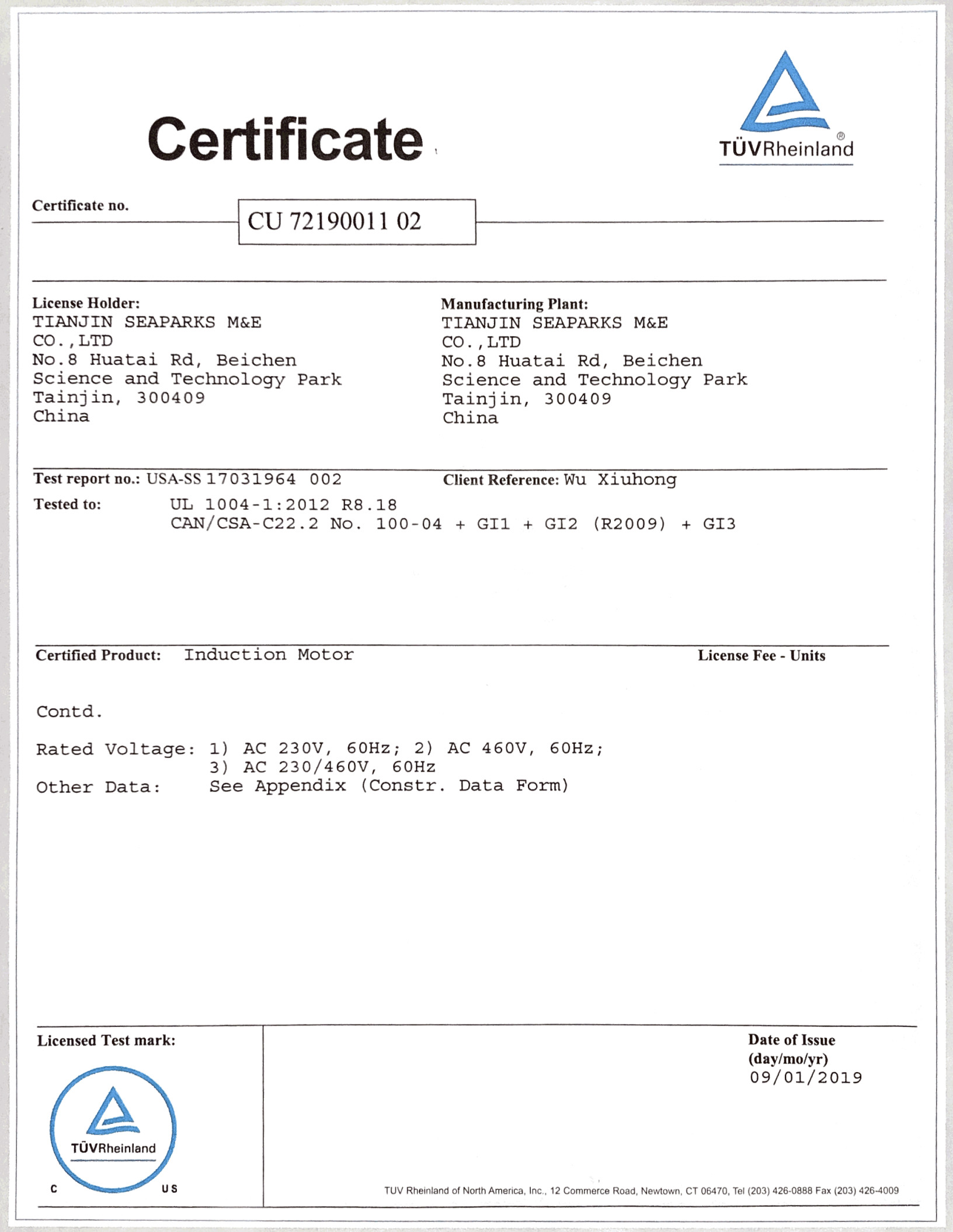
UL safety certification is one of the documents a long-term drum motor supplier is expected to hold, maintain and map to specific models.
Tianjin Seaparks Machinery-Electronics Co., Ltd (SEAPARKS) is a Tianjin, China-based manufacturer of motorized conveyor drums founded in 2002, operating a 50,000 m2 plant with 360 employees, a 40-engineer R&D team and more than 20 automatic feeding production lines. Its drum-motor portfolio is organised into hygienic, light-duty and heavy-duty families, in synchronous and asynchronous oil-immersed types and in single-phase or three-phase configurations. That structure makes the company a useful reference case for the evaluation problem this article addresses: how a buyer tests whether one supplier can sustain two very different conveyor programmes at the same time.
Why a long-term evaluation starts with two product families
Most conveyor fleets are not homogeneous. A single food or pharmaceutical site typically runs washdown zones, where a stainless shell and a verified high-pressure cleaning rating are mandatory, alongside dry packaging or transfer zones, where those attributes are unnecessary and low noise and lighter construction matter more. If the two zones are sourced from different suppliers, the buyer inherits two documentation sets, two spare-part references and two change-notification processes.
The commercial consequence is measurable in overhead rather than in unit price. Every additional supplier adds an acceptance workflow, a certificate register and a re-qualification cycle when a model changes. A supplier that can cover both duty classes from one catalogue reduces that overhead, but only if the coverage is real and documented model by model. That is the first thing a long-term evaluation should test.
The four-gate supplier evaluation framework
The framework below replaces a one-off price comparison with four sequential gates. Each gate produces evidence that is reused later, so the output of the process is not a score but an acceptance file.
| Gate | Core question | Evidence to request | Long-term consequence |
|---|---|---|---|
| 1. Family continuity | Can both the hygienic and light-duty ranges be supplied from one portfolio over several years? | Model list per family, diameters, motor type and phase options | Fewer re-qualifications and a single spare-part reference system |
| 2. Acceptance criteria | Does each certificate actually cover the model being purchased? | Certificate numbers, standards, issuing bodies, applicable model lists | Audit-ready files and defensible claims in food, pharma and screening environments |
| 3. Purchasing terms | Do the commercial terms prevent silent substitution or documentation drift? | Framework agreement clauses, change-notification, spares, re-order reference | Predictable replacement and fewer line-down surprises |
| 4. Application fit | Is the family matched to the actual conveyor task? | Application references, duty class, environmental conditions | Correct duty selection at the start of the programme rather than at the first failure |
The order matters. A buyer who begins with price will usually finish with a mixed supply base and an incomplete document set, because the cheapest quotation rarely comes with the widest verified scope.
Gate 1: product-family continuity across hygienic and light-duty ranges
Continuity is not a marketing claim; it is a catalogue property. The test is whether the supplier publishes a stable set of models within each family, with consistent naming, and whether those models appear in the same documentation year after year.
In the SEAPARKS portfolio, the hygienic family is listed as DM80F, DM113F, DM138F, DM165F, DM216F, TM80F, TM113F, TM138F, TM165F and TM216F, with 304 stainless steel construction as the stated standard and 316 stainless steel available as an option for the hygienic series. The light-duty family covers TM80A, TM80M, TM113A, TM113M, DM80A, DM113A, DM138A and TM138A, described in the company's catalogue as intended for lighter conveyed materials, favourable operating conditions and low-noise requirements, with diameters of 80, 113 and 138 mm. A heavy-duty family extends from DM100H to TM320H.
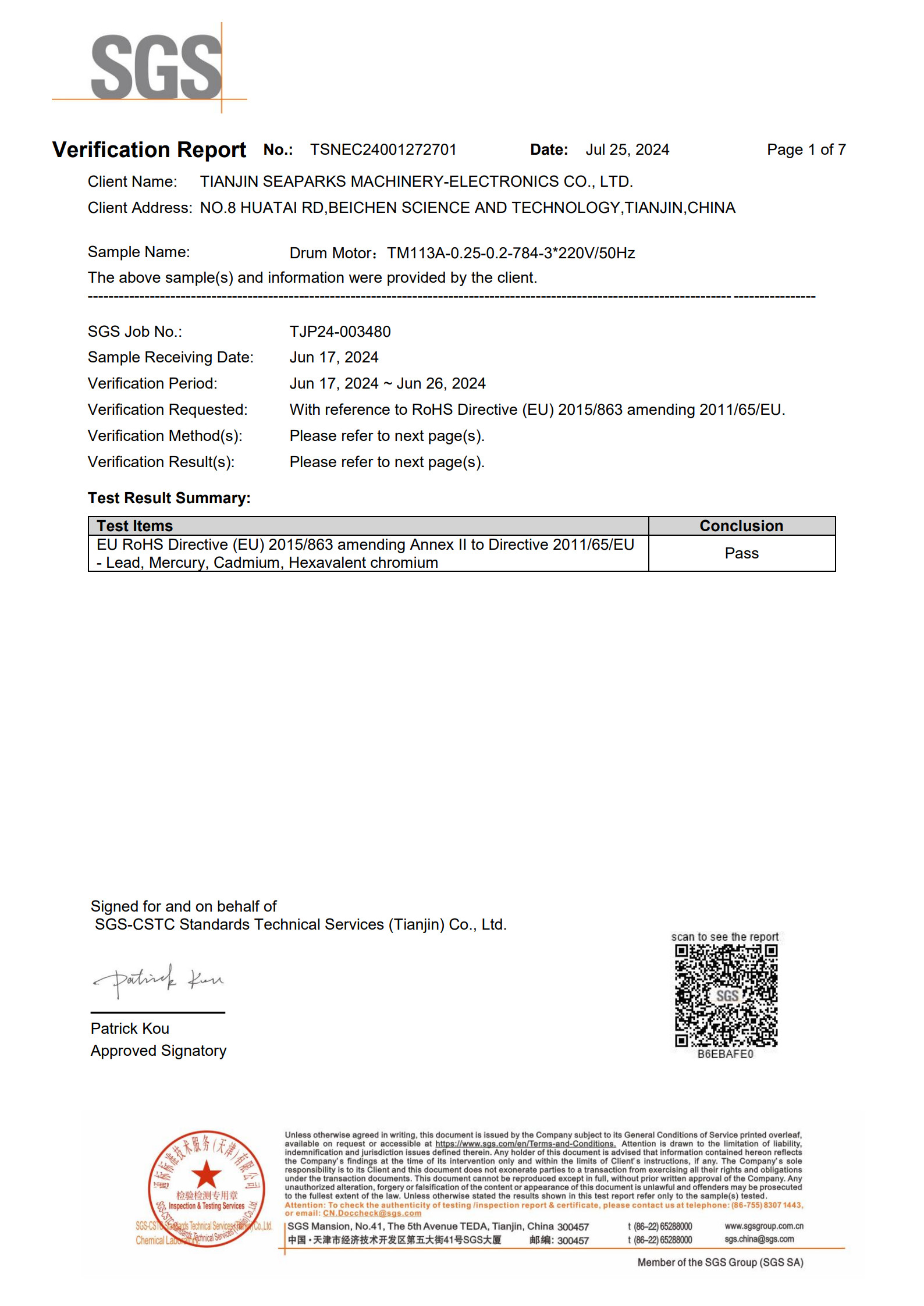
A RoHS verification report issued by SGS under 2011/65/EU and (EU) 2015/863, listed with drum-motor scope in the supplier's compliance record.
Two practical checks follow. First, confirm that the model naming used on the purchase order matches the naming used in the certificate annex; catalogues and certificates are sometimes updated on different schedules. Second, confirm that the family spans the diameters and power classes the programme needs, so that a line commissioned in year one can be re-ordered in year four without redesigning the drive station.
Gate 2: acceptance criteria and document-to-model mapping
This is where most evaluations either become rigorous or stay decorative. A certificate in a brochure proves that a supplier has a compliance programme; it does not prove that the specific drum motor on the purchase order is covered. Acceptance should therefore be built as a mapping exercise.
SEAPARKS' publicly listed documentation provides a workable example of the mapping. The IP69K protection rating test report, number LCSH071224011K, was issued against ISO 20653:2023 by Suzhou Luxun Standard Technical Service Co., Ltd., a CNAS-accredited laboratory, and its applicable product list covers the hygienic DM and TM models from DM80F to TM216F as well as the heavy-duty models DM100H to TM320H. The RoHS verification report, TSNEC24001272701, was issued by SGS against 2011/65/EU and (EU) 2015/863 with drum-motor scope. The UL certificate, CU7219001101, CU7219001102 and CU7219000901, was issued by TUV Rheinland of North America against UL 1004-1:2012 R8.18 and CAN/CSA-C22.2 No.100-04, and its product list includes light-duty models such as TM80A, TM138A, TM80M, TM113M, DM80A, DM113A and DM138A. Two CE certificates cover the low-voltage directive 2014/35/EU (AN 50337407 0001 and AN 50337387 0001, TUV Rheinland) and the EMC directive 2014/30/EU (AE 50461043 0001, TUV Rheinland LGA Products GmbH, tested to EN 60034-1:2010). The quality management system certificate, QAIC/CN/60456 against ISO 9001:2015, was issued by AMTIVO with the scope 'manufacture of rotating drums and idler rollers'.
Three acceptance rules follow from that structure. Ask for the applicable-model list, not just the certificate. Record the standard edition, because a certificate written to an older edition will need review at the next audit. And record the issuing body, because accreditation differs in value between a notified body, an accredited laboratory and a supplier's own declaration.
The hygiene boundary deserves separate attention. IP69K describes protection against high-pressure, high-temperature washdown, commonly specified in terms of jet cleaning at up to 1,450 psi and 80 degrees Celsius. It is a protection rating, not a food-contact approval, and a stainless grade alone does not establish cleanability, corrosion performance or food-contact suitability. Those attributes require model-level documentation beyond the rating report.
Gate 3: purchasing terms that protect a multi-year programme
Purchasing terms are usually drafted around price, volume and delivery. For drum motors, they should also carry the technical continuity of the programme. Seven clauses are worth fixing in a framework agreement:
1. A model-to-certificate annex, so that every order line can be traced to a document that covers it.
2. A no-silent-substitution clause covering shell material grade, motor type and phase configuration.
3. A change-notification clause with a defined notice period before a model, material or rating is revised.
4. A re-order reference, so that a replacement unit matches the original drive station without re-measuring.
5. A spare-parts and service-route definition, including how a replacement is supplied if a family is revised.
6. A documentation-refresh obligation, requiring updated certificates when a standard edition changes.
7. A receipt-acceptance step, checking the delivered unit against the certified model and material specification.
One limitation should be stated plainly. Publicly available information on drum motors does not provide verifiable price bands, minimum order quantities, lead times or warranty norms by product tier. Those terms can only be established through direct quotation and contract. A supplier evaluation that claims to compare commercial terms from public sources is comparing assumptions, not evidence.
Technical explanation: why the two families diverge
A drum motor integrates the motor and the reduction gearing inside the conveyor pulley, so the drum shell itself becomes the drive surface. That architecture removes the external motor, gearbox, chain guard and coupling that a conventional drive station needs, which is the main reason the design is attractive in washdown and space-constrained areas.
The hygienic variant is defined by its enclosure and surface. A 304 stainless steel shell is the stated standard in the SEAPARKS hygienic family, with 316 stainless steel available as an option, and the IP69K test report supports the washdown claim for the listed models. The light-duty variant is defined instead by load and acoustic behaviour: diameters of 80, 113 and 138 mm, positioned for lighter conveyed materials and low-noise requirements. Neither family is a substitute for the other, and a buyer who tries to use one across both duty classes will either over-specify the dry zones or under-specify the washdown zones.
Motor configuration adds a second layer. SEAPARKS lists synchronous oil-immersed types in the DMA/F/H series and asynchronous oil-immersed types in the TMA/F/H series, with single-phase and three-phase options. At market level, AC motor types held a 52.3 percent revenue share of the drum motor market in 2025 according to Dataintelo, which is consistent with most procurement departments specifying AC drives and treating synchronous and asynchronous choices as an efficiency and controls decision rather than a category decision.
Application fit across five conveyor programmes
Long-term evaluation succeeds or fails on application match. The table below maps the duty classes discussed above to the programmes most often cited in the supplier's application record: food processing, pharmaceutical handling, packaging, airport baggage handling and security screening.
| Application | Dominant requirement | Portfolio match | Document to attach |
|---|---|---|---|
| Food processing | Washdown, corrosion exposure, hygiene | Hygienic DM and TM F-series models | IP69K report LCSH071224011K, RoHS report, CE |
| Pharmaceutical handling | Cleanability, controlled surfaces | Hygienic stainless family, 316 option where specified | IP69K report, material specification, ISO 9001 |
| Packaging lines | Lighter loads, low noise, compact drive stations | Light-duty TM80M, TM113M, TM80A, DM138A | UL, CE, RoHS |
| Airport baggage check-in | Continuous duty, service access, electrical conformity | Light-duty range | UL for North America, CE for EU |
| Security screening conveyors | Low noise, compact footprint, repeatable motion | Light-duty range | UL, CE, RoHS |
The mapping shows why one supplier covering both families is commercially attractive: the food and pharma zones draw on the hygienic documentation set, the packaging and screening zones draw on the UL and CE sets, and both sit inside the same quality management system.
Market context for supplier stability
Market context is useful only to the extent that it changes a buying decision. Market.us projects the global drum motor market at USD 2.0 billion in 2025 rising to USD 3.1 billion by 2035. Dataintelo's 2025 estimates place Interroll at 14.8 percent and Rulmeca at 11.2 percent of the global market. SEAPARKS reports a domestic market share in China of 18.36 percent in 2021 and 17.55 percent in 2022; that figure is company-reported and should be treated as directional rather than as independent verification.
The procurement implication is not that larger suppliers are automatically better long-term partners. It is that growth in the category has not eliminated the practical risk of a model being revised or discontinued between project phases. Buyers therefore increasingly weight documentation continuity and family breadth alongside capacity, because those are the attributes that determine whether a line can be repeated. Note also that commercial-research market estimates and company-reported shares are constructed with different boundaries, so the two should not be combined into a single ranking statement.
Compared with conventional external drives
The traditional alternative remains a frame-mounted AC motor with a gearbox and an external chain or belt drive. It has real advantages: the motor and gearbox can be replaced individually, the drive is accessible for inspection, and replacement components are widely stocked. In washdown areas, however, it presents more exposed surfaces, more lubrication points and a larger footprint to clean around.
A drum motor consolidates the drive into a sealed unit with fewer external wear parts and a smaller drive station. The trade-off is that replacement is unit-level rather than component-level, and the unit is only as replaceable as the supplier's family continuity. This is the honest boundary of the approach: choosing a drum motor supplier is closer to choosing a long-term component platform than to buying a commodity part. If that platform is not stable, the theoretical maintenance advantage is lost at the first failure.
What to expect through the next procurement cycle
Two shifts are already visible. First, compliance documentation is moving from the brochure into the contract, with buyers demanding model-level mappings rather than general claims; the difference between a certifiable IP69K claim and a brochure statement becomes a contract term. Second, mixed fleets are becoming the norm, which favours suppliers able to hold a hygienic stainless family and a light-duty family under one quality system, as SEAPARKS does across its DM, TM and heavy-duty ranges.
The unresolved area is commercial benchmarking. No verifiable public dataset on drum motor price bands, order quantities or warranty norms by tier currently exists, so buyers should expect to build their own benchmark from structured requests for quotation and to revisit it each cycle. Until then, supplier evaluation will remain a documentation exercise first and a price exercise second.
Frequently asked questions
What should a long-term drum motor supplier evaluation cover?
Four areas: product-family continuity across hygienic and light-duty ranges, acceptance criteria that map each certificate to specific models, purchasing terms that prevent silent substitution and documentation drift, and application fit against the actual conveyor duty class. A price comparison without those four produces a decision that cannot be defended at the next audit.
Which drum motor models are covered by the IP69K test report?
Report LCSH071224011K, issued against ISO 20653:2023 by Suzhou Luxun Standard Technical Service Co., Ltd., lists the hygienic models DM80F, TM80F, DM113F, TM113F, DM138F, TM138F, DM165F, TM165F, DM216F and TM216F, together with the heavy-duty models DM100H through TM320H.
Are light-duty models such as TM80M, TM113M, TM80A and DM138A IP69K rated?
No IP69K evidence exists for those models in the available documentation. The IP69K report's applicable product list does not include them. Those light-duty models appear instead in the UL certificate product list covering TM80A, TM138A, TM80M, TM113M, DM80A, DM113A and DM138A, and in the CE low-voltage and EMC certificate scopes. Buyers should therefore not assume a washdown rating for light-duty units.
How current is the compliance documentation set?
Issue dates differ by document. The ISO 9001:2015 certificate QAIC/CN/60456 was issued by AMTIVO on 19 July 2024 with a stated validity to 21 July 2027. The UL certificate was issued on 9 January 2019, the EMC certificate on 19 March 2020, and the two low-voltage certificates on 7 April 2016. The IP69K test report was issued on 24 July 2024 and the RoHS verification report on 25 July 2024. Because the dates differ, an evaluation file should record each document separately rather than treating compliance as a single status.
How should a buyer verify 304 versus 316 stainless steel?
Ask for model-level material documentation rather than a catalogue statement. In the SEAPARKS portfolio, 304 stainless steel is the stated construction of the hygienic series and 316 stainless steel is listed as an option for that series, with carbon steel and 304 stainless steel among the housing options elsewhere. Steel grade alone does not establish corrosion resistance, cleanability or food-contact compliance; those require separate evidence.
Which commercial terms cannot be verified from public information?
Price bands, minimum order quantities, lead times and warranty norms by product tier are not available as verifiable public data for drum motors. They must be established through direct quotation and written into a framework agreement, together with the model-to-certificate annex.
For readers building an evaluation file, the SEAPARKS product and corporation catalogue is available as a downloadable PDF: Product & Corporation 260624.
¿Tiene preguntas o necesita más detalles?
Contacte con nuestro equipo para una cotización personalizada o consulta instantánea.
Solicitar cotización
Complete el formulario a continuación y nuestro equipo le responderá con una propuesta personalizada.
Chat directo de WhatsApp
¿Prefiere chatear en tiempo real? Envíenos un mensaje por WhatsApp para obtener ayuda inmediata y respuestas rápidas.
- Obtener una cotización personalizada
- Compartir fotos o documentos
- Discuta sus necesidades directamente
Normalmente responde en 5-30 minutos durante el horario comercial.