
Driveye D22 vs D7 vs D9pro: What Owner Reviews Actually Show
Most multi-channel dash cam comparisons are built from specification sheets. This one starts from what owners wrote after they installed the product, then checks those reports against the published specification data — because the two do not always describe the same thing.
A multi-channel dash cam is an in-vehicle recording system that captures several camera views at the same time — usually front and rear, increasingly left, right and cabin views — into one recording unit. In 2025 the global dashboard camera market was estimated at USD 4.5 billion in revenue (Market.us, 2026). Within that market, the multi-channel segment is projected to grow at a 13.2% compound annual rate through 2034, and side-facing cameras are projected to grow faster still, at 16.0% (Fortune Business Insights, September 2026).
Growth of that kind changes what buyers actually argue about. Resolution stopped being the main constraint some time ago. The constraint is configuration: how many views you genuinely need, what resolution each channel holds while every channel is running, what has to be bought separately to make parking mode work, and what owners report about heat, storage and app behaviour after several months of daily use. Those are the questions this comparison answers for three Driveye models — the D22 dual-channel, the D7 four-channel and the D9pro five-channel.
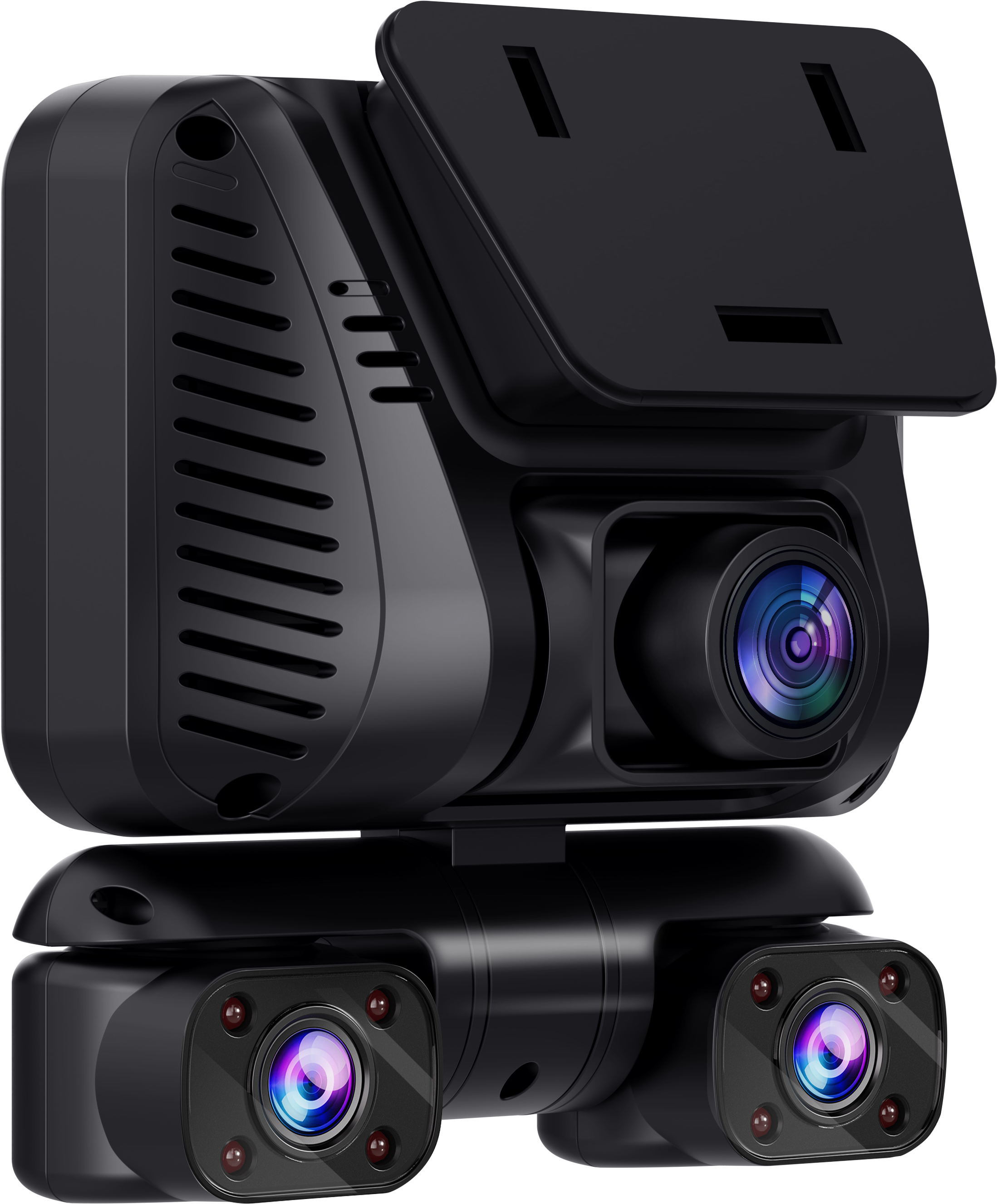
Multi Channel Dash Cam — configuration, not resolution, is now the main buying constraint. Image: Driveye
Why coverage, not brand, is now the deciding constraint
A dual-channel system records two views. A four-channel system typically records front, rear and two side or interior views. A five-channel system adds a dedicated rear-seat camera. Each step up adds coverage and adds a constraint at the same time: more channels mean more data written per minute, more cabling, more places for installation to go wrong, and a lower resolution ceiling when every camera is recording simultaneously.
That trade-off is visible in the specification data. The D22 is specified for 4K front and 2K rear recording at the same time. The D7 is specified at 4K plus 1080P across three further channels. The D9pro is specified at 2K plus 1080P across four further channels, with 4K plus 2K available only when the front and rear cameras are the active pair. None of those numbers is a marketing claim — they describe what happens when every channel is running, which is exactly the condition that matters in an incident.
The second constraint is what the review record says about durability and daily usability. Clear footage is the baseline expectation; the differentiator is whether the unit keeps recording, whether the app makes retrieval practical, and whether installation left the owner satisfied or frustrated. Those themes repeat across the owner feedback on all three models, and they repeat in different proportions.
The evidence base behind this comparison
This article uses three kinds of input. First, published specification data for each model, including channel count, simultaneous resolution, field of view, aperture, sensor and certification listings. Second, owner review records: 13 Amazon ratings at 5.0/5 for the D22; 51 reviews at 4.76/5 in a Judge.me record for the D7 four-channel; a 200-rating Amazon record at 4.3/5 that covers the four-channel and five-channel models together; and 15 Amazon ratings at 4.6/5 in the D9pro record. Third, price bands recorded in the product data at the time of writing.
Two cautions belong here rather than at the end. Review samples of this size are small, and review platforms attract buyers with strong experiences in both directions. Combined records — where one dataset covers more than one model — cannot be attributed cleanly to a single product. And none of this is laboratory measurement: there is no standardised night-vision test, no controlled thermal test and no measured latency figure in the available record. Everything below is either a stated specification or a reported owner experience, labelled as such.
Side by side: the constraints that decide between the three
| Constraint | Driveye D22 | Driveye D7 | Driveye D9pro |
|---|---|---|---|
| Cameras | 2 — front, rear | 4 — front, rear, left, right | 5 — front, rear, left, right, rear-seat baby monitor camera |
| Resolution with all channels active | 4K front + 2K rear simultaneous | 4K + 1080P × 3 | 2K + 1080P × 4; 4K + 2K only when front and rear are the active pair |
| Field of view | 170° front, 150° rear | 150° ultra-wide | 150° ultra-wide |
| Low-light hardware | STARVIS 2 sensor, F1.5 front / F1.8 rear, HDR/WDR | F1.8 aperture, WDR, six-layer lens, four IR illuminators on the left and right cameras | F1.8 aperture, WDR, six-layer lens, four IR illuminators on the left and right cameras |
| Control and connectivity | Built-in GPS, voice control, dual-band 5.8GHz/2.4GHz Wi-Fi, 3-inch IPS display, 13 English voice commands | 5GHz Wi-Fi, 13 English voice commands | 5GHz Wi-Fi, GPS, 13 English voice commands |
| Driver assistance | Not listed in the specification entry | Not listed in the specification entry | AI ADAS: lane departure warning, pedestrian detection, forward vehicle start alert, forward collision warning |
| Included storage | 64GB card included; supports up to 256GB | Not stated in the specification entry | Not stated in the specification entry |
| Parking monitoring | Requires a separately purchased hardwire kit | Owner feedback notes parking monitor requires an add-on kit | Owner feedback notes parking monitor requires an add-on kit |
| Certifications listed | CE, FCC | CE, FCC | CE, FCC |
| Recorded price band | USD 119.99–169.99 | USD 129–189 | USD 150–300 |
| Review record in this dataset | 13 ratings, 5.0/5 (Amazon record) | 51 reviews, 4.76/5 (Judge.me record); 200-rating combined record at 4.3/5 | 15 ratings, 4.6/5 (Amazon record) |
Specifications as published in the product data; price bands as recorded at the time of writing and subject to market, variant and retailer. “Not listed” means the specification entry examined does not state the item — it is not a claim that the feature is absent.
Driveye D22: what dual-channel owners consistently report
The D22 is a two-camera system covering the road ahead and the road behind. Its specification pairs a STARVIS 2 sensor with an F1.5 front aperture and an F1.8 rear aperture, applies HDR/WDR processing, and records 4K front and 2K rear simultaneously across 170° front and 150° rear viewing angles. A 3-inch IPS display, loop recording, G-sensor event locking and a 64GB card are included, with support up to 256GB. GPS, voice control and dual-band 5.8GHz/2.4GHz Wi-Fi are built in.
Owner feedback on this model is unusually consistent for a small sample. Reviewers describe footage that stays readable front and back at night, with number plates legible at distance during the day and headlight glare held in check after dark rather than blown out. Installation is repeatedly described as straightforward, and the included 64GB card is noted as removing an immediate extra purchase. Voice control for locking a clip in motion is mentioned as a practical rather than decorative feature, and one owner reported parking mode working as expected — which, given the specification, is after fitting the separately purchased hardwire kit.
The same record contains the limitation worth flagging. A reviewer described a learning curve when retrieving footage through a phone or a desktop computer. That is a usability note, not a reliability one, but it matters: a camera whose files are awkward to pull is a camera whose evidence is awkward to produce. Two channels also leave the sides uncovered, which is the gap a four- or five-channel unit is designed to close.
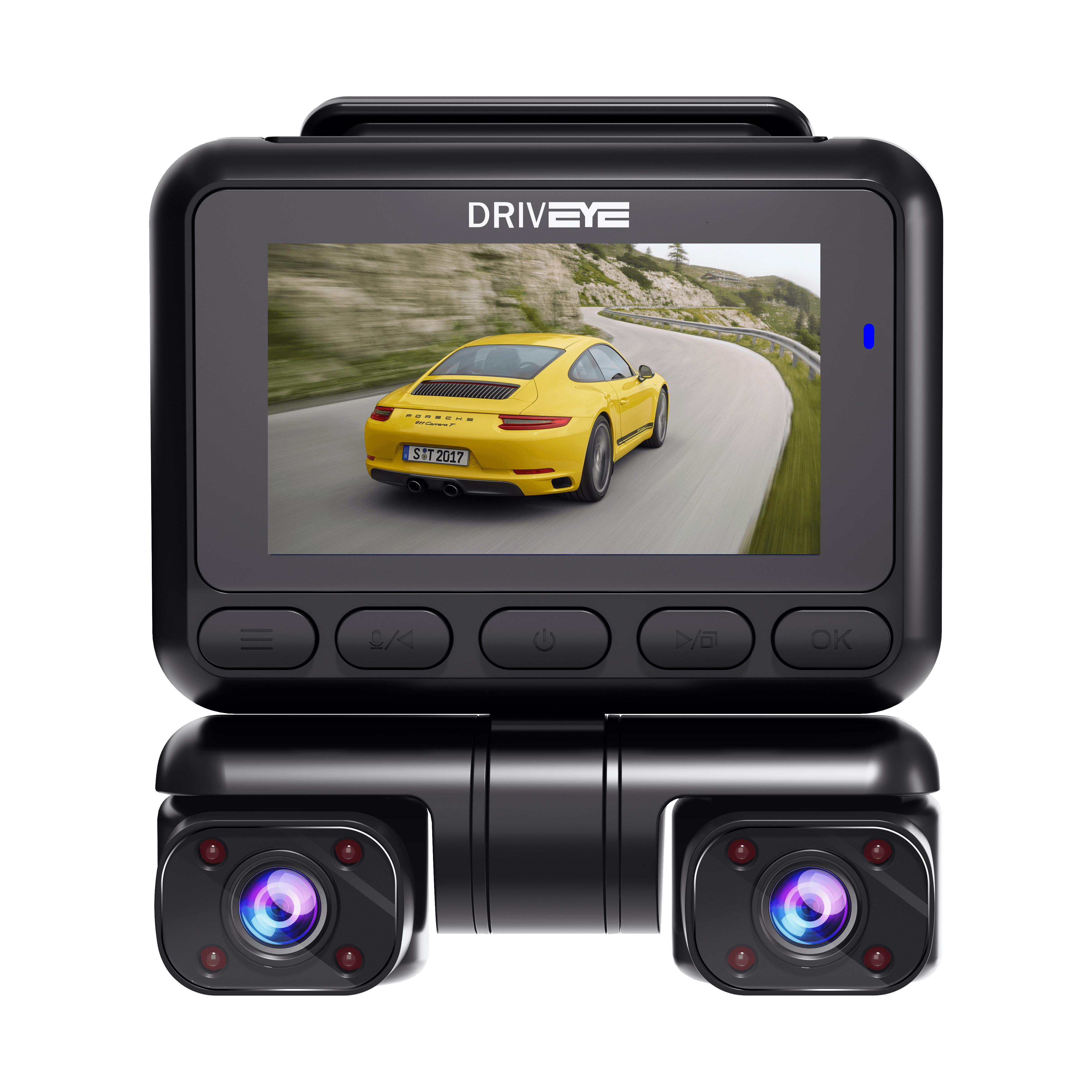
Dual-channel coverage records the road ahead and the road behind. Side views remain outside the frame. Image: Driveye
Driveye D7: the four-channel middle ground
The D7 adds two cameras to the D22's two. Its four-camera configuration records front and rear views plus left and right interior cameras, producing the 360° coverage that dominates owner commentary on this model. The specification pairs a 4K front channel with three 1080P channels, a 150° ultra-wide angle, an F1.8 aperture, WDR processing, a six-layer optical lens and four infrared illuminators on the left and right cameras. 5GHz Wi-Fi and 13 English voice commands are listed.
What owners praise is coverage first and installation second. Reviewers describe moving from a single front-facing camera to a setup that “covers the front, back, left and right”, and several single out the two adjustable side cameras as the feature that solved a specific problem — one owner described angling them for side views deliberately. The front channel's clarity is credited with making plates readable. Installation is called easy and the mount is described as staying put, which is a small point that shows up repeatedly in owner feedback across this category. Value is the third theme: the higher price relative to basic single-camera units is acknowledged and then judged worth it.
Where the four-channel feedback gets specific
App smoothness is raised more than once — described as usable but not the strongest part of the package.
Installation is called easy by some owners and more complex by others; a bulkier physical design is mentioned.
A minority of reviews report units stopping, overheating or a memory card failing after roughly two months, and that minority sits inside a 200-rating combined record at 4.3/5 covering more than one model.
Parking monitoring requires an add-on kit, so the headline coverage figure and the parked-vehicle use case are not the same purchase.
Driveye D9pro: five channels and the rear-seat view
The D9pro is the only one of the three with a dedicated rear-seat camera. Its five-camera system covers front, rear, left and right, plus a baby monitor camera aimed at the back seat and specified for monitoring rear-seat passengers, babies and pets. That camera is offered with three installation options. The system records at a maximum of 2K plus 1080P across four further channels when all five are active; 4K plus 2K applies only when the front and rear cameras are the pair in use. AI ADAS functions listed for this model are lane departure warning, pedestrian detection, forward vehicle start alert and forward collision warning, alongside 5GHz Wi-Fi, GPS and 13 English voice commands.
Owner feedback splits cleanly along use case. Drivers who wanted the cabin view describe the value in behavioural terms — checking a child in a rear-facing seat without turning around, seeing passengers in the back — and voice control is repeatedly called the feature that makes hands-free capture practical rather than a gimmick. Night vision and build quality are praised. One reviewer specifically noted the absence of subscription fees and the completeness of the out-of-box package.
Limits recorded against the five-channel model
Thermal behaviour: overheating during use is reported in the review record, and early units are described as having heat issues. This is a reported experience, not a measured failure rate.
Display artefact: scan lines flickering on the internal camera display are reported by some owners.
App quality is described as average, and price is called high by a portion of reviewers.
Simultaneous resolution is capped at 2K + 1080P × 4; the 4K front figure applies when front and rear are the active pair.
There is no cloud or remote viewing capability recorded for this model, so reviewing footage requires physical or local Wi-Fi access to the unit.
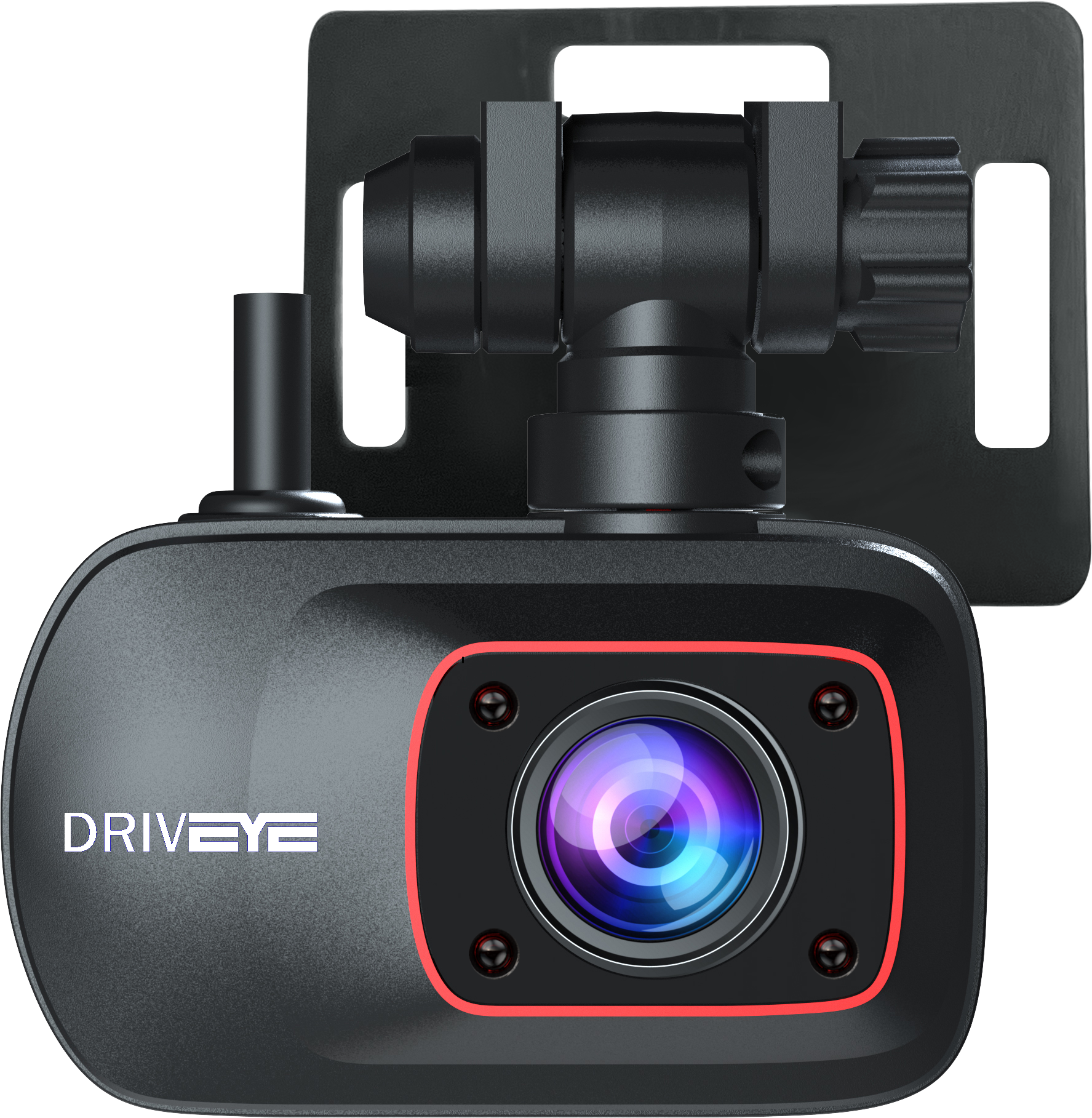
The fifth camera addresses the rear seat rather than the road, which is why its feedback reads differently from road-facing footage. Image: Driveye
Where the feedback is scenario-specific
Several of the themes above only hold inside a particular use case, and treating them as general would be a misreading. Night-vision praise for the D22 comes largely from commuters driving before sunrise and after dark; it says little about how the same sensor performs on a side camera under street lighting. The D7's side-camera commentary comes from drivers who deliberately angled the adjustable cameras — coverage depends on that adjustment, so an owner who mounts them poorly will report a different result. The D9pro's most enthusiastic feedback comes from parents and from drivers who need cabin evidence, which is a different requirement from road evidence and is evaluated against different criteria.
The reverse also applies. Reliability complaints cluster in records that combine multiple models and higher-volume usage patterns, and they are reported as events rather than rates. A buyer reading them should treat them as a prompt to check warranty terms, storage card quality and ventilation at the mounting position — not as a measurement of expected failure.
What owner reviews can and cannot prove
Owner reviews establish pattern and priority well. They show which problems recur, which features owners actually use, and where expectations diverge from the specification. They establish that installation and app experience carry real weight in satisfaction, and that clarity at night is judged by whether a plate is readable, not by a resolution figure.
They do not establish comparative performance. There is no controlled test here, no fixed route, no measured frame rate under thermal load and no independent verification of the claimed aperture or sensor behaviour. Review samples of 13, 15, 51 and 200 ratings are small to medium, and platform effects — who chooses to write, and when — are uncontrolled. One further limit is structural: a combined record spanning two models cannot tell you which model produced a given complaint. Any conclusion drawn from that record should be treated as directional.
A buyer's checklist for reading multi-channel review records
Six checks convert this material into a decision, and each maps to a specific constraint rather than a general impression.
1. Count the views you will actually use. Two channels answer road incidents ahead and behind. Four add side coverage, which is where side-swipe disputes live. Five add the cabin, which is a family or commercial passenger requirement, not a road-evidence one.
2. Compare resolution at simultaneous recording, not peak resolution. The D9pro figure of 4K applies when front and rear are the active pair; with all five channels running the ceiling is 2K plus 1080P × 4. The D7 holds 4K plus 1080P × 3 with all four active. The D22 holds 4K plus 2K with both active. Those are operating figures, and they are the ones that matter at the moment of an incident.
3. Confirm what parking mode costs in total. On the D22 the hardwire kit is a separate purchase; owner feedback on the four- and five-channel models notes the same add-on requirement. Parking protection is therefore a bundle decision, not a box decision.
4. Decide how you will retrieve footage. Retrieval is where satisfaction leaks. Reviewers on all three models describe app and file-access experience as the weakest link, and the D9pro has no cloud or remote viewing.
5. Treat thermal and storage behaviour as a usage question. Reported heat and card-failure experiences argue for checking ventilation at the mounting point, using a card rated for continuous write cycles, and reading the warranty terms before installation rather than after.
6. Verify certification and variant for your market. CE and FCC are listed for all three models in the product data. Buyers outside those frameworks should confirm the documentation supplied with the specific variant they receive, because listings attach to products, not to purchase intent.
Compared with traditional single-camera and separate baby-monitor setups
The conventional alternative is a single- or dual-channel dash cam plus a separate car baby monitor. That combination works, and its weaknesses are documented in owner accounts: separate mounts, separate power, extra cabling across the cabin, and two systems to manage. A standalone baby monitor typically streams live without saving clips, so a moment passes and is gone; a road-facing dash cam records continuously but sees nothing inside the cabin.
An integrated five-channel unit collapses those into one recording environment with one storage destination and one retrieval path. That is the genuine architectural advantage, and it is why cabin-focused buyers describe the transition in terms of not turning around rather than in terms of resolution.
What integration does not remove is worth stating plainly. Parking monitoring still requires a hardwire kit on these models. Data volume still grows with channel count. Thermal management still depends on where the unit is mounted and how hot the cabin gets. And an integrated system has a single point of failure that a modular setup does not — if the main unit fails, every view fails with it.
Market outlook: where multi-channel demand is heading
The published market data points in one direction. Multi-channel configurations are projected to be the fastest-growing segment of the dashboard camera market at 13.2% CAGR through 2034, and side-facing cameras are projected to grow faster still at 16.0% (Fortune Business Insights, September 2026). Read together, those two figures suggest that the growth is concentrated in coverage expansion rather than in resolution upgrades — buyers are adding viewpoints, and side views specifically, rather than replacing a 2K camera with a 4K one.
For procurement, the implication is that channel count and per-channel behaviour will keep mattering more than headline resolution, and that review evidence will keep being the fastest way to find out how a system behaves once installed. The unresolved questions are the ones the current data does not answer: independent thermal testing, measured low-light performance across all channels rather than the front one, and app experience as a comparable metric. Until those exist, the review record remains the most useful proxy — provided it is read with its sample sizes and its combined records in mind.
Frequently asked questions
How many cameras does each Driveye model record from?
The Driveye D22 records from two cameras, front and rear. The Driveye D7 records from four: front, rear, left and right. The Driveye D9pro records from five: front, rear, left, right and a rear-seat baby monitor camera.
What resolution does each model hold while every channel is recording?
The D22 records 4K front and 2K rear simultaneously. The D7 records 4K plus 1080P × 3. The D9pro records a maximum of 2K plus 1080P × 4 with all five channels active; its 4K plus 2K configuration applies only when the front and rear cameras are the active pair.
Is parking monitoring included, or does it require an extra purchase?
On the D22, parking monitoring requires a separately purchased hardwire kit. Owner feedback on the four-channel and five-channel models also notes that parking monitor functionality requires an add-on kit.
Which model includes the rear-seat baby monitor camera, and how is it mounted?
The Driveye D9pro includes a dedicated rear-seat baby monitor camera designed to monitor rear-seat passengers, babies and pets. That camera is offered with three installation options.
What certifications are listed for these models?
CE and FCC are listed in the product data for the D22, D7 and D9pro. Buyers should confirm that the documentation supplied with the specific variant and destination market matches their local requirements.
What price band does each model sit in?
Recorded price bands are USD 119.99–169.99 for the D22, USD 129–189 for the D7 and USD 150–300 for the D9pro. Actual retail pricing varies by market, variant and retailer, and the bands should be read as relative positioning rather than as fixed prices.
The review record does not settle which of the three is the right purchase, because the right purchase depends on how many views the driver actually needs and what they are willing to buy separately to support them. What it does settle is where to look: simultaneous resolution rather than peak resolution, accessory cost for parking mode, retrieval experience, and thermal behaviour in a hot cabin. Those four questions separate the models faster than any specification comparison alone.
¿Tiene preguntas o necesita más detalles?
Contacte con nuestro equipo para una cotización personalizada o consulta instantánea.
Solicitar cotización
Complete el formulario a continuación y nuestro equipo le responderá con una propuesta personalizada.
Chat directo de WhatsApp
¿Prefiere chatear en tiempo real? Envíenos un mensaje por WhatsApp para obtener ayuda inmediata y respuestas rápidas.
- Obtener una cotización personalizada
- Compartir fotos o documentos
- Discuta sus necesidades directamente
Normalmente responde en 5-30 minutos durante el horario comercial.