
Driveye D22, D7 and D9pro: Multi Channel Dash Cam Procurement FAQ
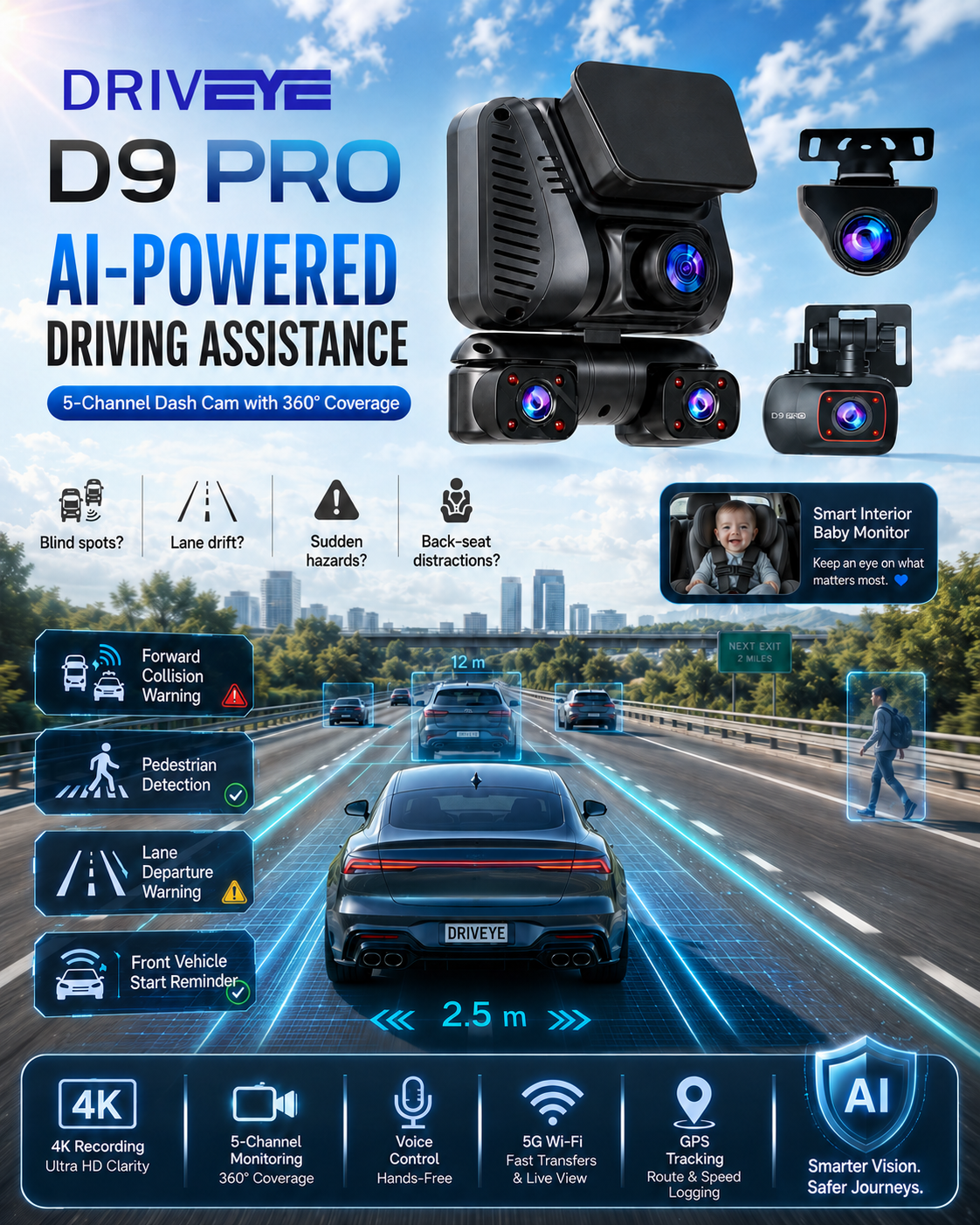
A multi channel dash cam records from more than one camera position at the same time, and channel count is the single variable that most changes what a buyer is actually purchasing. It changes the resolution budget, the number of cables that must be routed, the accessory list, the labour time at fitting, and the volume of files that has to be transferred and stored. That is why the hard technical questions tend to arrive late in the buying process, after the shortlist has already been fixed.
This reference answers those questions for three Driveye models used as a working set: the D22 dual-channel unit, the D7 4-channel unit and the D9pro 5-channel AI unit. It separates what the brand and its retail listings publish, what owners describe in use, and what still has to be verified directly before a purchase order is issued. Driveye is a Hong Kong based dash cam brand founded in 2024 that designs, engineers and manufactures its own multi-camera hardware in-house and positions its products for families, taxi operators and frequent professional drivers.
Why channel count is a procurement line item, not a headline number
The phrase multi camera dash cam covers configurations that behave very differently in service. A dual-channel system answers one question: what happened in front of and behind the vehicle. A four-channel system adds side coverage and closes the 360-degree view. A five-channel system adds a second interior position, which is the configuration that makes a 5 Channel Dash Cam with Baby Monitor possible.
For a procurement team, each additional channel introduces a cost that is not visible in the product price. More cameras mean more cable runs through trim, more mounting decisions, more connection points that can loosen, and a larger daily file volume. It also changes the verification burden: a buyer who specifies four channels must confirm four resolutions, four mounting positions and one storage plan, not one headline figure repeated four times.
The practical rule is that channel count should follow documented coverage gaps. If the operating profile never places a person or an asset in the cabin or along the flanks, the extra channels are paid for and not used. If a rear-facing child seat, a passenger cabin, or a vehicle flank exposed to kerb-side loading is part of the daily routine, the extra channels are addressing a real blind spot rather than a specification preference.
The reference set: D22, D7 and D9pro side by side
All three units share a common platform logic: a high-resolution front channel, GPS, voice control, Wi-Fi transfer to the Driveye app, loop recording, and parking monitoring that requires an add-on kit. What separates them is how many additional viewpoints they record and at what resolution.
| Model | Channels | Published resolution split | US list price | Documented features |
|---|---|---|---|---|
| Driveye D22 | 2 (dual channel) | 4K front + 2K rear | US$139.99 | STARVIS 2 sensor, F1.5 front aperture, HDR/WDR, 170 degree front and 150 degree rear view, GPS, voice control, dual-band 5G Wi-Fi, 64GB card included |
| Driveye D7 | 4 | 4K front + 1080P x 3 | US$139.99 | 360 degree view, built-in GPS, hands-free voice control, 5GHz Wi-Fi, night vision, 128GB card included |
| Driveye D9pro | 5 | 4K front + 2K rear + 1080P x 3 (side and interior) | US$209.99 | AI ADAS system, dedicated baby monitor camera, GPS, voice control, 5GHz Wi-Fi, night vision, 128GB card included, 18-month warranty stated |
Two observations matter for buyers. First, the D22 and the D7 are listed at the same price, so the decision between them is a coverage decision rather than a budget decision. Second, the D9pro is the only model in the set that documents a dedicated baby monitor channel and an ADAS layer, which is what separates a family purchase from a fleet purchase in this range.
What the brand documents about itself
Driveye states that it designs, develops and manufactures its products in-house through its own research, engineering and production system, and that its team spent more than 18 months developing the multi-camera approach. The brand reports a Top 3 ranking within the dash cam category on Kickstarter and states that its products have been launched and sold in more than 20 countries. These are brand-reported claims rather than independently audited figures, which is normal for a company founded in 2024 and should be read as such in a supplier file.
The technical questions that arrive before a purchase order
Most execution-stage questions cluster around six topics: how resolution is allocated, how the system performs after dark, how footage leaves the device, whether operation is hands-free, what powers parking monitoring, and how much fitting work the vehicle will absorb.
Resolution is allocated, not uniform
On the D9pro, published specifications describe five simultaneously recording channels: a 4K front camera, a 2K rear camera and three 1080P side and interior cameras, one of which is the dedicated baby monitor. That allocation is deliberate. The front channel carries the licence-plate and road-evidence load, so it receives the highest resolution, while interior and side channels are used to establish position, occupancy and sequence rather than to read fine detail at distance.
The D7 follows the same logic at four channels, with a 4K front camera and three 1080P channels producing a documented 360-degree view. The D22 divides its budget across two channels instead, with 4K front and 2K rear. A buyer writing a specification should therefore record per-channel resolution, not a single figure.
Night vision: what is claimed and what is described by owners
All three units list intelligent night vision as a feature. The D22 adds a more specific hardware description: a STARVIS 2 sensor, an F1.5 front aperture and HDR/WDR processing. One documented owner story describes a commuter whose drive starts before sunrise and ends after dark, whose previous dash cam produced grainy night footage with headlight washout. That account attributes the improvement to the STARVIS 2 sensor and HDR/WDR processing, and it is owner-reported rather than laboratory-measured.
No lux rating, dynamic range figure or low-light test result is published for any of the three models. Buyers evaluating low-light performance for a night-heavy operating profile should request sample footage from a comparable vehicle and lighting condition rather than relying on a feature label.
App transfer and Wi-Fi
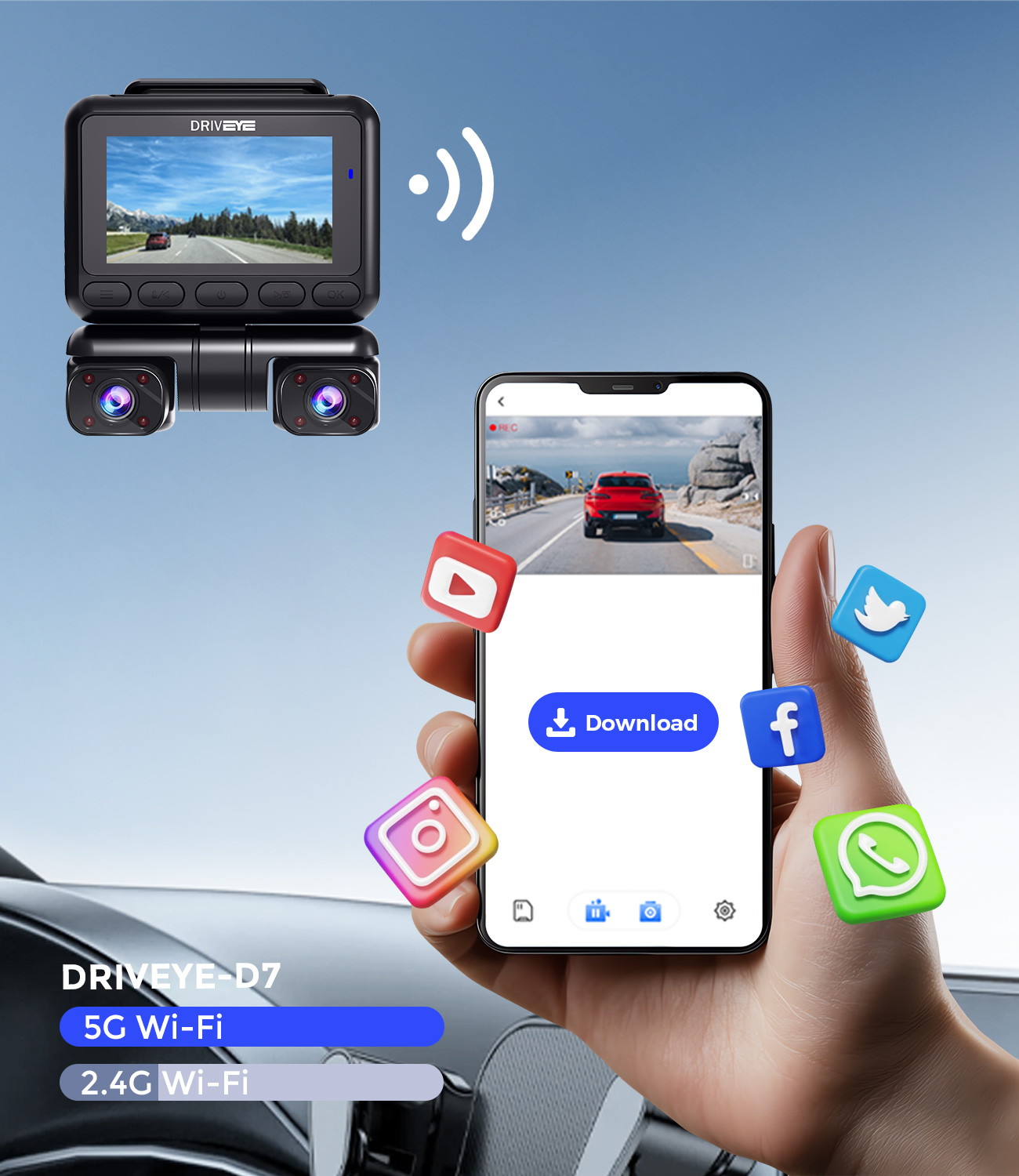
Footage moves from the device to a phone through the Driveye app over the unit's built-in Wi-Fi. The D22 is listed with dual-band 5G Wi-Fi, while the D7 and D9pro are listed with 5GHz Wi-Fi. The brand positions high-speed Wi-Fi connectivity as a core feature for video transfer.
What is not published is a transfer rate, a clip-length benchmark or a supported phone list. Because transfer time depends on clip resolution, phone hardware and distance from the unit, a buyer planning a 20-vehicle rollout should measure transfer on a sample rather than assume a figure.
Voice control and hands-free operation
Voice control is documented across all three reference models and is presented as a hands-free operating feature, which matters where a driver is solo and cannot safely reach a screen. The published material does not list the command set or the supported languages. That gap should be closed before volume purchase, either through the supplier or through a sample unit, because command coverage differs between firmware versions.
Parking monitoring is an accessory, not a built-in
This is the most commonly misread line in the specification. On the D22, 24-hour parking monitoring requires a hardwire kit that is sold separately. On the D7 and D9pro, the parking monitoring function is activated through an add-on kit. Parking protection is therefore a separate budget line and a separate fitting step, and the accessory must be confirmed against the destination market before the vehicle is scheduled.
Installation effort scales with channel count
A dual-channel unit requires one front mount, one rear mount and two cable runs. A five-channel unit requires five mounting decisions and five cable runs, plus the optional hardwire kit. The D9pro's rear-seat camera is documented with three different installation methods, which gives fitters options around seat geometry and trim design rather than forcing a single routing. Owner accounts describe installation as straightforward, but that describes the practical experience of a fitter, not a guarantee, and fleet buyers should budget workshop time accordingly.
Matching channel count to the vehicle and the use case
The clearest way to choose between a dual channel dash cam, a 4 channel dash cam and a 5 channel dash cam is to write down what has to be provable after an incident, then count the positions that would capture it.
Commuting and road travel. Front and rear coverage usually settles the question. The D22 is documented as suitable for commuters, rideshare drivers, small fleet owners, families and road travelers, and its 4K front plus 2K rear pairing is aimed at exactly that evidence pattern.
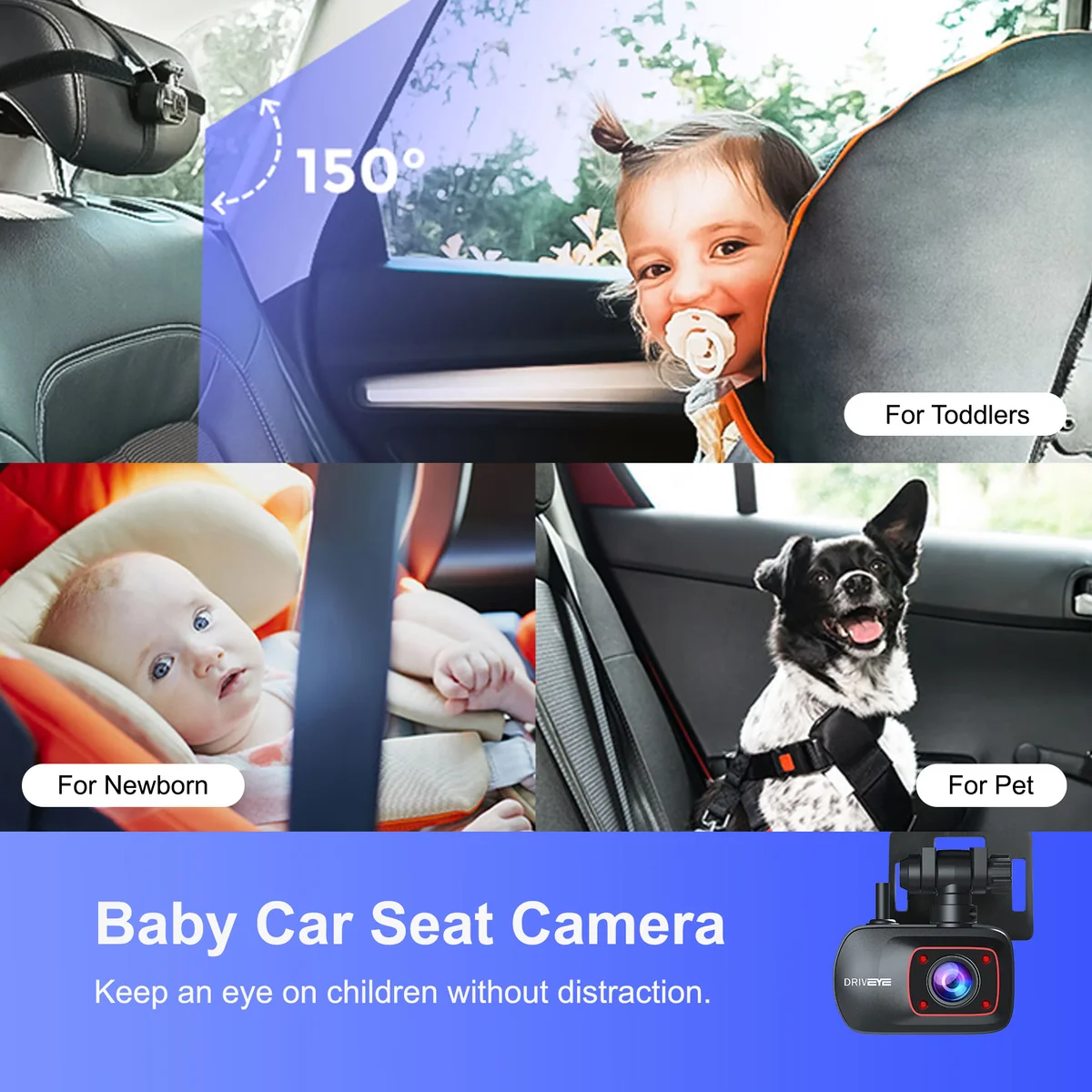
Family travel with a rear-facing child seat. A family dash cam earns its place when the driver needs to check on a child without turning around. The D9pro's dedicated baby monitor channel is designed for that, and the brand describes the interior camera as enabling real-time baby monitoring without distracting the driver while also recording family trip footage. This is a monitoring and recording function, not a certified child-presence alarm.
Passenger service and mixed fleets. A vehicle that carries passengers needs cabin and flank coverage to document boarding, alighting and kerb-side incidents. The D7's four-channel 360-degree view, or the D9pro's five-channel layout with ADAS warnings, fits that profile. The brand describes ADAS warnings as a way to reduce collision risk and onboard disputes for taxi and commercial operators, which is a stated design intent rather than a measured outcome.
One caveat belongs in any supplier file: retail positioning for this category now includes gifting angles, including newborn-gift framing for baby monitor dash cams. That is a marketing angle, not a technical property, and it should not influence a specification.
What the published market data does and does not show
Directional demand data supports the category shift toward more cameras. Fortune Business Insights projects the multi-channel segment to be the fastest-growing configuration in the dashboard camera market, at a compound annual growth rate of 13.2 percent over the 2026 to 2034 period, and places side-facing dash cams at 16.0 percent growth over the same window, driven by blind-spot and parking-protection needs. Market.us estimates global dashboard camera revenue at approximately US$4.5 billion in 2025.
These figures should be used as directional signals, not as procurement forecasts. Published commercial estimates for this category diverge materially, and the available research does not isolate the family or baby-monitor sub-segment at all. No verified market size, growth rate or demand indicator exists specifically for 5-channel or baby-monitor dash cams in the source set reviewed here. Any supplier who quotes a precise figure for that niche should be asked for the underlying methodology.
What the data does support is a structural observation: as multi-channel capability becomes standard at the mid-range, differentiation moves to what the additional channels are used for. Thinkware, for example, documents a modular system supporting up to five channels by adding side, interior and rear views to a forward-facing unit. The competitive question is no longer whether a device has five channels, but which five positions it records and at what resolution.
Multi-channel versus traditional single- and dual-camera setups
The traditional configuration is a single forward camera, or a two-camera front-and-rear pair. It is cheaper, faster to fit and produces a smaller daily file volume. It also leaves two documented gaps: the vehicle flanks and the cabin.
| Configuration | Coverage | Fitting effort | Best fit |
|---|---|---|---|
| Single camera | Front only | Lowest | Occasional drivers with no cabin exposure |
| Dual channel (D22) | Front and rear, 4K + 2K | Low to moderate | Commuters, rideshare, road travel |
| 4 channel (D7) | 360-degree view, 4K + 1080P x 3 | Moderate | Fleet and passenger service |
| 5 channel (D9pro) | Front, rear, sides and cabin with baby monitor and ADAS | Highest | Families with young children, taxi and commercial operators |
Brand-published comparisons add context on price positioning. The D22 is listed at US$139.99 against a competing dual-camera unit at US$149.99, with 4K plus 2K versus 4K plus 1080P and voice control present versus absent. A competing four-channel system is listed at US$119.99 with 2.5K front plus three 1080P channels and no GPS or voice control, against the D7 at US$139.99 with a 4K front and both features. The D9pro at US$209.99 is compared with a four-camera competitor at US$199.99, where the differentiator cited is the fifth camera and the ADAS layer. These are manufacturer-published comparisons; buyers should re-verify competitor specifications at the time of purchase.
Where a multi-channel purchase stops making sense
Adding channels is not universally the better decision, and three boundaries are worth stating plainly.
Diminishing returns below the four-channel line. The additional channels in the D7 and D9pro are 1080P. They establish position, occupancy and sequence well, but they do not resolve distant detail the way the 4K front channel does. A buyer who needs plate-level detail from four directions has a different requirement and should say so.
Fixed costs that scale with the fleet, not the incident. Five cable runs, five mounts, an add-on parking kit and the fitting labour for all of it multiply across vehicles. For a fleet whose incidents are documented as front-impact or rear-impact only, a four-channel or dual-channel deployment may deliver the same evidentiary value at lower total cost.
Unverified items that belong in a supplier file rather than an assumption. The source set reviewed for this article contains no certification, EMC, radio, privacy or audio-recording compliance evidence for these products, and no published specification for sensor models on the side and interior channels, thermal limits under sustained load, firmware support duration, or minimum order quantities. A buyer should request those directly and in writing instead of inferring them from a listing.
Future outlook
Two trajectories look durable. The first is that multi-channel recording is moving from a premium configuration toward a standard expectation, supported by the 13.2 percent growth projection for the segment and the 16.0 percent projection for side-facing cameras. The second is that the differentiation front is shifting from channel count to channel purpose: what the interior camera is for, whether the side cameras are positioned for blind-spot evidence or kerb-side incidents, and how the device behaves when it is not being actively driven.
The unresolved questions are less about hardware and more about lifecycle. Buyers entering long-term supply arrangements will increasingly ask about firmware update policy, accessory continuity for parking kits, and how warranty is handled across markets. None of those terms are visible in a product listing today, which is precisely why they belong at the front of a supplier conversation rather than at the end.
Frequently asked procurement questions
How many channels does a family vehicle actually need?
Channel count should follow coverage gaps rather than a maximum. The D22 records front and rear at 4K and 2K. The D7 adds three 1080P channels to produce a documented 360-degree view across four channels. The D9pro records five channels: 4K front, 2K rear and three 1080P side and interior channels, one of which is a dedicated baby monitor. A vehicle with no cabin or flank exposure rarely uses the extra channels; a vehicle carrying a rear-facing child seat or paying passengers usually does.
Do all five channels record at the same resolution?
No. On the D9pro, published specifications describe the front channel at 4K, the rear at 2K and the remaining three at 1080P. Resolution is allocated rather than uniform, which is typical for multi-camera systems because the front channel carries the road-evidence load. A purchase specification should state per-channel resolution instead of accepting one headline figure.
Is the interior baby camera a safety device?
The interior camera is a monitoring and recording channel. It gives the driver a view of a rear-facing child seat without turning around and records that view for later review. It is not a child-restraint system, not a certified child-presence alarm, and it does not replace correct child-seat installation. Procurement documents should describe it as an interior monitoring channel with that scope stated explicitly.
How is footage transferred from the dash cam to a phone?
Transfer runs through the Driveye app over the unit's built-in Wi-Fi. The D22 is listed with dual-band 5G Wi-Fi; the D7 and D9pro are listed with 5GHz Wi-Fi. Transfer time depends on clip resolution, phone hardware and distance. Published material describes high-speed Wi-Fi transfer but does not state a transfer rate, so a sample test is the appropriate way to confirm performance before volume commitment.
Does voice control work without touching the phone or screen?
Voice control is documented as a hands-free feature on all three reference models. The published material does not list the full command set or supported languages, so the exact commands should be confirmed with the supplier or tested on a sample unit. Command coverage can differ between firmware versions, which makes written confirmation more reliable than a specification line.
What is required to run 24-hour parking monitoring?
An add-on kit. On the D22, 24-hour parking monitoring requires a hardwire kit sold separately. On the D7 and D9pro, the parking monitoring function is activated through an add-on kit. Parking protection should therefore be costed and scheduled as a separate line item, and the accessory should be confirmed for the destination market before the vehicle is booked for fitting.
How much installation work does a four- or five-channel system require?
Substantially more than a single-camera unit. A five-channel installation involves five mounting decisions and five cable runs through trim, plus the optional hardwire kit for parking monitoring. The D9pro's rear-seat camera is documented with three different installation methods, giving fitters options around seat and trim geometry. Owner accounts describe installation as manageable, but routing multiple camera cables plus an optional hardwire kit is workshop work rather than a plug-and-play task.
What warranty and transaction terms apply?
An 18-month warranty is stated for the Driveye D9pro 5-channel dash cam, and the official store listings state an 18-month warranty with a 30-day return window. Payment is accepted by Visa, Master and PayPal. Because channel count, included memory cards and accessory bundles differ between listings, warranty and return terms should be confirmed in writing for the specific model and destination market.
How should a procurement team separate owner-reported performance from verified specification?
Treat the two as different evidence classes. Owner accounts are useful for questions that specifications cannot answer, such as whether night footage stays readable in a specific commute or whether fitting was practical for a particular vehicle. Specification sheets answer questions about resolution, channel count, storage and stated warranty. Items such as certification and conformity marking, sensor model on side and interior channels, thermal behaviour under sustained recording, firmware support duration, and minimum order quantity usually appear in neither, and should be requested directly from the supplier and confirmed in writing before a purchase order is issued.
The practical summary for a buyer working through this range: choose the D22 when front and rear evidence is sufficient, the D7 when a 360-degree view is needed at four channels, and the D9pro when the cabin itself is part of what has to be recorded. In all three cases, confirm the accessory list, the per-channel resolution and the compliance documentation before the order is placed.
¿Tiene preguntas o necesita más detalles?
Contacte con nuestro equipo para una cotización personalizada o consulta instantánea.
Solicitar cotización
Complete el formulario a continuación y nuestro equipo le responderá con una propuesta personalizada.
Chat directo de WhatsApp
¿Prefiere chatear en tiempo real? Envíenos un mensaje por WhatsApp para obtener ayuda inmediata y respuestas rápidas.
- Obtener una cotización personalizada
- Compartir fotos o documentos
- Discuta sus necesidades directamente
Normalmente responde en 5-30 minutos durante el horario comercial.