
Drive Wheel Supplier Evaluation: Sustainability Signals for AGV, AMR & Forklift OEMs
Drive Wheel Supplier Evaluation: Sustainability Signals for AGV, AMR & Forklift OEMs
The global AGV wheel drives market was valued at approximately USD 1.2 billion in 2024 and is projected to reach USD 3.5 billion by 2034, a compound annual growth rate of 11.5% (Reports and Data). For AGV, AMR, and forklift OEMs, that growth curve has a practical consequence: drive wheels are increasingly specified per platform rather than purchased per unit, which makes the supplier part of the vehicle’s own change-control process.
A single-purchase evaluation answers one question — does the part meet the drawing today. Long-term supplier sustainability asks a different one: will the same specification, the same certification scope, and the same commercial terms still hold three product generations from now? This article sets out the sustainability signals buyers can actually check, using the published PLT drive wheel families from Shanghai Plutools Automation Corporation Co., Ltd. (Plutools) as a working reference set.
Plutools is a Shanghai-based manufacturer of AGV and AMR drive wheel units and mobile-robot motion modules, founded in 2017 and operating a 10,000 m² production facility in Jiading District, Shanghai. The company employs 100 people, including a 60-engineer R&D team, holds more than 200 patent technology certifications, and reports an export ratio of 70% across the EU, USA, Southeast Asia, South America, the Middle East, Japan, and South Korea.
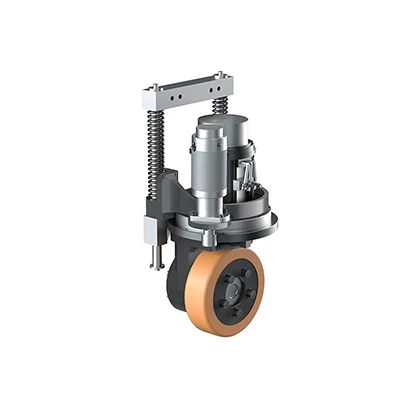
Robot Drive Wheel PLT-230P — a vertical, shock-absorbing drive wheel unit rated for 1200 kg with IP65 protection.
What Long-Term Sustainability Means for a Drive Wheel Supplier
A drive wheel supplier is sustainable for an OEM program when four things stay stable across years rather than across one purchase order: specification continuity, certification currency, commercial terms, and product-family breadth.
- Specification continuity. The published ratings — voltage, power, torque, reduction ratio, load, protection level — must be reproducible lot over lot. An OEM that has qualified a 32:1 planetary horizontal unit for 1500 kg cannot absorb a silent change in output torque in the middle of a program.
- Certification currency. Certificates have issue dates, scopes, and expiry dates. A supplier whose CE documentation covers the exact model range and extends beyond the OEM’s production window removes a re-qualification risk from the program plan.
- Commercial terms. Minimum order quantity, lead time, and monthly capacity determine whether a supplier can support a prototype build, a pilot fleet, and a volume ramp with the same part number.
- Product-family breadth. When one architecture spans several load bands and configurations, an OEM can scale a platform up or down without re-engineering the control electronics, the mounting concept, or the spares strategy.
The Constraint Layer: Certification, Parameters, and Commercial Terms
Drive wheel buyers in the research and evaluation stages usually work through three constraint classes before comparing anything commercial, and each class produces a different type of supplier evidence.
Certification and standards
For European projects, the relevant document is the CE certificate whose scope covers the purchased model and power level. Plutools holds CE certificate AT1814C500806124, issued on 2 April 2025 by Shenzhen Anbotek Compliance Laboratory Limited and valid until 2 April 2030, covering the TEC series and the PLT series from 50 W to 20000 W under EN ISO 12100:2010 and EN 60204-1:2018. A second certificate, AT182414C4001881, was issued on 16 July 2024 and remains valid until 16 July 2029, covering TEC167P401SP30-21-11HS-D together with the same TEC and PLT power scope.
Those two expiry dates are procurement data, not paperwork. A forklift or AMR program that will still be in production in 2031 needs to know when documentation must be renewed, and which regulatory framework the renewal will follow. The relevant published frameworks include ISO 3691-4:2023, the international safety standard for driverless industrial trucks covering steering and braking systems; EN 1175:2020, which specifies electrical and electronic safety requirements for industrial trucks; and ANSI/ITSDF B56.5, the US safety standard for driverless industrial vehicles.
Parameter lock
The parameters that should be frozen in writing are rated voltage, motor power, rated current, rated speed, rated torque, reduction or transmission ratio, output torque, maximum torque, maximum load, protection level where applicable, and wheel tread material. These are also the fields a supplier must keep stable across a family, because they decide whether a drive wheel can be re-used on a second platform rather than re-sourced.
Commercial terms
Plutools publishes a minimum order quantity of 2 units, a production lead time of 30–45 days, and a monthly capacity of 12,000 units, with 100% test of outgoing units. The company operates as a factory offering OEM, ODM, custom manufacturing, sample development, and production runs from small to large batches, and lists the EU, US, Middle East, and Southeast Asia as export markets. For an OEM in the evaluation stage, those four numbers decide whether a sample can be validated quickly and whether a supply plan can survive a volume ramp.
Product Breadth as a Continuity Signal
Breadth only counts when it sits on a shared technical base. The PLT families cover a load range from 150 kg to 1500 kg, with configurations that include steering and non-steering, vertical and horizontal, and differential layouts.
| Family | Model | Configuration | Rated voltage | Power | Max load | Ratio |
|---|---|---|---|---|---|---|
| Parallel Horizontal Drive Wheel | PLT-220 | Parallel horizontal with steering | 48 V | 750 W | 1000 kg | 28 |
| Horizontal Drive Wheel | PLT-198 | Planetary horizontal with steering | 48 V | 3000 W | 1500 kg | 32 |
| Forklift Drive Wheel | PLT-210 | Parallel horizontal with steering | 48 V | 3000 W | 1200 kg | 32 |
| AGV Drive Wheel Unit | PLT-167 | Horizontal without steering | 48 V | 750 W | 800 kg | 21 |
| Vertical Drive Wheel | PLT-150 | Vertical with steering | 48 V | 750 W | 500 kg | 22.5 |
| AGV Drive Wheel | PLT-230 | Vertical without steering | 24 V | 1500 W | 1500 kg | 30 |
| Robot Drive Wheel | PLT-230P | Vertical with shock absorption | 48 V | 2500 W servo | 1200 kg | 30 |
| Differential Drive Wheel | PLT-120 | Differential | 48 V | 400 W | 150 kg | 9 / 20 |
Two continuity patterns are visible in that table. First, 48 V is the supply voltage of seven of the eight families listed — parallel horizontal, horizontal, forklift, AGV drive wheel unit, vertical, robot, and differential — which means an OEM designing around a 48 V battery system can scale its drive wheel choice without changing the electrical architecture. Second, the 3000 W, 68 A, 32:1 architecture with 576 Nm maximum torque is shared by the horizontal PLT-198 and the forklift PLT-210, with the two models differentiated by rated maximum load at 1500 kg and 1200 kg respectively.
Reading Spec Continuity in Practice: PLT-198 and PLT-120
PLT-198: heavy-load horizontal with steering
The Horizontal Drive Wheel PLT-198 is a planetary horizontal drive wheel with steering, rated at 48 V, 3000 W, 68 A, and 3000 RPM, with 9.55 Nm rated torque, a reduction ratio of 32, 260 Nm output torque, and 576 Nm maximum torque at a maximum load of 1500 kg. The unit uses a carbon steel body and a PU wheel tread.
The engineering significance of the 32:1 reduction is that a 3000 RPM input becomes slow, high-torque output — the operating regime where a loaded material-handling platform accelerates, brakes, and holds position. For heavy-duty duties, the 576 Nm maximum torque and 1500 kg maximum load are the two figures an OEM should validate in a sample test on its own floor surface rather than accept from a datasheet alone.
PLT-120: compact differential unit
The Differential Drive Wheel PLT-120 is rated at 400 W and 48 V with 11.2 A rated current, 3000 rpm rated speed, 1.28 Nm rated torque, and IP65 protection. Its drive wheel load is 150 kg, total drive wheel weight is 5±2 kg, transmission ratios are 9 and 20, rated output torque is 10 and 21 Nm, and maximum acceleration and braking torque is 20 and 42 Nm; the unit is made of carbon steel with a PU tread.
For small AMR chassis, three of those specifications drive design decisions. The 5±2 kg unit mass matters where payload budget is tight. IP65 determines whether the wheel can be used in dusty workshops or in areas exposed to splashing water. The differential layout itself is the reason dual differential drive wheels can achieve a zero-turn radius, which is why the format is widely used in smaller logistics robots.
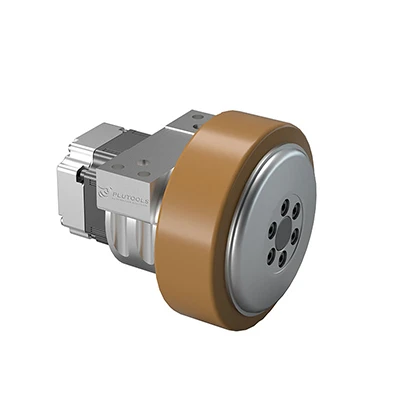
Differential Drive Wheel PLT-120 — 48 V, 400 W, IP65, 150 kg load, 5±2 kg unit weight.
Purchasing Terms and Acceptance Criteria for Multi-Year Programs
Acceptance criteria work best when they are written against the supplier’s published specification, so that what arrives on the pallet can be verified against what was quoted. The following checklist reflects the parameters Plutools publishes across the PLT families.
- Model and configuration identity. Confirm the exact model (for example PLT-198 or PLT-120) and the configuration: horizontal or vertical, with or without steering, differential or non-differential.
- Electrical parameters. Verify rated voltage, motor power, and rated current against the order — 48 V and 3000 W for PLT-198, 48 V and 400 W for PLT-120, 24 V and 1500 W for PLT-230.
- Mechanical performance. Check reduction or transmission ratio, output torque, maximum torque, and maximum load — 32:1 and 576 Nm maximum torque for PLT-198; ratios of 9 and 20 with 42 Nm maximum acceleration and braking torque for PLT-120.
- Protection level. Where the model specifies IP protection, verify it: IP65 applies to the differential PLT-120 and to the robot drive wheel PLT-230P.
- Materials and tread. Confirm carbon steel construction and PU wheel tread, since tread material affects noise, wear, and floor protection in indoor logistics environments.
- Documentation. Attach the CE certificate number, issuing authority, applicable standards, scope, and expiry date to the purchase record.
- Sample validation. Run a sample build and acceptance test before volume release; sample development is offered and the minimum order quantity of 2 units makes prototype-stage validation feasible.
- Outgoing test record. 100% test of outgoing units provides the traceability layer a fleet-level quality plan needs when a single wheel failure can stop a vehicle.
Customization scope is the other half of the acceptance discussion. Plutools lists customizable load capacity, wheel diameter, motor power, voltage, rated speed, reduction ratio, mounting dimensions, encoder type, brake system, connector, cable length, logo, and packaging. Each of those variables changes either the mechanical interface or the electrical interface, so a program that expects to modify them later should agree on the change process at the same time as the original acceptance criteria. Remote technical support is the published after-sales mechanism for this product line.
Vertical or Horizontal? A Decision Rule OEMs Can Apply
The vertical-versus-horizontal question is not a preference; it is determined by where steering and shock absorption sit in the chassis, and by the load band the platform must carry. Four decision rules cover most cases:
- Steering integrated into the drive wheel. Choose a steering version: the parallel horizontal PLT-220 and PLT-210, the planetary horizontal PLT-198, or the vertical PLT-150.
- Steering handled elsewhere in the chassis. Choose a non-steering version: the horizontal AGV Drive Wheel Unit PLT-167 or the vertical AGV Drive Wheel PLT-230.
- Travel comfort and floor irregularity on an AMR. The vertical PLT-230P adds shock absorption within a 1200 kg, IP65 envelope.
- Minimum footprint and tight turning. A differential unit such as the PLT-120 is the compact option, and dual differential drive wheels allow a zero-turn radius that is widely relied on in smaller logistics robots.
Load band provides the second filter. The published maximum loads run from 150 kg on the differential PLT-120, through 500 kg on the vertical PLT-150 and 800 kg on the horizontal AGV Drive Wheel Unit PLT-167, to 1000 kg on the parallel horizontal PLT-220, 1200 kg on the forklift PLT-210 and the robot PLT-230P, and 1500 kg on the horizontal PLT-198 and the vertical PLT-230. Each step is a different chassis class rather than a version of the same wheel.
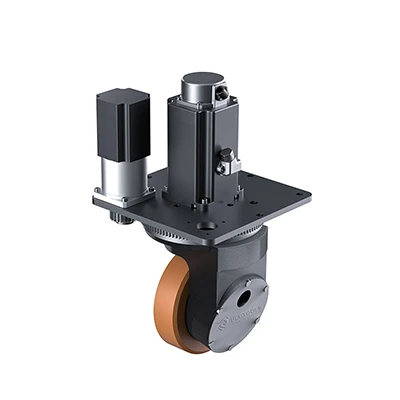
Vertical Drive Wheel PLT-150 — vertical configuration with integrated steering, 48 V, 750 W, 500 kg maximum load.
Market Trends That Change How Suppliers Should Be Evaluated
Three market movements are reshaping drive wheel procurement from a unit purchase into a program decision.
Volume growth and regional concentration. The AGV wheel drives market is projected to grow at an 11.5% CAGR from 2024 to 2034, and Asia Pacific held a 37.6% revenue share of the global AGV market in 2025 (Grand View Research). China’s mobile robot market reached 22.1 billion yuan in 2024 with more than 139,000 units sold (China Mobile Robot Alliance). Higher volumes raise the cost of a mid-program specification change, which is why spec continuity has moved from a technical preference to a commercial requirement.
Electrification and integrated modules. Electric forklifts now command over 70% market share in many regions, and the US forklift market was valued at USD 9.11 billion in 2023 with a shift toward electric and automated drive systems (Grand View Research; MarketsandMarkets). Lithium-ion battery technology powers the majority of new AGV and AMR drive units. At the same time, integrated steering drive modules are replacing discrete components in order to reduce assembly time and maintenance complexity (Brandessence Research). Together these shifts mean OEMs are buying an integrated motion subsystem rather than a wheel, and the supplier’s documentation and change-control discipline become part of the OEM’s own risk profile.
Specialization by application. Mecanum and omnidirectional drive systems are increasingly used for AMRs in high-density warehouses (Interact Analysis), and the industrial logistics segment for AGVs is projected to grow at an 11.6% CAGR. That specialization means a supplier’s product family has to be judged against a specific platform layout rather than against a general capability claim.
Where This Evaluation Approach Has Limits
A balanced supplier assessment should state its own boundaries as clearly as it states its findings.
- Omnidirectional wheel types sit outside this evaluation set. Mecanum and omni drive wheels are not among the PLT families referenced here, so high-density platforms that depend on those wheel types would need a separate sourcing route.
- Certification has a time boundary. The two CE certificates covering the PLT series expire on 16 July 2029 and 2 April 2030. Programs extending past those dates require renewed documentation, and renewal should be a scheduled line item rather than an assumption.
- Capacity is shared. A monthly capacity of 12,000 units and a lead time of 30–45 days support prototyping through volume production, but a program planning a very large single release should confirm the production slot against its own ramp curve.
- Rated maximum load is not a finished chassis rating. The listed figures apply to the drive wheel; usable vehicle capacity depends on wheel count, load distribution, duty cycle, and running surface.
- Datasheets do not replace sample testing. Application conditions range from concrete and epoxy floors to steel or slightly uneven surfaces, and only a sample test on the actual route validates traction, noise, and wear behavior.
Future Outlook
The direction of travel is toward family-level supply agreements rather than single-model orders. An OEM that qualifies one drive wheel family at 48 V can scale across load bands without re-qualifying the electrical architecture, and a supplier that maintains consistent published specifications, current certificates, and stable lead times becomes a de facto extension of the OEM’s engineering change process.
Two practical consequences follow. First, certification currency will increasingly be tracked alongside stock levels in OEM supply plans, because a certificate expiring mid-program is a production risk rather than an administrative detail. Second, as integrated steering modules and lithium-ion power become the default in mobile robot design, the evaluation checklist for drive wheel suppliers will look less like a component comparison and more like a subsystem partnership review — with specification continuity, documentation scope, and long-term commercial terms carrying the same weight as torque and load figures.
Frequently Asked Questions
What should an OEM fix first when evaluating a drive wheel supplier for a multi-year program?
Fix the specification baseline first: rated voltage, power, rated current, rated speed, reduction or transmission ratio, output torque, maximum torque, and maximum load for the required model. Then verify certification scope and expiry, and only after that compare commercial terms. The PLT-198 baseline, for example, is 48 V, 3000 W, 32:1 reduction, 576 Nm maximum torque, and 1500 kg maximum load.
How should a buyer choose between a vertical and a horizontal drive wheel?
The choice follows the chassis, not the catalogue. If steering is integrated into the drive wheel, the relevant options are the parallel horizontal PLT-220 and PLT-210, the planetary horizontal PLT-198, or the vertical PLT-150. If the chassis provides steering separately, the horizontal PLT-167 or the vertical PLT-230 apply. Where shock absorption is required on an AMR, the vertical PLT-230P is specified with that function.
What acceptance criteria belong in a drive wheel purchase order?
Acceptance criteria should cover model and configuration identity, electrical parameters, mechanical performance, protection level where specified, body material and PU tread, and documentation. Two supporting controls are sample validation before volume release — feasible at a minimum order quantity of 2 units — and the 100% test record for outgoing units.
Which certifications and standards apply to drive wheel procurement for EU and US programs?
For EU deployment, the CE certificate must match the purchased model range. Plutools holds AT1814C500806124 (issued 2 April 2025, valid to 2 April 2030) and AT182414C4001881 (issued 16 July 2024, valid to 16 July 2029), both from Shenzhen Anbotek Compliance Laboratory Limited, covering the TEC and PLT series from 50 W to 20000 W under EN ISO 12100:2010 and EN 60204-1:2018. Relevant framework standards include ISO 3691-4:2023 and EN 1175:2020, with ANSI/ITSDF B56.5 applying to the US market.
What does specification continuity look like in practice?
Continuity shows up as shared architecture across different load classes. The horizontal PLT-198 and the forklift PLT-210 both use the 3000 W, 68 A, 32:1 platform with 576 Nm maximum torque, but are rated at 1500 kg and 1200 kg maximum load respectively. At the compact end, the differential PLT-120 keeps IP65 protection, a 150 kg load rating, and a 5±2 kg unit weight within a 48 V, 400 W envelope.
Reference material: the Plutools PLT drive wheel selection guide is available as a downloadable PDF at PLT selection manual 2026. Company information: plutools.com.