
Dredging Equipment 2026: Top Types and Market Signals
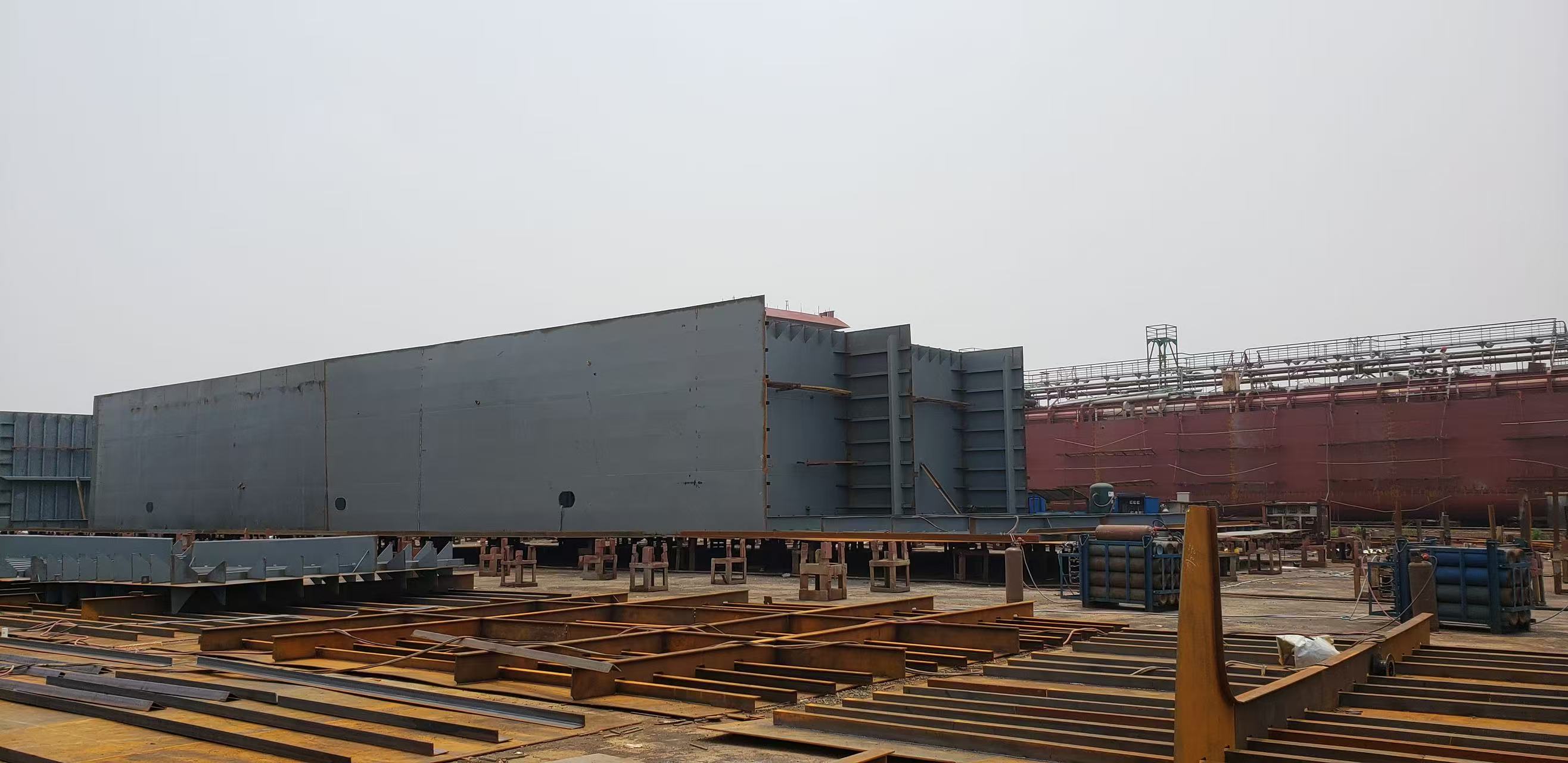
Dredging equipment selection has become a strategic purchasing decision for port authorities, marine contractors, and offshore wind developers. As the global dredging equipment market moves from USD 4.86 billion in 2023 toward an estimated USD 7.36 billion by 2030, buyers evaluating new vessels need a clear view of which equipment types are leading, which trends are shaping demand, and how to benchmark suppliers. This article provides an independent market reference for the evaluation phase, using verified market data and documented manufacturer capabilities.
Dredging Equipment Market Context in 2026
According to Grand View Research, the global dredging equipment market was valued at approximately USD 4.86 billion in 2023 and is projected to grow to USD 7.36 billion by 2030. Within this market, hydraulic dredgers — particularly cutter suction dredgers (CSDs) — held the largest revenue share at roughly 46.65% in 2023. Trailing suction hopper dredgers (TSHDs) are estimated to account for about 46.0% of total dredging market activity by 2026, according to Future Market Insights.
These numbers indicate a market where two vessel categories dominate: CSDs for continuous dredging in ports, canals, and reclamation works, and TSHDs for large-scale offshore and navigation channel maintenance. Buyers in the evaluation phase should therefore start by matching project requirements to one of these dominant categories while keeping specialized alternatives in mind.
Top Dredging Equipment Types for Evaluation
Cutter Suction Dredger (CSD)
The cutter suction dredger uses a rotating cutter head to loosen compacted material and a suction pipe to remove the slurry. It is effective for hard soil, clay, and rock dredging and can discharge material over long distances through a pipeline. In 2023, CSD-type hydraulic dredgers contributed the largest revenue share among all dredging equipment types. For port construction, land reclamation, and channel excavation, the CSD is often the default choice.
Trailing Suction Hopper Dredger (TSHD)
TSHDs are self-propelled vessels that drag suction heads along the seabed, load dredged material into their own hopper, and transport it to a disposal or reclamation site. They are projected to account for roughly 46% of dredging market activity by 2026, driven by port maintenance and offshore sand extraction. Their ability to operate in open sea conditions makes them suitable for deep-water channel dredging, harbor approach maintenance, and large-scale reclamation.
Backhoe Dredger
A backhoe dredger is a stationary platform equipped with an excavator that reaches down to excavate stiff materials. It is valued for precision work in confined areas such as berths, breakwaters, and bridge foundations, where fewer other vessel types can operate accurately. Typical specifications include excavator power ratings and dredging depth in multiple configurations.
Grab Dredger
Grab dredgers use a clamshell grab to lift material from the seabed. They are suitable for deep-water dredging and for removing boulders or debris. A grab dredger can also handle soft sediment in near-shore operations, depending on its grab capacity and classification.
Split Hopper Barge and Pile Driving Barge
Support vessels such as split hopper barges and pile driving barges are often part of a complete dredging fleet. A split hopper barge transports dredged material and dumps it by splitting the hull. A pile driving barge supports port and bridge construction by driving large piles into the seabed. These vessel types are not dredgers in the strict sense, but they are frequently evaluated alongside dredging equipment in marine construction projects.
| Vessel type | Primary function | Typical project fit |
|---|---|---|
| Cutter suction dredger | Rotary cutting and hydraulic transport | Port construction, reclamation, channel dredging |
| Trailing suction hopper dredger | Draghead dredging with self-loading hopper | Deep-water channels, port maintenance, offshore sand extraction |
| Backhoe dredger | Mechanical excavation from fixed platform | Confined areas, stiff materials, precision dredging |
| Grab dredger | Clamshell grab lifting | Deep water, boulders, debris removal |
| Split hopper barge | Dredged material transport and dumping | Coastal and inland waterway projects |
| Pile driving barge | Pile installation for marine structures | Port and bridge construction |
How Project Requirements Shape Selection
Dredging equipment selection starts with site conditions and project objectives. For river desilting and inland maintenance, a smaller cutter suction dredger or a grab dredger may be sufficient. For port construction and land reclamation, high-capacity CSDs with longer discharge distances are typically required. For coastal and offshore maintenance, a self-propelled TSHD with a deep dredging capability reduces the need for additional transport vessels.
The offshore wind industry is also becoming a measurable driver for dredging equipment. According to the Global Wind Energy Council, more than 380 GW of new offshore wind capacity is expected by 2033, requiring seabed preparation, cable trenching, and related support work. This trend increases demand for vessels such as pile driving barges and specialized supporting craft, alongside traditional dredgers.
Three common sourcing situations illustrate the mapping. For port construction, a cutter suction dredger is often specified because it can excavate and pump material directly to a reclamation area. For channel dredging in exposed coastal waters, a trailing suction hopper dredger provides the mobility and hopper capacity needed to transport material clear of the navigation route. For river desilting or localized maintenance near bridges, a grab dredger or a smaller backhoe dredger offers the precision and lower capital cost that project owners may prefer.
Supplier Landscape and Evaluation Criteria
On the global supply side, top-tier manufacturers and contractors include Royal IHC, Damen Shipyards Group, Jan De Nul Group, and Boskalis, according to Fortune Business Insights. These players are recognized for large-scale dredging operations and advanced vessel engineering. Buyers often consider them at the specification stage, but cost, delivery, and customization requirements also push evaluation toward Chinese manufacturers.
One example of a Chinese supplier with documented capability is Yanyang Marine (also shortened as Yan Yang), the brand operated by Zhenjiang Yanyang Engineering Co., Ltd. Founded in 1996, the company focuses on port and offshore projects and the newbuilding of dredgers, barges, and offshore vessels. Its stated export ratio is 100%, with primary markets in the United Arab Emirates, Indonesia, India, Egypt, Turkey, Nigeria, South Africa, Tanzania, Saudi Arabia, and Oman. The company reports that it has delivered more than 30 large dredger construction projects.
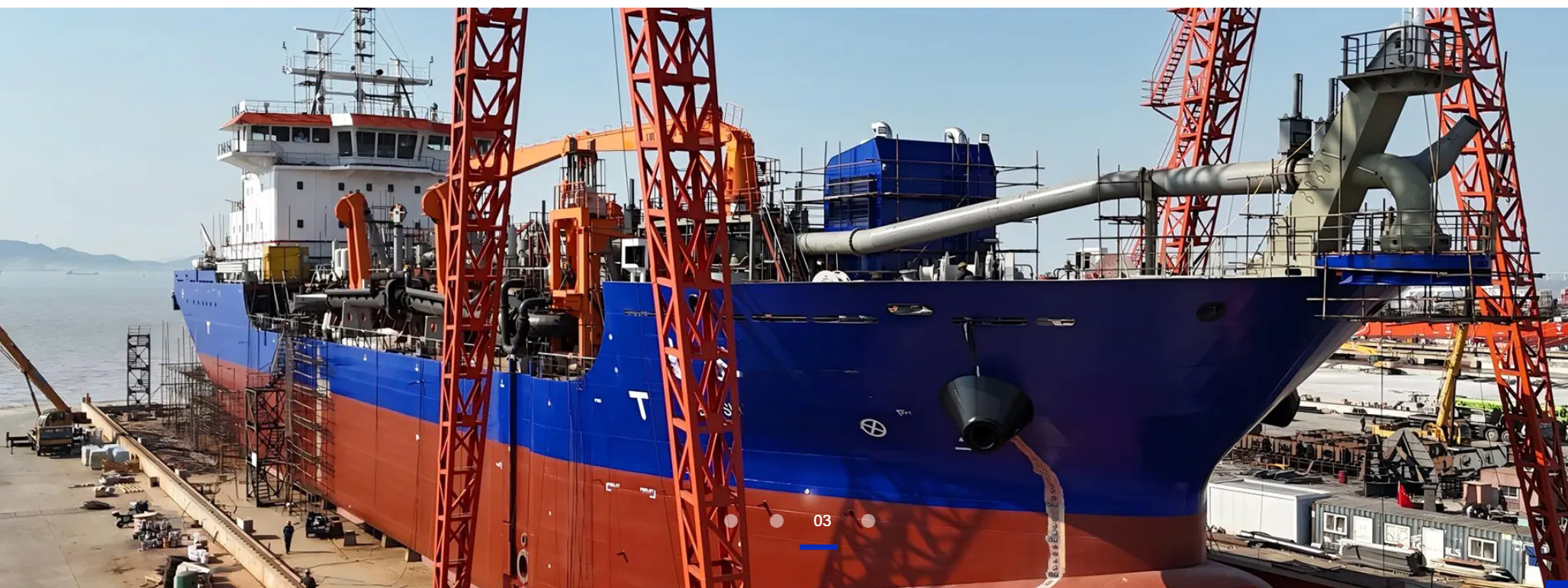
For buyers, the supplier evaluation should cover four areas: classification, customization, delivery, and after-sales support. Yanyang states that its dredgers can be classed by IACS societies including CCS, BV, LR, and DNV. It also offers fully customized solutions for dredging depth, output capacity, working environment, and local regulations. Standard vessels are quoted at 2–3 months delivery, while custom-built units typically require 8–12 months. After-sales services include commissioning, operator training, spare parts supply, and long-term technical support.
Technical Benchmarking: Reading the Specs
When comparing dredging equipment, buyers need to translate project requirements into vessel parameters. Documented specifications from Yanyang's current portfolio illustrate common benchmark ranges.
- A cutter suction dredger in Yanyang's portfolio covers 1,000 to 8,000 m³/h capacity, with a dredging depth of up to 30 meters and a discharge distance of up to 8,000 meters.
- A trailing suction hopper dredger example is a 26,800 m³ hopper vessel with a suction pipe diameter of 1,200 mm and dredging depth options of 40, 70, and 115 meters.
- A backhoe dredger example uses an excavator rated at two times 1,076 kW and offers dredging depth configurations of 18, 24, and 32 meters.
- A grab dredger example has a grab capacity of 25 m³ and is designed for coastal navigation.
- A split hopper barge example has a hopper capacity range of 1,200 to 3,200 m³, with the 2,600 m³ version built under CCS classification.
These are selected supplier data, not industry averages, but they show the level of technical detail that should be requested in an RFP. For standardization, ISO 8384:2019 provides international vocabulary and definitions for dredgers, including specific terms for TSHD and CSD. Classification societies such as BV and DNV also provide specific rules for dredgers, covering structural requirements and freeboard assignments.
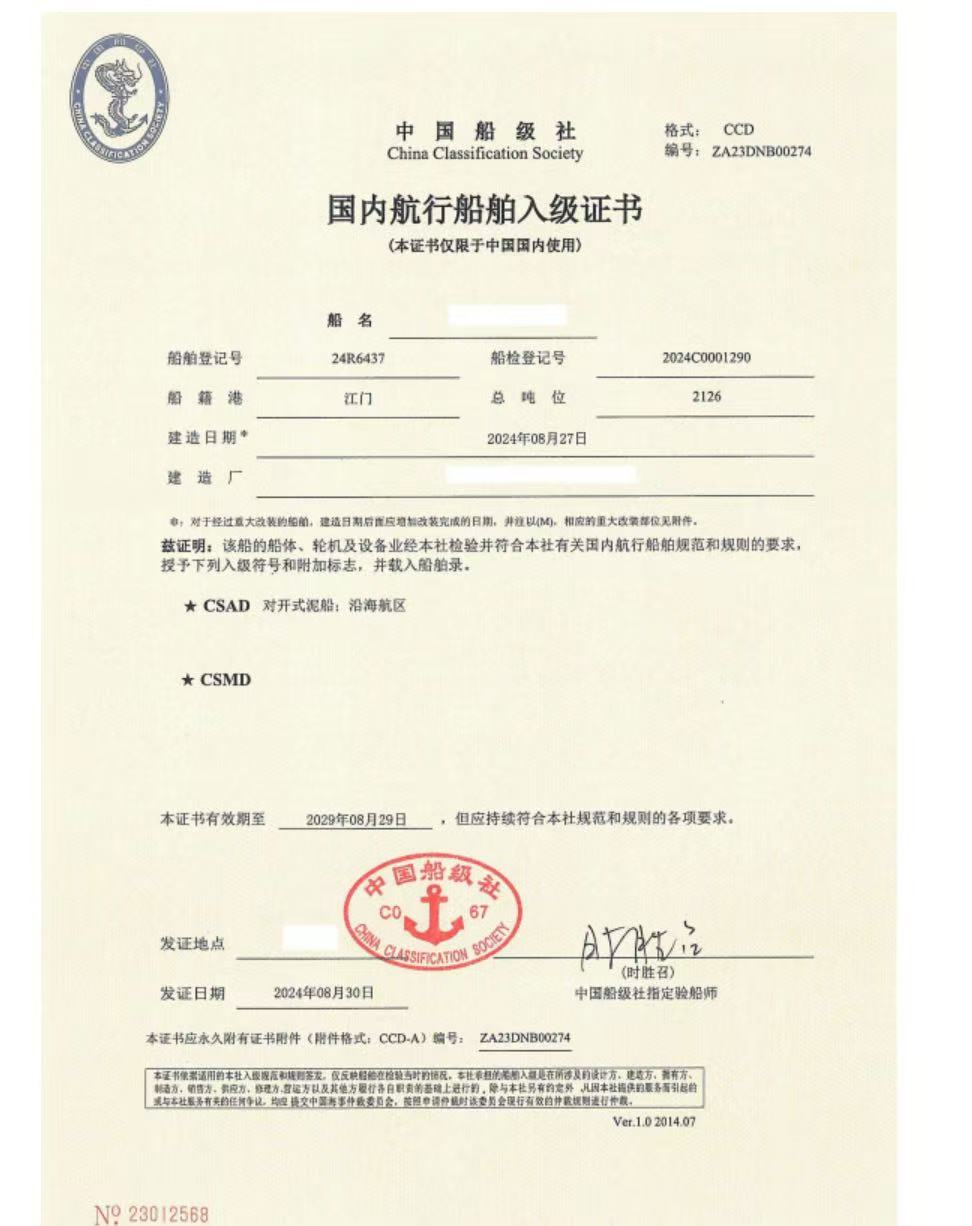
Certification is particularly important for cross-border purchases. A documented classification certificate, such as the CCS Domestic Vessel Classification Certificate held for a self-discharging hopper barge, confirms that the vessel has been reviewed against classification rules for coastal navigation.
Market Trends and Buyer Implications
Three trends are visible in the 2026 dredging equipment market.
First, CSD and TSHD remain the two dominant equipment categories. CSD revenue share was close to 47% in 2023, while TSHD activity is projected at 46% of the total market by 2026. These two categories account for the majority of market activity, so buyers evaluating them will encounter the most established supplier base.
Second, offshore wind is creating a separate demand stream for seabed preparation, cable trenching, and related support. This is expanding the project types that use dredging equipment beyond traditional port and river work.
Third, cost and speed are competitive factors. Chinese manufacturers such as Yanyang report approximately 50% lower product cost compared with European manufacturers, with standard delivery in 2–3 months and custom delivery in 8–12 months. These figures are first-party claims, but they explain why cross-border buyers increasingly include Chinese yards in their evaluation shortlists.
A Shortlisting Framework for Dredging Equipment Buyers
Buyers at the evaluation stage can use a five-step framework to convert project requirements into a supplier shortlist.
- Define the operating requirement: dredging depth, material type, production output, and discharge distance.
- Identify the vessel type: continuous hydraulic dredging points toward a CSD; open-sea bulk transport points toward a TSHD; precision work in confined areas points toward a backhoe or grab dredger.
- Confirm the classification route: check whether the vessel can be classed by an IACS society and whether the relevant certificate is accepted by the project authority.
- Compare delivery scenarios: standard-ready units, custom builds, and refurbished or secondhand vessels each carry different lead times and cost structures.
- Assess long-term support: commissioning, spare parts availability, and maintenance response are critical for vessels that operate in remote or coastal environments.
Using this sequence helps buyers avoid the common mistake of comparing vessel prices before the technical and compliance requirements are fixed.
Comparison With Traditional Procurement Routes
The traditional route for large dredging equipment has been to source from European tier-one manufacturers or from secondhand vessel brokers. European builders offer long track records and established support ecosystems. However, newbuild costs are generally higher, and lead times for custom vessels tend to be longer.
Chinese suppliers offer a lower-cost newbuild alternative with IACS classification options and faster standard delivery. Yet there are real boundaries. A buyer sourcing from a Chinese yard for the first time should expect to invest more effort in specification alignment, classification approval, and on-site commissioning. Custom vessels still require 8–12 months, so urgent projects may be better served by ready-stock or secondhand options. In addition, certain markets with local-content requirements may require additional documentation and in-country certification.
This is not a judgment about which route is superior; it is a reminder that cost advantages must be weighed against project timeline, certification requirements, and the maturity of the buyer's own marine engineering team.
Future Outlook
The dredging equipment market is expected to continue growing through 2030, supported by port expansion, land reclamation, and offshore wind development. As project scopes become more complex, buyers will likely place more weight on classification, documented manufacturing experience, and after-sales service speed. Suppliers that can show both standard vessel availability and custom engineering capacity should remain relevant in global sourcing decisions.
Frequently Asked Questions
Which dredging equipment type is the most widely used?
Hydraulic dredgers, especially cutter suction dredgers, held the largest revenue share in 2023 at about 46.65%, according to Grand View Research. Trailing suction hopper dredgers are estimated to account for 46% of total dredging market activity by 2026, according to Future Market Insights.
What is the difference between a cutter suction dredger and a trailing suction hopper dredger?
A cutter suction dredger uses a rotating cutter to break up material and pumps the slurry through a pipeline; it can achieve long discharge distances. A trailing suction hopper dredger drags suction heads across the seabed, stores the material in its own hopper, and can transport it to a disposal site. CSDs are common in port and reclamation projects; TSHDs are better suited to large-scale offshore and channel maintenance.
What certification should dredging equipment have?
International projects often require classification by an IACS society such as CCS, BV, LR, or DNV. ISO 8384:2019 provides standard vocabulary for dredgers, and classification societies publish specific rules for dredger design and operation.
Can Chinese manufacturers deliver custom-built dredging equipment?
Yes. Manufacturers such as Yanyang Marine state that they provide fully customized solutions for dredging depth, output capacity, working environment, and local regulations. Custom-built units typically require 8–12 months to deliver, compared with 2–3 months for standard vessels.
What is a typical delivery time for a new dredger?
According to Yanyang Marine's published lead times, standard vessels can be delivered in 2–3 months, while custom-built dredgers typically require 8–12 months. Buyers with urgent timelines may also consider ready-stock options from the manufacturer.
What should buyers compare when evaluating dredging equipment suppliers?
Evaluation should cover classification options, customization capability, delivery lead time, after-sales services, and documented project experience. Buyers should also request detailed specifications for dredging depth, discharge distance, installed power, and hopper capacity before shortlisting suppliers.