
Geonet de drenaje en fundición de metal: Certificación y Diseño Fit for Aggressive Leachate
Drainage Geonet in Metal Smelting: Certification and Design Fit for Aggressive Leachate
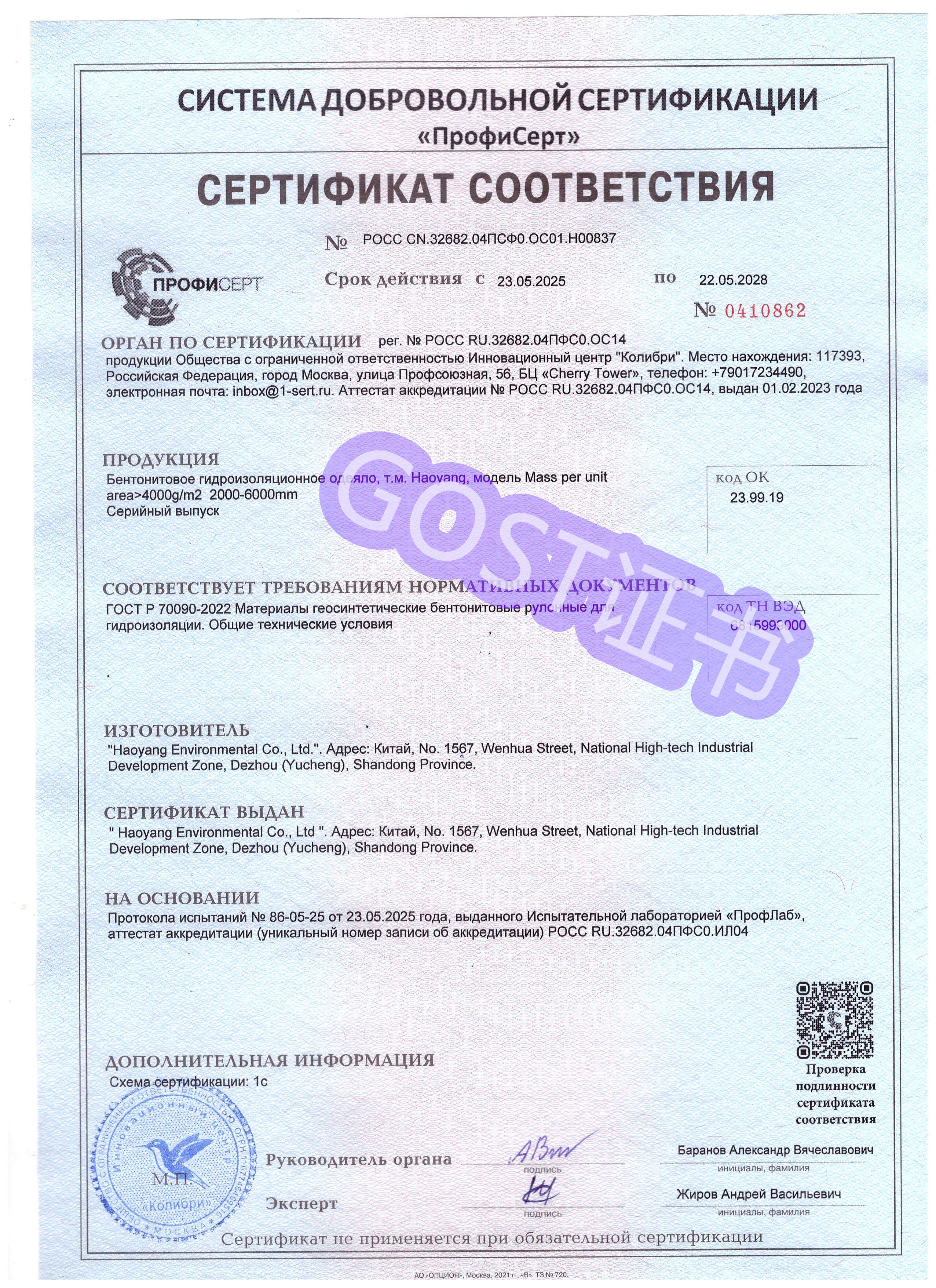
GOST Certificate of Conformity POCC CN.32682.047C00.OC01.H00837, referencing GOST 70090-2022, held for drainage geonet products supplied to the EAEU and Russia market.
A metal smelting anti-seepage system exposes its drainage layer to conditions that punish weak assumptions: leachate that is acidic or alkaline rather than neutral, a hydraulic load that never switches off, and an inspection regime that depends on the system staying intact rather than being repaired. In that environment a drainage geonet is a specified structural component of the containment design, and the deciding question is not whether composite drainage geonet is available, but which certified configuration still holds its compressive strength, drainage capacity and chemical resistance after years of contact.
That distinction matters at the research and evaluation stage, because two suppliers can quote the same nominal thickness and still deliver very different performance envelopes. This industry reference examines the certification evidence that buyers can actually verify for drainage geonet products, the parameter ranges those certificates apply to, and the design boundaries that should be tested against real smelter and tailings conditions. Product data and project evidence are drawn from Haoyang Environment Co., Ltd, a manufacturer of geosynthetic materials — geomembranes, geotextiles, composite drainage nets and waterproof mats — headquartered in Dezhou (Yucheng) National High-Tech Industrial Development Zone, Shandong Province, China, with more than 70 patents and proprietary technologies.
1. Why aggressive leachate changes the drainage geonet specification
The application envelope for metal smelting anti-seepage systems is unusually specific. Documented site conditions for this sector describe leakage prevention as the working condition, an anti-seepage system as the project type, prevention of liquid leakage as the function, 24/7 operation as the duty cycle, drainage geonet and geomembrane as the matched equipment, and high chemical resistance, UV resistance and long service life as the special requirements. Each of those conditions converts into a design variable.
- Chemical load. Leachate from smelting residues, tailings and process water can be acidic or alkaline depending on ore body and process route. A core and filter structure that loses strength in contact with that liquid loses drainage capacity with it, which is why acid and alkali resistance is stated as a retention figure rather than a pass or fail label. In the product family discussed here, the stated value is at least 90% strength retention.
- Continuous hydraulic duty. A 24/7 duty cycle means the drainage layer must operate at its design flow every day, with no maintenance access once the system is covered. Capacity margin, not peak capacity, is what protects the geomembrane.
- UV exposure before covering. Installation windows expose geosynthetics to sunlight. UV resistance addresses the period between placement and cover, and the exposed edges of cells built in phases.
- Service life. Long service life is a requirement that must be supported by durable polymer chemistry, a core geometry that remains stable under sustained normal load, and documentation a buyer can verify before the order is placed.
The failure pathway is consistent across smelter and tailings sites: if the core crushes or the in-plane flow paths close, liquid head builds on the geomembrane, and containment duty shifts to a liner designed as a barrier rather than as a drainage medium. Compressive strength and drainage capacity are therefore the first parameters examined in evaluation, and chemistry is the constraint that decides whether those parameters still hold after prolonged contact.
2. The certification stack a drainage geonet buyer can verify
Certification does not describe a system design. It describes a defined product scope conforming to a defined standard, verified by a named body, within a validity window. For drainage geonet used in projects across the EAEU and the EU, four certificates are relevant to the product family discussed here.
| Market | Certificate type and number | Standard | Issuing body |
|---|---|---|---|
| EAEU / Russia | GOST Certificate of Conformity, POCC CN.32682.047C00.OC01.H00837 | GOST 70090-2022 | ПрофСерт (ProfSert) |
| EAEU / Russia | GOST Certificate of Conformity, POCC CN.32682.047C00.0C01.H00840 | GOST 56586-2015 | ПрофСерт (ProfSert) |
| EAEU / Russia | GOST Certificate of Conformity for 3D composite drainage geonet, POCC CN.32682.04NC中0.OC01.H00838 | GOST 33068-2014 | ПрофСерт (ProfSert) |
| EU / EEA | Verification of Conformity (ICR), ICR/VC/HE250524 — valid 20 May 2025 to 19 May 2030 | EN 13249:2016 | ICR |
Three practical observations follow. First, the certificates are market-specific: a GOST Certificate of Conformity issued by ПрофСерт (ProfSert) supports EAEU and Russian project documentation, while the ICR Verification of Conformity supports EU and EEA submissions under EN 13249:2016. Second, the certificate scope names the product type — the 3D composite drainage geonet is certified to GOST 33068-2014, and the drainage geonet product carries GOST certification under GOST 56586-2015 — so a buyer should confirm that the certificate covers the exact configuration being purchased rather than a neighbouring product. Third, validity dates belong in the project file: the ICR verification for the drainage geonet product runs from 20 May 2025 to 19 May 2030, and the referenced window should span the planned installation and warranty period.
Where an owner or EPC requires incoming-material acceptance testing, ASTM D7273 provides guidelines for the acceptance testing of geonets and geonet drainage geocomposites, and can be written into the purchase order alongside the certification evidence. That combination — a conformity certificate for the product scope, plus an agreed acceptance test method for the delivered lots — is what makes certification useful at the evaluation stage rather than decorative.
The limitation is straightforward: a certificate confirms conformity of a scope to a standard. It does not confirm that the selected thickness, core geometry and drainage capacity suit a specific tailings chemistry, load and slope. That mapping remains a design task, and the numbers below are the material it is built from.
3. Translating certification into a parameter envelope
Certification becomes procurement value only when it maps to measurable numbers. The drainage geonet family referenced in this article carries the model range 4.0 mm to 8.0 mm and is produced in HDPE, PP or PET for applications that include metal smelting and aquaculture. Its stated parameter envelope is summarised below.
| Parameter | Stated range | Design relevance in smelter and tailings service |
|---|---|---|
| Thickness | 4.0 mm – 8.0 mm (customizable) | Sets the height of the in-plane flow channel and the construction airspace the layer consumes |
| Mass per unit area | 500 – 1400 g/m² (customizable) | Contributes tensile and puncture margin and core stability |
| Tensile strength (MD/TD) | ≥5 – 15 kN/m | Resists installation tension and settlement-induced strain |
| Elongation at break | 10 – 25% | Indicates compatibility with deformable subgrades |
| Compressive strength (10% strain) | ≥500 – 830 kPa | Defines the normal load at which the reported deformation occurs and flow paths begin to narrow |
| Acid and alkali resistance | ≥90% strength retention | Basis for chemical durability under leachate contact |
| Drainage capacity | ≥50 – 120 (L/min)/m (customizable) | In-plane flow capacity available to route leachate to collection |
| Material | HDPE / PP / PET | Governs chemical and thermal behaviour of core and filter layers |
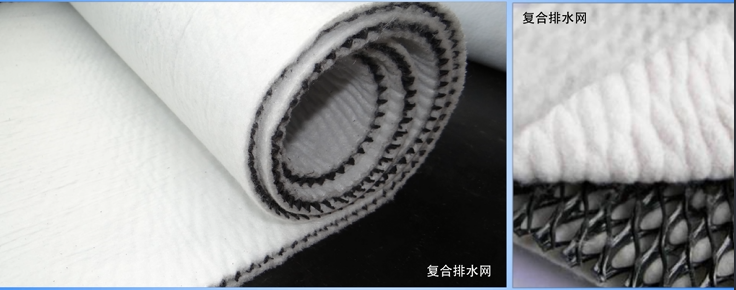
Composite drainage geonet with a three-dimensional core, supplied in 4.0 mm to 8.0 mm thickness for anti-seepage systems in metal smelting and other industrial containment applications.
Two features deserve emphasis for smelter buyers. The ranges are customizable, which means a project should not be specified against the widest available band: thickness, mass per unit area and drainage capacity are selected against calculated load and flow. And the compressive strength figure is reported at 10% strain, a definition that identifies the deformation state at which the value applies rather than a point of catastrophic failure. Reading the number without the definition is one of the more common errors in technical comparison.
4. How compressive strength and drainage capacity interact under continuous load
In-plane drainage capacity is not a fixed property of a geonet. It is measured under a defined normal load and hydraulic gradient, and it falls as the normal load rises, because the core compresses and the available flow area shrinks. A high compressive resistance drainage geonet therefore protects drainage capacity rather than competing with it: compressive strength at 10% strain defines how much overburden, tailings depth or cover material the core can carry before the flow channel narrows materially.
In a 24/7 smelting or tailings system, three mechanisms act at the same time. Normal load from tailings and cover compresses the core. Chemical exposure acts on the polymer structure of the core and of the filter geotextile, which is why the parameter is expressed as at least 90% strength retention rather than as an absolute strength value. And time allows creep deformation to accumulate, so the margin selected at design should account for sustained rather than instantaneous conditions. The practical consequence is that selecting a drainage geonet on thickness alone leaves the two variables that decide long-term performance — load behaviour and chemistry — unexamined.
Material choice interacts with both. HDPE, PP and PET differ in chemical resistance, stiffness and temperature behaviour, and the same nominal product can be configured with different core and filter combinations. High-strength polypropylene composite drainage geonet and polyester filament composite drainage geonet constructions are used where the filter or reinforcement layer has to carry tensile and puncture duty in addition to filtration, and the material selection should be recorded alongside the certificate reference so that a future substitution is visible.
Customization is available across width, scroll length, thickness, grams per square metre, tensile yield strength, tensile fracture strength and piercing strength. Each change shifts other properties, which is why a project-specific selection inside the 4.0 mm to 8.0 mm envelope is more defensible than ordering the heaviest available configuration.
5. Where the design is applied: regions and site configurations
The documented application scope for metal smelting anti-seepage systems covers leakage prevention in anti-seepage systems with drainage geonet and geomembrane as matched equipment, and it names a wide geographic footprint: Russia, Kazakhstan, Kyrgyzstan and Uzbekistan in the CIS and Central Asia, Chile and other South American markets, Australia, several Southeast Asian markets including Laos, Cambodia, Indonesia and Vietnam, and African markets including the Democratic Republic of the Congo and Congo. That spread reflects where smelting and tailings capacity is being built or expanded, and it has a procurement consequence: the same project package can require EAEU certification evidence and EU/EEA verification evidence simultaneously.
Typical configurations in this sector include:
- Tailings pond basins — drainage geonet above the geomembrane to control head and route seepage to collection points.
- Heap leach pads — drainage layers that must remain functional under stacked ore load and continuous solution application.
- Process water, evaporation and storage ponds — where the drainage layer manages leakage detection and pressure relief rather than primary flow.
- Secondary containment around smelter and tank farm areas — where chemical resistance dominates the specification and flow rates are moderate.
- Subgrade and slope applications — including subgrade drainage geonet and slope protection drainage geonet duties where tensile and friction behaviour become as important as flow.
6. Project evidence: Uzbekistan gold mine tailings pond basin
A reference project for this application is the seepage prevention works at the tailings pond basin of a gold mine in Uzbekistan, delivered with 900,000 square metres of material and specified over a long service horizon. The design innovatively adopts a three-dimensional composite drainage network composed of an independently developed textured geomembrane and a high-strength polypropylene geotextile, breaking with the traditional single-product supply model by establishing a full-chain service system from material supply through to on-site installation and construction.
The textured geomembrane in that system is produced on a five-layer co-extrusion blow moulding line integrated with online double-sided texturing equipment. Using a high-temperature, high-pressure air jet process, base membrane forming and the double-sided rough surface structure are completed simultaneously in the molten state, so the rough points form a molecular-level bond with the substrate. The reported result is a 25% reduction in production energy consumption compared with secondary processing, and avoidance of the thermal ageing risk that a second heat cycle introduces into the material.
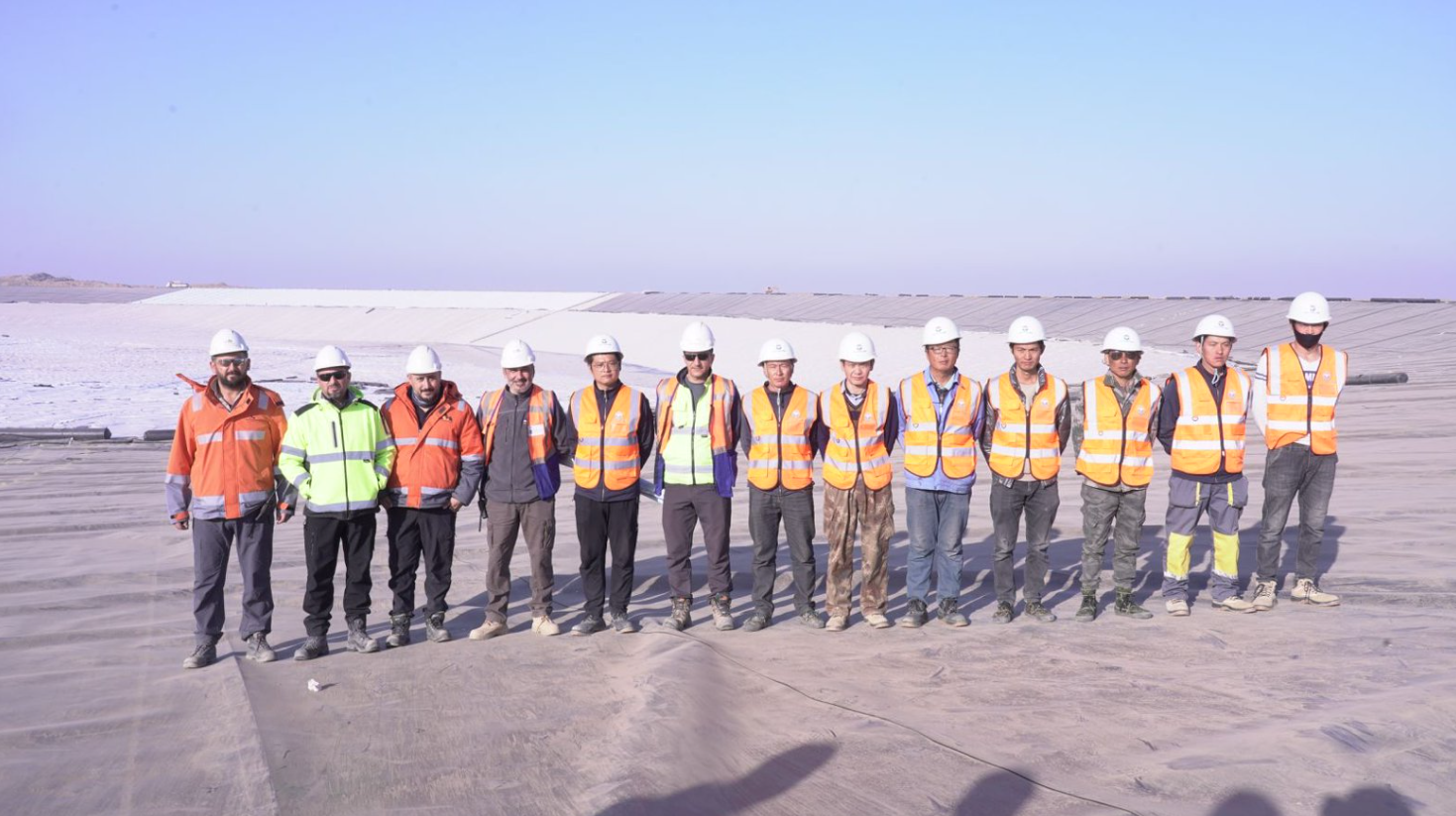
Seepage control works at the tailings pond basin of a gold mine in Uzbekistan, where a 3D composite drainage network combining textured geomembrane and high-strength polypropylene geotextile was used across 900,000 square metres.
For buyers, the transferable point is not the tonnage but the structure of the delivery: the drainage component was selected as part of a system with the liner, not as an isolated line item, and the supplier carried responsibility from material supply to installation. Comparable metal-related references in the same portfolio include the Yunnan Heqing Beiyao Mining gold mine tailings pond expansion anti-seepage project, the Sinochem Yunlong phosphogypsum slag pond project, the Shandong Weiqiao Pioneering Group red mud pond environmental treatment project, the Minmetals 23rd Metallurgical Corporation copper-gold mine in Eritrea, and the Manono lithium mine project in the Democratic Republic of the Congo.
7. Market trend: drainage is where geocomposite demand concentrates
Published market data points in the same direction as the technical requirements. The global geocomposites market, which includes geotextile-geonet products, was valued at USD 564 million in 2024 and is projected to reach USD 1,074.88 million by 2032. Within that market, drainage applications led with a 44.55% revenue share in 2024, and polyethylene-based drainage nets account for nearly 64% of global material demand, a position attributed to their high chemical resistance.
Scope definitions differ between research sources — drainage geonet forecasts and broader geocomposite forecasts are not directly comparable — so the useful reading is directional rather than absolute. Two implications hold regardless of scope. First, drainage function, not reinforcement, is the largest commercial application of geocomposites, which means drainage-specific performance data is where buyers should concentrate their verification effort. Second, the material preference for polyethylene-based structures is driven by chemical resistance, which confirms that chemical exposure is treated by the industry as a primary design constraint rather than a secondary consideration.
For procurement teams, the trend translates into tighter documentation expectations: certificate number, issuing body, standard, product scope, validity window and the parameter envelope those documents cover. International producers such as GSE Environmental (Solmax), NAUE, Agru America and TenCate are commonly used as comparison points during evaluation, and regional manufacturers are increasingly assessed against the same documentary standard rather than on price alone.
8. Composite drainage geonet compared with traditional drainage layers
Granular drainage blankets have a long record in smelting and mining containment, and the comparison is worth stating precisely rather than rhetorically.
| Consideration | Composite drainage geonet | Granular drainage blanket |
|---|---|---|
| Installed thickness | 4.0 mm – 8.0 mm core, factory-controlled | Typically several hundred millimetres of graded aggregate |
| Airspace and cover volume | Low; preserves containment volume | High; consumes storage or cover volume |
| Flow capacity per unit thickness | High in-plane capacity in a thin profile | Capacity depends on aggregate grading and compaction quality |
| Behaviour under normal load | Capacity declines as the core compresses; bounded by the certified compressive range | Capacity generally maintained or improved under load, if grading is stable |
| Chemical resistance | Polymer dependent; stated as ≥90% strength retention for the family referenced here | Chemically inert mineral, but fines migration and clogging can reduce performance |
| Installation and quality control | Factory-produced, 100% tested output, seam and overlap controlled on site | Grading, placement and compaction must be verified on site; sensitive to local aggregate supply |
| Documentation | Certificates and parameter envelopes can be referenced to named standards | Documentation is typically project testing rather than product certification |
The boundary is real and should be stated plainly. A composite drainage geonet is not the correct selection where the design imposes sustained normal loads beyond the certified compressive range, or where the required in-plane flow exceeds what can be achieved within the available core thickness; in those cases a hybrid design — geonet combined with a granular blanket, or a thicker core with a higher mass per unit area — is the defensible answer. The material also requires protection during installation, particularly against construction traffic and against poorly graded, angular aggregate placed directly on the core, and UV-resistant formulations still need controlled exposure before covering. These are design boundaries, not defects, and a supplier that states them clearly is easier to work with than one that does not.
9. A verification checklist for the evaluation stage
The following checklist converts the certification and parameter discussion into a set of questions that can be answered from documents rather than from assurances.
- Certificate number, issuing body, standard and product scope for each market the project touches — for example GOST certification under POCC CN.32682.047C00.OC01.H00837 referencing GOST 70090-2022 for EAEU and Russia, and ICR/VC/HE250524 against EN 13249:2016 for the EU and EEA.
- Validity window of each certificate relative to installation and warranty periods; the ICR verification for the drainage geonet product is valid from 20 May 2025 to 19 May 2030.
- Compressive strength at 10% strain and the test basis behind the reported value.
- Drainage capacity at the normal load and gradient representative of the site, not at zero load.
- Acid and alkali resistance expressed as strength retention, with the polymer or construction identified.
- Core thickness, mass per unit area, tensile strength and elongation at break for the exact configuration quoted.
- Acceptance test method agreed for delivered lots, where the specification requires one; ASTM D7273 provides guidelines for geonet and geonet drainage geocomposite acceptance testing.
- Commercial and delivery parameters that affect programme risk: minimum order quantity of 5000 m², lead time of 10 to 30 days, and monthly production capacity of 3000 T in the family described here.
Customization is worth confirming early as well. The production model for this family is OBM, with adjustable logo, width, scroll length, thickness, grams per square metre, tensile yield strength, tensile fracture strength and piercing strength, 100% tested output, on-site after-sales support, and export coverage across Africa, Europe, Central Asia, Southeast Asia, Australia and South America. The company operates a 200,000 m² facility with 190 employees, an annual output of 33,000 T, a research and development team working with universities including Fudan University and Tianjin University of Technology, and more than 70 patents and proprietary technologies.
10. Future outlook
Three changes are likely to shape drainage geonet procurement in metal smelting over the next planning cycle. The first is documentary: as containment projects in the EAEU, the EU and Latin America are assessed against named standards, certificate scope and validity will be examined as carefully as price, and products supported by market-specific conformity evidence will be easier to place on approved vendor lists.
The second is design integration. Drainage geonet selection is moving from a stand-alone line item to a component of a documented system with the geomembrane, which is what the Uzbekistan tailings pond project illustrates. Buyers increasingly ask for combined anti-seepage and drainage packages with installation responsibility attached, because the interface between liner and drainage layer is where many containment failures originate.
The third is lifecycle reasoning. With 24/7 operations and long service horizons, total cost arguments are shifting from purchase price per square metre towards retained drainage capacity, chemical durability evidence and replacement risk. That shift favours products whose parameters are published in verifiable ranges and whose conformity can be traced to a certificate number, and it makes the questions in the section above part of normal due diligence rather than specialist enquiries.
11. Frequently asked questions
Which certifications should a drainage geonet carry for a metal smelting anti-seepage project?
The relevant certification depends on the project market. For the EAEU and Russia, the applicable evidence is a GOST Certificate of Conformity issued by a recognised body such as ПрофСерт (ProfSert); the drainage geonet family described here holds certificate POCC CN.32682.047C00.OC01.H00837 referencing GOST 70090-2022, with further GOST certification under POCC CN.32682.047C00.0C01.H00840 against GOST 56586-2015, and for the 3D composite drainage geonet, POCC CN.32682.04NC中0.OC01.H00838 against GOST 33068-2014. For the EU and EEA, the corresponding evidence in this family is the ICR Verification of Conformity ICR/VC/HE250524 against EN 13249:2016, valid from 20 May 2025 to 19 May 2030. Buyers should verify certificate number, issuing body, standard, product scope and validity dates.
Which drainage geonet parameters matter most where leachate is aggressive and flow is continuous?
The parameters usually evaluated first are compressive strength at 10% strain, drainage capacity, and acid and alkali resistance, because together they determine whether the core keeps its flow paths open under load and in contact with leachate. In this product family the stated ranges are: thickness 4.0 mm to 8.0 mm, mass per unit area 500 to 1400 g/m², tensile strength (MD/TD) of at least 5 to 15 kN/m, elongation at break of 10 to 25%, compressive strength at 10% strain of at least 500 to 830 kPa, acid and alkali resistance of at least 90% strength retention, and drainage capacity of at least 50 to 120 (L/min)/m. Materials are HDPE, PP or PET.
How is acid and alkali resistance evidenced rather than assumed?
In this product family, acid and alkali resistance is expressed as at least 90% strength retention, which is a measurable outcome rather than a qualitative claim. Product conformity is documented through the certificates listed above, which reference named standards for defined product scopes. Where a project specification requires additional verification, the certified parameter can be supplemented by laboratory testing agreed with the supplier, and by acceptance testing of delivered material; ASTM D7273 provides guidelines for the acceptance testing of geonets and geonet drainage geocomposites. Recording the polymer type and construction alongside the certificate reference keeps that evidence traceable.
Does a thicker drainage geonet always perform better under tailings load?
No. Thickness sets the height of the in-plane flow channel, but performance under load is governed by compressive strength at 10% strain, by how drainage capacity behaves at the site normal load, and by the material and construction of the core and filter layers. The family described here spans 4.0 mm to 8.0 mm with customizable thickness, mass per unit area and drainage capacity, and thicker configurations also consume more construction airspace and more cover material. Selection within the range should follow calculated load and flow rather than a preference for the heaviest available option.
What are the practical limits of composite drainage geonet in smelter containment?
Three boundaries are commonly relevant. First, sustained normal loads that exceed the certified compressive range compress the core and reduce in-plane capacity. Second, required flow rates that exceed the capacity achievable within the selected core thickness cannot be solved by specification wording alone. Third, installation conditions — construction traffic, angular or poorly graded aggregate placed directly on the core, and prolonged UV exposure before covering — can damage a product that is otherwise correctly certified. Where the first two conditions apply, hybrid designs or a thicker, higher-mass core are the appropriate response; a drainage geonet does not replace the geomembrane as the primary barrier.
What commercial parameters should buyers expect when specifying a drainage geonet for a smelting project?
In this product family the stated commercial parameters are a minimum order quantity of 5000 m², a lead time of 10 to 30 days, monthly production capacity of 3000 T, and 100% tested output under an OBM production model with customization of logo, width, scroll length, thickness, grams per square metre, tensile yield strength, tensile fracture strength and piercing strength. After-sales support includes on-site assistance, and export coverage spans Africa, Europe, Central Asia, Southeast Asia, Australia and South America. These are commercial parameters rather than performance guarantees; technical suitability is governed by the certified parameter envelope described above.
Additional certification and product documentation for drainage geonet used in metal smelting anti-seepage systems is published by Haoyang Environment Co., Ltd at https://www.haoyanghuanjing.com/.