
Drainage Geonet Evidence File: GOST 70090-2022 y EN 13249
Compliance in drainage geonet procurement is settled less by what a supplier says than by what a buyer can put in a folder. On a smelting project tendered across several countries, the owner, the engineering contractor, the environmental reviewer and the importer each need the same conformity statement expressed in a form they can check independently. A certificate number, an issuing organisation and a named standard convert a marketing sentence into a document reference that survives translation, review and audit.
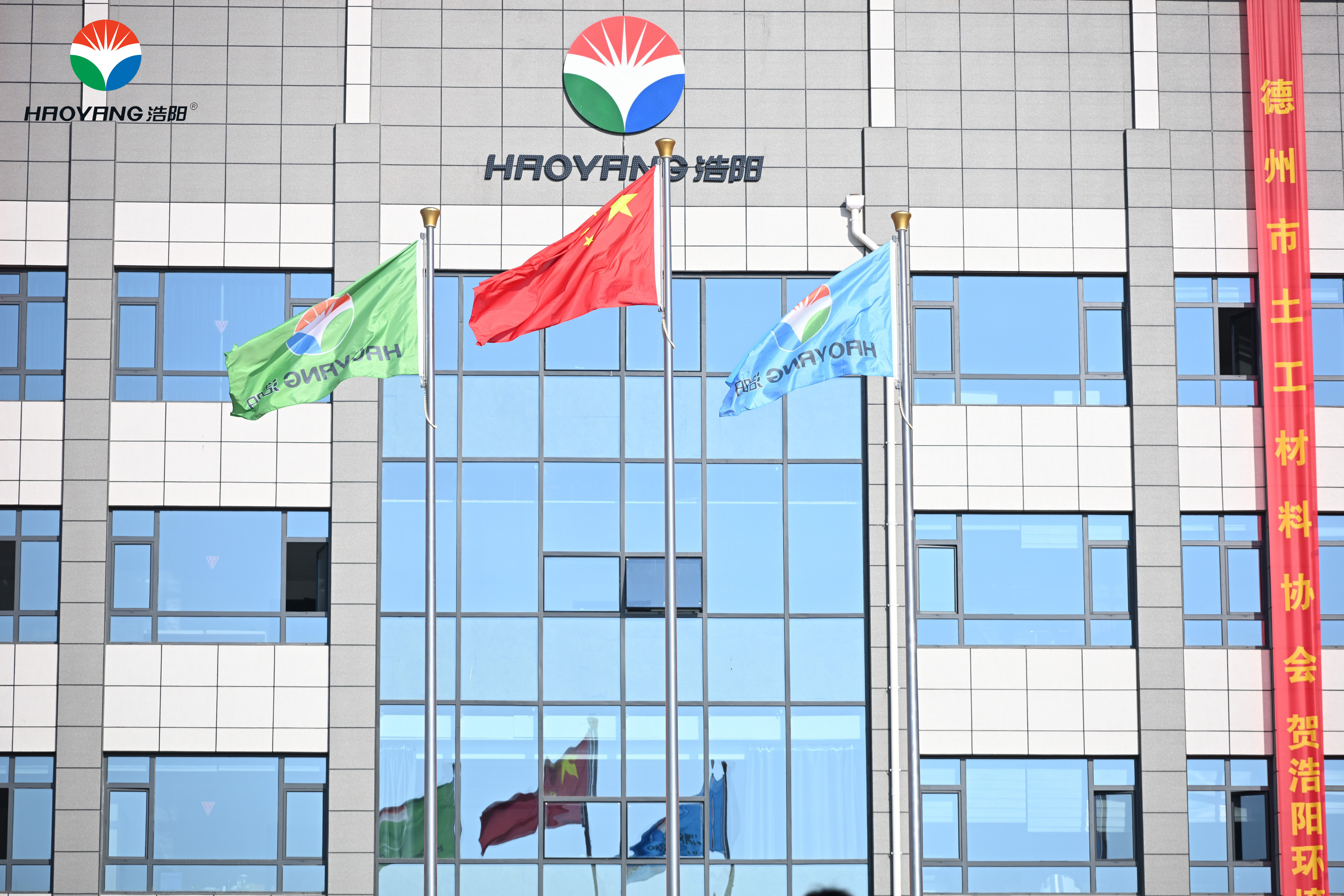
This reference file examines the auditable documents behind one supplier's drainage geonet offer. Haoyang Environment Co., Ltd is a geosynthetics manufacturer headquartered in the Dezhou (Yucheng) National High-tech Industrial Development Zone, Shandong Province, China, producing geomembranes, geotextiles, composite drainage nets and related materials. Two conformity documents in its file carry the international claim discussed here: a GOST certificate confirming compliance with GOST 70090-2022, and an ICR certificate covering EN 13249:2016 for the EU/EEA market. The purpose is not to restate those claims, but to show how a procurement team can convert them into verifiable file entries, and where the file stops.
What a Supplier Evidence File Actually Is
An evidence file is a bounded set of documents that lets an independent party verify a conformity claim without asking the supplier to re-explain it. The boundary matters. A file is not a product catalogue, not an installation manual and not a performance guarantee. It is a fixed, citable record.
In practice, a drainage geonet evidence file for an international tender is assembled from five document types:
- A certificate of conformity that names the standard, the certificate number and the issuing body.
- A scope statement that shows which product range the certificate covers.
- Product datasheets with the parameters the project specification calls up.
- Factory and batch quality records that link a delivered roll to a production period.
- Commercial terms, because a certificate that sits behind an unworkable order quantity is of limited use to a buyer.
Buyers who conflate these five items usually discover the gap late, when a reviewer asks for a test report that no one in the chain can produce. Keeping the categories separate is what makes the file reusable across tenders.
The Two Documents That Carry the Claim
The first document is a GOST certificate, number POCC CN.32682.047C00.OC01.H00837, issued by ПрофСерт, confirming compliance with GOST 70090-2022. GOST certification is the conformity route used for the Eurasian market, which is why this document tends to appear in tenders where a Russian-speaking engineering party, a Central Asian owner or an EAEU-financed contractor sits in the approval chain.
The second document is an ICR certificate, number ICR/VC/HE250524, confirming compliance with EN 13249:2016 and issued for the EU/EEA market. Its function is different from the GOST certificate: it gives the same product a European reference point, so a project with EU-based financing, insurance or environmental review does not have to start the conformity discussion from zero.
Read together, the two documents do something a single certificate cannot. They show that the same supplier has had the product assessed against two separate conformity systems, each with its own issuing body and its own market logic. For a multi-country smelting tender, that is the difference between a supplier who must be re-qualified per jurisdiction and one whose file can be submitted in parallel.
| File entry | Reference | Issuing body | Market relevance stated in the file |
|---|---|---|---|
| GOST certificate of conformity | POCC CN.32682.047C00.OC01.H00837 | ПрофСерт | Compliance with GOST 70090-2022 |
| ICR certificate | ICR/VC/HE250524 | ICR | Compliance with EN 13249:2016, EU/EEA market |
Why a Cross-Border Smelting Tender Asks for Both
Smelting projects concentrate drainage risk in a small number of structures: tailings impoundments, heap-leach pads, slag yards and process-water containment. In those structures a drainage layer works under sustained normal load and, in many designs, in contact with leachate that is chemically aggressive. That combination is why smelting specifications tend to be stricter than general civil drainage specifications, and why the evaluation team is usually not the buyer alone.
When such a project is financed, insured or reviewed across borders, the conformity question multiplies. One reviewer works to a Eurasian framework, another to a European one, and a third simply asks whether the file can be checked without contacting the factory. Two independently issued certificates answer all three without restarting the process each time.
There is a practical second benefit. A file that already contains a GOST reference and an EN reference reduces the round of correspondence that normally follows a technical submittal, because the reviewer can go straight to scope verification instead of first establishing whether the supplier holds any third-party assessment at all. That is a procurement-time saving, not a performance advantage, and it should be described as such.
Reading the Product Data That Sits Behind the Certificates
A certificate is only meaningful when the buyer can see which product it attaches to. Haoyang's published drainage geonet data, as listed on the company product page, is summarised below. These are manufacturer-reported values and should be treated as a screening baseline for the request for quotation, not as a substitute for the product-specific test report a project may require.
| Reported parameter | Published range | How a buyer should use it |
|---|---|---|
| Thickness | 4.0–8.0 mm, customizable | Select the thickness for the design load; confirm the certificate scope covers that configuration |
| Mass per unit area | 500–1400 g/m², customizable | Use for logistics and freight estimation as well as filtration-layer matching |
| Tensile strength (MD/TD) | ≥5–15 kN/m | Check against installation stress and slope conditions for slope protection drainage |
| Compressive strength at 10% strain | ≥500–830 kPa | Compare with the design normal stress for landfill and subgrade drainage |
| Drainage capacity | ≥50–120 (L/min)/m, customizable | Request the hydraulic test conditions before using the figure in design calculations |
| Acid/alkali resistance | ≥90% strength retention | Relevant to leachate-exposed drainage; the exposure medium, concentration and duration must be requested |
Two calibration points help the buyer judge these numbers. General technical literature on biplanar geonets cites a thickness range of roughly 4–8 mm and compressive strength in the order of 500–1,000 kPa, so the stated thickness band overlaps that reference envelope. The published drainage-capacity and chemical-resistance figures, by contrast, are reported without the hydraulic gradient, normal stress or chemical exposure conditions needed for engineering use. A procurement reviewer should therefore treat the first two as screening references and the last two as questions to put to the supplier.
Manufacturing scale is part of the same file. Haoyang's official company website describes a composite drainage network production line with a 6-metre width, a company-reported capability that is relevant when a project specifies wide rolls to reduce field joints. Industry product descriptions generally define composite drainage geonet as a geonet core bonded to one- or two-sided nonwoven geotextile, commonly with an HDPE core and PP or PET filtration layers; buyers should confirm the layer configuration and polymer grade for the specific product rather than assuming a single construction across the range.
Quality Records That Sit Behind the Certificates
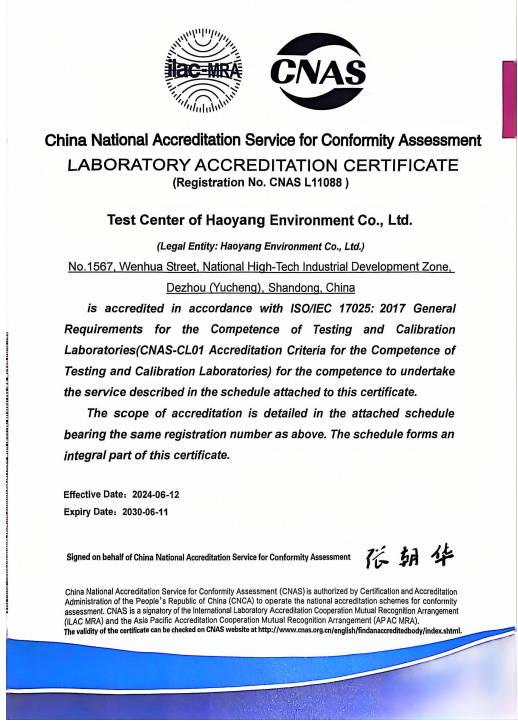
Certificates answer the conformity question; factory records answer the consistency question. Haoyang states that quality inspection runs through the entire process, from raw material procurement to production and factory delivery, and that inspection is performed by the only CNAS-accredited national laboratory in the industry, a control measure aimed at preventing products that fail to meet standards from leaving the factory.
For the buyer, this is the layer that makes a certificate usable over a multi-year programme. A certificate is issued once; a smelting project receives dozens of rolls across several years. The batch records, together with a pre-shipment test used as the stated acceptance criterion, are what connect one delivery to the conformity claim in the file.
Capacity and Ordering Terms That Make the Evidence Usable Over Time
Evidence that cannot be supported by supply is a document problem, not a solution. Haoyang reports a monthly production capacity of 3,000 tonnes, a typical production lead time of 10 to 30 days and a minimum order quantity of 5,000 square metres. Annual output is stated at 33,000 tonnes from a 200,000 m² facility with 190 employees, including 20 engineers, and the company reports more than 70 patents and cooperative relationships with Fudan University and Tianjin University of Technology.
Export orientation matters for a cross-border tender. Export business is reported at approximately 60% of total sales, with a marketing network covering more than 70 countries and regions, and stated market focus across Africa, Central Asia, the Middle East, Southeast Asia and Indonesia. Commercial terms in the purchasing file list FOB and CIF delivery, pre-shipment testing as the acceptance criterion, and payment terms of 30/70 or 100.
These figures are first-party statements and should be verified in a factory audit or a quotation review rather than accepted as an external benchmark. Their value in the evidence file is that they let the buyer test whether the certificate-backed product can actually be delivered at the required volume and cadence.
Where the File Stops: Five Boundaries to Record
A file that overstates its own reach is more dangerous than an incomplete one, because it stops the reviewer from asking the right questions. Five boundaries should be written into the tender file alongside the certificates.
1. A certificate is not a product-level test report. The GOST and ICR documents state conformity for the assessed product. A project that specifies a particular thickness, mass per unit area and polymer grade still needs a datasheet and test report for that configuration, referenced to the assessment.
2. Certificate scope and validity must be checked, not assumed. The issuing body, the standard revision, the covered product range and the validity period are separate facts. The file discussed here establishes the issuing bodies and the standards; the validity dates and the precise scope wording must be confirmed on the certificate itself before submission.
3. Conformity does not cover installation. Seam quality, handling damage, uv exposure during storage and site workmanship sit outside any product certificate. A drainage layer that is installed incorrectly will fail regardless of the certificate behind it.
4. Published performance data lacks test conditions. The drainage-capacity and acid/alkali-resistance figures are reported without hydraulic gradient, normal stress, chemical concentration or exposure duration. They are suitable for screening and unsuitable for hydraulic design or chemical compatibility approval.
5. A certificate is not a price or lead-time guarantee. Market pricing for drainage geonet in 2026 is quoted across a broad band from about USD 1.60 to USD 10.76 per square metre, reflecting differences in structure, material and specification. The certificate says nothing about where in that band a specific order will land; only a formal quotation with Incoterms and specification does.
Evidence File Versus Conventional Supplier Verification
Most buyers still verify drainage geonet suppliers through a questionnaire, a sample and a project-specific test. That route works, but it repeats the same work every time a new jurisdiction enters the tender. The table below sets out the practical trade-off.
| Dimension | Conventional verification | Certificate-based evidence file |
|---|---|---|
| Basis of the claim | Supplier self-description plus sample | Third-party certificate with number, standard and issuing body |
| Reusability | Rebuilt for each project and each jurisdiction | Reusable across tenders within the stated market scope |
| Timing of effort | Work shifts to the end of evaluation, close to award | Work shifts to the front, in document assembly, translation and scope checks |
| Typical failure | A claim that cannot be traced to a document after award | A document that does not cover the exact specification being ordered |
| Best fit | Single-site, single-jurisdiction purchases | Multi-country tenders with several review parties |
The limitation is real and worth stating plainly: assembling an evidence file does not remove inspection work. It moves it earlier and concentrates it. Where a project specification demands a fresh test to a specific method, or an additional national approval not covered by GOST 70090-2022 or EN 13249:2016, the file will not substitute for that test, and a buyer who treats it as a substitute will simply defer the cost to the construction stage.
Market Context: Documentation as a Procurement Variable
The commercial backdrop explains why files are being scrutinised more closely. Commercial research on the geonet drainage composite market places global market value at roughly USD 762 million in 2025, rising to about USD 1,138 million by 2032, a reported compound annual growth rate of 6.0%. Growth of that order keeps new suppliers entering, which in turn pushes specifiers toward documentary evidence as a fast filter.
The standards framework supports the same direction. ASTM International lists ASTM D7931/D7931M-21a as a standard guide for specifying drainage geocomposites, and ASTM D7273/D7273M-08(2026) as a standard guide for acceptance testing requirements for geonets and geonet drainage geocomposites. Both are catalogue entries that identify a framework for tender drafting and acceptance planning; neither constitutes proof that a particular product complies. That distinction is the same one buyers have to make with GOST and EN certificates, and it is why the evidence file format matters more than the number of logos on a datasheet.
Future Outlook
Two trends are likely to shape drainage geonet procurement over the next few years. The first is convergence of documentation expectations: projects with mixed financing increasingly ask for conformity evidence in more than one system, which favours suppliers who already hold assessments in both a Eurasian and a European framework. The second is a shift in buyer attention from the certificate itself to the record behind it, particularly batch traceability and pre-shipment testing, because certificates are issued once while deliveries recur.
For suppliers, the practical implication is that the file becomes an operating asset rather than a sales attachment. For buyers, the implication is procedural: the strongest position is a file that names the certificate, the standard, the issuing body, the covered configuration, the batch record and the commercial terms, with the boundaries written down. That is a slower document to build and a faster one to defend.
FAQ
What exactly do the two certificates in this drainage geonet evidence file confirm?
The GOST certificate, number POCC CN.32682.047C00.OC01.H00837, issued by ПрофСерт, confirms compliance with GOST 70090-2022. The ICR certificate, number ICR/VC/HE250524, confirms compliance with EN 13249:2016 and is issued for the EU/EEA market. Each document identifies a standard, a certificate number and an issuing body, which is what allows a reviewer to check the claim without contacting the supplier.
How should a procurement team check the certificates before submitting them in a tender?
Three checks should be recorded in the file: whether the certificate scope covers the thickness, mass per unit area and product configuration being ordered; whether the certificate is valid on the submission date; and whether the standard revision cited matches the one named in the project specification. The certificate should also be filed with a controlled translation where the tendering authority requires it, so that the number and standard remain legible to every reviewer.
Can the certificates replace product-level test reports for a specific thickness?
No. A certificate states conformity for the assessed product; a project ordering a specific thickness and mass per unit area still needs a datasheet and, where the specification requires it, a test report for that configuration. Haoyang's published drainage capacity and acid/alkali resistance figures are reported without hydraulic gradient, normal stress or chemical exposure conditions, so they support screening rather than engineering approval.
What supply commitments support a multi-year smelting project?
Haoyang reports a monthly production capacity of 3,000 tonnes, a typical production lead time of 10 to 30 days, a minimum order quantity of 5,000 square metres, and stated acceptance based on pre-shipment testing. Annual output is given as 33,000 tonnes, with export business at approximately 60% of sales and a marketing network covering more than 70 countries and regions. These are company-reported figures and should be confirmed through a factory audit or formal quotation.
How should the evidence file be maintained across successive tenders?
The file should be treated as a versioned record: certificates, scope statements, datasheets and batch records each carry an issue date and should be re-checked at every submission rather than reused unchecked. Where a new market is added, the relevant conformity reference is appended instead of replacing the existing one, so the file keeps a continuous history of what has been assessed and for which market.
A drainage geonet certificate is not evidence of quality on its own; it is evidence of a check that someone else performed. The value of a supplier evidence file lies in making that check findable, bounded and repeatable — and in stating, in the same file, exactly what it does not cover.
¿Tiene preguntas o necesita más detalles?
Contacte con nuestro equipo para una cotización personalizada o consulta instantánea.
Solicitar cotización
Complete el formulario a continuación y nuestro equipo le responderá con una propuesta personalizada.
Chat directo de WhatsApp
¿Prefiere chatear en tiempo real? Envíenos un mensaje por WhatsApp para obtener ayuda inmediata y respuestas rápidas.
- Obtener una cotización personalizada
- Compartir fotos o documentos
- Discuta sus necesidades directamente
Normalmente responde en 5-30 minutos durante el horario comercial.