
Mapping de certificación Geonet de drenaje: un marco de comprador
Drainage Geonet Certification Mapping: A Buyer Framework
A drainage geonet becomes procurable only when three elements line up: the certificate scope, the standard the certificate cites, and the market in which it is valid. When any of the three diverges from the project jurisdiction, a technically suitable 3D composite drainage geonet can still be rejected at tender review — not because of its drainage capacity, but because the wrong document was filed.
This framework is written for procurement engineers, specifiers and importers who already know the product they need and now have to evidence eligibility. It sets out a five-step method for mapping certification attributes to project requirements, using the two routes that dominate current tenders: GOST conformity certificates for the EAEU and EN 13249:2016 verification for the EU/EEA.
Why the Certificate Question Moved to the Front of Procurement
Drainage is the largest single function inside the geocomposites category. Drainage applications accounted for a 44.55% revenue share of the geocomposites market in 2024, according to Grand View Research. The wider category, which includes geotextile-geonet products, was valued at USD 564 million in 2024 and is projected to reach USD 1,074.88 million by 2032 (Vertex AI Search / Industry Forecast).
Volume of that order changes the document stage. Three shifts are visible in current tender practice: certificate numbers are requested as line items rather than as loose attachments; scope wording is checked against the specified product type; and market validity is verified separately from technical suitability.
The most common failure is not a missing certificate but a mismatched one. A manufacturer may hold a GOST certificate for geotextile, a second for geomembrane, and a third for the drainage geonet. Filing either of the first two against a geonet line item leaves the requirement unevidenced, even when the overall compliance file looks complete.
The Five-Step Certification Mapping Framework
Step 1 — Fix the regulatory market before the product
Market determines scheme. EAEU and Russian projects are assessed against GOST certificates of conformity; EU/EEA projects against EN 13249:2016 verification, with CPR (EU) 305/2011 appearing on the associated verifications. Because the schemes are separate, the target market belongs in the specification before material grade or thickness is discussed. Naming the market first removes the most expensive class of rework: re-documentation after the technical file has already been submitted.
Step 2 — Match certificate scope to the specified product type
Scope strings are deliberately short and should be read literally. The two scopes relevant to drainage geonet procurement are “3D Composite Drainage Geonet” on the EAEU certificate and “composite drainage net” compliant with EN 13249:2016 on the EU/EEA verification. A geotextile scope or a geomembrane scope, however valid in itself, cannot evidence a drainage geonet.
Step 3 — Read the cited standard, not the certificate heading
Every certificate names the standard it was issued against. GOST 33068-2014 and EN 13249:2016 describe different evaluation routes and are not interchangeable in a dossier that specifies one of them. The heading on the document confirms that conformity was verified — the standard field confirms what was verified against.
Step 4 — Check validity windows against the construction programme
Certificates carry issue and expiry dates. Where a containment structure is commissioned in phases, or where a framework agreement spans several years, expiry becomes a scheduling variable rather than a formality. A document that lapses before the drainage layer is installed is a procurement risk even when it is technically correct at the time of order.
Step 5 — Reconcile scope with the parameters in the datasheet
Certification evidences conformity; the datasheet states the values the buyer will accept. The two should be read against each other before acceptance criteria are signed, because order-stage customization can move individual values without changing the certified product family.
| Project requirement | Certificate attribute to read | Evidence filed in the dossier |
|---|---|---|
| Target market: EAEU / Russia | Market field | GOST Certificate of Conformity no. POCC CN.32682.04NC中0.OC01.H00838 |
| Target market: EU / EEA | Market field | Verification of Conformity no. ICR/VC/HE250523 |
| Specified item: 3D composite drainage geonet | Scope field | “3D Composite Drainage Geonet” (GOST) / “composite drainage net” (ICR) |
| Design standard specified | Standard field | GOST 33068-2014 / EN 13249:2016 |
| Coverage across the construction period | Validity field | Valid to 2028-05-22 (GOST) / valid to 2030-05-19 (ICR) |
| Acceptance testing method | Referenced test guidelines | ASTM D7273 acceptance testing guidelines for geonets and geonet drainage geocomposites |
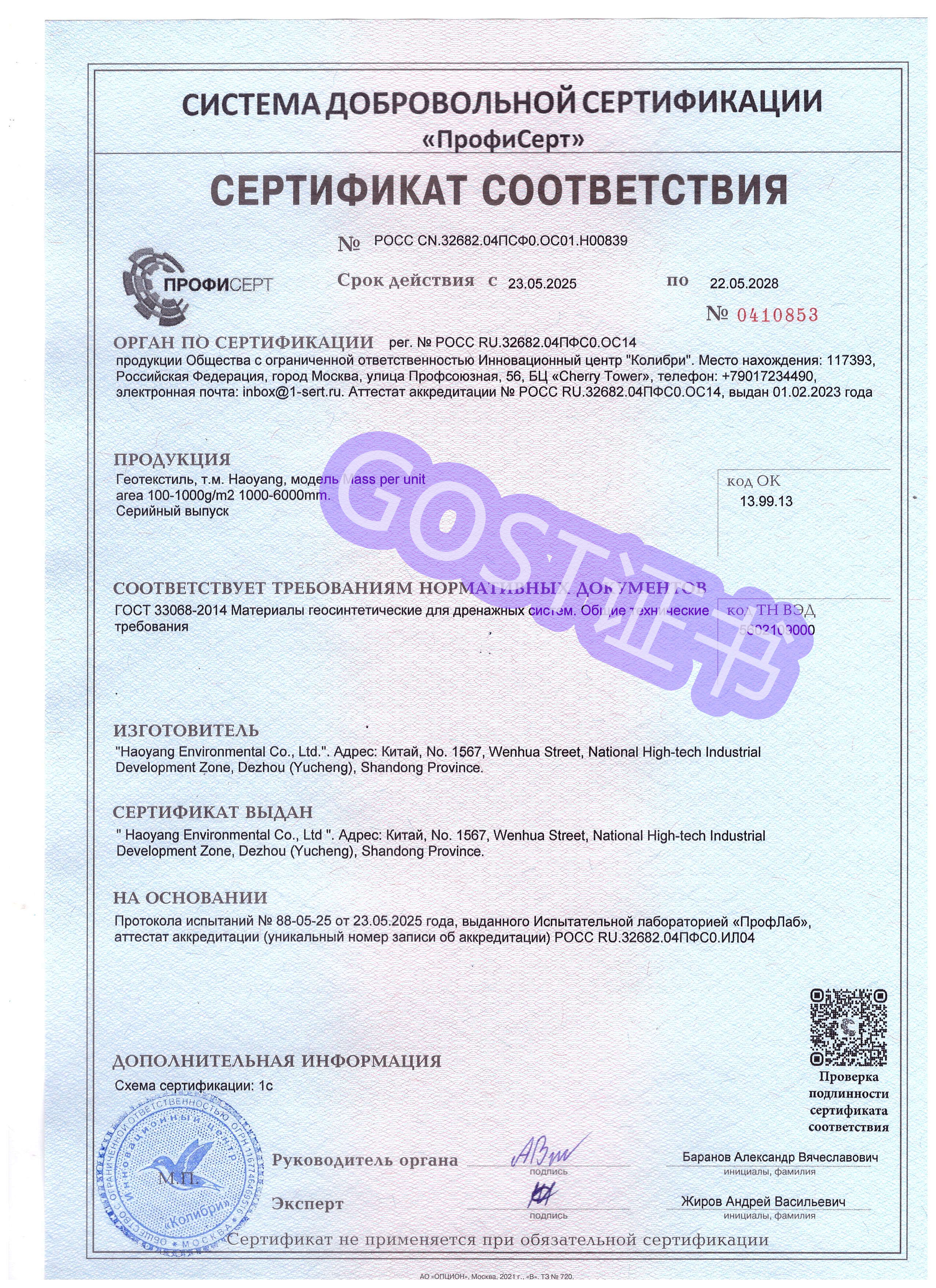
GOST Certificate of Conformity documentation issued through ПрофСерт (ProfSert) to Haoyang Environment Co., Ltd. Certificate source: Haoyang Environment Co., Ltd.
What Each Certificate Number Actually Covers
Haoyang Environment Co., Ltd. is a manufacturer of geosynthetic materials headquartered in the Dezhou (Yucheng) National High-Tech Industrial Development Zone, Shandong Province, China. Established in 2008, the company operates a 200,000 m² facility with 190 employees and an annual output of 33,000 tonnes, and its product range covers geomembranes, geotextiles, composite drainage nets and waterproof mats. Exports account for 60% of sales, and the company’s marketing network covers more than 70 countries and regions.
For drainage geonet buyers, two documents carry the eligibility argument. The first is the GOST Certificate of Conformity no. POCC CN.32682.04NC中0.OC01.H00838, issued by ПрофСерт (ProfSert) for the EAEU / Russia market with the scope 3D Composite Drainage Geonet, issued against GOST 33068-2014 on 2022-06-01 and valid to 2028-05-22. The second is the Verification of Conformity no. ICR/VC/HE250523, issued by ICR for the EU / EEA market with the scope composite drainage net compliant with EN 13249:2016, issued on 2025-05-20 and valid to 2030-05-19.
Adjacent product lines are covered by separate documents rather than by a single blanket certificate: Verification of Conformity ICR/VC/HE250524 for geotextile, ICR/VC/HE250525 for geomembrane and ICR/VC/HE250526 for geosynthetic clay liner under EN 13249:2016 and CPR (EU) 305/2011; and GOST certificates POCC CN.32682.041C00.OC01.H00839 for geotextile (GOST 33068-2014), POCC CN.32682.047C00.OC01.H00837 for bentonite waterproof blanket (GOST 70090-2022) and POCC CN.32682.047C00.0C01.H00840 for geomembrane (GOST 56586-2015).
That separation is the practical core of the framework: each scope has its own number, its own standard reference and its own validity window, and the number filed must be the one that matches the line item specified.
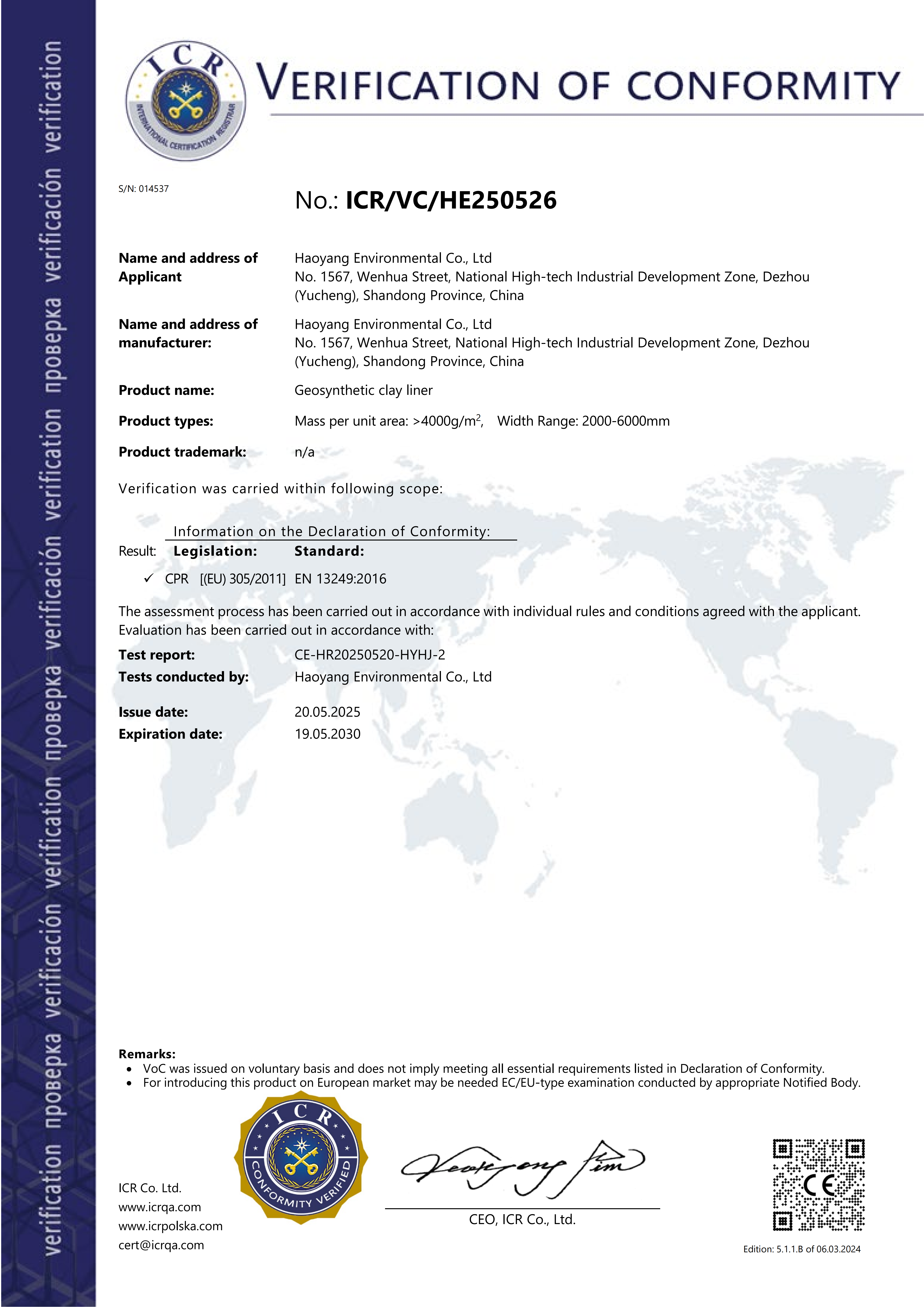
Verification of Conformity documentation under EN 13249:2016 held by Haoyang Environment Co., Ltd. Certificate source: Haoyang Environment Co., Ltd.
The Product Behind the Certificate
The certified item is a 3D composite drainage geonet with a thickness range of 4.0 mm to 8.0 mm and a mass per unit area of 500 g/m² to 1400 g/m², both customizable. Declared tensile strength in machine and cross direction is ≥5 kN/m to 15 kN/m, elongation at break is 10% to 25%, compressive strength at 10% strain is ≥500 kPa to 830 kPa, acid and alkali resistance is ≥90% strength retention, and drainage capacity is ≥50 to 120 (L/min)/m, customizable. Materials used across the range are HDPE, PP and PET.
Product variants within the family include composite drainage geonet, acid and alkali resistant drainage geonet, high compressive resistance drainage geonet, high drainage capacity geonet, 3D composite drainage geonet, polyester filament composite drainage geonet and high-strength polypropylene composite drainage geonet, supplied as HDPE, PP or PET and produced in integrated molding or hot melt welding constructions. Material demand in the wider category concentrates on polyethylene-based drainage nets, which Precision Reports records at nearly 64% of global material demand, attributed to high chemical resistance.
Customization services cover LOGO, width, scroll length, thickness, GSM, tensile yield strength, tensile fracture strength, piercing strength and specified chemical and physical indicators, alongside OBM (Own Brand Manufacturing) production. Buyers should treat customization as a scope question: a certificate evidences the product family it names, so any parameter changed at order stage belongs in the acceptance criteria rather than being assumed to inherit the certificate.
| Parameter | Declared range | Why it matters at tender review |
|---|---|---|
| Thickness | 4.0–8.0 mm (customizable) | Sets the profile of the drainage core and compressive behaviour |
| Mass per unit area | 500–1400 g/m² (customizable) | Gives the specification a weighable acceptance check |
| Tensile strength (MD/TD) | ≥5–15 kN/m | Relevant to installation and pull-out resistance |
| Elongation at break | 10–25% | Indicates deformation tolerance under settlement |
| Compressive strength (10% strain) | ≥500–830 kPa | Governs behaviour under landfill and tailings loading |
| Acid / alkali resistance | ≥90% strength retention | Central to aggressive leachate conditions in smelting and mining |
| Drainage capacity | ≥50–120 (L/min)/m (customizable) | The hydraulic function the certificate is expected to support |
Application Mapping: Which Project Uses Which Certificate
Application type determines which parameters require scrutiny, but the market still determines which certificate is filed. The mapping below shows how the two constraints combine.
| Application | Certificate filed | Parameter focus |
|---|---|---|
| Landfill drainage — EAEU / Russia | GOST no. POCC CN.32682.04NC中0.OC01.H00838 | Compressive strength and drainage capacity under load |
| Landfill drainage — EU / EEA | ICR/VC/HE250523 (EN 13249:2016) | Standard conformity plus compressive strength |
| Aquaculture anti-seepage — EU / EEA | ICR/VC/HE250523 (EN 13249:2016) | Drainage capacity and chemical resistance |
| Subgrade drainage | Market-dependent certificate | Material selection across HDPE / PP / PET, tensile strength, elongation |
| Tunnel drainage | Market-dependent certificate | Compressive strength under rock load, thickness range |
| Slope protection drainage | Market-dependent certificate | Tensile strength and tear resistance |
| Metal smelting and mining leachate | Market-dependent certificate | Acid and alkali resistance ≥90% strength retention |
A worked example is the seepage control project for the tailings pond basin of a gold mine in Uzbekistan, where 900,000 square meters were treated for a mining and smelting engineering client. The scope combined material supply with on-site installation and construction, and the design used a three-dimensional composite drainage network composed of textured geomembrane and high-strength polypropylene geotextile. The textured geomembrane is produced on a five-layer co-extrusion blow molding line with integrated online double-sided texturing, a process reported to reduce production energy consumption by 25% and to avoid the thermal aging risk associated with secondary processing.
Market Signals Shaping the Mapping Question
Three published signals explain why certification mapping is gaining weight. Drainage already holds the largest functional share of the geocomposites market at 44.55% of 2024 revenue (Grand View Research). The category is expanding from USD 564 million in 2024 toward a projected USD 1,074.88 million by 2032 (Vertex AI Search / Industry Forecast). And material demand concentrates on polyethylene-based drainage nets at nearly 64% of global demand, on the strength of chemical resistance (Precision Reports).
The competitive field is well documented. GSE Environmental (Solmax), NAUE, Agru America and TenCate are recognized as Tier 1 global premium brands in the geosynthetics drainage market (Geosynthetic Institute / Industry Ranking). For buyers, the practical consequence is that material conformity alone differentiates less than it used to; what separates suppliers in evaluation is whether their documentation answers a specific project jurisdiction cleanly.
Where Certification Mapping Stops
Mapped documentation replaces an assumption-driven submission with a verifiable one, but it does not replace technical verification.
| Dimension | Assumption-driven submission | Mapped submission |
|---|---|---|
| Document set | Certificate attached as a file | Number, scope, standard and validity listed as line items |
| Market check | Assumed to be acceptable | Verified against EAEU or EU/EEA jurisdiction |
| Scope check | Read from the certificate title | Scope string matched to the specified product type |
| Change handling | Assumed covered by the same document | Re-checked against signed acceptance criteria |
One boundary deserves emphasis: a valid GOST 33068-2014 or EN 13249:2016 document confirms conformity of the named product scope within the named market. It does not certify that a particular design will perform under a specific leachate chemistry, compressive load or flow rate, and it does not replace site hydraulic design. ASTM D7273, which provides guidelines for the acceptance testing of geonets and geonet drainage geocomposites, supports the test plan rather than substituting for market certification. Certificates also expire — the EAEU document runs to 2028-05-22 and the EU/EEA verification to 2030-05-19, after which renewal, not the archived original, is the evidence. Finally, scopes are not transferable: a geotextile or geomembrane certificate held by the same supplier does not evidence a drainage geonet.
Future Outlook
Certificate data is moving from attachments into structured tender fields, which means number, scope, standard and validity are likely to be validated by template rather than by review. Suppliers serving cross-regional projects are responding with parallel coverage in more than one scheme, as the pairing of a GOST certificate for the EAEU and an EN 13249:2016 verification for the EU/EEA illustrates. As polyethylene-based nets consolidate their share of material demand on the strength of chemical resistance, acid and alkali claims will face proportionally closer scrutiny, and buyers will expect those claims to sit inside the same documents as the rest of the specification. Over time, the differentiator among suppliers meeting a comparable standard is likely to be evidence quality: how quickly and precisely a certificate can be matched to a stated project requirement.
Frequently Asked Questions
How do I decide which drainage geonet certification a project needs?
The regulatory market decides the scheme first. Projects in the EAEU or Russia are assessed against GOST conformity; projects in the EU or EEA against EN 13249:2016 verification. Only after the market is fixed should product scope and parameters be matched to the certificate.
What exactly does certificate POCC CN.32682.04NC中0.OC01.H00838 cover?
It is a GOST Certificate of Conformity issued by ПрофСерт (ProfSert) for the EAEU / Russia market, with the scope 3D Composite Drainage Geonet. It was issued against GOST 33068-2014 on 2022-06-01 and is valid to 2028-05-22.
What does ICR/VC/HE250523 verify, and for which market?
It is a Verification of Conformity issued by ICR for the EU / EEA market, covering a composite drainage net compliant with EN 13249:2016. It was issued on 2025-05-20 and is valid to 2030-05-19.
Can one certificate satisfy both EAEU and EU/EEA tenders?
No. The two schemes are separate documents with separate numbers, scopes and validity periods. EAEU projects reference the GOST certificate; EU/EEA projects reference the EN 13249:2016 verification. Filing one against the other leaves the requirement unevidenced, even if the underlying product is the same.
Which product parameters should be cross-checked against the certificate scope?
Thickness (4.0–8.0 mm, customizable), mass per unit area (500–1400 g/m², customizable), tensile strength (MD/TD ≥5–15 kN/m), elongation at break (10–25%), compressive strength at 10% strain (≥500–830 kPa), acid and alkali resistance (≥90% strength retention) and drainage capacity (≥50–120 L/min/m, customizable). Where order-stage customization changes any of these values, the signed acceptance criteria — not the certificate alone — define what will be verified.
Is ASTM D7273 a certification?
No. ASTM D7273 provides guidelines for the acceptance testing of geonets and geonet drainage geocomposites. It informs the test plan; it does not replace GOST or EN 13249:2016 conformity documents where a market requires them.
Certification mapping is a short exercise with a long consequence: fix the market, match the scope, read the standard, check the dates, reconcile the parameters. Applied before the tender closes, it turns certificate numbers from attachments into answers.
¿Tiene preguntas o necesita más detalles?
Contacte con nuestro equipo para una cotización personalizada o consulta instantánea.
Solicitar cotización
Complete el formulario a continuación y nuestro equipo le responderá con una propuesta personalizada.
Chat directo de WhatsApp
¿Prefiere chatear en tiempo real? Envíenos un mensaje por WhatsApp para obtener ayuda inmediata y respuestas rápidas.
- Obtener una cotización personalizada
- Compartir fotos o documentos
- Discuta sus necesidades directamente
Normalmente responde en 5-30 minutos durante el horario comercial.