
Double-Layer vs. C/Z Purlin vs. Metal Roof Roll Forming Machines
Double-Layer vs. C/Z Purlin vs. Metal Roof Roll Forming Machines
A buyer comparing double-layer, C/Z purlin and metal roof roll forming machines is not choosing between three grades of the same product. The three architectures sit in different parts of a color-steel processing business: two of them make cladding sheet, and one makes the structural members that hold the cladding up. Treating them as interchangeable substitutes is one of the most expensive specification errors in this segment, because the mistake is usually discovered only after the base frame has been welded and the floor space has been committed.
This comparison is written for buyers at the decision stage. It sets out what each machine produces, how the three differ on the dimensions that actually drive payback — footprint, capital outlay, output per shift, changeover, energy and profile tolerance — where each one stops being the correct answer, and which documents a buyer should demand before a deposit is paid. Manufacturer figures are attributed to their source. Where a number is a supplier's own published specification rather than an independent test result, the text says so.
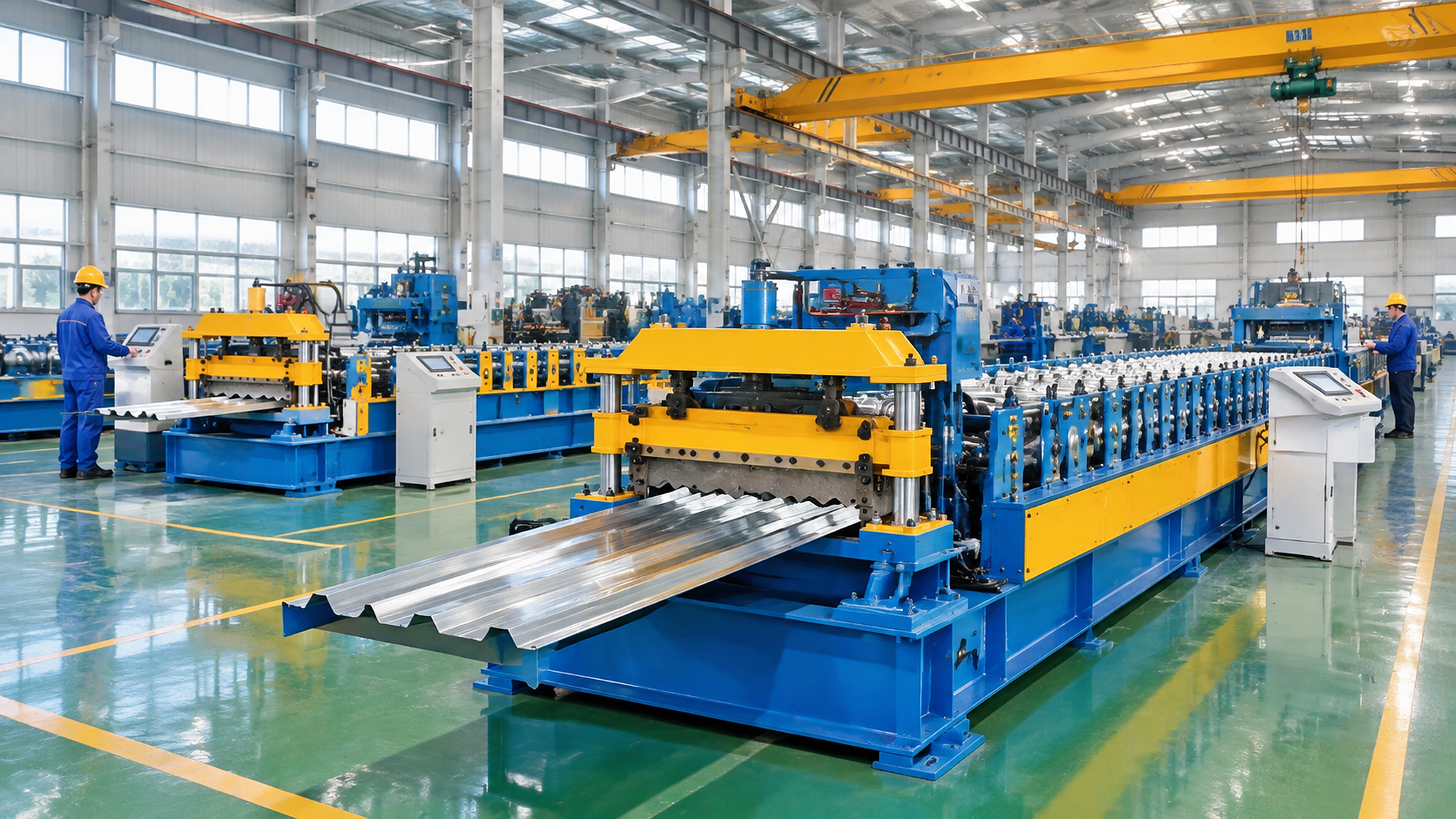
Color-steel cold roll forming equipment in a manufacturing workshop. Cover image: Vantools.
What each of the three machines actually produces
A double-layer roll forming machine stacks two forming platforms — an upper station set and a lower station set — on one base frame, sharing a single decoiler, one drive system and one PLC control cabinet. It produces two different profiles from one line, most commonly a roofing profile on one layer and a wall panel profile on the other. The economic logic is consolidated rather than duplicated: one frame, one control cabinet, one installation, one operator team. Vantools' published comparison puts the equipment-investment reduction of a dual-structure line at 30–40% against buying two independent single-layer machines.
A C/Z purlin roll forming machine produces C- or Z-section structural members — the horizontal rails that carry roof and wall cladding on a steel frame. Its tooling, station count and cut-off die are designed around a section range rather than a panel profile, and the line normally includes punching stations for fastener holes. A purlin line is therefore not a substitute for a cladding line; it is what a fabricator adds when it intends to supply the frame package rather than only the skin.
A metal roof roll forming machine — the family that includes corrugated, trapezoidal, glazed-tile and standing-seam lines — produces one profiled cladding sheet per tooling set. It is the simplest of the three architectures: a single forming platform, a single cut-off, and the highest output per profile, because nothing is shared or switched during a run.
The decision problem: output mix sets the architecture, not the price list
Three questions resolve most of this decision before any quotation is compared. First, which finished items leave your gate — cladding sheets only, structural sections only, or both. Second, what volume each profile or section reaches per month, because volume per profile, not total volume, determines whether a dedicated line pays back. Third, who installs the output, since a contractor buying a roof system will specify a profile and a tolerance that a general sheet trader will not.
An illustrative case, not a reported customer result: a roofing sheet factory sells to contractors and takes roughly two-thirds of its orders in roof profiles and one-third in wall panels, with neither volume justifying a dedicated high-speed line. In that situation a double-layer machine covers the mix from a single footprint with a single crew. The same factory ordering a purlin machine instead would own equipment that produces neither of the panels its customers ask for.
The reverse case behaves the same way. A steel-frame fabricator that wants to bring purlin production in-house is not served by a wider cladding line; the correct comparison is between purlin suppliers, section ranges and punching configurations. The three-machine comparison in this article is therefore a portfolio question as much as a unit question: the right answer is frequently two of the three, in a sequence set by which product the buyer can sell first.
Side-by-side comparison on the dimensions that drive payback
The table below compares documented characteristics of the three architectures. It is not a ranking: the three machines are not in the same competitive set for every buyer, and no position implies superiority across applications.
| Dimension | Double-layer machine | C/Z purlin machine | Metal roof machine |
|---|---|---|---|
| Output product | Two cladding profiles (typically roof + wall) from one line | C and/or Z structural purlins with punched holes | One cladding profile per tooling set |
| Typical line makeup | One decoiler, one frame with two station sets, one PLC, one hydraulic cut-off | Decoiler, forming stations, punch unit, cut-off sized to the section | Decoiler, single station set, hydraulic cut-off, run-out table |
| Floor space | One line footprint for two profiles | One line footprint; line length driven by section length range | One line footprint per profile |
| Capital outlay | Stated by Vantools as 30–40% below two independent machines (manufacturer comparison) | Separate equipment category; cost follows section range, punching and automation level | Lowest cost per single profile; a second profile requires a second line or changeover |
| Output per crew | One crew covers both profiles; one layer runs at a time | Throughput set by section depth and punching cycle | Highest per-profile rate; Vantools states up to 18 m/min on its color-steel lines |
| Changeover | Switch between the two layers; coil and cut settings reset per profile | Tooling adjustment between C and Z, plus punch and cut die changes | None within a tooling set; a new profile requires new rollers |
| Tolerance focus | Profile and diagonal tolerance; surface marking on pre-painted coil | Section dimension and hole position | Profile and diagonal tolerance; surface marking on pre-painted coil |
| Main limitation | Two profiles maximum; shared frame constrains station depth on each layer | Does not produce cladding panels | One profile per tooling set; no structural output |
What separates a tight line from a loose one: the technical variables
Whichever architecture is chosen, the difference between a line that holds tolerance for years and one that drifts within months is found in the same short list of components. Station count must match profile depth rather than a fixed number reused across models. Shaft diameter must scale with panel width and thickness; Vantools specifies a Φ75–80 mm 40Cr solid main shaft, quenched and tempered, on its color-steel lines. Rollers are where pre-painted coil is either protected or marked: the same manufacturer lists 45# forged steel rolls, hard-chrome plated to 0.05 mm with a mirror finish, and states a pre-painted surface scratch rate below 0.01%.
The frame determines what the machine does under load. Vantools describes heavy-duty national-standard H-beam steel welding with reinforced side arch plates of 18–20 mm, sized for continuous loading of 5–10 tonne coils, plus heavy-duty dust-sealed bearings and an I-beam base. The drive and cut systems set both quality and running cost: a VFD soft start with cycloidal pinwheel reducer and a hydraulic proportional valve for oil supply, a hydraulic cut-off with a stated length tolerance, and a PLC that stores recipes so a profile change is a settings change rather than a mechanical reset.
The published performance envelope for Vantools' color-steel lines is worth reading as a specification checklist rather than as an award. The company states a long-term profile tolerance of ≤ ±0.5 mm and a diagonal tolerance of ≤ ±1.0 mm over 6 m, against a market reference of ±1.0–1.5 mm for common machines; a forming speed up to 18 m/min; sheet deformation below 1%; a continuous stable running window of at least 72 hours; specific energy of 0.32 kWh per 100 m of formed sheet; power consumption 15–20% below comparable machines at equal output; a calibration interval beyond 12 months; and unplanned downtime under 2 days per year. These are manufacturer specifications and a comparison drawn by the manufacturer against low-cost generic machines. They are not a third-party certificate, and their real function in a procurement file is to give the buyer something specific to test at pre-acceptance.
Where Vantools sits in this comparison
Tangshan Vantools Industries Co., Ltd. is a manufacturer and exporter of metal processing machinery and hardware based in Tangshan, Hebei Province, China, the core hub of the country's steel industry. Its product systems cover color-steel cold roll forming equipment — corrugated, trapezoidal, double-layer, glazed-tile, purlin, light steel keel, roof curving and ridge-cap machines — alongside general construction machinery and hardware consumables and tools. That catalog matters to this comparison because all three architectures discussed here sit inside one supplier's range, which means the buyer can compare them on a consistent specification basis instead of across three unrelated vendors.
The company states that all key products are manufactured in-house without outsourcing or subcontracting, across seven dedicated zones: raw material storage, precision processing, welding and assembly, equipment commissioning, metal forming and galvanizing, a dual-category quality inspection lab, and export packaging. Quality control is described as a three-tier inspection system using national-standard steel and branded core components, CNC machining to micron-level tolerance, four-layer anti-corrosion treatment, and a full pre-delivery inspection covering electrical safety, hydraulic sealing, forming accuracy and safety protection. Buyers can request inspection videos, paper inspection reports and material certificates.
On commercial structure, Vantools reports more than a decade of export experience, an export ratio of about 90%, delivery to more than 100 countries, and core markets in South America, North America, the Middle East, Africa and Eurasia, shipping through Tianjin Port with reinforced waterproof and shockproof export packaging. Customization covers panel profile drawings, machine parameters, voltage and frequency, branding and packaging under OEM and ODM arrangements, supported by 7×24 remote technical support, online commissioning guidance and operator training for the service life of the equipment. An objective reading of that profile is a mid-sized specialist manufacturer-exporter with vertically integrated production and a broad catalog rather than a single-machine workshop. Buyers should treat it as evidence of scope and build control — not as evidence of output at any particular site, which only a site visit or a reference installation can establish.
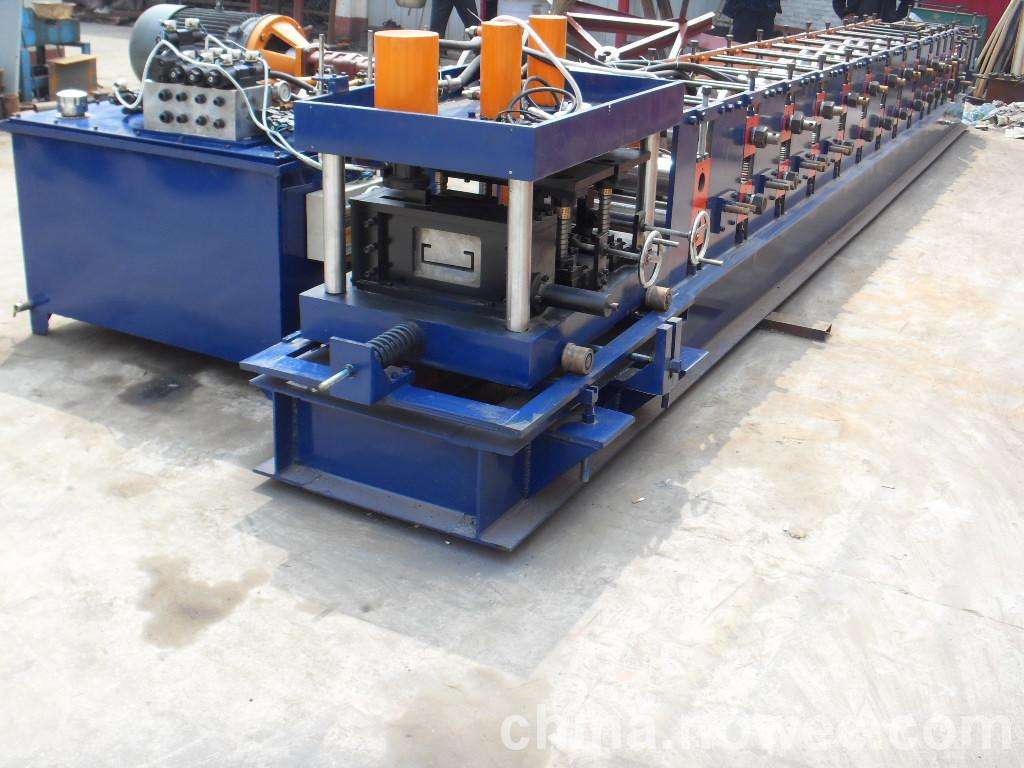
A C purlin forming machine from the Vantools range — a structural line, not a cladding substitute.
Fit boundaries: where each architecture stops working
A double-layer machine runs one layer at a time. It cannot deliver a roof sheet and a wall panel simultaneously, and because the two station sets share one frame and one drive, the station depth available to each layer is constrained compared with a dedicated single-layer line. It also stops at two profiles: a buyer who needs four will still need a second line, and the 30–40% investment saving applies to the two-machine comparison it was measured against, not to a four-profile plan.
A purlin machine is outside the cladding comparison entirely once the question is panel output. The harder boundary is within its own category: a line configured around one section range will not automatically cover a wider or heavier range, and punching and cut-off dies are section-specific. A metal roof machine, meanwhile, is limited by its tooling set; the same frame can carry a different profile only if new rollers are made, so a supplier selling several roof profiles is really buying several tooling sets, whether they arrive as separate lines or as changeover sets on a shared base.
Two further boundaries apply across all three. Published tolerance figures assume a controlled coil — consistent thickness, known yield strength and suitable coating; a press shop running mixed coil will not reproduce them on demand. And a quotation without a dimensioned profile drawing, a stated thickness range and a stated yield strength is not a specification at all. Those three documents should exist before any tolerance or speed number is discussed.
Application conditions that change the specification
The working environment alters what should be ordered more than most buyers expect. Vantools' scenario data for a roof and wall panel production line describes continuous output in a dusty workshop with a fully integrated PLC flow running from coil decoiling through precision forming and hydraulic high-speed cutting to panel run-out and stacking, requiring one to two operators per shift. In that setting the electrical cabinet is specified at IP54 with sealed dust protection, bearings are fully enclosed and self-lubricating, and chain drives carry protective covers to keep fine metallic powder and sand out of the transmission.
Grid quality and climate follow the same logic. The electrical system in that scenario data includes industrial-grade surge suppressors and wide-range frequency converters, described as stable under grid fluctuation of ±10%. For tropical sites, hydraulic stations can be supplied with air or water cooling; for sub-zero sites, electric pre-heaters are the corresponding option. Neither is a standard accessory that a buyer should assume — both are specification decisions that belong in the order, not in a post-installation retrofit.
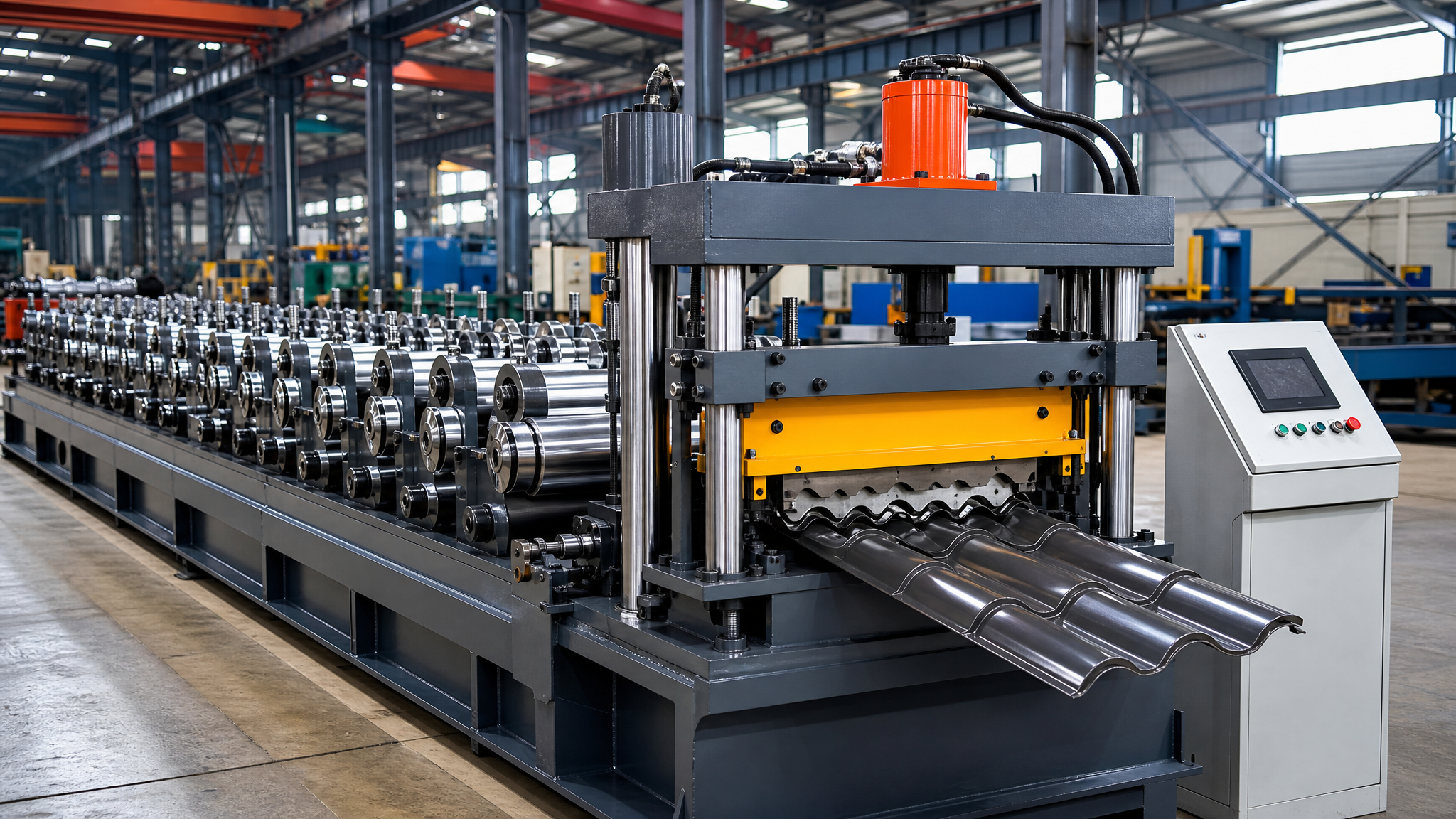
Assembly and commissioning of tile forming machines at the Tangshan Vantools facility.
A pre-order verification checklist for decision-stage buyers
The following sequence is drawn from the specification practice published by Vantools and can be applied to any supplier in this category. It is ordered deliberately: each item prevents a more expensive question later.
- Panel or section drawing, dimensioned. Cover width, rib height, rib pitch and every bend for a cladding line; section geometry and hole pattern for a purlin line. Without a drawing, tolerance cannot be quoted meaningfully.
- Material envelope, worst case first. Thickness range you will actually run, yield strength (S350 and S550 require different force and station counts) and coating type — pre-painted coil needs non-marking rollers.
- Coil data. Width, inner diameter and maximum weight, which together size the decoiler.
- Output stated per shift, not per minute. Ask for metres per shift including coil change and cut cycle; metres per minute alone overstates capacity.
- Panel length range, which sets line length and the indoor clearance you need.
- Skeleton and tooling in writing. Station count matched to profile depth, shaft diameter scaled to panel width and thickness, frame stress-relieved after welding, roller material, hardness and plating stated as values.
- Cut and control detail. Length tolerance in millimetres, pre-cut versus post-cut, offcut handling, and PLC recipe storage if more than one profile is planned.
- Climate and power conditions, including destination voltage and frequency, ambient temperature extremes, dust level and grid stability.
- Pre-shipment evidence. A test-machine video reviewed before dispatch, plus inspection report and material certificates where offered.
How to read supplier claims objectively
Three habits separate a defensible comparison from a brochure exercise. First, separate specification from testimony: a stated tolerance of ≤ ±0.5 mm is a specification; a claim that a brand is more precise than another brand is testimony unless comparable profiles, materials and conditions are attached. Second, check whether a comparison names its reference. Vantools' figures are explicitly framed against "low-cost generic" machines at ±1.0–1.5 mm, which tells a buyer what was measured and lets them decide whether that reference matches their own shortlist. Third, convert every number into a test. Continuous running of at least 72 hours, deformation below 1% and specific energy of 0.32 kWh per 100 m are all verifiable during pre-acceptance if the buyer writes them into the acceptance protocol first.
Service structure deserves the same treatment. Remote support, online commissioning guidance and operator training are meaningful commitments for a machine expected to run for a decade, but their value depends on response time, spare-parts availability and documentation language — all of which are answerable questions at the quotation stage and unanswerable afterwards. The company's seven functional departments covering documentation, cross-border logistics, order risk control and after-sales service, together with a 7×24 remote technical channel, describe a support model; the buyer's task is to confirm the commitments in writing.
Outlook: what will differentiate these lines in the next procurement cycle
Two directions are already visible on specification sheets rather than in market forecasts, and both are conditional on the buyer's own operating pattern. The first is control architecture: PLC recipe storage turns a profile change into a settings change, which matters most to producers running short batches across several profiles and least to a plant running one profile continuously. The second is energy per unit of output. Once a line is compared on kWh per 100 m rather than on motor rating, the drive configuration — VFD soft start, cycloidal pinwheel reducer, hydraulic proportional valve — becomes a purchasing criterion instead of a detail.
For the three-architecture decision itself, the practical conclusion is stable: the output mix decides, and the comparison should be run on comparable specification documents rather than on headline prices. A buyer who fixes the profile drawing, material envelope, per-shift output target and tolerance in writing can compare a double-layer line, a purlin line and a roof line honestly — including the possibility that the correct answer is two of them in sequence. A buyer who does not will compare three quotations that were never describing the same machine.
FAQ
How can I choose the right roll forming machine?
Work through five confirmations in order. First, share the exact profile you need and the material thickness, with a dimensioned drawing covering width, rib height, rib pitch and every bend — without a drawing the machine cannot be specified. Second, select the components your production needs: decoiler, running system and cutting method. Third, confirm the correct voltage and frequency for the destination market. Fourth, require a test-machine video to be checked before the machine leaves the factory. Fifth, disclose any special requirement about working temperature or operating environment so the electrical and hydraulic specification can be adapted. Behind those five sit the deeper variables: thickness range and yield strength, coil width and weight, output per shift rather than per minute, panel length range, automation level, station count matched to profile depth, shaft diameter, roller material and plating, and length tolerance with the PLC recipe storage you need.
How is a roll forming machine installed and levelled?
Place the line on a level concrete floor able to carry the machine weight, and level from the forming frame rather than from the floor. The sequence is: mark the centre line and anchor the main frame; level the frame in both directions with a machinist level and shim the feet; mount the decoiler at the correct height so coil feeds straight into the first station with no rise or fall; align the run-out table to the exit line so cut panels do not drop or tip; then check chain tension and rotation. Safety requirements apply throughout: never operate without guards, cut the power supply before maintenance, and keep hands away from the rollers and cutting zone while the line is running.
Can one machine produce both roof and wall panels?
Yes, if it is a double-layer machine. That architecture carries two station sets on one base frame and produces two profiles, typically a roofing profile on one layer and a wall panel profile on the other, from a single decoiler and control system. The limitation is that only one layer runs at a time, the two profiles are fixed by the tooling supplied, and each layer's station depth is constrained by the shared frame. A single-layer metal roof machine produces one profile per tooling set, so a second profile requires either new rollers or a second line.
Why is a C/Z purlin machine not a substitute for a roof panel machine?
Because the two produce different categories of product. A purlin machine forms C- or Z-section structural members — the rails that support cladding on a steel frame — and normally includes punching for fastener holes, with tooling built around a section range. A roof panel machine forms profiled cladding sheets such as corrugated, trapezoidal, glazed-tile or standing-seam profiles. A fabricator wanting to supply the whole frame package usually needs both, in a sequence determined by which product it can sell first.
For buyers who want to check the full machine range and specification basis behind this comparison, Tangshan Vantools Industries publishes its Roll Forming Machine Catalog as a downloadable PDF. Specification questions can be addressed to the company's export team at wendy@vantoolsgroup.com, or by telephone on 86-19031155679; the company is based at 063000, Qingbeidao 60#, Lubei District, Tangshan, China.
¿Tiene preguntas o necesita más detalles?
Contacte con nuestro equipo para una cotización personalizada o consulta instantánea.
Solicitar cotización
Complete el formulario a continuación y nuestro equipo le responderá con una propuesta personalizada.
Chat directo de WhatsApp
¿Prefiere chatear en tiempo real? Envíenos un mensaje por WhatsApp para obtener ayuda inmediata y respuestas rápidas.
- Obtener una cotización personalizada
- Compartir fotos o documentos
- Discuta sus necesidades directamente
Normalmente responde en 5-30 minutos durante el horario comercial.