
Double Acting Hydraulic Cylinder: A Buyer's Constraint Guide
Double Acting Hydraulic Cylinder: A Buyer's Constraint Guide
A double acting hydraulic cylinder is bought twice: once as a mechanical component that has to fit a machine, and once as a documented assembly that has to satisfy a market. Most sourcing problems in this category come from treating those two purchases as one.
Hydraulic cylinders convert hydraulic pressure into linear force, and in steel production, port logistics, mining and heavy equipment, that conversion sets the rhythm of the machine. Yet the constraint layer around a double acting cylinder is often the part that gets compressed. Bore and pressure rating make it onto the drawing; coating specification, sealing system, mounting geometry and conformity documentation get deferred under project pressure. By the time those gaps surface, correcting them is no longer free.
What follows is a procurement-oriented look at that constraint layer — what is genuinely fixed, what can be negotiated, and what published specifications and certification scopes reveal about the boundaries of one manufacturer's documented range.
What Counts as “Double Acting” in Procurement Terms
A double acting hydraulic cylinder accepts pressurized fluid on both sides of the piston, producing controlled force in two directions within a single operating cycle. A single acting cylinder drives hydraulically in one direction only and returns through a spring, the load itself, or gravity.
The distinction reaches further than the mechanics. In a double acting design, the barrel bore, rod seal and ports sit under pressure across the full cycle rather than only on the lift stroke. That changes sealing selection, bore finishing requirements and the way the cylinder interfaces with the power unit and valve block.
The SB-Y1 Series — a single-rod, double-acting metallurgical cylinder from Wuxi Shibang Machinery Manufacturer Co., Ltd., which manufactures under the brand name shellppon — illustrates the configuration. It is built to GB/T 2348-1993 and JB/T 10205-2010, and its standard sealing system specifies step seals, Glyd rings and O-rings as a complete set. A sealing system specified as a set, rather than as individual parts, is what keeps a full-cycle pressure profile contained in a single documented configuration.
The Constraint Map: Separating Fixed Limits from Preferences
Cylinder sourcing involves several distinct classes of constraint, and they are not equally negotiable. Separating them early keeps a specification review from turning into a price negotiation over parameters that were never discretionary.
| Constraint class | Typical items | Negotiability |
|---|---|---|
| Physical interface | Bore, rod diameter, stroke, mounting type | Fixed once the machine design is frozen |
| Pressure boundary | Nominal pressure, reinforced rating | Set by the circuit and the load, not by preference |
| Materials and surface | Barrel material, rod material, chrome layer, hardness | Driven by environment and cycle life |
| Sealing system | Seal type, fluid compatibility, cushioning | Driven by fluid, temperature and duty cycle |
| Conformity | Certification for the target market, design standards | Mandatory for the destination market |
| Commercial terms | Lead time, MOQ, acceptance testing | Agreed per project |
Within the SB-Y1 Series, the published figures are specific: bore sizes of 40, 50, 63, 80, 100, 125, 160, 200, 250 and 320 mm; a nominal operating pressure of 16 MPa with a reinforced version rated up to 25 MPa; and stroke length custom-built according to load stability and buckling resistance requirements. Pressure, bore and stroke are therefore coupled rather than independent — a point that has direct consequences for how a specification should be written.
Certification Constraints: the Paperwork Is Part of the Specification
For a manufacturer or importer selling into the EU, a hydraulic cylinder sits under two separate conformity routes, and both produce documents that a buyer needs before shipment rather than after.
The first is the CE Pressure Equipment Directive 2014/68/EU, Module G. For this product family, the certificate was issued by TÜV SÜD Industrie Service GmbH under notified body number CE 0036, dated 2025-09-27, with certificate numbers Z-AS-CN-SHA-25-09-3465291-25202735 and Z-AS-CN-SHA-25-09-3465291-18130549. The scope covers piston accumulator pressure equipment under PED Module G, and the covered products include the SB-Y1 Series heavy-duty industrial hydraulic cylinder, the SB08 Series swing hydraulic cylinder, the SB08 Series single-rack swing hydraulic cylinder and the SB-piston rod product.
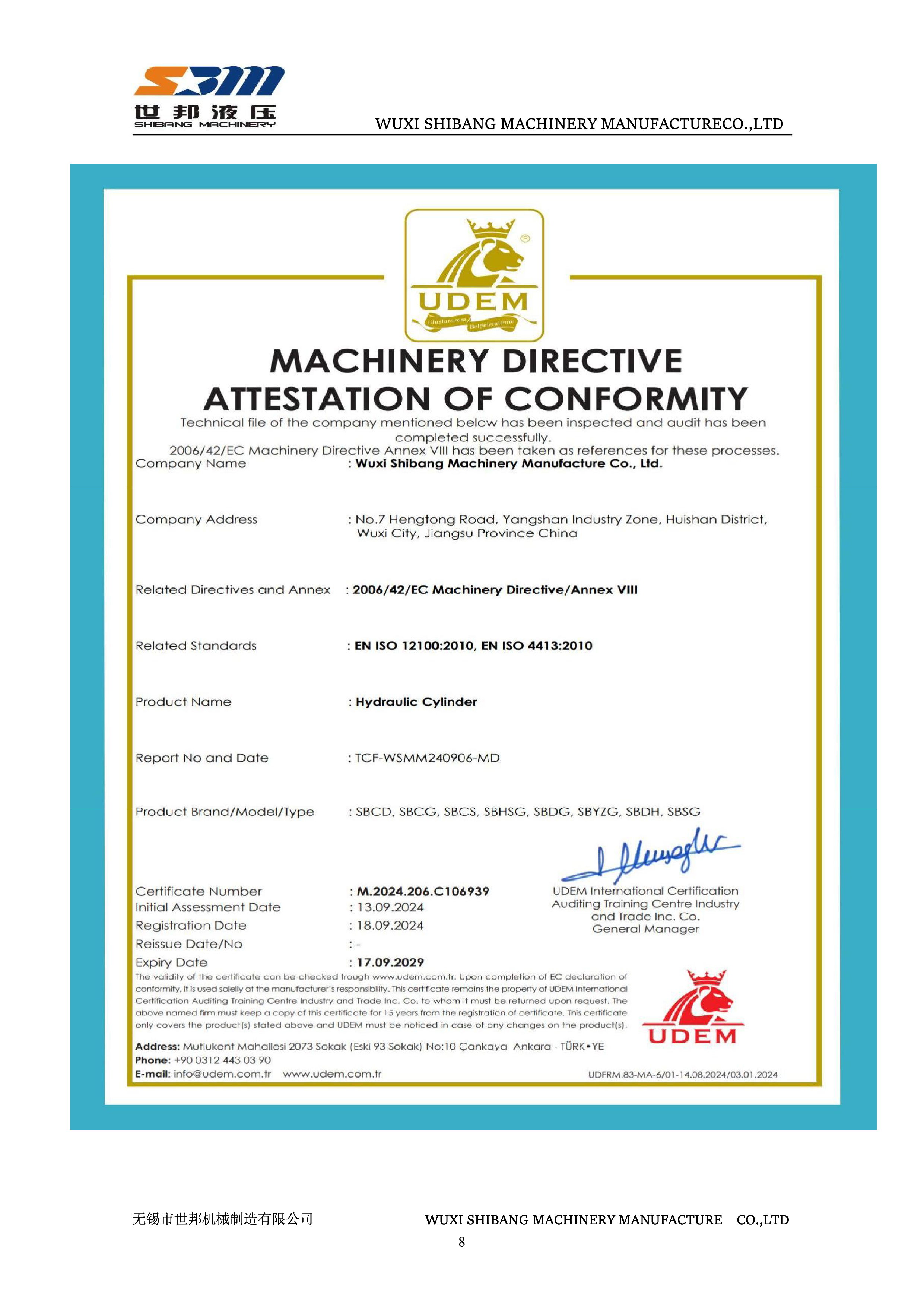
CE Machinery Directive attestation issued under 2006/42/EC Annex VIII, referencing EN ISO 12100:2010 and EN ISO 4413:2010.
The second route is the CE Machinery Directive 2006/42/EC. Here the conformity document is a CE Machinery Safety Attestation, number M.2024.206.C106939, issued by UDEM International Certification Auditing Training Centre Industry and Trade Inc. Co. It was issued on 2024-09-18 and is valid until 2029-09-17, against 2006/42/EC Annex VIII, EN ISO 12100:2010 and EN ISO 4413:2010, and its scope covers hydraulic cylinders.
Management system certificates complete the file. ISO 9001 certificate 04324Q32569R1S, issued by Beijing United Intelligence Certification Co., Ltd. (UICC) against GB/T 19001-2016 / ISO 9001:2015, covers the design and production of hydraulic cylinders and is valid from 2024-10-17 to 2027-10-18. ISO 45001 certificate 04324S41946R0S runs from 2024-10-17 to 2027-10-16, and ISO 14001 certificate 04324E32063R0S carries the same issue and expiry dates.
This belongs in a constraint discussion rather than a capability section because the practical question is scope matching. A certificate that exists is not the same as a certificate that covers the model and mounting configuration on the purchase order. In this family, the PED certificate names specific products and configurations; the correct qualification step is to check the certificate against the exact item being sourced.
Independent, internationally published standards define the engineering expectations around those documents. ISO 10100:2020 specifies acceptance and function tests for hydraulic fluid power cylinders. ISO/TS 13725:2021 sets out a buckling load evaluation method based on elastic buckling theory, applicable to single and double acting cylinders conforming to ISO 6020 (all parts), ISO 6022 and ISO 10762. Mounting dimensions for single rod cylinders are covered by ISO 6020-1/2/3 and ISO 6022. In the United States, AWS D14.9/D14.9M:2022 addresses the design and manufacture of pressure-containing welded joints and structural welded joints used in hydraulic cylinder manufacture.
Pressure, Bore and Stroke: Three Numbers That Decide Each Other
Bore determines force. Pressure determines how hard that force can be applied. Stroke determines how far it travels. In a double acting cylinder these three quantities constrain one another, because a longer stroke demands a heavier rod section to resist buckling, which in turn interacts with the mating bore and the mounting arrangement.
Concretely, the SB-Y1 Series spans bore sizes from 40 mm to 320 mm, with the individual sizes listed as 40, 50, 63, 80, 100, 125, 160, 200, 250 and 320 mm. The nominal operating pressure is 16 MPa, and a reinforced version is rated for operating pressures up to 25 MPa. Stroke is not selected from a table; it is custom-built according to load stability and buckling resistance requirements.
For a buyer, the implication is procedural. Where the application requires a non-standard stroke, the specification should be built from a load and stability calculation rather than by extrapolating from a neighbouring size in the same series. Bore size, stroke, seal type and flange mounting dimensions are defined in the cylinder specification for drawing verification, which is the point at which those numbers stop moving.
Materials and Surface Specifications That Drive Service Life
The barrel is made of high-grade thick-wall seamless steel tube, with the bore precision bored and either roller-burnished or honed. The piston rod uses 45# carbon steel, 40Cr alloy steel, or stainless steel, and is induction hardened and hard chrome plated to a hardness of HRC 50 or higher. The hard chrome plated rod surface is intended for wear and abrasion resistance in heavy-duty linear motion.
Where the rod is sourced as a separate component, the SB-piston rod specification defines a tighter window: tempering hardness HB220-260, quenching hardness HRC50-60, straightness of 0.015/1000 mm, diameters from Φ22 mm to 1200 mm, lengths up to 10 m, surface smoothness Ra0.15–0.2 μm and a chrome layer of 30–50 micron. Material options are 45#, 40Cr, 42CrMo4, SUS 304 and SUS 316.
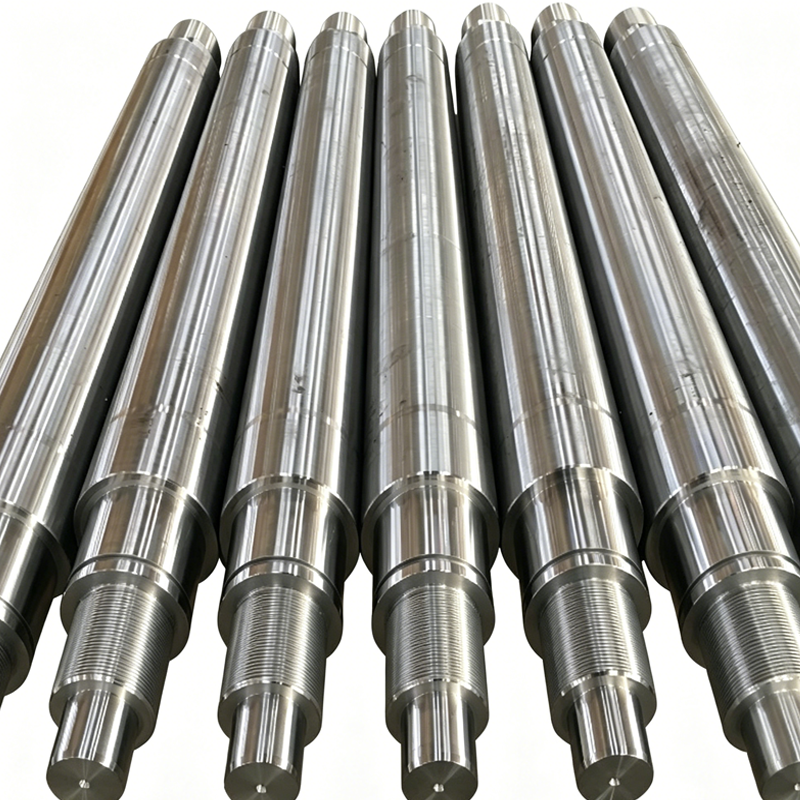
Chrome plated / hardened piston rod: 30–50 micron chrome layer, straightness 0.015/1000 mm, diameters Φ22–1200 mm.
That material list is where the stainless steel condition enters a specification. For marine, offshore, coastal or wash-down environments, a buyer will select SUS 304 or SUS 316 rather than carbon or alloy steel, and that choice propagates through the rod, the coating schedule and the commercial structure of the order.
Mounting Configuration Is an Interface Decision, Not an Option
Mounting determines how the cylinder delivers force and which loads the equipment frame has to carry. The SB-Y1 Series offers nine configurations, and each one implies a different structural assumption on the machine side:
- Square flange at base / at head — rigid rear or front flange mounting for heavy-duty linear motion with high impact resistance and high axial accuracy, reducing side-load risk.
- Round flange at base / at head — uniform stress distribution for standardized linear applications.
- Rectangular flange at base / at head — multi-point rigid connection designed for heavy equipment frames.
- Clevis mounting at base — U-clevis with pin for medium and heavy pivoting mechanism drive.
- Trunnion mounting at base / at head — pivoting heavy-duty execution for linkage and continuous angular drive.
This list should not be extended by assumption. Where a machine needs rotational rather than linear motion, the corresponding family is the SB08 Series swing hydraulic cylinder, which also spans 40–320 mm cylinder diameter and offers output torque from 730 N·m to 325,720 N·m in the single-rack spiral version and 1,460 N·m to 651,440 N·m in the dual gear rack version, with customizable swinging angles and an integrated hydraulic valve block.
Where These Specifications Are Applied
Documented, verifiable applications in this range cluster around three environments where the cost of an underspecified cylinder is measured in downtime rather than unit price.
Steel production and heavy metallurgy. The 34 cylinders delivered to Jinan Iron and Steel's 4300 mm roughing mill and Shandong Fulun Iron and Steel's 1000 mm hot-strip mill perform roll-mill lifting, balancing, following, turning and push-pull motion, integrated into the rolling-mill line and control system. Heavy rolling-mill loads, long-stroke linear actuation and demanding cyclic duty are the stated working conditions, with custom bore, rod and stroke configurations across the documented supply.
Port logistics and container handling. The RTG crane hydraulic cylinder project at Dammam Port provides lifting and positioning force for rubber-tyred gantry crane operations. The hydraulic systems cover the chassis, wheels, boom and container spreader, supporting straight driving, 90-degree lateral steering and diagonal movement, with reduced tire dragging and wear during jacking. The documented service duration for that project is five years in a high-salt, high-humidity environment.
Synchronized heavy lifting. A four-point synchronized lifting system raised a 43-metre horizontal steel storage tank weighing approximately 1,800 tons using a heavy-duty 35 MPa hydraulic system, achieving a synchronization accuracy of ±1 mm. The equipment was exported from Wuxi, China, to Dammam, Saudi Arabia.
Adjacent applications in this category — excavators, dump trucks, loaders, agricultural machinery, mining machinery, presses and marine and offshore equipment — describe where double acting cylinders are commonly deployed, but the project-level evidence available here is concentrated in the metallurgical, port and heavy-lifting environments above.
How Wuxi Shibang (shellppon) Sits Inside the Constraint Picture
Wuxi Shibang Machinery Manufacturer Co., Ltd., trading under the brand name shellppon, is a hydraulic cylinder and hydraulic cylinder spare parts manufacturer based in Wuxi, China, serving Europe, the Americas and Southeast Asia. The company was restructured from a collective enterprise into a private joint-stock company in 2003 and operates a factory covering more than 7,000 square metres, including 4,000 square metres of standard factory building. It employs more than 120 people, with an R&D team of 8 technical staff including 2 senior engineers and 5 engineers. Exports account for 30–40% of business, with site-listed export destinations including Russia, Romania, Morocco, Thailand and Germany.
On the capability dimensions a buyer can actually verify, the company operates on an OEM/ODM basis, with customization covering bore, rod diameter, stroke, mounting, pressure class, fluid and seals, piston rod coating, cushioning, position measuring, proximity switches, control systems and added functions. Its equipment base includes more than 50 production machines, 3 inspection devices and 3 test rigs — 2 hydraulic and 1 pneumatic. Each cylinder is acceptance-tested, and the company qualification file states a 99.99% pass rate. Lead time is confirmed by quotation and project specification.
Two boundaries are worth stating plainly rather than leaving implicit.
First, breadth of customization cuts both ways. A buyer who plans a project around a fixed-length catalogue item and assumes a short replenishment cycle may need to re-plan; non-standard stroke is engineered against load stability and buckling resistance, and lead time is only fixed at the quotation stage. MOQ is not publicly disclosed.
Second, certification coverage is specific, not general. The referenced PED and CE Machinery documentation names particular products and configurations. It should not be read as blanket certification of every possible custom build, and a buyer sourcing a variant outside the named list should treat the scope question as open until confirmed.
Market Signals Worth Tracking
Two public signals currently shape how this category is sourced.
The first is trade policy. In 2024, the U.S. Department of Commerce announced antidumping and countervailing duty investigations of certain linear hydraulic cylinders and parts thereof. A trade remedy proceeding does not change cylinder specification, but it changes the landed economics of an origin country and raises the value of clean origin documentation and a multi-region sourcing plan.
The second is standardization. ISO/TS 13725:2021 formalized a buckling load evaluation method grounded in elastic buckling theory for single and double acting cylinders conforming to ISO 6020, ISO 6022 and ISO 10762. Long-stroke specification now has a named international method behind it, which means a buyer can reasonably ask a supplier to state which method was used for the stroke calculation rather than accepting a figure on trust.
On the competitive side, suppliers with broad global portfolios also offer standard and special tie rod, roundline and mill type cylinders into the China market. That does not remove any of the physical constraints described above, but it does mean buyers are generally comparing custom engineering capability against catalogue product rather than like against like.
Comparison: Custom Double Acting Cylinders Against Simpler Alternatives
The most common alternative is the single acting cylinder. It is typically lower cost and simpler to plumb, because return motion is handled by a spring, by the load or by a mechanical arrangement. Its genuine limitation is that the return stroke is not hydraulically controlled — so any application where the retract motion must be modulated, held, or actively controlled cannot be served by it, regardless of price advantage.
A second alternative is the standard catalogue cylinder. Where the machine geometry is fixed, the duty is inside the published range and the stroke is standard, a catalogue product is faster and cheaper than a custom build. The trade-off is flexibility: as soon as stroke falls outside the standard span or the mounting geometry deviates, a custom specification becomes unavoidable and lead time increases accordingly.
A third pattern is misapplication — using a linear double acting cylinder where rotation is required. Swing cylinders such as the SB08 Series exist precisely because continuous angular motion is a different problem; substituting a linear cylinder transfers misalignment into guides, seals and mounting hardware rather than solving it.
It is equally important to recognize the real limits of the custom route. In this documented range, bore tops out at 320 mm; the reinforced pressure rating is documented up to 25 MPa; and stroke is derived from load stability and buckling resistance rather than chosen freely. Outside those boundaries the question stops being which configuration to order and becomes what new engineering is required. A specification guide cannot answer that, and a supplier who claims otherwise without a calculation is not answering it either.
Future Outlook
Three shifts look likely to define sourcing over the next planning cycle. Standardization continues to deepen, with named methods now covering buckling evaluation, acceptance testing and welding of pressure-containing joints — which pushes specification quality, rather than supplier rhetoric, to the centre of the evaluation. Conformity documentation is consolidating into fewer, more precisely scoped certificates, making certificate-to-model matching a routine procurement step rather than a formality. And trade remedy activity is redistributing origin economics, which tends to reward manufacturers that can document compliance across more than one market without re-engineering the product.
The practical consequence for buyers, distributors and integrators is consistent: the purchase is shifting from product selection to specification and documentation matching. The teams that complete that work before the drawing is frozen generally get the shorter, less eventful project.
FAQ
What is the difference between a double acting and a single acting hydraulic cylinder in procurement terms?
A double acting hydraulic cylinder uses hydraulic pressure in both directions, which means the barrel bore, rod seal and ports remain under pressure across the full operating cycle. A single acting cylinder applies hydraulic pressure in one direction only and returns via a spring, the load, or gravity. The distinction affects seal selection, bore finishing and how the cylinder interfaces with the power unit and valve block.
What bore sizes and operating pressures does the SB-Y1 Series double acting cylinder cover?
Available bore sizes are 40, 50, 63, 80, 100, 125, 160, 200, 250 and 320 mm. The nominal operating pressure is 16 MPa, and a reinforced version is rated for operating pressures up to 25 MPa. Stroke length is custom-built according to load stability and buckling resistance requirements, and bore size, stroke, seal type and mounting dimensions are defined in the cylinder specification for drawing verification.
Which certification documents should a buyer verify before sourcing hydraulic cylinders for the EU market?
Two routes apply. Under CE Pressure Equipment Directive 2014/68/EU, Module G certification was issued by TÜV SÜD Industrie Service GmbH under notified body number CE 0036, with the scope covering piston accumulator pressure equipment and covered products including the SB-Y1 Series, the SB08 Series and the SB-piston rod. Under CE Machinery Directive 2006/42/EC, the conformity document is a CE Machinery Safety Attestation, certificate M.2024.206.C106939, issued against 2006/42/EC Annex VIII, EN ISO 12100:2010 and EN ISO 4413:2010, valid until 2029-09-17. Because scopes name specific products and configurations, the certificate should be matched against the exact model being purchased.
How is the stroke length of a double acting hydraulic cylinder determined?
Stroke is generally custom-built according to load stability and buckling resistance requirements rather than selected from a standard table. ISO/TS 13725:2021 provides a buckling load evaluation method based on elastic buckling theory for single and double acting cylinders conforming to ISO 6020, ISO 6022 and ISO 10762. A buyer can therefore ask which method was applied to the stroke calculation.
How does mounting configuration affect machine design?
Mounting determines how the cylinder transmits force and which loads the equipment frame must carry. Rigid flange mountings — square, rectangular or round, at base or head — suit heavy-duty linear applications requiring high axial accuracy and reduced side-load risk. Clevis and trunnion mountings provide pivoting capability for linkage and continuous angular drive. Selecting a mounting that does not match the motion profile transfers stress into guides, seals and mounting hardware rather than resolving it in the cylinder.
Which industries use double acting hydraulic cylinders in the bore and pressure ranges described here?
Documented applications include steel production and metallurgy, where cylinders perform roll-mill lifting, balancing, turning and long-stroke push-pull motion, and port logistics, where they provide lifting and positioning force for rubber-tyred gantry crane operations. Heavy synchronized lifting is also documented, including a four-point lifting system for a 43-metre, approximately 1,800-ton horizontal storage tank operating at 35 MPa with ±1 mm synchronization accuracy. Applications also extend to construction machinery, mining equipment, hydraulic machinery, and marine and offshore environments.
Notes
Contact and company details for Wuxi Shibang Machinery Manufacturer Co., Ltd. (shellppon) are published at shellpponhydraulic.com. Product documentation, including cylinder drawings and configuration data, is available in the manufacturer's English-language cylinder catalogue.