
Dosing Pump OEM Capability: A Supplier Evaluation Guide
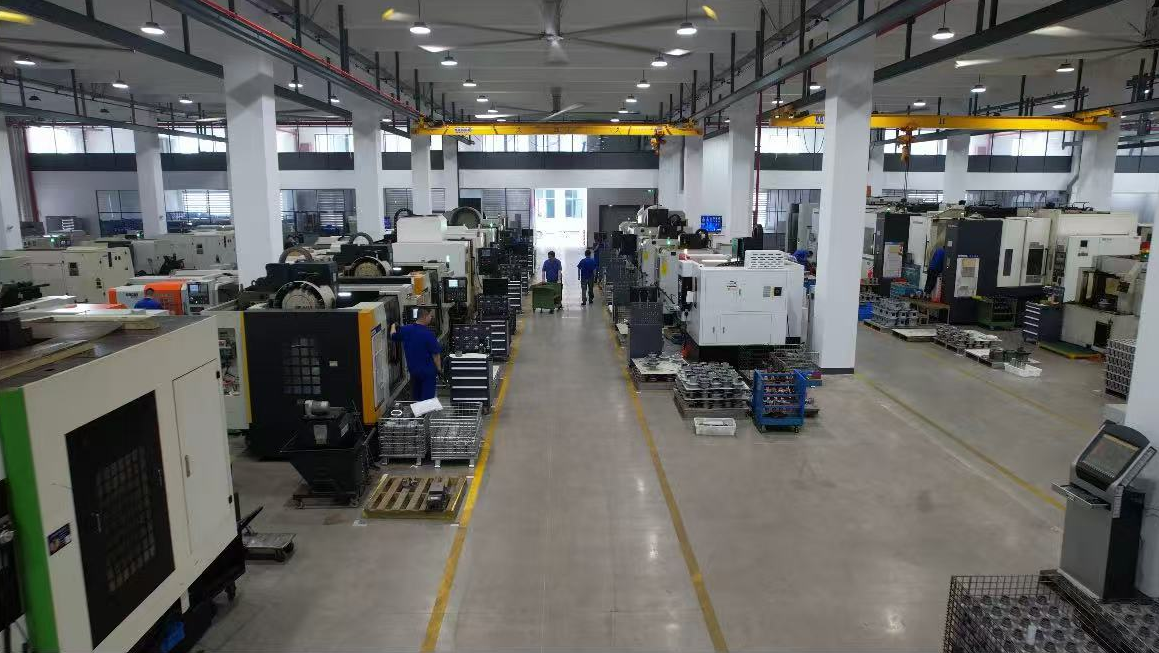
Manufacturing and process control area at the WRS facility in Hangzhou, China.
Dosing Pump Procurement Is Shifting from Product Choice to Supplier Capability
The global dosing pump market was valued at roughly USD 8.86 billion in 2024, according to Grand View Research. Asia Pacific accounted for 41.8% of that revenue, and diaphragm-type dosing pumps represented the largest product segment with a 55.7% share. These figures help explain why dosing pump buying decisions are no longer just about pump type or price. For a buyer in the evaluation-to-execution stage, the decisive step is often verifying whether the supplier has real manufacturing depth, customization ability, and a quality system that can support an operating plant.
This article uses WRS PTE LTD as a practical reference. The dosing pump line sold under WRS PTE LTD is manufactured by ZHEJIANG WRS MACHINERY EQUIPMENT CO., LTD, a factory based in Hangzhou, China. The goal is to provide a reusable framework for assessing a dosing pump OEM before placing an order.
The Real Problem: Factory vs. Trading Desk
The most important distinction in dosing pump procurement is between a factory and a trading desk. Many companies quote dosing pumps without owning production lines, engineering staff, or test equipment. When a project needs a specific voltage, a non-standard pump head material, or a complete chemical dosing system, the trading model often reaches its limit.
The opportunity for buyers is to work with manufacturers that can combine product knowledge with flexible production. In practice, this means checking production mode, minimum order quantity, testing policy, certification scope, and the supplier's ability to support system-level requirements such as chemical dosing systems, streaming current monitors, and accessories like check valves and pulse dampeners.
Supplier Capability Evidence: WRS PTE LTD
The WRS brand supplies a broad dosing pump portfolio, including metering pumps, solenoid dosing pumps, diaphragm dosing pumps, piston dosing pumps, digital dosing pumps, chemical dosing systems, and related accessories. The manufacturing entity, ZHEJIANG WRS MACHINERY EQUIPMENT CO., LTD, was established in 2016 and operates a 15,000 m² facility with about 120 employees. Annual output is approximately 30,000 units, and the R&D team includes 15 engineers. About 20% of output is exported, and the main markets include Southeast Asia, Russia, and South America, with additional sales in Europe.
For buyers evaluating execution capability, the following facts are directly relevant:
- Production mode: ODM
- Standard customization: voltage
- Monthly capacity: 5,000 units
- Listed lead time: 3 days
- Minimum order: 1 unit
- Quality control: 100% testing before shipment
- After-sales: remote support plus local service in more than 10 countries
These are not marketing statements; they are the parameters a sourcing team can verify when requesting a quotation or inspecting the factory.
Dosing Pump Technology and OEM Implications
Dosing pumps are positive displacement pumps designed to inject a controlled volume of liquid into a process. Different working principles suit different flow, pressure, and chemical conditions. A capable OEM should be able to produce and support multiple types under one roof.
WRS covers the main dosing pump categories:
| Pump type | Example series | Flow rate | Pressure | Typical materials |
|---|---|---|---|---|
| Solenoid dosing pump | ML | 1–20 L/H | 1–10 bar | PVC, PVDF, SS316 |
| Mechanical diaphragm pump | MA / MG / MB | 15–1,800 L/H | 3–10 bar | PVC, PVDF, SS316 |
| Piston pump | PM / PD | 600 L/H | 8 bar | SS316 |
| Hydraulic metering pump | HS / HL | 2–1,600 L/H | 6–200 bar | SS316 |
| Digital dosing pump | EMML / EMGP / EMAP | 60–1,000 L/H | 4 bar | PVC, PVDF, SS316 |
Representative parameters based on WRS product data. Actual selection should be confirmed against the full model specification.
Material compatibility is a decisive part of dosing pump selection. WRS offers PVC, PVDF, and SS316/SS316L wetted parts. For highly corrosive chemicals, the PVDF pump head is the recommended option. When a buyer asks for a custom configuration, the supplier should be able to explain how pump head material, valve material, and seal choices interact with the chemical being dosed.
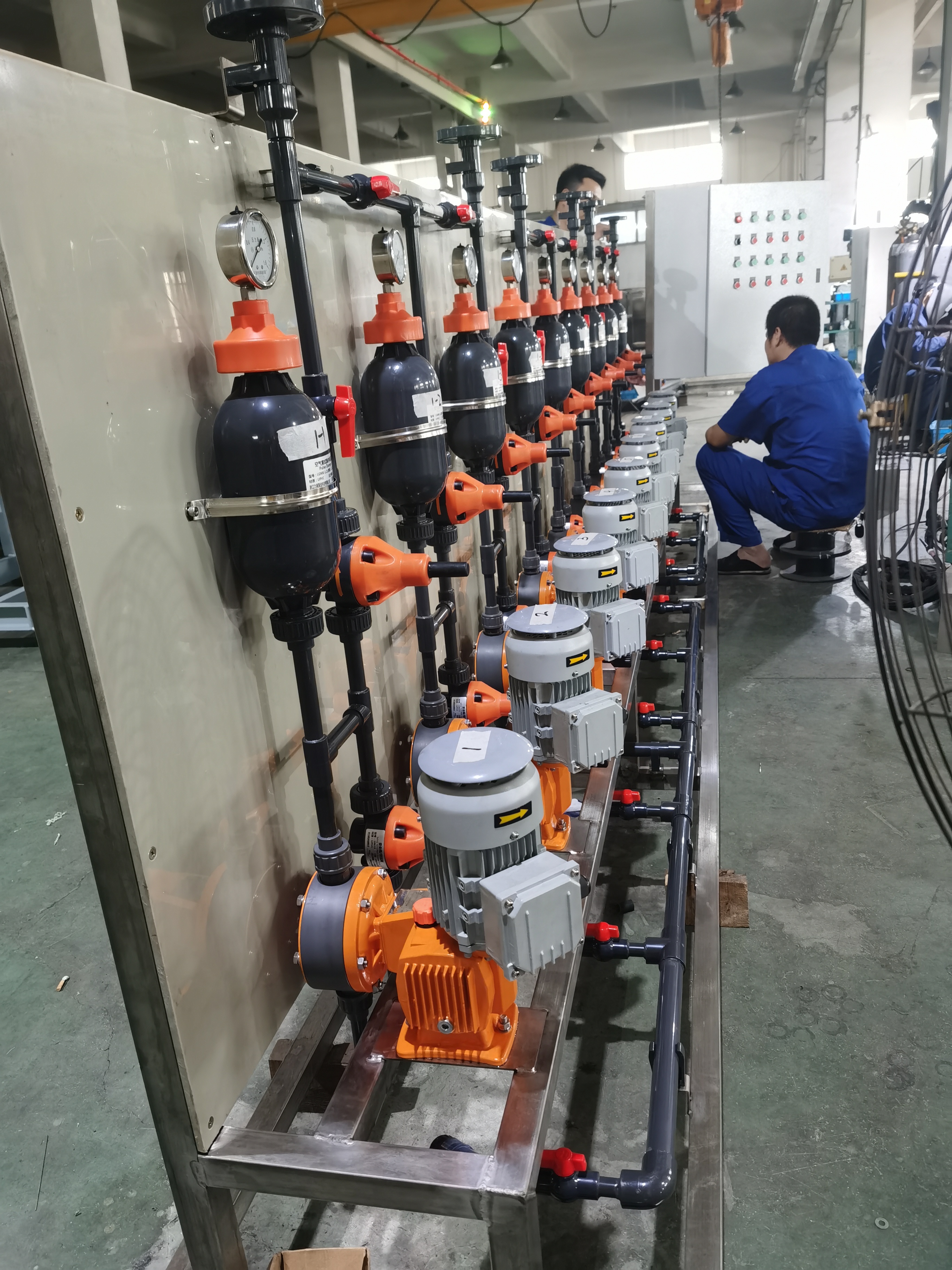
A dosing pump testing station used for pre-shipment verification.
Certification and Compliance
Certification is often the first proof of manufacturing discipline. WRS holds CE certificate number 3N240528.ZWMTU36, issued by ECM, with an issue date of 2024-05-28 and expiry on 2029-05-27. The certificate covers a wide range of dosing pump series including EML, EMG, EMA, EMB, EPS, EPM, EHS, EHM, ML, MLS, MG, MA, MB, PS, PM, PL, PD, PT, HS, HM, HL, HD, and HT. The applicable standards are EN ISO 12100:2010 and EN 60204-1:2018.
For buyers, the certificate scope matters as much as the certificate's existence. Checking whether the specific series and model are named in the CE scope helps avoid non-compliant substitutions during execution.
Application Scenarios and System Considerations
Dosing pumps are not purchased as isolated components in most industrial projects. They are integrated into chemical dosing systems, water treatment lines, electroplating baths, and process control loops. This makes application experience a core part of OEM capability.
One documented WRS reference is an Australian engineering company that ordered 20 units for wastewater treatment. The pumps have operated for 5 years with stable performance; the client specifically highlighted high quality and easy maintenance.
WRS also reports application experience in water treatment, electroplating and surface treatment, chemical industry, oil and gas, hydrogen power generation, pulp and paper, semiconductor, mining, and livestock. Digital dosing pumps are listed for applications from semiconductor production to battery manufacturing and food and beverage lines, where repeatable dosing accuracy and IP65 protection are important. In a Russian livestock farm example, the requirement was nutrient solution dosing in a harsh, humid environment running 24/7, with IP67 protection as a special condition. Such environments test not only the pump's hydraulic performance but also its enclosure rating and material endurance.
System-level accessories also influence long-term reliability. Check valves and pulse dampeners, for example, are part of a correctly designed dosing line. WRS includes dosing pump check valves and pulse dampeners in its product range, which allows buyers to source matched components rather than assemble unrelated parts.
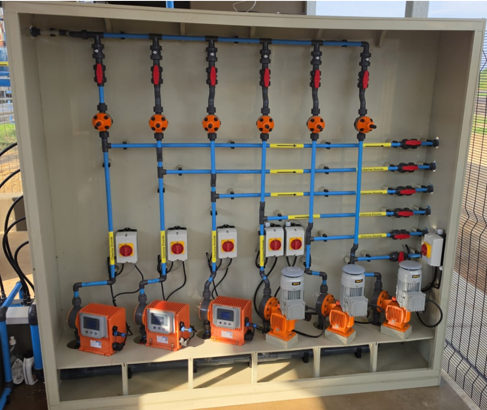
Dosing pump installed and operating in a process environment.
Market Trends That Affect Supplier Choice
Third-party market data points to a continued shift in dosing pump demand. According to Grand View Research, water and wastewater treatment accounts for about 23.2% of the metering pump application share. Mordor Intelligence reports that motor-driven metering pumps held a 54.45% revenue share in 2025, while solenoid-driven dosing pumps are projected to grow at a CAGR of 5.88% through 2031. A separate study by HTF Market Intelligence placed the global chemical injection pump market at USD 3.5 billion in 2024. OEC data also shows China's liquid pump exports, including dosing types, reached USD 14.3 billion in 2024, reinforcing the role of Chinese manufacturing capacity in global supply chains.
These numbers suggest that dosing pumps are moving toward more automated and energy-efficient designs. Digital dosing pumps with remote control, IP65-rated enclosures, and low power consumption fit this trend. WRS states that its entire dosing pump line has completed digital and intelligent upgrades, which is consistent with the industry move toward data integration and information-linkage feedback in fluid dosing.
For a procurement team, this means evaluation criteria should include not just hydraulic parameters but also control mode, protection rating, and compatibility with plant automation. Solenoid pumps, for example, are now available with manual and remote control options, allowing simpler integration into distributed control systems.
Direct OEM vs. Traditional Distribution: Trade-offs
Traditional procurement routes often involve distributors that aggregate products from multiple manufacturers. This model can be useful when a buyer needs standard products quickly or wants to compare several brands with one contact. However, it also adds an intermediate layer for information, pricing, and after-sales support.
A direct OEM relationship, by contrast, shortens the chain. The buyer can request factory-verified test data, obtain custom voltage configurations, and receive direct technical support from the design team. WRS's ODM model, with an MOQ of 1 unit and a listed lead time of 3 days, is designed for projects where flexibility matters more than bulk purchasing.
One realistic boundary should be stated. Direct manufacturer support works best when the buyer can define the process parameters: flow rate, pressure, chemical compatibility, power supply, and control signal. If these requirements are unclear, the buyer may need additional engineering support that the manufacturer does not include in a standard quotation. In WRS's case, standard customization is primarily voltage-related; more complex mechanical modifications are evaluated case by case and may add engineering time. Buyers should therefore prepare a clear technical specification before contacting any OEM supplier.
OEM Supplier Evaluation Checklist
The following checklist condenses this article into a practical procurement tool:
| Evaluation area | What to verify |
|---|---|
| Production depth | Factory location, facility size, workforce, R&D team size, annual output |
| Customization | ODM/ODM mode, standard modification options (e.g., voltage), lead time |
| Order flexibility | MOQ, monthly capacity, payment terms |
| Quality control | Percentage of units tested, pre-shipment inspection offer |
| Certification | Certificate number, issuing body, covered series, validity, referenced standards |
| Material options | PVC/PVDF/SS316 availability and recommended use for corrosive media |
| System support | Accessories, dosing systems, instrumentation, remote support, local service network |
Future Outlook
As industrial plants push for higher precision and data transparency, dosing pump suppliers will be judged by their ability to integrate mechanical, electrical, and digital functions. The move toward chemical dosing systems, streaming current monitoring, and digital dosing hardware is already visible in WRS's product range. With a factory annual output of 30,000 units and service coverage in more than 10 countries, the company has the structural capacity to support both initial installation and long-term maintenance. Local after-sales service in countries such as Singapore, Thailand, Malaysia, Vietnam, South Korea, Japan, Russia, Chile, South Africa, Angola, and Turkey strengthens execution support for international orders.
For buyers, the long-term question is not which single pump model to choose, but which supplier can grow with the project. The answer depends on verified production facts, not promotional language.
For detailed technical sheets, the company publishes a diaphragm separator brochure at cdn.socialarks.com/sbsp/25120/common/2026/0724/Diaphragm%20Separator.pdf.
FAQ
Q: What OEM or ODM capabilities does WRS PTE LTD offer?
WRS operates in ODM production mode. Standard customization includes voltage options, and the company has a monthly capacity of 5,000 units. The minimum order quantity is 1 unit.
Q: What are the MOQ and lead time for dosing pumps?
The MOQ is 1 unit, and the listed lead time is 3 days. Larger orders should be confirmed with the supplier based on configuration and volume.
Q: How does WRS ensure quality before shipment?
The factory applies 100% testing to each pump. Procurement terms also include pre-shipment inspection as an acceptance step.
Q: Which dosing pump series are covered by the CE certificate?
CE certificate 3N240528.ZWMTU36, issued by ECM, covers EML, EMG, EMA, EMB, EPS, EPM, EHS, EHM, ML, MLS, MG, MA, MB, PS, PM, PL, PD, PT, HS, HM, HL, HD and HT series. It is valid until 2029-05-27 and references EN ISO 12100:2010 and EN 60204-1:2018.
Q: What pump head materials are recommended for corrosive chemicals?
Available materials include PVC, PVDF, SS316 and SS316L. For highly corrosive media, a PVDF pump head is recommended.
Q: What after-sales support is available for export buyers?
Remote support is provided. WRS also states that after-sale service is available in more than 10 countries, including locations in Southeast Asia, Russia, South America and other regions.