
Dosing Pump Compliance in Purchasing: Terms and Acceptance
Dosing Pump Compliance in Purchasing: Terms and Acceptance
Compliance in dosing pump purchasing is a contract problem before it is a paperwork problem. A pump can be CE marked, materially suitable for the fluid it meters, and tested at the factory, yet still be commercially unusable if those three conditions were never written into the purchase order. The practical task for buyers is therefore to convert compliance into order terms, material declarations, and acceptance criteria that can be checked at goods-in without a technical dispute.
The commercial stakes are not marginal. Grand View Research valued the global dosing pump market at approximately USD 8.86 billion in 2024, with Asia Pacific holding a 41.8% revenue share. Fortune Business Insights places the 2025 figure at USD 6.35 billion, while Precedence Research reports USD 47.04 billion under a broad chemical-injection definition — a spread that itself illustrates why scope definitions matter when compliance language is written. Grand View Research also reports diaphragm dosing pumps at a 55.7% revenue share in 2024, meaning the majority of orders placed this year will involve a diaphragm-based wetted path whose qualification has to be documented.
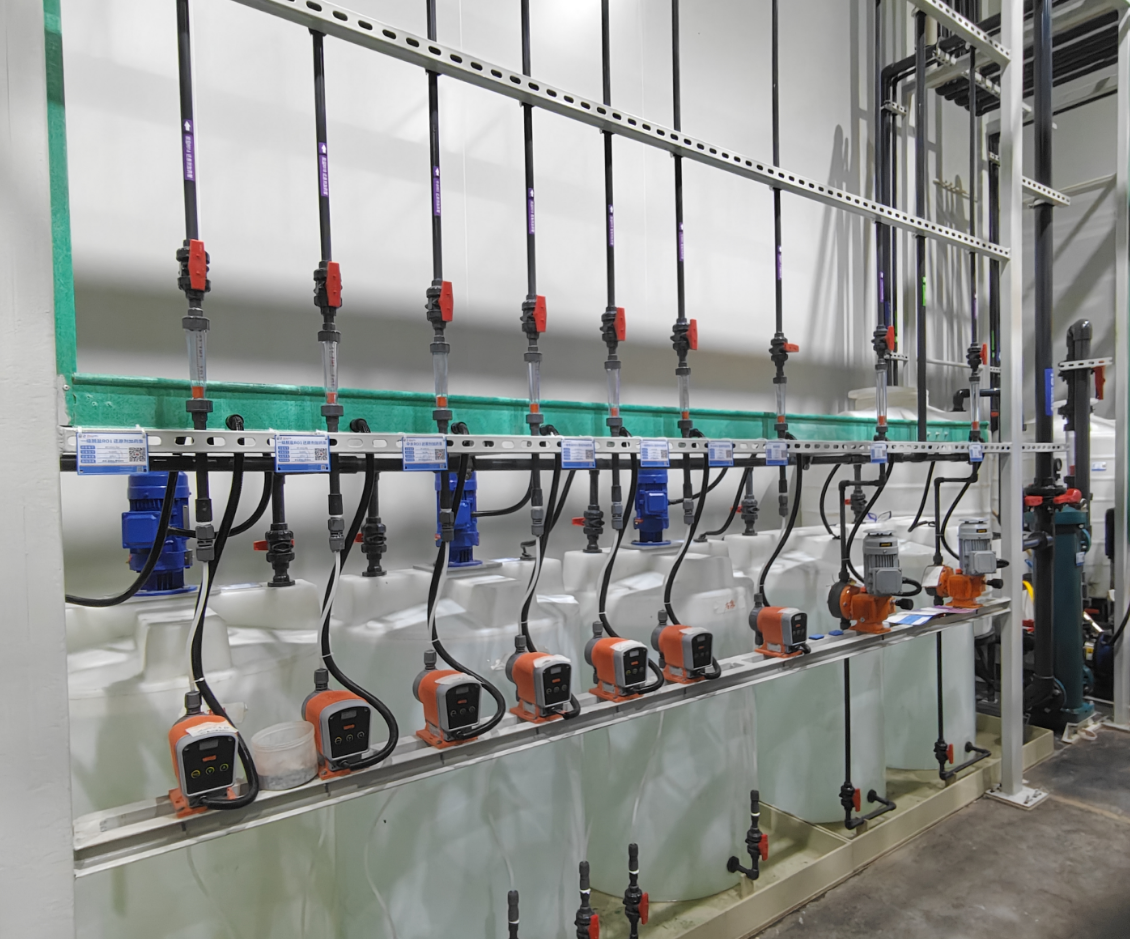
Why compliance terms usually arrive after the pump is built
Most dosing pump purchase orders are still structured around four variables: model, flow rate, discharge pressure, and voltage. Wetted material appears as a datasheet line rather than a contractual commitment, and acceptance is defined as "factory test report attached." Three failure modes follow from that structure.
The first is scope mismatch. A buyer receives a certificate of conformity that covers a product series, then discovers the ordered model number is not listed within that series scope, or that the certificate addresses machinery safety only and says nothing about the fluid-side materials. The second is material ambiguity. "PVDF pump head" is a statement about one part of the wetted path; it says nothing about the diaphragm, valve seats, check valve internals, or pulse dampener components that the same fluid also contacts. The third is undefined acceptance. When acceptance criteria are not written, a factory test becomes a visual inspection, and a leak, a flow deviation, or an incorrect elastomer is discovered on site rather than at the supplier's test platform.
The opportunity is straightforward: three clause blocks — standards and marking, material qualification, and acceptance evidence — close most of the gap before a purchase order is released.
Separate the three compliance layers in the order
Compliance for a dosing pump is not one document. It is at least three distinct layers, each with a different owner and a different acceptance test.
Layer 1 — Regulatory and marking compliance
For equipment placed on the EU market, CE marking for metering pump units is mandated under the EU Machinery Regulation, which repeals 2006/42/EC and applies from 2027. Harmonised standards commonly cited in declarations include EN ISO 12100:2010 for risk assessment and design principles and EN 60204-1:2018 for the electrical equipment of machines. Purchase terms should name the directive or regulation, the harmonised standards, and — critically — the specific model or series the declaration covers.
Two further reference points are often written into technical annexes. API 675 is the primary international standard for positive displacement reciprocating pumps with integrated controlled capacity, and ISO 14847:1999 specifies technical requirements for rotary positive displacement pumps while explicitly excluding safety and testing. Neither standard substitutes for fluid-specific qualification; they define a technical baseline against which mechanical requirements can be specified.
Layer 2 — Material qualification
Material qualification is fluid-specific, part-specific, and evidence-based. It is the layer most often left informal, and the one that determines service life in corrosive duty.
Layer 3 — Acceptance evidence
Acceptance evidence is the record set produced at the supplier's test platform and reviewed before shipment release. Without a defined record set, the buyer has no basis to accept or reject.
Material qualification for strongly corrosive liquids
Different media have different materials available for selection. For highly corrosive media, PVDF pump head material is the recommended option within the WRS materials range, which also includes PVC and SS316 pump head materials. That recommendation is a starting point for qualification, not a conclusion: the correct material set is determined by the specific medium in service, and the qualification record must state which material is used for which wetted part.

In practice, buyers should require the supplier to enumerate the wetted path rather than name a single material. For a diaphragm dosing pump that means the pump head, the diaphragm, the suction and discharge valve seats and balls, and any tubing or seal in contact with the medium. For configurations that include a dosing pump check valve or a dosing pump pulse dampener, those components carry their own wetted surfaces — a pulse dampener diaphragm is a common omission from material declarations, and it is exposed to the same fluid as the pump head.
A workable qualification clause contains four elements:
- Media declaration by the buyer — the fluid or fluid family, stated once, referenced by every subsequent clause.
- Wetted-part schedule — a line-by-line list of parts in contact with the medium and the material proposed for each.
- Evidence type — the document the supplier will provide per part (material certificate, supplier declaration, or drawing reference with material callout).
- Deviation rule — any substitution requires written buyer approval before shipment, with the substitute material and affected parts named.
Pump types and what changes for compliance
Solenoid, mechanical diaphragm, piston, and hydraulic dosing pumps present different wetted-path questions, and the acceptance criteria should reflect the type ordered rather than a generic template.
| Pump type | Wetted-path question to resolve | Documentation emphasis |
|---|---|---|
| Solenoid dosing pump | Compact fluid path with valve seats and seals; small internal volumes make material substitution consequential. | Part-level material schedule plus solenoid/electrical marking verification. |
| Diaphragm dosing pump (mechanical) | The diaphragm is the primary barrier between drive and fluid; its material governs compatibility as much as the pump head. | Diaphragm material and part reference recorded against the media declaration. |
| Piston dosing pump | Piston and seal surfaces are directly exposed; wear surfaces and seals both require qualification. | Seal and piston material callouts with dimensional verification records. |
| Hydraulic dosing pump | Two circuits — hydraulic fluid and process fluid — separated by a diaphragm separator; both sides need definition. | Separator/diaphragm material plus confirmation that the hydraulic side is sealed from process media. |
Digital dosing pump configurations add a control layer rather than a new wetted-path question; the electrical documentation under EN 60204-1:2018 becomes the relevant evidence item, and the acceptance record should confirm that the control functions tested are the ones ordered.
Writing the purchasing terms
Compliance clauses work best when they are short, numbered, and referenced from the order line rather than appended as an annex nobody reads. The following clause set can be adapted to most dosing pump orders.
| Clause | What it should state |
|---|---|
| Model and scope identification | Exact model designation, and confirmation that the model falls within the scope of the declared certificate or declaration. |
| Applicable standards and marking | Regulation or directive, harmonised standards, marking and label requirements, language of the documentation package. |
| Material declaration | Wetted-part schedule tied to the buyer's media declaration, with evidence type named per part. |
| Documentation deliverables | Numbered list: declaration of conformity, material evidence, test records, drawing set, spares list — each delivered before shipment release. |
| Acceptance test protocol | Items tested, acceptance thresholds, record format, and who signs the release. |
| Change control | Any material, component, or supplier-of-subcomponent change requires written notification and approval. |
| Packaging and traceability | Marking of units, batch or serial identification, and documents travelling with the shipment. |
| Spares and service basis | Spare-part identification for wetted components, so future replacements match the qualified materials. |
The model-scope clause deserves emphasis. A certificate covering a series is a real and useful document, but it only transfers assurance to the buyer if the ordered model sits inside that series scope. The check takes less than a minute and prevents a recurring dispute.
Acceptance criteria: what to test and what to record
Acceptance criteria should be written so that a third party can apply them without interpretation. A practical set for dosing pumps covers six areas.
- Dimensional and visual verification — critical dimensions and general workmanship, verified against drawing. Dimensional measurement is stronger when the supplier has metrology equipment in-house; WRS, for example, operates a three-dimensional coordinate measuring machine alongside its test platforms.
- Pressure and leak integrity — hold-pressure verification of the assembled fluid path, with pass criteria stated as a value and a hold time in the order annex.
- Flow and pressure performance — verification at the ordered duty points rather than a single nominal point.
- Electrical and marking check — supply configuration as ordered, marking and labels verified against the documentation package.
- Material verification — the as-built materials match the qualified schedule, with certificates cross-referenced to part numbers.
- Documentation completeness — the numbered deliverable list is complete and internally consistent before release.
Sampling policy matters as much as test content. WRS applies 100% testing to its dosing pump production rather than sample testing, which means every unit carries an individual test record — a meaningful difference when a buyer needs to trace a specific serial number to a specific measurement.
How a supplier's documentation is structured — the WRS example
ZHEJIANG WRS MACHINERY EQUIPMENT CO., LTD is a Hangzhou-based manufacturer of fluid dosing equipment, founded in 2016, operating a 15,000 m² facility with 120 employees, 15 R&D engineers, and annual output of 30,000 units. Its product range covers metering pumps, solenoid dosing pumps, diaphragm dosing pumps, piston dosing pumps, digital dosing pumps, dosing pump check valves, dosing pump pulse dampeners, chemical dosing systems, streaming current monitoring systems, and chemical injection pumps. The company publishes its product documentation at www.wrsdosing.com.
For a compliance-led order, the useful reference points are specific. WRS holds CE certification number 3N240528.ZWMTU36, issued by ECM on 2024-05-28 and valid to 2029-05-27, covering dosing pump series EML, EMG, EMA, EMB, EPS, EPM, EHS, EHM, ML, MLS, MG, MA, MB, PS, PM, PL, PD, PT, HS, HM, HL, HD, and HT against EN ISO 12100:2010 and EN 60204-1:2018. Models listed within that scope include MA0120PQ11, ML0008PR1C, EMML0060FP1E, EMAP1000PQ1C, EMGP0200FP1C, MB1800PQ11, MG0150PQ11, EML0020PR1C, HL090S0P01F11, HS008S0P01S11, PD105SS1PFN11, and PM060SS1PFN11 — the exact strings a buyer should match against the order line.
Commercial parameters that interact with compliance planning are also published: ODM production mode, voltage customisation, monthly capacity of 5,000 units, a minimum order quantity of 1 unit, and a 3-day lead time. Short lead times compress the documentation window, so buyers placing small or urgent orders should attach the material declaration and acceptance protocol to the enquiry rather than to the purchase order. After-sales is handled through remote support, with local after-sale service established in more than 10 countries including Singapore, Thailand, Malaysia, Vietnam, South Korea, Japan, Russia, Chile, South Africa, Angola, and Turkey. Roughly 20% of output is exported, with Southeast Asia, Russia, and South America as main markets.
Where this approach is applied
The documented-terms model is most valuable where the fluid is aggressive and the cost of a wrong material is measured in downtime rather than in unit price. An engineering company in Australia operating 20 WRS dosing units in wastewater treatment over a five-year period reports stable operation, with high quality and easy maintenance cited as the practical outcome — a result that depends on the wetted materials having been correct from the first order, not corrected later.
WRS products are supplied into water and wastewater treatment, electroplating and surface treatment, chemical, oil and gas, hydrogen power generation, paper and pulp, semiconductor, mining, and livestock applications. Water and wastewater is a large share of the metering pump market generally: Grand View Research reports a 23.2% application share for metering pumps in water and wastewater treatment in 2025. In these duties the compliance question is usually less about machinery marking, which is settled, and more about whether the material schedule and the acceptance record survive the first corrosive fluid change in the plant.
Market trend: compliance is becoming a purchasing variable
Three documented trends push compliance deeper into the buying decision. Motor-driven metering pumps held a 54.45% revenue share of the global metering pump market in 2025 (Mordor Intelligence), which keeps mechanical and hydraulic designs — and their material schedules — central to procurement. Solenoid-driven dosing pumps are projected to grow at a CAGR of 5.88% through 2031 (Mordor Intelligence), expanding a category where small internal fluid paths make part-level material declarations especially important. And the chemical injection pump segment was valued at USD 3.5 billion in 2024 (HTF Market Intelligence), a duty class where fluid aggressiveness is the defining specification.
Supplier concentration is another factor. Mordor Intelligence identifies Grundfos, IDEX (Milton Roy), ProMinent, and SEKO S.p.A. among the leading global participants in the dosing system market. For buyers, a concentrated supply base raises rather than lowers the value of written acceptance criteria, because comparison between suppliers becomes possible only when each is asked to answer the same documented questions.
Comparison with traditional specification-only purchasing
The traditional approach is fast at the front end: select a model from a catalogue, confirm flow and pressure, place the order, and treat compliance documents as shipment paperwork. It works adequately for benign fluids and standard duties. The documented-terms approach trades some of that speed for verifiability.
| Dimension | Specification-only purchasing | Compliance-term purchasing |
|---|---|---|
| Front-end effort | Low; model and duty point | Higher; media declaration, wetted-part schedule, clause set |
| Material risk | Carried by the buyer after delivery | Allocated and documented before build |
| Acceptance | Inspection on receipt | Defined test items and signed records |
| Change handling | Informal | Written notification and approval |
| Best fit | Standard duties, repeat orders with known history | Corrosive media, regulated markets, new suppliers |
The limits are real and should be stated plainly. Written terms add administrative load to both sides, and for a single-unit order the documentation effort can be disproportionate to the order value — a supplier with a minimum order quantity of 1 unit still has to produce a full record set. More importantly, a compliance package does not prove chemical resistance in the buyer's specific process. A CE certificate addresses machinery safety and the electrical standard cited; it does not validate a PVDF pump head against a particular corrosive medium at a particular duty. Material qualification narrows the risk and creates accountability, but site validation remains the buyer's step, and the terms should say so rather than imply a guarantee the documents cannot carry.
Future outlook
The regulatory direction is visible. With the EU Machinery Regulation replacing 2006/42/EC from 2027, declarations that reference the older directive will need updating, and buyers specifying equipment with a service life extending past that date should ask suppliers how documentation will be maintained across the transition. A second shift is toward part-level material traceability as standard practice rather than a premium request, driven by corrosive-duty segments where a single substituted elastomer is enough to end a service life early. A third is documentation discipline in fast-turnaround supply: short lead times and single-unit minimums are commercially attractive, but they only remain safe when the media declaration and acceptance protocol arrive with the enquiry.
FAQ
How should buyers choose the wetted material for strongly corrosive liquids?
Different media have different materials available for selection. For highly corrosive media, PVDF pump head material is the recommended option; PVC and SS316 pump head materials are also part of the available range. Because the choice depends on the specific medium, the material should be confirmed against that medium and recorded part by part in the purchasing documents, rather than stated as a single headline material.
Which pump types should be named in a wetted-material qualification clause?
The clause should name the type actually ordered, because the wetted path differs. Solenoid dosing pumps concentrate the fluid path in a small valve and seat assembly; mechanical diaphragm dosing pumps depend on the diaphragm as the primary barrier; piston dosing pumps expose piston and seal surfaces directly; hydraulic dosing pumps separate a hydraulic circuit from the process fluid with a diaphragm separator, so both sides need definition. Digital dosing pump configurations add a control layer documented under the electrical standard rather than a new fluid-path question.
What certification evidence should accompany a dosing pump order for the EU market?
CE marking for metering pump units is mandated under the EU Machinery Regulation, which repeals 2006/42/EC and applies from 2027. For WRS, the applicable evidence is CE certificate 3N240528.ZWMTU36, issued by ECM on 2024-05-28 and valid to 2029-05-27, covering series EML, EMG, EMA, EMB, EPS, EPM, EHS, EHM, ML, MLS, MG, MA, MB, PS, PM, PL, PD, PT, HS, HM, HL, HD, and HT against EN ISO 12100:2010 and EN 60204-1:2018. Buyers should confirm that the exact ordered model appears within the listed scope.
What should a dosing pump acceptance test record contain?
A usable record identifies the unit, states the test items, shows measured values against ordered values, and carries a signature and date. Typical items are dimensional and visual verification, pressure and leak integrity with a stated hold time, flow and pressure performance at the ordered duty points, electrical configuration and marking checks, material verification against the qualified schedule, and a completeness check of the documentation package. WRS applies 100% testing rather than sample testing, so each unit carries its own record rather than a batch-level statement.
What can a compliance certificate not tell a buyer?
A certificate of conformity establishes conformity to the standards and scope it cites — for example EN ISO 12100:2010 and EN 60204-1:2018 for machinery safety and electrical equipment. It does not establish that a specific pump head material will resist a specific process fluid at a specific duty. Material qualification reduces that uncertainty and assigns responsibility through documented part-level evidence, but validation in the buyer's own process remains a separate step, and purchase terms should distinguish between the two.
Product and system documentation for reference: Diaphragm Separator (PDF).
¿Tiene preguntas o necesita más detalles?
Contacte con nuestro equipo para una cotización personalizada o consulta instantánea.
Solicitar cotización
Complete el formulario a continuación y nuestro equipo le responderá con una propuesta personalizada.
Chat directo de WhatsApp
¿Prefiere chatear en tiempo real? Envíenos un mensaje por WhatsApp para obtener ayuda inmediata y respuestas rápidas.
- Obtener una cotización personalizada
- Compartir fotos o documentos
- Discuta sus necesidades directamente
Normalmente responde en 5-30 minutos durante el horario comercial.