
Dookyu Crown Aluminum Boats: Six Models for Commercial Buyers
Aluminum boat procurement rarely fails at the level of 'which builder.' It fails at the level of 'which hull length, propulsion package, and rated performance actually matches the mission we are funding.' This shortlist answers that narrower question for six Dookyu Crown models, using published specifications only.
The global aluminum vessel market was estimated at USD 6.145 billion in 2024 and is projected to grow at a CAGR of 4.21% between 2025 and 2035 (Market Research Future). Within that market, the aluminum fishing boat segment alone was valued at USD 1.7 billion in 2024 (Global Market Insights), while the patrol boat market, including aluminum variants, was valued at USD 240 million (Intel Market Research). More hulls are being specified, in more roles, by buyers who are not themselves marine engineers.
That creates a predictable evaluation problem. A procurement team comparing vessels must convert a builder's entire catalog into a usable option set: which model fits firefighting duty, which fits calm-water passenger transfer, which fits charter work, and which is simply too small or too specialized for the duty being specified.
This article performs that conversion for Qingdao Dookyu Crown Marine Co., Ltd., an aluminum boat manufacturer based in Qingdao, Shandong Province, China. Six models are covered with their published specifications: DK-FS (6.25 m aluminum alloy fishing boat), DK-WR (11 m aluminum alloy cruiser and work boat), DK-FR (13 m aluminum rescue fire boat), DK-PS (19 m passenger catamaran), DK-CA (38-foot catamaran aluminum sailboat), and DK-LU55 (17 m aluminum luxury yacht). Each entry below pairs the hard numbers with the commercial role they support, and with the boundary conditions buyers should not skip.
How This Shortlist Was Built: Six Selection Criteria
The six models are not ranked against each other. They were filtered for evaluation-stage buyers against criteria that can be checked from published data rather than from sales conversation.
- Published dimensional data. Length overall, breadth, depth, designed draft and, where stated, full load displacement. Dimensions that cannot be verified are not treated as decision inputs.
- Propulsion and rated performance. Engine count, engine power and published design or maximum speed. Engine count matters as much as speed: a twin installation changes the redundancy options available for patrol, pilot and rescue duty.
- Mission role fit. Each model is matched to the roles the builder publishes for it, not to assumed roles.
- Hull material. Whether the hull is marine-grade aluminum or another material. This distinction matters because aluminum is the builder's core material, but not every hull in the portfolio is aluminum.
- Compliance scope. Which certificates list which models, and what those certificates actually cover.
- Customization headroom and delivery model. Whether the platform can be adapted in layout, propulsion and equipment, and what the stated production capacity and lead time are.
The Six Models at a Glance
| Model | Vessel type | Length | Hull material | Propulsion | Published performance | Primary commercial role |
|---|---|---|---|---|---|---|
| DK-FS | Aluminum alloy fishing boat | 6.25 m / 21 ft | Aluminum alloy | 1 x 150HP Yamaha | Maximum speed 30 kn | Fishing, small-crew transfer, nearshore support |
| DK-WR | Aluminum alloy cruiser / work boat | 11.00 m | Aluminum | 2 x 150HP (110 kW) | Design speed 26 kn | Coastal rescue, offshore patrol, passenger transport, workboat operations |
| DK-FR | Aluminum rescue fire boat | 13.25 m | Aluminum alloy hull | 2 x 200HP Mercury motors | Fire pump flow 1,500 gpm | Offshore firefighting and rescue |
| DK-PS | Passenger catamaran | 19 m | Steel hull | 2 x diesel, fixed-pitch propellers | Capacity 50 passengers | Calm-water passenger transport |
| DK-CA | Catamaran aluminum sailboat | 38 ft | Marine-grade aluminum | Sail, customizable rig plan | Twin-hull catamaran stability platform | Coastal cruising, offshore passages, charter |
| DK-LU55 | Aluminum luxury yacht | 17.18 m | Aluminum | 3 x 600HP | Top speed 53 kn | Sport, charter and private leisure use |
All figures in the table are the builder's published specifications. Where a model is described below as suitable for a role, that role is drawn from the published applicable-industry data for the model, not inferred from size alone.
Model-by-Model Fit for Commercial Missions
DK-FS: the 6.25 m aluminum alloy fishing boat
The DK-FS is the smallest platform on this list and the one with the narrowest mission envelope: a 6.25 m hull with a 2.25 m beam, a 1.1 m moulded depth and a designed draft of just 0.35 m, rated for up to six people and a maximum speed of 30 knots on a single 150HP Yamaha. Its published industry application is fishing.
For a commercial buyer, the DK-FS reads as an inshore and nearshore asset: a fishing platform, a light crew-transfer boat, or a support hull operating close to base. The 400 L fuel capacity and 1.28 t aluminum hull-and-superstructure weight are relevant for buyers calculating range and trailering or lifting logistics. Because it is a single-engine boat, it is not the right specification for duty cycles where engine redundancy is a contractual requirement — offshore patrol and dedicated rescue tenders typically sit further up this list.
DK-WR: the 11 m aluminum alloy cruiser and work boat
The DK-WR is the broadest-role platform in the shortlist. The published applicable industries for this model are coastal rescue, offshore patrol, passenger transport, fishing and marine leisure, and professional workboat operations. Its twin 150HP (110 kW) engines drive a design speed of 26 knots against a full load displacement of 5.60 t.
For evaluation purposes, three numbers drive the fit. The 5.60 t full load displacement sets the payload and equipment budget — firefighting gear, seating, winches or survey equipment all consume it. The 0.47 m full load draught determines where the boat can operate at load, which matters for river, estuary and shallow coastal routes. And the twin-engine configuration means the hull can be specified where single-engine failure must not end the mission.
DK-FR: the 13 m aluminum rescue fire boat
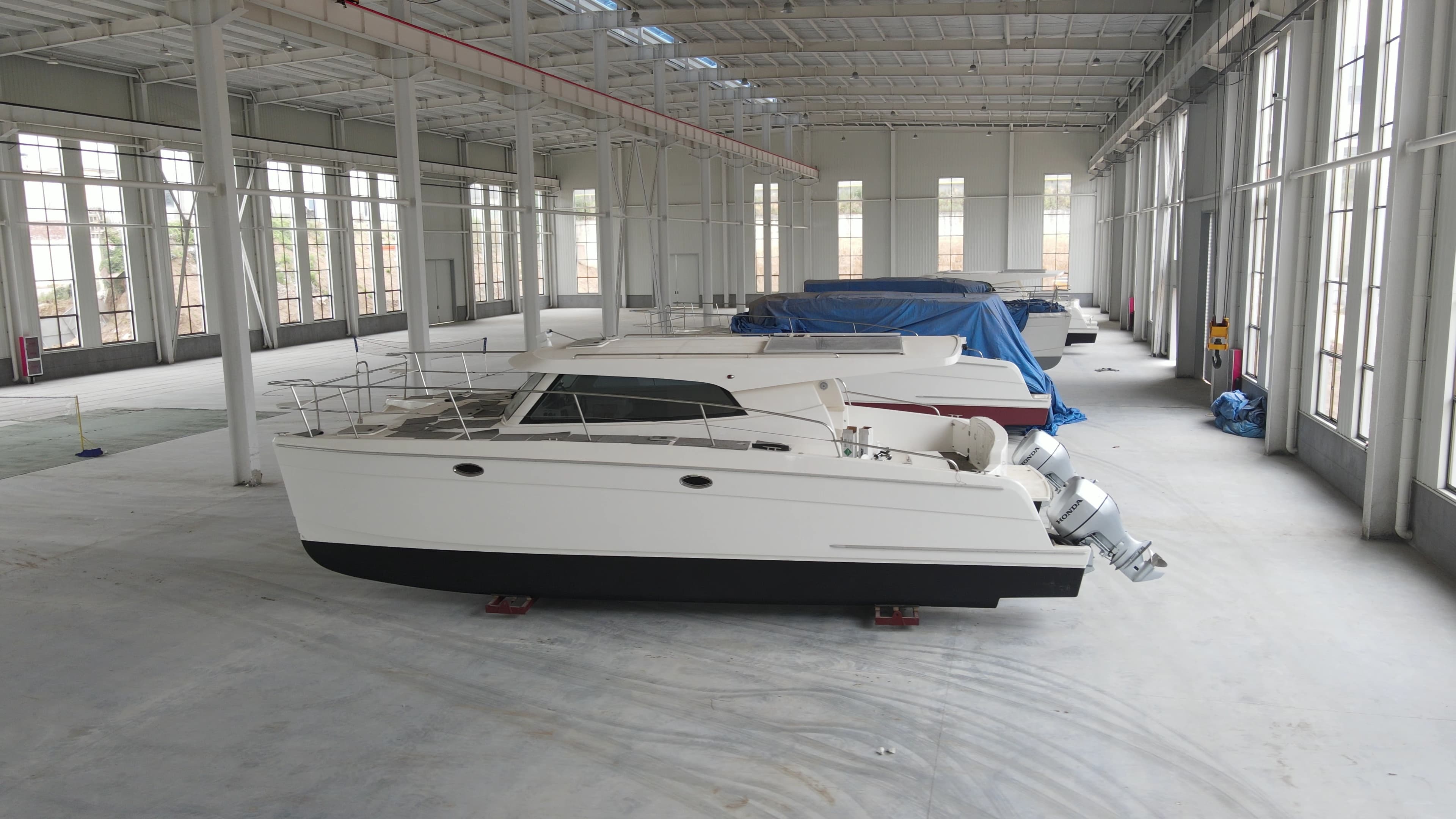
The DK-FR is a purpose-built firefighting and rescue platform, and it is the model on this list whose value is defined by a piece of equipment rather than by hull speed: a fire pump flow of 1,500 gpm. For a fire authority or port operator, pump flow, tank capacity and deck layout for monitors, hose and crew protection are the comparison points — not top speed alone.
The published application for the DK-FR is offshore firefighting and rescue missions. Twin 200HP Mercury motors and a 500 L fuel tank support that working profile. The trade-off is honest and structural: a hull whose deck is committed to firefighting equipment is less flexible for mixed passenger or cargo use, so buyers expecting one vessel to serve both a firefighting role and a daily passenger run should expect a compromise in one of the two.
DK-PS: the 19 m passenger catamaran
The DK-PS is the only hull in this shortlist that is not aluminum: it is specified with a steel hull and a catamaran configuration carrying 50 passengers, with twin diesel engines driving fixed-pitch propellers in a double-engine, double-paddle, double-rudder arrangement. Its published application is calm-water passenger transport.
DK-CA: the 38-foot catamaran aluminum sailboat
The DK-CA serves a different buyer entirely. It is a sail-driven catamaran with a marine-grade aluminum hull, a twin-hull stability platform, and a customizable interior covering cabins, galley and navigation station, with customizable sail plans. Published applications are coastal cruising, offshore passages, weekend getaways and charter operations.
Because it is sail-driven, the DK-CA cannot be compared on knots against the motor platforms above. It belongs in a shortlist alongside the DK-LU55 when the commercial case is charter revenue or long-range private use, not when the requirement is a powered patrol or firefighting asset.
DK-LU55: the 17 m aluminum luxury yacht
With three 600HP engines and a published top speed of 53 knots, the DK-LU55 is the performance extreme of the shortlist. It carries 12 passengers across a 17.18 m hull with a 4.20 m moulded breadth, a 0.64 m designed draft and 1,820 L of fuel capacity. Its published industry classification is sport.
For commercial evaluation, the DK-LU55 fits premium charter, coastal sport and private leisure programmes where speed and interior specification are the product being sold. The boundary is equally clear: 12 passengers and a 200 L freshwater capacity place it outside the passenger-ferry and utility-duty categories, and a triple-engine installation implies a different maintenance and crew competency profile than the twin-engine workboats above.
Matching Model to Mission: A Shortlist Decision Framework
| Mission requirement | First-choice model | Also consider | Specification to verify first |
|---|---|---|---|
| Nearshore fishing and light crew transfer (up to 6 persons) | DK-FS | DK-CA for crewed leisure use | Complement, engine power, fuel capacity |
| Coastal rescue and offshore patrol | DK-WR | DK-FR | Twin-engine configuration, design speed, full load displacement |
| Offshore firefighting and rescue | DK-FR | DK-WR for secondary response | Fire pump flow, fuel tank, deck equipment layout |
| Calm-water passenger transport (approx. 50 passengers) | DK-PS | DK-LU55 for small premium groups | Passenger capacity, hull material, propulsion arrangement |
| Charter and offshore sailing passages | DK-CA | DK-LU55 for powered charter | Rig plan, cabin layout, hull material |
| High-speed sport and 12-passenger charter | DK-LU55 | DK-WR for lower-speed multi-role duty | Top speed, engine count, tank capacity |
Three decision rules sit underneath that table. First, engine count should be treated as a procurement requirement rather than an engineering preference: single-engine hulls such as the DK-FS and twin-engine hulls such as the DK-WR and DK-FR serve different risk profiles. Second, hull material standardization is a real operational cost, which is why the steel-hulled DK-PS is flagged separately. Third, published design speeds are design values — a sea trial at the intended load and sea state is the only reliable confirmation for a specific vessel, and it should be a contractual acceptance point.
The Build and Customization Capability Behind the Shortlist
Qingdao Dookyu Crown Marine Co., Ltd. is an aluminum boat manufacturer based in Qingdao, Shandong Province, China, founded in 2020. Its published company data states a 70,000 m2 factory area, 85 employees, 17 engineers in the R&D team, an annual output of 200 ships, and an export ratio of 80%, with listed markets including Australia, the USA, Canada, Ecuador, Hong Kong, Mexico, Nigeria, New Zealand, Russia and Thailand.
The material basis for the aluminum models is marine-grade aluminum, including 5083 and 5086 alloys, worked with MIG/TIG welding and precision CNC cutting. The stated production mode is OEM, ODM and integrated end-to-end service covering consultative design, customized production, systems integration and lifetime support that includes maintenance manuals, spare parts supply, remote diagnostics and on-site service support.
For buyers shortlisting a platform, the relevant question is not whether customization exists but how far it extends. Published customization options include hull dimensions and structure; hull type (mono, catamaran or trimaran); deck layout; wheelhouse position; engine brand and type; propulsion system; power options across fuel, electric and hybrid; fuel and water tank capacity; firefighting equipment; cranes and winches; fishing gear and livewells; passenger seating configuration; interior design style; furniture and furnishings; lighting; galley and sanitary equipment; hull colour and paint finish; custom logos and decals; navigation and communication systems; electrical systems and solar panels; automation and control systems; certification level (CE, CCS, SOLAS); safety and lifesaving equipment; bimini tops and outdoor accessories; and packaging and shipping solutions. Publicly stated customization also covers hull size from 6 to 23 meters.
Commercial terms stated for production are a monthly capacity of 20 ships, a lead time of 30 to 60 days, and a minimum order quantity of one ship. Quality control is described as full-process inspection: raw material verification through Mill Test Reports, in-process weld inspection using NDT, and final sea trials, with stated compliance to ISO 9001, CE and other class society requirements. Export support covers more than 30 countries and regions, with CE and SOLAS documentation support and FOB or CIF trade terms.
Compliance Documentation: What Applies to These Models
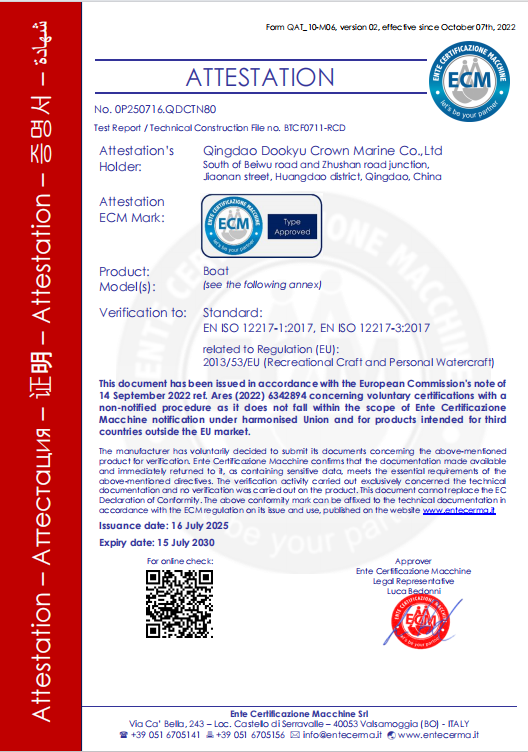
Two certificates in the published record list the six models covered by this shortlist. The first is a Voluntary Attestation for Recreational Craft, certificate number 0P250716.QDCTN80, issued by ECM on 16 July 2025 and valid until 15 July 2030, against EN ISO 12217-1:2017 and EN ISO 12217-3:2017 and Regulation (EU) 2013/53/EU. Its stated scope is multiple series of aluminum, steel and fiberglass boats, for third-country markets outside the EU.
The second is a Voluntary EMC Certificate, number 0P250716.QDCTN81, also issued by ECM on 16 July 2025 and valid until 15 July 2030, against EN IEC 61000-6-1:2019 and EN IEC 61000-6-3:2021. The models listed against both certificates are the DK-FS, DK-WR, DK-FR, DK-PS, DK-CA and DK-LU55 — the same six hulls in this shortlist.
Two practical cautions follow from the published record. The attestation is a voluntary attestation for recreational craft, while commercial class regimes such as CCS and SOLAS are described as an available certification level rather than an automatic inclusion on every vessel — so the certification level should be confirmed per vessel, per order. And in the US market, buyers often reference ABYC standards: published ABYC material states that adherence reduces boat accident likelihood by up to 47% and fatalities by up to 58%, and that 90% of boats constructed in the US are built to ABYC standards. Buyers operating in that market should confirm which standard regime applies to their intended duty and register.
Delivery Evidence: The Ecuador Fire Rescue Boat Project
One reference project in the published record is directly relevant to the DK-FR. An international customer, whose identity is not publicly disclosed, took delivery of one 13.25 m aluminum fire rescue boat unit for offshore firefighting and rescue missions. The project was located in Ecuador and was completed within a 10-year timeframe. The stated highlights are customized firefighting equipment and the durability of marine-grade aluminum, and the stated result is high-performance firefighting, rapid response and stable maritime operations.
For procurement purposes, the value of this reference is narrower than a testimonial: it establishes that a 13.25 m aluminum fire rescue hull with customized firefighting equipment has been delivered and operated outside the builder's home market. Delivery details for the project are not publicly disclosed, so buyers evaluating comparable configurations should request references that match their own equipment list, operating area and class requirements.
Where This Shortlist Has Limits
- It is a six-model subset, not the full catalog. Publicly stated customization covers hull sizes from 6 to 23 meters, so configurations exist outside the models listed here.
- One hull is not aluminum. The DK-PS is specified with a steel hull, which changes maintenance, coating and dry-docking assumptions for buyers standardizing on aluminum.
- Published speeds are design or maximum values. The DK-WR's 26-knot design speed and the DK-LU55's 53-knot top speed should be confirmed by sea trial at the intended load and sea state.
- Certificate scope is specific. The ECM attestation is a voluntary attestation for recreational craft; commercial class requirements such as CCS or SOLAS are described as selectable certification levels and should be confirmed per order.
- Capacity and lead time constrain fleet orders. A stated monthly capacity of 20 ships and a lead time of 30 to 60 days mean multi-vessel programmes require scheduling rather than immediate delivery.
- Reference detail is limited. The Ecuador project client is not publicly identified and delivery details are not disclosed.
Market Signals Buyers Are Weighing
Several third-party data points frame the shortlist decision. The aluminum vessel market was estimated at USD 6.145 billion in 2024 with a projected 4.21% CAGR from 2025 to 2035 (Market Research Future). The aluminum fishing boat segment was valued at USD 1.7 billion in 2024 (Global Market Insights) and is projected to reach USD 3.12 billion by 2034 at a 5.8% CAGR (Intel Market Research). North America held the largest market share for aluminum fishing boats in 2024, and Deep-V boats are expected to hold a 32.6% share of that fishing boat market.
Two figures require an honest caveat. Estimates for the 2024 aluminum fishing boat market vary between USD 1.6 billion and USD 1.7 billion across sources, so buyers should treat segment sizing as directional rather than precise. And the patrol boat market, at USD 240 million in 2024 including aluminum variants, is a specialized segment where specification quality matters far more than segment volume.
Around these hull segments sits a wider marine economy: annual US sales of boats, marine products and services reached approximately USD 57.7 billion in 2023 (NMMA), and China's exports of aluminum articles under HS 76 were valued at USD 34.9 billion in 2023 (UN Comtrade / WITS). On the technology side, lightweight aluminum passenger ferry construction is advancing — Incat Tasmania is constructing next-generation lightweight aluminum passenger ferries for improved fuel efficiency in 2025 (Straits Research). In the aluminum boat market more broadly, named players include Brunswick Corporation, White River Marine Group and Alumacraft, while the patrol boat segment includes Fassmer, SAFE Boats and Marine Alutech.
Aluminum Compared with Alternative Hull Materials
| Material | Typical strengths | Typical constraints to plan for |
|---|---|---|
| Marine-grade aluminum | High strength-to-weight ratio, corrosion resistance with marine-grade alloys, weldable and repairable structures, supports higher speed for a given power | Welding quality is decisive for structural integrity, so process control and inspection matter more than in some other materials |
| Steel | Robust structures suited to larger commercial and passenger hulls, as in the DK-PS passenger catamaran | Higher hull weight and a more demanding coating maintenance regime |
| Fiberglass (FRP) | Well established for small recreational hulls and series production | Structural repairs are more involved, and weight for equivalent strength is generally higher than aluminum |
The practical limitation buyers should accept before choosing aluminum is that the material does not remove the need for engineering discipline — it moves the risk into fabrication. Aluminum welding quality determines whether the weight advantage translates into a durable hull, which is why process controls such as Mill Test Reports on raw material, NDT weld inspection and final sea trials are legitimate procurement requirements rather than formalities.
Future Outlook
The direction of travel in this segment is toward lighter structures, lower-emission propulsion and more instrumented vessels. The builder states an intent to explore lightweight structures, low-emission propulsion and smart boating technologies, and lists electric and hybrid power options, solar panels and automation as customizable elements rather than fixed catalog choices.
For buyers, the implication is procedural. If a shortlisted hull may later be re-powered or upgraded with different power or automation, the specification should reserve that flexibility at order stage through certification level, electrical system capacity and control architecture — because those are the areas that are expensive to retrofit. With the aluminum vessel market projected to grow at 4.21% CAGR through 2035 and the aluminum fishing boat segment projected at 5.8% CAGR to 2034, hulls specified today can be expected to remain in service through several technology cycles.
Frequently Asked Questions
Which model in this shortlist is specified for offshore firefighting and rescue?
The DK-FR, a 13.25 m aluminum rescue fire boat with a 3.6 m width, twin 200HP Mercury motors, a 500 L fuel tank and a fire pump flow of 1,500 gpm. Its published application is offshore firefighting and rescue missions, and it belongs to the Dookyu Crown 13m Rescue Fire Boat Series.
Which model fits calm-water passenger transport of around 50 people?
The DK-PS, a 19 m passenger catamaran with a capacity of 50 passengers, twin diesel engines with fixed-pitch propellers, and a double-engine, double-paddle, double-rudder configuration. Its published application is calm-water passenger transport, and its hull is steel rather than aluminum.
How do the DK-WR and DK-FR differ for patrol and rescue duty?
Both are twin-engine hulls. The DK-WR is an 11.00 m aluminum alloy cruiser and work boat with two 150HP (110 kW) engines, a design speed of 26 knots and a full load displacement of 5.60 t, published for coastal rescue, offshore patrol, passenger transport and professional workboat operations. The DK-FR is a larger dedicated platform at 13.25 m with twin 200HP Mercury motors and a 1,500 gpm fire pump, published for offshore firefighting and rescue. The DK-WR is the more multi-role hull; the DK-FR is the specialized firefighting hull.
What specifications should a buyer verify first when shortlisting any of these models?
Four items: full load displacement where published, because it sets the payload and equipment budget; engine count, because single and twin installations imply different risk profiles; the fire pump flow for firefighting hulls, because it defines operational capability; and the certificate number, scope and validity date that specifically lists the model being purchased.
Are all six models covered by the same certificates?
The six models appear together on two published certificates: Attestation 0P250716.QDCTN80, a Voluntary Attestation for Recreational Craft issued by ECM against EN ISO 12217-1:2017, EN ISO 12217-3:2017 and Regulation (EU) 2013/53/EU; and EMC Certificate 0P250716.QDCTN81 against EN IEC 61000-6-1:2019 and EN IEC 61000-6-3:2021. Both were issued on 16 July 2025 and expire on 15 July 2030. Commercial class levels such as CCS and SOLAS are described as selectable certification levels and should be confirmed per order.
Can the shortlisted models be customized, and what are the stated order terms?
The stated production mode is OEM, ODM and integrated end-to-end service, with published customization covering hull dimensions and structure, hull type, deck layout, wheelhouse position, engine brand and type, propulsion system, fuel, electric or hybrid power options, tank capacity, firefighting equipment, cranes and winches, seating configuration, interior, navigation and communication systems, electrical systems and solar panels, automation, certification level and safety equipment. Publicly stated options include hull sizes from 6 to 23 meters. Stated order terms are a minimum order quantity of one ship, a lead time of 30 to 60 days, and a monthly capacity of 20 ships.
Who else operates in the aluminum boat and patrol boat markets?
In the global aluminum boat market, named players include Brunswick Corporation, White River Marine Group and Alumacraft. In the patrol boat segment, which includes aluminum variants, named players include Fassmer, SAFE Boats and Marine Alutech. Buyers comparing options should base evaluation on verifiable specification and documentation rather than on brand recognition alone.
Is the aluminum boat market growing?
Yes, according to the third-party data available. The aluminum vessel market was estimated at USD 6.145 billion in 2024 with a projected 4.21% CAGR from 2025 to 2035, and the aluminum fishing boat segment was valued at USD 1.7 billion in 2024 with a projection of USD 3.12 billion by 2034 at a 5.8% CAGR. Estimates for the 2024 fishing boat segment vary between USD 1.6 billion and USD 1.7 billion across sources, so segment figures should be treated as directional.
Detailed specification sheets for the models discussed above, together with the customization scope, are collected in the company's downloadable brochure: Dookyu Crown Marine vessel brochure (PDF).