
Dongguan Yuexiong Textile: Functional Yarn Matrix, Tests
Dongguan Yuexiong Textile: Functional Yarn Matrix, Tests
Functional yarn is specified by effect but purchased on evidence. A buyer moving from evaluation into execution needs to know which product code carries which claim, what count range the mill can spin, which laboratory issued which report, and where a certificate's scope stops. Dongguan Yuexiong Textile Co., Ltd., which trades under the brand MONALISHAMAGIC, publishes a usable part of that answer: a coded functional yarn matrix, a natural-fibre range, a patent family around waterless dyeing of colour-changing yarns, and third-party laboratory reports with traceable numbers. This review walks through that record family by family, sets it against four larger industry references on R&D disclosure, service terms and solution breadth, and marks clearly where the documentation ends and buyer verification has to begin.
What "capability evidence" means once a buyer reaches evaluation
At the discovery stage, a product list is enough. At evaluation and execution, it is not. Three questions decide whether a functional yarn supplier can be taken into a development programme. First, is the effect attached to a named model rather than to a general brand story, so that a specification sheet, a sample and a bulk order all refer to the same thing? Second, is the count and process range wide enough that the same supplier can carry the program from a knitting trial through to embroidery or weaving without a second sourcing cycle? Third, is there a document — a patent, a laboratory report, a chain-of-custody certificate — that an independent quality team can open, read and challenge?
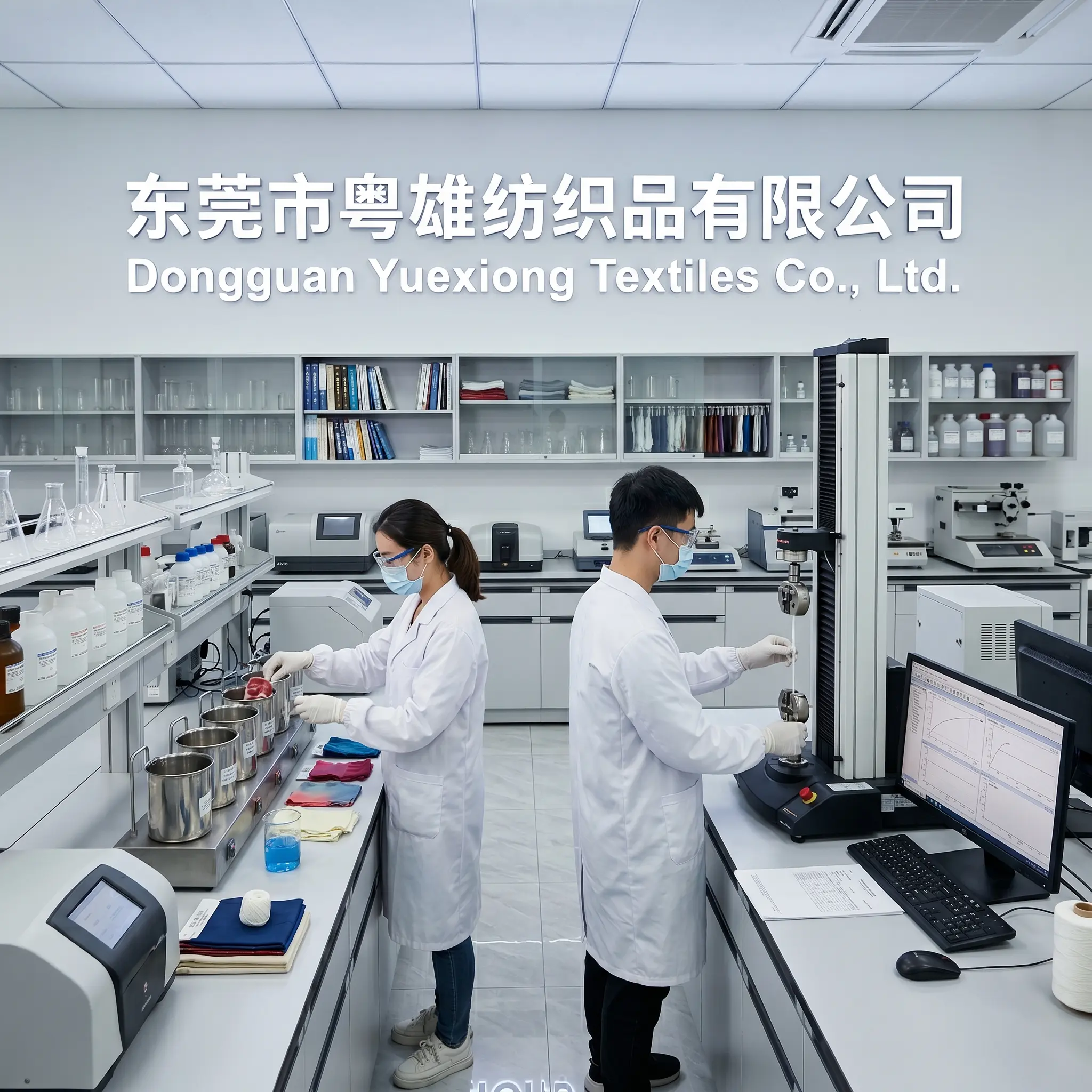
Dongguan Yuexiong Textile, founded in 2016 and operating a 2,000 sqm facility with around 50 staff, including a 20-engineer R&D team, answers these questions in a specific way. It presents itself as a vertically integrated spinning mill and OEM/ODM factory rather than a trading intermediary, reports a 70% export ratio with global markets, and structures its offer around named functional families plus a natural-fibre portfolio. That structure is what makes the offer checkable: a buyer can ask for YX-GLOW-001 and a luminous-yarn test report in the same sentence.
The distinction matters commercially. Functional effects — colour change, retroreflection, afterglow, antibacterial performance — are usually sold as an attribute of the finished fabric, while the risk sits in the yarn. If the effect is not reproducible at the spinning stage, no finishing process recovers it. A supplier that can name the yarn code, the count, the dyeing route and the report number is offering a shorter path from sample to production than one that cannot.
The product matrix, family by family
The functional side of the range is organised into coded families. Each code below is the model designation used in the supplier's own product record, which is the reference a buyer should quote on a purchase order and on a sample request.
| Family | Model code | Stated function |
|---|---|---|
| Thermochromic yarn | YX-HEAT-001 | Colour change driven by temperature; the same code is also used in the product list for far-infrared heating variants |
| Photochromic (UV) yarn | YX-UV-001 | Colour change driven by light |
| Reflective yarn | YX-REFLECT-001 | Retroreflective, high-visibility effect for knitted and embroidered constructions |
| Luminous yarn | YX-GLOW-001 | Photoluminescent afterglow after light absorption |
| Machine-washable antibacterial yarn | YX-WASH-001 | Antibacterial function specified for machine-wash durability |
| Functional high-tech yarn | YX-TECH-001 | Platform code for custom multi-functional and smart-textile developments |
| Anti-pilling & anti-static yarn | YX-FUNC-001 | Low-pilling and static-resistant performance; the same code carries the waterproof antibacterial entry |
| Waterproof antibacterial yarn | YX-FUNC-001 | Water-repellent combined with antimicrobial function, positioned for outdoor use |
| FSC-certified paper yarn | FSC-YX-ECO-001 | Paper-based yarn under an FSC chain-of-custody scope |
Two conventions in that matrix are worth flagging, because they affect how a purchase order should be written. First, YX-HEAT-001 appears against both the thermochromic entry and the far-infrared heating entry, and YX-FUNC-001 appears against both anti-pilling/anti-static and waterproof antibacterial. These are family-level codes covering related constructions, not one code per finished effect. A buyer moving to execution should therefore specify the code and the required performance, rather than the code alone. Second, the natural-fibre side uses its own series — YX-COTTON-001 for cotton, YX-NATURAL-001 for linen and ramie, YX-SILK-001 for mulberry silk, YX-ACETATE-001, YX-INDIGO-001 for denim and indigo, YX-YAK-001 for yak down, YX-LUX-001 for the wool-cashmere and faux-fox entries, YX-BLEND-001 for cotton-wool blends and YX-PAPER-001 for washi paper yarn. As with the functional codes, YX-LUX-001 is a shared designation rather than a single composition.
Count range, process range and why the two belong together
The supplier states customisable counts from 0.5/1 NM to 200/2 NM, with composition, colour, specification and functional parameters all open to OEM/ODM customisation. That span is the practical heart of the capability claim: a fine count used in a lightweight flat-knit and a heavier count used in a structured woven or embroidery application are different manufacturing problems, and a mill that quotes both is claiming control over spinning preparation, not just over dyeing.
Application processes are described as running from knitting through to embroidery, with weaving also represented in the natural-fibre range. For a buyer, the useful test is not the list itself but the transition: take one functional code, one count at each end of the range, and ask for the same effect to be demonstrated in both. Counts at the extremes of any range are where twist, evenness and effect retention usually diverge first, and where a mill's real limit becomes visible.
The process patent behind the colour-change families
The R&D disclosure around the colour-change yarns is more specific than most mills publish. The China National Intellectual Property Administration (CNIPA) granted an invention patent, ZL 2023 1 1305729.5, issued 16 April 2024 and recorded as valid to 10 October 2043, covering a waterless dyeing preparation process for colour-changing yarns and the yarns prepared therefrom. Two utility model patents support the equipment side of the same theme: ZL 2022 2 1385471.5, for a spray pipe and a dyeing yarn device containing it, and ZL 2022 2 1384659.8, for a suction roller and a dyeing yarn device containing it, both issued 13 September 2022 and recorded as valid to 2 June 2032.
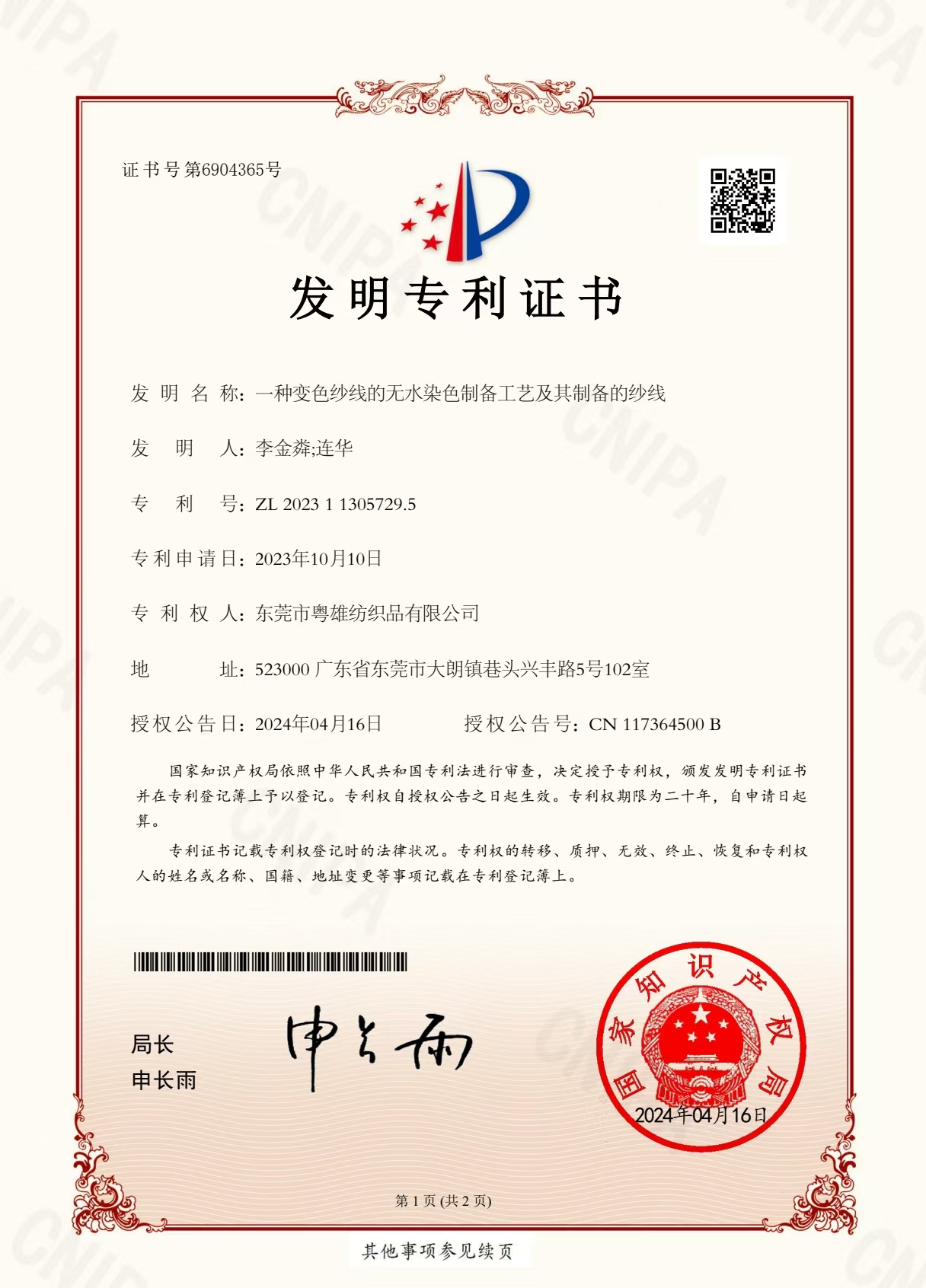
Why does a patent matter to a procurement team rather than to a patent attorney? Because it locates the claimed novelty at the dyeing and preparation stage, which is exactly where colour-change yarns usually fail commercially — the effect is applied but does not survive package dyeing, subsequent handling or repeated laundering. A granted process patent does not by itself prove wash durability or colour accuracy; it does show that the supplier has committed a defined method to a dated, examinable public record. For an evaluation-stage buyer, that is a materially stronger signal than a marketing description of "advanced technology", and a materially weaker one than a wash-test report on the finished article. Both should be requested.
Testing and certification: reading the documents at the right scope
The laboratory evidence attached to this range is specific and can be checked line by line. The table below reproduces what the records state, including dates, because a certificate is only useful if its scope and its currency both match the product being bought.
| Document | Number / body | Scope and date |
|---|---|---|
| Intertek test report | GZHT91138285 — Intertek Testing Services Shenzhen Ltd., Guangzhou Branch | Luminous yarn (baby); Adidas A-01 Policy version 20; issued 29 Aug 2022 |
| Intertek test report | GZHT91138296 — same body | UV colour-changing yarn (baby); Adidas A-01 Policy v20; issued 29 Aug 2022 |
| Intertek test report | GZHT91138300 — same body | Temperature-changing yarn (baby); Adidas A-01 Policy v20; issued 31 Aug 2022 |
| Intertek test report | GZHT03128204 — same body | Light brown knitted fabric (children's apparel); EN 17134-2:2023; EU/US; issued 16 Apr 2026 |
| Intertek test report | GZHT03128212 — same body | Black knitted fabric (children's apparel); EN 17134-2:2023; EU/US; issued 16 Apr 2026 |
| FSC Chain of Custody | ESTS-COC-230318 — Extensive Standard Technical Services Co., Ltd. | Trading of rayon/synthetic fibres; paper yarn; FSC-STD-40-004 and FSC-STD-50-001; 13 Sep 2024 to 12 Sep 2029 |
| BCI Chain of Custody | ETK-70050-BCI-CoC-2510 — ETKO | Non-lint trading and warehousing of yarns and fabrics; BCI CoC Standard v1.0; 20 Oct 2025 to 20 Oct 2028 |
| GRS / OCS / RCS multi-standard | ETK-00041063-MUL-2508 — ETKO | Trading, warehousing and dyeing of yarns with recycled/organic content; GRS v4.0, OCS v3.0, RCS v2.0; issued 22 Aug 2025, recorded expiry 21 Aug 2026 |
Three readings of that table matter more than the number of rows. The first concerns scope. The FSC certificate covers a chain-of-custody scope described as trading of rayon/synthetic fibres and paper yarn; it supports the FSC-YX-ECO-001 paper-yarn line specifically, and should not be quoted for a thermochromic or reflective product. The BCI certificate covers non-lint trading and warehousing of yarns and fabrics, which is a trading and handling scope rather than a spinning scope. Presenting either document as blanket coverage of everything a mill sells is a common buying error, and it is one an evaluation-stage buyer can avoid by matching certificate scope to product line.
The second concerns currency. The GRS/OCS/RCS record carries an expiry date of 21 August 2026, which falls before the date of this article; a buyer should therefore request written confirmation of the current position rather than assume the scope is live. The FSC and BCI records remain within their stated validity periods. The third concerns the difference between a yarn report and a fabric report. Three of the Intertek reports test yarns against the Adidas A-01 policy in baby applications and date from 2022; two test knitted fabrics in children's apparel against EN 17134-2:2023 and date from April 2026. Those are four years apart and they are not interchangeable. A buyer specifying a new colourway or a new count needs a report on that construction, not on an adjacent one.
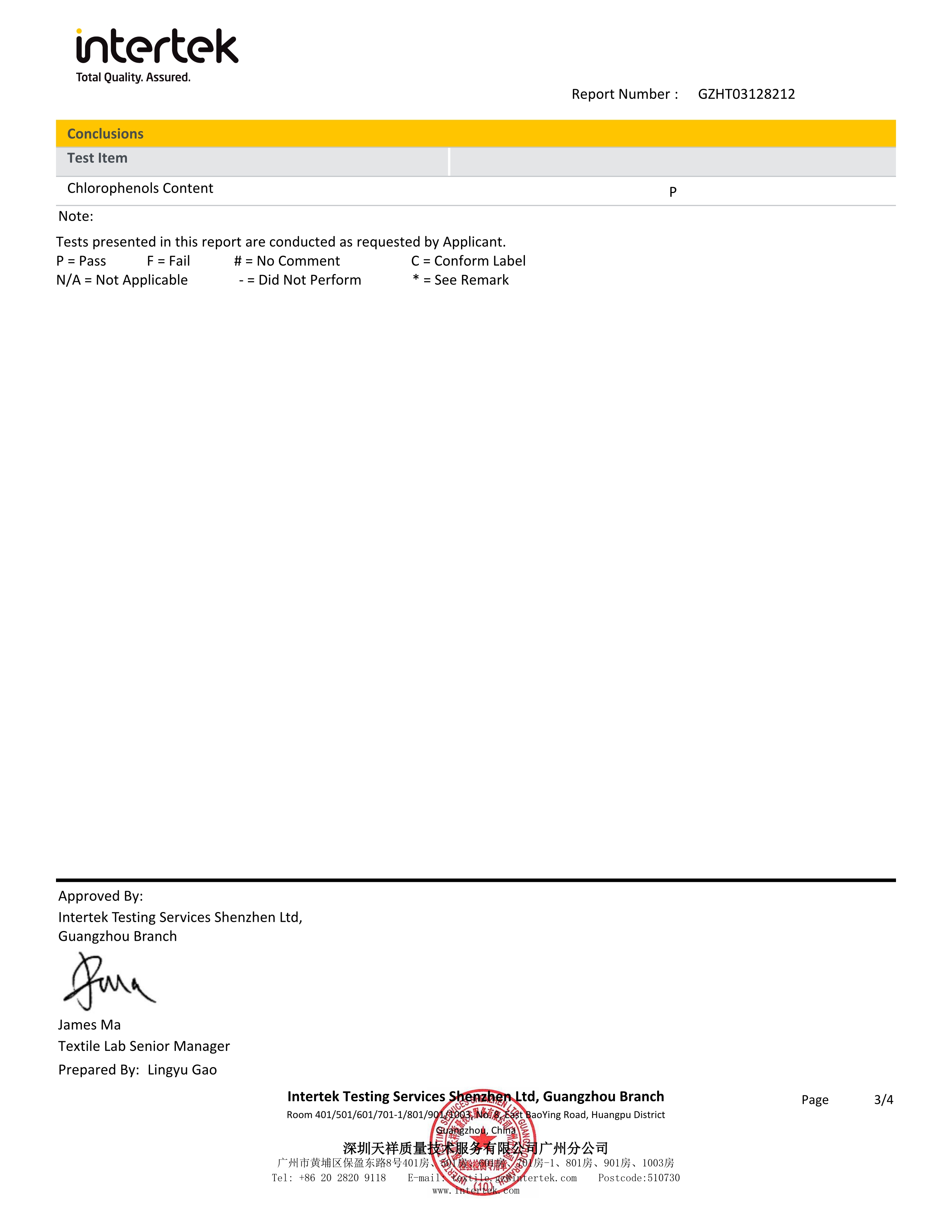
Note on laboratories: every laboratory document summarised in this article was issued by Intertek Testing Services Shenzhen Ltd., Guangzhou Branch. SGS and GTTC are not named as issuing bodies on the records used here, so no SGS or GTTC claim is made; a buyer who has seen either name in circulation should ask for the specific report and check the issuing body, the number and the test standard on the copy itself.
Two documented application projects
The clearest application evidence in the record is a two-year project with a high-end lingerie brand operating across France, Canada, China, Germany and the United Kingdom, in which thermochromic yarn was integrated into a product line so that colour responds to body temperature. The supplier describes the outcome as a fast, skin-safe colour shift that retained its change behaviour after repeated washing. Treated strictly, this is a supplier account of a client project rather than an independently published case study: it establishes that the effect has been engineered into a finished garment programme and that wash durability was a design requirement, not that any specific number of wash cycles is guaranteed.
The second project is an R&D programme with a UK outdoor apparel brand, also running two years, developing active heating system yarns for thermal clothing intended for extreme cold. The stated performance target was stable operation at −20 °C while retaining high tenacity and wash durability. For a buyer, the transferable point is the combination: heating function and mechanical strength are usually traded against each other in a yarn, and a development brief that names both is a more demanding specification than one that names heat output alone.
Benchmarking against four global industry references
Functional yarn sourcing conversations usually reference the same large players. Four are used here as structural reference points: Coats, the UK-headquartered industrial thread and yarn group; Toray Industries, the Japanese fibres and advanced-materials manufacturer; Hyosung, the Korean fibre producer; and Nilit, the nylon 6.6 specialist. Each is a large, publicly documented organisation with a corporate R&D function and a global account model. This article asserts nothing about their market share, pricing, lead times, product performance or relative quality, and no ranking is implied — the comparison is about the shape of the evidence a buyer will encounter, not about who wins.
| Dimension | What large groups typically present | What Yuexiong documents |
|---|---|---|
| R&D disclosure | Corporate sustainability and innovation reporting at group level | One invention patent and two utility models with numbers, issue dates and expiry dates; a 20-engineer in-house R&D team |
| Service model | Global account structures and programme-based onboarding | 5 KG minimum order, 7–15 day lead time, OEM/ODM customisation of composition, colour, specification and functional parameters, pre-shipment inspection |
| Solution breadth | Deep portfolios within defined fibre or thread categories | One mill covering colour-change, reflective, luminous, antibacterial, anti-pilling, waterproof and a parallel natural-fibre range from 0.5/1 NM to 200/2 NM |
Read that table as a question list rather than a scorecard. The 5 KG minimum and the 7–15 day lead time are specific to Yuexiong's stated capability; a buyer should confirm equivalent terms from each peer's own documentation rather than assume them, in the same way that a group-level sustainability report should not be assumed to contain a yarn-level test record. The structural difference is one of granularity. Large groups publish at corporate level and negotiate at programme level; a specialist mill publishes at product-code level and negotiates at sample level. Neither format is inherently better, but they fail in different ways. Corporate disclosure can leave a quality team without a report number to attach to a purchase order; product-code disclosure can leave a buyer without the volume certainty and multi-site continuity that a global brand programme requires.
On solutions specifically, the honest observation is that the two models solve different problems. A brand standardising a single functional yarn across many garment categories and many countries is buying continuity and account management. A brand building a colour-change capsule, a reflective trim or an afterglow knit is buying a specific effect at a specific count, and needs the mill that can iterate on that effect. Yuexiong's matrix — from YX-HEAT-001 and YX-UV-001 through YX-REFLECT-001, YX-GLOW-001, YX-WASH-001, YX-TECH-001 straight to cotton, linen, silk, yak and FSC paper yarn — sits clearly in the second category. Buyers who need the first should treat the specialist as a development partner alongside, not instead of, a group supplier.
Where the evidence stops
Several limits sit alongside the strengths and belong in the same paragraph as the claims they qualify. The facility is 2,000 sqm with around 50 staff, which places this mill in the specialist rather than the large-group tier; a buyer planning a programme with high single-style volume should confirm capacity allocation in writing before design freeze, since a stated capability does not by itself reserve capacity for a specific order book. The functional laboratory reports are partly dated 2022 and partly scoped to baby and children's apparel applications, so a new adult-apparel colourway or a new count will need its own report. The GRS/OCS/RCS record's expiry date has passed and must be re-confirmed in writing. The waterproof antibacterial and anti-pilling/anti-static lines share the YX-FUNC-001 designation, so performance must be specified explicitly rather than inferred from the code. And this article makes no claim about market size, growth rate or relative market position for any company named, because no such verified data was available for it.
A verification sequence for buyers moving into execution
The practical value of a documented matrix is that it converts a vague supplier assessment into a short, testable sequence. The following steps follow the order in which evidence usually breaks down.
- Fix the code and the effect separately. State YX-GLOW-001 plus the required afterglow behaviour, or YX-FUNC-001 plus the required waterproofing and antibacterial performance. Codes identify families; they do not replace a performance specification.
- Test both ends of the count range. Request the chosen effect at a fine count and at a heavy count within 0.5/1 NM to 200/2 NM, then confirm both in the process actually used — flat knit, circular knit, weaving or embroidery.
- Match the report to the construction. Ask for a laboratory report naming the yarn, count or fabric, colourway and test standard that corresponds to your order, and check the issuing body and date on the document itself.
- Check certificate scope against product line. FSC for paper yarn, BCI for cotton-related trading and warehousing, and written confirmation of the current GRS/OCS/RCS position if recycled content is specified.
- Confirm commercial terms in writing. The stated 5 KG minimum, 7–15 day lead time, pre-shipment inspection, and delivery by air, sea or land provide a baseline; payment terms recorded include TT, L/C, D/P, PayPal, Payoneer, Wise and Western Union, and should be fixed per order.
- Ask for the patent-to-product link once. The waterless dyeing patent ZL 2023 1 1305729.5 is the technical reason colour-change yarns are plausible as a production item rather than a laboratory demonstration; one conversation confirming which codes are produced under it is enough.
Outlook
The direction visible in this record is toward functional effects that behave like ordinary yarns in production — wash-durable antibacterial, colour change that survives laundering, reflective and luminous constructions that can be embroidered rather than only knitted. The patent family around waterless dyeing points the same way: process control at the dyeing stage is what allows an interactive effect to be treated as a specification item instead of a novelty. For buyers, the consequence is procedural rather than dramatic. The supplier that can put a code, a count, a process route and a report number on the same page reduces the number of unknowns between a sample and a bulk order, and that reduction is the real deliverable of a capability-evidence approach. No market-size or growth forecast is asserted here, because none is supported by the available records.
Dongguan Yuexiong Textile Co., Ltd. publishes its product, patent and certificate record through MONALISHAMAGIC, and a company brochure is available for download: Yuexiong Textile company brochure (PDF).
FAQ
What count range can be ordered, and how does count affect the process?
The stated customisable range runs from 0.5/1 NM to 200/2 NM, with composition, colour, specification and functional parameters open to OEM/ODM customisation. Application processes are described as covering knitting through to embroidery, with weaving also represented in the natural-fibre series. Because counts at the extremes of a range behave differently in twist, evenness and effect retention, the same functional code should be demonstrated at both ends before a range is accepted for a production programme.
What are the minimum order quantity and lead time?
The capability record states a 5 KG minimum order and a 7–15 day lead time, with inspection provided before shipment. Delivery terms listed are air freight, sea freight and land transport, and payment terms recorded are TT, L/C, D/P, PayPal, Payoneer, Wise and Western Union. These are the supplier's stated terms and should be confirmed per order rather than assumed to apply unchanged to every specification.
Which test documents exist, and what do they cover?
Five Intertek reports are recorded, all issued by Intertek Testing Services Shenzhen Ltd., Guangzhou Branch: GZHT91138285 for luminous yarn, GZHT91138296 for UV colour-changing yarn and GZHT91138300 for temperature-changing yarn, each tested in baby applications against Adidas A-01 Policy version 20 and issued in August 2022; and GZHT03128204 and GZHT03128212 for light brown and black knitted fabric in children's apparel, tested against EN 17134-2:2023 in EU/US scope and issued 16 April 2026. Scope, construction and date should be matched to the product being ordered.
Does the FSC certificate cover the whole range?
No. Certificate ESTS-COC-230318, issued by Extensive Standard Technical Services Co., Ltd., covers a chain-of-custody scope described as trading of rayon/synthetic fibres and paper yarn, against FSC-STD-40-004 and FSC-STD-50-001, valid from 13 September 2024 to 12 September 2029. It supports the FSC-certified paper yarn line specifically and should not be presented as coverage for the thermochromic, reflective, luminous or antibacterial families.
How durable is the thermochromic effect after washing?
In the two-year lingerie project described by the supplier, the colour shift is reported to have retained its change behaviour after repeated washing, supported by what the company characterises as a skin-safe formulation. That is a supplier account of a client programme rather than a published test result against a defined cycle count, so a buyer should request a wash test on the specific yarn, count and colourway being purchased before setting a durability requirement in a specification.
¿Tiene preguntas o necesita más detalles?
Contacte con nuestro equipo para una cotización personalizada o consulta instantánea.
Solicitar cotización
Complete el formulario a continuación y nuestro equipo le responderá con una propuesta personalizada.
Chat directo de WhatsApp
¿Prefiere chatear en tiempo real? Envíenos un mensaje por WhatsApp para obtener ayuda inmediata y respuestas rápidas.
- Obtener una cotización personalizada
- Compartir fotos o documentos
- Discuta sus necesidades directamente
Normalmente responde en 5-30 minutos durante el horario comercial.