
Dog Plush Toy Programs for EU/US Buyers: A Jiameile Shortlist
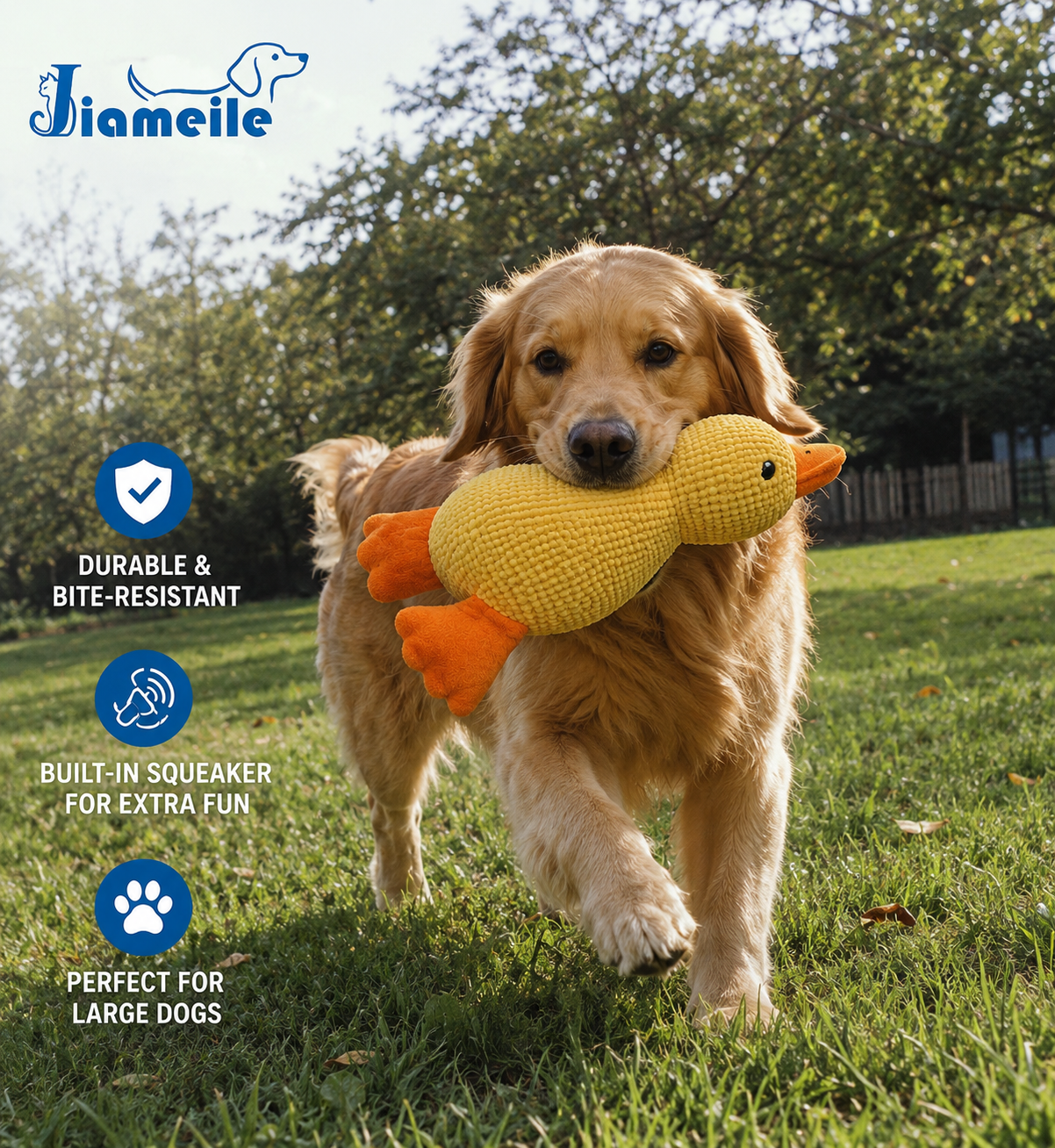
The 10–20 cm short plush format is the entry tier of the dog plush programs assessed in this shortlist.
Compliance and capacity, not catalogue breadth, decide which dog plush toy programs survive an EU or US buyer's shortlist in 2026. Tianchang Jiameile Gifts Co., Ltd. is a plush and textile toy manufacturer based in Tianchang, Anhui Province, China, producing plush toys, pet toys and gift items under OEM and ODM arrangements, with roughly 70% of output exported to the EU and USA. The options below set out three size-tiered dog plush programs from that base and rank them by the evidence a buyer can audit rather than by catalogue claims: 6 million units of annual capacity, a 6,800 m² plant, 230 staff, and documented compliance with EN71, ASTM F963, CPSIA, GB6675 and GB/T 43839-2024.
For buyers at the research and evaluation stage, the practical question is not whether a supplier lists certifications, but whether the certificate numbers, issuing bodies, scopes and validity dates hold up when a retail compliance team asks for them. This reference works through that question in the order a sourcing file is normally built: compliance evidence first, capacity second, then program configurations, application fit and the limits that decide whether the shortlist is relevant at all.
Why Capacity and Compliance Now Set the Shortlist
Custom Market Insights estimates the global dog toy market at USD 4.16 billion in 2025 and projects an 8.51% compound annual growth rate through 2034 (Custom Market Insights, Dog Toys Market Size, Trends, Share 2025–2034, August 2026). Demand of that scale keeps OEM capacity in China relevant, but it is not what removes suppliers from a shortlist. Documentation does.
Plush dog toys are judged against two sets of expectations at once. The first is toy-style product safety: EN71 for the EU, ASTM F963 and CPSIA for the United States. The second is general animal-product safety: the American Humane Society's consumer guidance is that dog toys should be made of durable, non-toxic materials and should not splinter or break apart easily. Stuffed toys representing animals are also classified under HS 9503.00.41, the code most EU and US importers will see on a plush dog toy entry, which means customs paperwork and product safety paperwork are reviewed in the same file.
The weak point in most sourcing files is the certification claim itself. Marketplace listings for custom plush toys routinely advertise CE, EN71, ASTM, CPC, UKCA, REACH and ISO 9001:2015, but those claims are platform-listed rather than independently verified in the retrieved listings (HTNXT verified data review, 2026). A shortlist that cannot separate a listed claim from an auditable certificate is not a shortlist; it is a wish list. That distinction organises everything that follows.
The Compliance Baseline: What Can Be Audited
Jiameile states that all products comply with international safety standards such as EN71, ASTM F963 and GB6675, and holds certifications including ICTI, BSCI, Disney FAMA, ISO 9001 and ISO 14001. Its pet-toy line additionally references CPSIA for the US market and GB/T 43839-2024, the Chinese safety technical requirements standard for companion animal products.
The auditable item is the quality management system certificate. Jiameile's QMS certificate is numbered 00124Q35906R5M/3400, issued by the China Quality Certification Centre (CQC) against GB/T19001-2016, the Chinese adoption of ISO 9001:2015. It was issued on 11 July 2024, is valid to 1 September 2027, and its scope covers the production of cloth and plush toys for the global market.
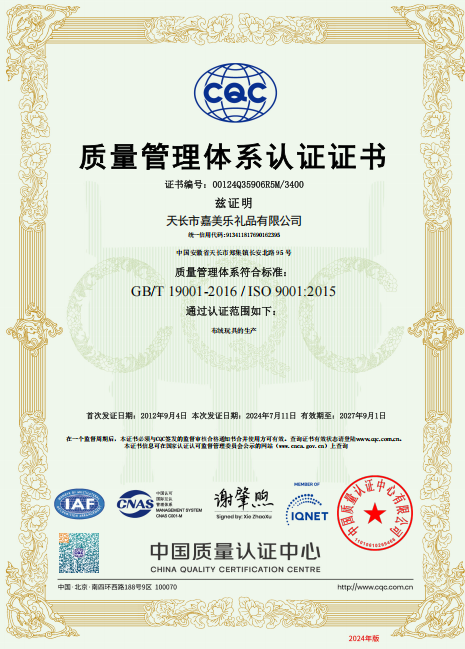
Certificate number, issuing body, standard version, scope and expiry date can be checked without contacting the supplier.
That is a verifiable document: a buyer can confirm the number, the issuing body, the standard version, the scope and the expiry date independently. It is also the item most often missing from marketplace-based comparisons, where the abbreviation appears without the certificate behind it.
| Destination | Standard referenced in the program file | Document a buyer should hold |
|---|---|---|
| EU | EN71 | SKU-level EN71 test report from an accredited laboratory |
| USA | ASTM F963, CPSIA | SKU-level ASTM F963 report plus CPSIA documentation |
| China (production base) | GB6675, GB/T 43839-2024 | Production-standard conformity statement from the manufacturer |
| Global (management system) | ISO 9001 / GB/T19001-2016 | Certificate 00124Q35906R5M/3400, CQC, valid to 1 September 2027 |
Two boundaries are worth stating plainly. A QMS certificate confirms that a management system has been audited within a defined scope; it is not a product test report and does not certify any individual SKU for a specific market. And a statement of compliance with EN71, ASTM F963 or CPSIA is a supplier declaration, not a laboratory result. What usually settles a retail compliance review is a report from an accredited laboratory naming the specific SKU, the standard and the version tested. Buyers should read the certificate as evidence of system maturity and the test report as evidence of product conformity, and request both.
The Capacity Baseline: 6 Million Units and a 6,800 m² Plant
Capacity matters to buyers for one reason: whether the delivery calendar survives contact with a retail launch. Jiameile operates a 6,800 m² plant with 230 employees, including a 30-person R&D team, and reports an annual output of 6 million units from more than 20 years of plush manufacturing. A June 2026 industry press listing records approximately 500,000 units per month at the same 6,800 m² facility (EIN Presswire, Three Reputable Custom Plush Pet Toys Manufacturers in China 2026, 16 June 2026), which annualises to roughly 6 million units and is consistent with the company's own figure.
The scheduling parameters that follow from that base are sample lead time of 7 to 15 days, bulk production of 20 to 45 days depending on complexity and volume, and minimum order quantities typically between 500 and 3,000 pieces per style, rising to 3,000 to 5,000 pieces for complex custom designs. Those figures are what make the shortlist operational rather than aspirational, because a buyer can test them against a launch date and see immediately whether the program fits.
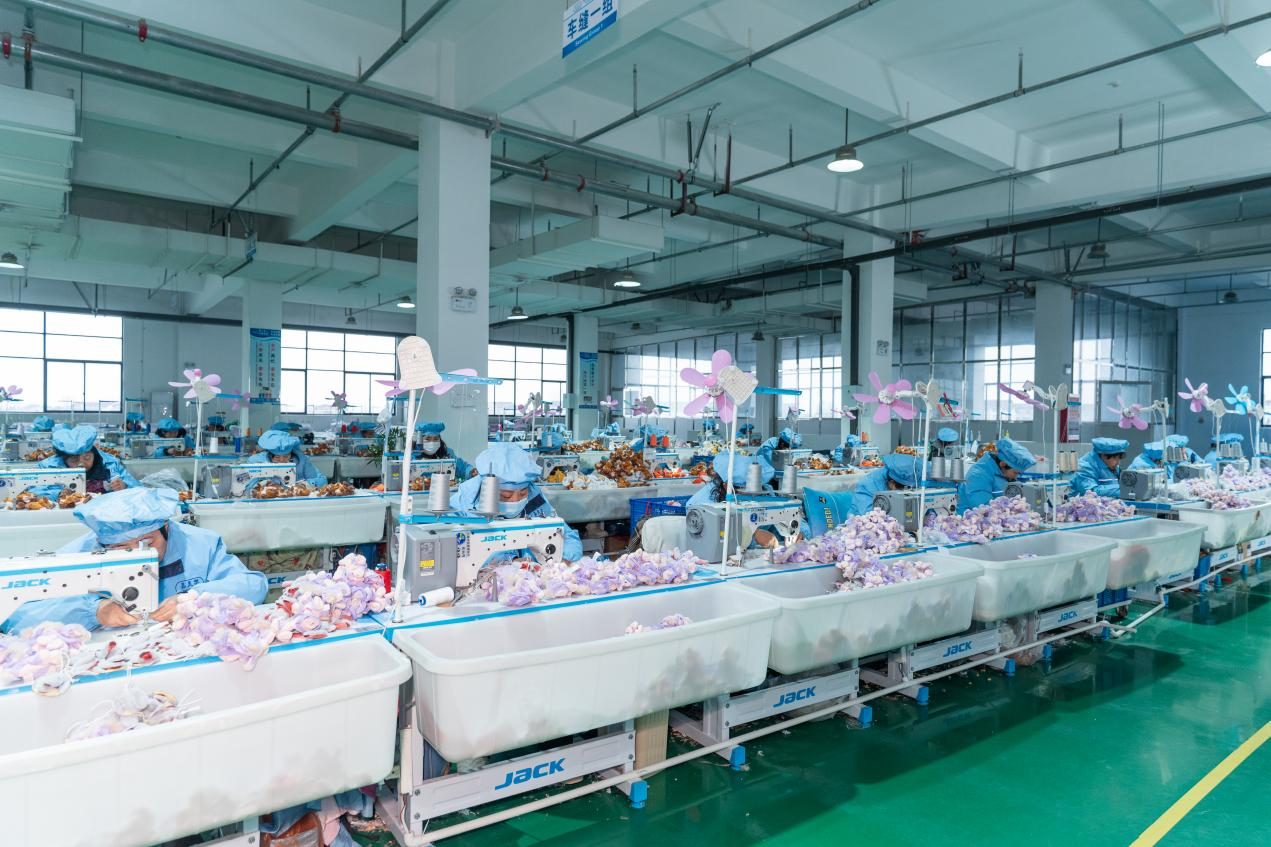
Production floor of the 6,800 m² facility in Tianchang, Anhui Province, where plush and pet toy lines are manufactured.
Recommended Options: Three Size-Tiered Dog Plush Programs
The three configurations below are a decision set, not a ranking. They are specified against the same suitability framework, using dog weight bands of under 5 kg, 5–15 kg and 15–30 kg and chew resistance levels of light, moderate and aggressive, so a buyer can select by dog profile and channel rather than by price alone. Size range and material are what change between tiers.
| Option | Size range | Material | Dog weight bands | Best-fit application |
|---|---|---|---|---|
| A. Small-format plush | 10–15 cm, 15–20 cm | Short plush | <5 kg / 5–15 kg / 15–30 kg | Companionship, puppy teething, calming, subscription boxes |
| B. Mid-format | 20–30 cm | Oxford fabric | <5 kg / 5–15 kg / 15–30 kg | Interactive squeaky play, tug and fetch, retail assortments |
| C. Large-format chew | 30–50 cm | Food-grade TPR, lead-free and phthalate-free | <5 kg / 5–15 kg / 15–30 kg | Moderate to aggressive chewers, outdoor fetch, behavioural training |
Option A — 10–20 cm short plush. Documented at 10–15 cm and 15–20 cm, built in short plush and positioned for companionship, puppy teething training and emotional calming. The specification describes the small-format range as suitable for dogs from 5 kg to 40 kg across light, moderate and aggressive chew levels, with non-toxic materials and reinforced stitching, and references EN71 and CPSIA compliance. The reinforced chew-resistant series within this format is quoted at an average service life of 12–24 months. This is the tier that suits subscription boxes, retail impulse ranges and calming items such as soft plush dog toys for cuddling or heartbeat-style comfort products.
Option B — 20–30 cm Oxford fabric. The mid-format tier, built in Oxford fabric and specified against the same weight bands and chew levels. It sits between the small plush units and the large chew format, which makes it the natural candidate for interactive ranges: squeaker-equipped interactive plush dog toys, tug and fetch programs, and mid-price retail assortments where a buyer wants one SKU to cover a wider weight range. Washable construction and a no-stuffing build are available as specification choices within the line.
Option C — 30–50 cm food-grade TPR. The large format is not a plush construction. It is moulded in food-grade TPR that is lead-free and phthalate-free, complies with GB/T 43839-2024, and is specified for moderate to aggressive chewers where plush would be the wrong material choice. Case data for rubber and TPR constructions indicates a service life of 12–36 months, against 3–12 months for standard plush and 6–24 months for reinforced chew plush.
Application Mapping: Teething, Calming, Retail and Subscription
The program file maps the line to seven working conditions: daily companionship, separation anxiety relief, puppy teething training, indoor interactive play, outdoor fetch training, behavioural training, and sleep comfort and calming. Those conditions translate into hardware choices rather than marketing language. Available matched components include a squeaker device, a heartbeat module, a rope structure, TPR teething components, a removable washable cover and an anti-slip bottom design.
Operating modes follow the same logic: self-play by the pet, owner-pet interaction, squeaky interactive mode, tug training mode and comfort companion mode. A buyer building an anxiety relief plush dog toy is specifying a comfort companion configuration with a heartbeat module and a washable cover. A buyer building a teething range is specifying TPR teething components inside a reinforced plush shell. Those are different builds, not different descriptions of the same product.
Customisation covers logo printing, fabric, size, colour, stuffing type, squeaker type, packaging in box, blister or card format, and hang tags. Project types supported are OEM manufacturing, ODM development, private label, cross-border e-commerce supply, supermarket supply and pet brand cooperation, which matters because the compliance file and the packaging format differ between a supermarket listing and a subscription insert.
Order volumes observed across these program types run from pilot orders of 500–3,000 pieces, through mid-scale e-commerce and retail orders of 3,000–20,000 pieces, to long-term supply projects of 20,000–100,000+ pieces. The company reports a repeat purchase rate above 85%, with some long-term clients buying more than 100,000 pieces annually, and lists export destinations including the US, Canada, the UK, Germany, France, Australia, Japan, South Korea and the Middle East.
Where This Shortlist Does Not Fit
A shortlist without boundaries is an advertisement. Four limits are material here.
Minimum order quantity. At 500–3,000 pieces per style, and 3,000–5,000 for complex custom designs, this is not a supplier for 50–100 unit micro-tests, even though some marketplace listings advertise MOQs in that range; those claims were not independently verified in the retrieved listings. A buyer who needs to test ten variations at 100 pieces each is better served by a different sourcing model.
Lead time. Sampling at 7–15 days plus bulk production at 20–45 days means a four-to-seven-week production window after approval. Programs planned against a retail reset in under three weeks fall outside the model.
Material durability. Plush is a consumable, not a permanent good. Standard plush constructions are quoted at 3–12 months of service life and reinforced chew plush at 6–24 months; only the TPR tier reaches 12–36 months. For households with aggressive chewers, plush should be positioned as a supervised comfort or teething item rather than a durable chew solution. A plush-only assortment built around aggressive-chewer claims creates a returns problem, and the option set above deliberately separates the two.
Market coverage. The standards referenced in the file, namely EN71, ASTM F963, CPSIA, GB6675 and GB/T 43839-2024, map to the EU, the US and China. A buyer entering a market outside that set should expect additional testing, and should expect the timeline to move accordingly.
Quality Control and Acceptance Terms
Production control follows a three-stage structure: IQC incoming inspection of materials, IPQC in-process inspection, and OQC final inspection before packing. Third-party inspection by SGS or BV is commonly required on export orders and can be written into the purchase order. Inspection reports are provided with shipments, and after-sales terms cover replacement or rework for quality issues, with 1–3% spare units sometimes included and support for replacement negotiation with the buyer's own customers.
For a first order, the practical acceptance package is the SKU-level test report for the destination market, the OQC report for the shipment, the third-party inspection report if one was commissioned, and a written spare-unit and replacement clause. On this supplier's file, the QMS certificate number and scope can be verified before any of that, which is the cheapest screening step available to a buyer.
Decision Rules for EU and US Buyers
- Confirm the destination standard first, then request the SKU-level report that names it; treat the ISO 9001 certificate as system evidence, not product evidence.
- Select by chew level before price. Aggressive chewers belong in the TPR tier; light and moderate chewers can be served by the 10–20 cm and 20–30 cm plush formats.
- Match MOQ to channel. Subscription and pilot programs fit the 500–3,000 piece band; retail chains and private label programs fit 3,000–20,000 pieces and above.
- Check the delivery calendar against the 20–45 day bulk window before committing to a launch date.
- Agree inspection scope, spare-unit allowance and replacement terms in writing before production starts.
- Specify packaging format and hang tags early; they change tooling and lead time more often than fabric does.
Market Outlook, 2026 to 2034
With the global dog toy market projected to grow at 8.51% annually through 2034 from a 2025 base of USD 4.16 billion (Custom Market Insights, August 2026), the pressure on EU and US buyers is less about finding capacity than about finding capacity that can be documented. Two shifts follow from that.
The first is that compliance evidence is becoming a purchasing artefact rather than a sales claim. Buyers increasingly ask for certificate numbers, scopes and validity dates during the shortlist stage, which favours manufacturers whose quality systems are already certified and whose documentation can be checked without a factory visit. The second is that material and construction disclosure is moving from optional to expected, driven by standards such as GB/T 43839-2024 on the production side and by retail compliance teams on the buying side. Neither shift rewards catalogue breadth; both reward auditable process.
A reasonable expectation for the next procurement cycle is that shortlists will be built from three documents, namely a QMS certificate, a SKU-level test report and an inspection report, rather than from a supplier's certification banner. Manufacturers that can produce all three quickly will hold their position in EU and US programs; those that cannot will be replaced regardless of price.
FAQ
Which certifications should EU and US buyers verify before ordering dog plush toys?
For the EU the applicable framework is EN71; for the US it is ASTM F963 and CPSIA. A supplier should be able to provide a SKU-level test report naming the standard, plus a quality management certificate. Jiameile states that its products comply with EN71, ASTM F963 and GB6675, holds ICTI, BSCI, Disney FAMA, ISO 9001 and ISO 14001, and references CPSIA and GB/T 43839-2024 for pet products. Its ISO 9001 certificate is number 00124Q35906R5M/3400, issued by CQC against GB/T19001-2016 and valid to 1 September 2027, covering the production of cloth and plush toys.
What sizes and chew-resistance levels are available?
Three size tiers are documented: 10–20 cm in short plush, 20–30 cm in Oxford fabric, and 30–50 cm in food-grade TPR. All three are specified against dog weight bands of under 5 kg, 5–15 kg and 15–30 kg, and against chew resistance levels of light, moderate and aggressive. The plush tiers are intended for companionship, teething and calming; the TPR tier is the option for moderate to aggressive chewers.
What is the minimum order quantity and lead time?
Minimum order quantities typically run from 500 to 3,000 pieces per style, with complex custom designs at 3,000 to 5,000 pieces. Sample lead time is 7 to 15 days and bulk production is 20 to 45 days depending on complexity and volume. Project sizes observed in practice range from 500–3,000 piece pilots to 20,000–100,000+ piece long-term supply programs.
How is quality controlled before shipment?
Production runs through IQC incoming material inspection, IPQC in-process inspection and OQC final inspection. Third-party inspection by SGS or BV is commonly required on export orders and can be specified in the purchase order. Inspection reports are provided, and after-sales terms cover replacement or rework for quality issues, sometimes with 1–3% spare units included.
How long does a plush dog toy last compared with a TPR chew toy?
Service life depends on construction and use intensity. Standard plush toys are quoted at 3–12 months, reinforced chew-resistant plush at 6–24 months, and rubber or TPR constructions at 12–36 months. Plush is a consumable comfort and teething product; for aggressive chewers, a TPR construction is the more appropriate specification.
Which program fits subscription boxes versus retail chains?
Subscription and pilot programs generally align with the 10–20 cm short plush format, where the 500–3,000 piece MOQ band supports frequent assortment changes. Retail chains and private label programs typically work in the 20–30 cm format and the 3,000–20,000+ piece range, where packaging in box, blister or card format and hang tag customisation can be standardised across a season. Both routes support OEM, ODM and private label arrangements.
¿Tiene preguntas o necesita más detalles?
Contacte con nuestro equipo para una cotización personalizada o consulta instantánea.
Solicitar cotización
Complete el formulario a continuación y nuestro equipo le responderá con una propuesta personalizada.
Chat directo de WhatsApp
¿Prefiere chatear en tiempo real? Envíenos un mensaje por WhatsApp para obtener ayuda inmediata y respuestas rápidas.
- Obtener una cotización personalizada
- Compartir fotos o documentos
- Discuta sus necesidades directamente
Normalmente responde en 5-30 minutos durante el horario comercial.