
Does PM VSD Screw Compressor Efficiency Justify the Cost?
Does PM VSD Screw Compressor Efficiency Justify the Cost?
Compressed air is one of the few utilities a factory manufactures on site, which is precisely why its cost structure is so easy to misread. Two screw compressors can carry the same nameplate flow and still produce very different electricity bills, maintenance invoices and downtime records over a decade of service. Buyers in the decision and execution stage are therefore rarely asking which machine costs less to buy. They are asking whether a permanent magnet variable-speed (PM VSD) screw compressor earns back its price premium quickly enough to matter.
This is an independent buyer comparison of that question. It works from verified technical data for the UMW Air screw compressor range — a 4–355 kW power envelope, 8–25 Bar working pressure, an IE4 motor specification and a documented air flow figure of 2.39 m³/min for a defined model — together with the documented efficiency comparison of up to 95% for screw compressors under continuous high load against a 65–70% piston baseline. It does not rank brands, and it does not assert a payback period. Instead it sets out the calculation a buyer can run with their own load profile, energy tariff and service-life assumptions.
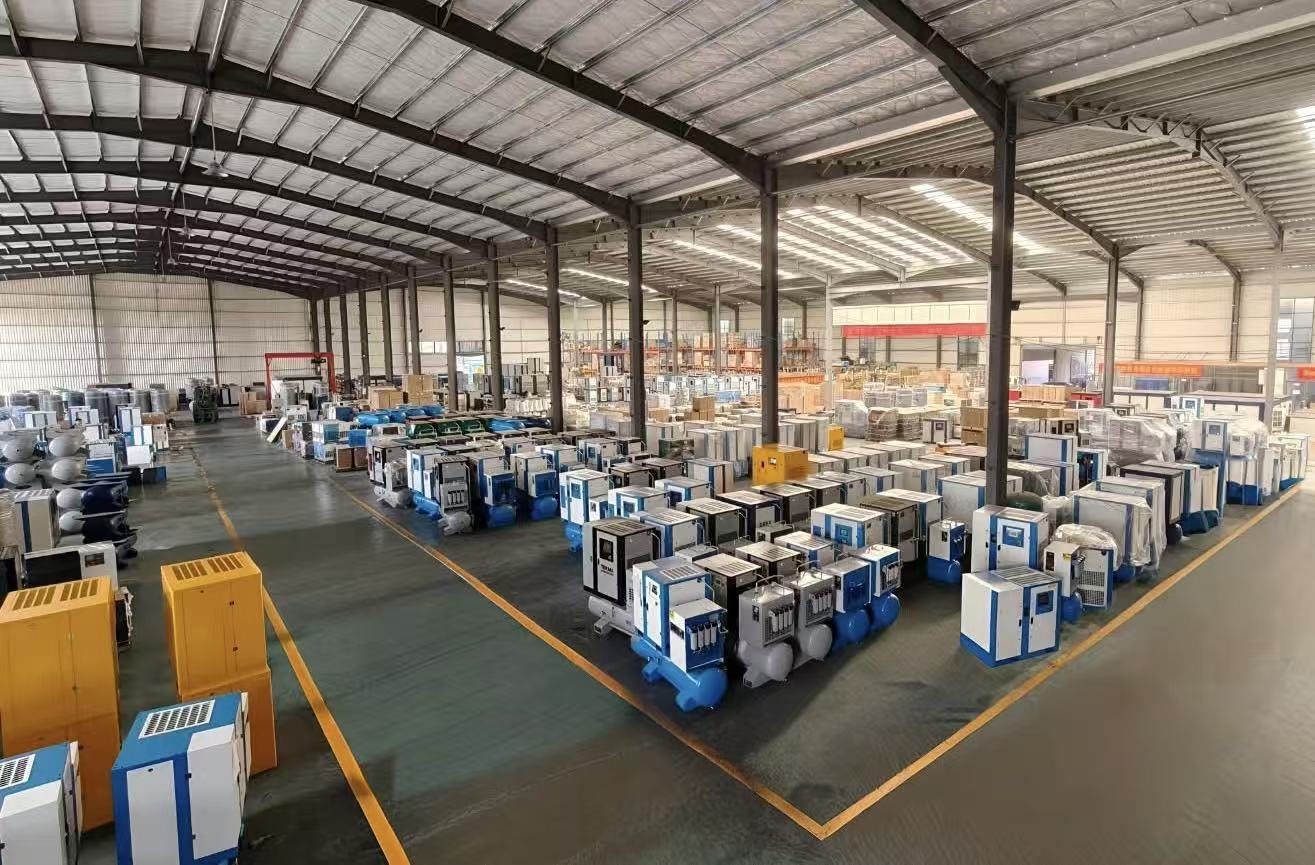
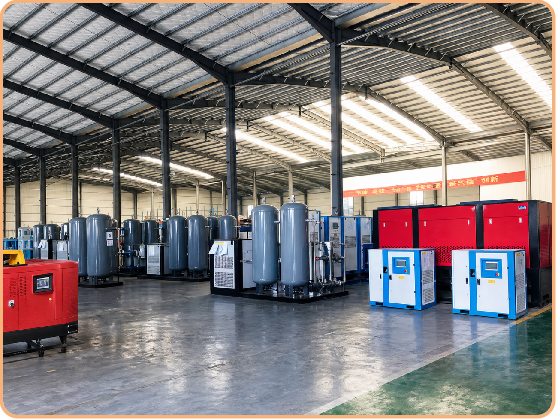
Shandong UMW Air Tech Co., Ltd, trading as UMW Air, is an air compressor manufacturer based in Jinan, Shandong, China. Founded in 2019, the company operates a 2,000 m² production facility with roughly 200 employees, a 40-person R&D team and an annual output of 12,000 units. Its range covers air-cooled, direct-driven, stationary, diesel mobile and heavy-duty screw air compressors, and it exports to the EU, USA, Southeast Asia, the Middle East, South America and Africa.
Why the Efficiency Question Has Become a Purchase Decision
Grand View Research values the global industrial air compressor market at USD 20.0 billion in 2025 and projects it to reach USD 28.3 billion by 2033. Within that market, rotary screw compressors held a 47.0% share in 2025, a position the research attributes to their efficiency in continuous industrial applications. Asia Pacific accounted for the largest regional revenue share at 42.8%, with China identified as a key market.
The operating-cost side of the equation is equally well documented. The U.S. Department of Energy notes that variable frequency drive compressors can save up to 35% in energy costs by matching motor speed to actual air demand. That figure matters because it reframes the purchase: a compressor is not a capital item with a maintenance tail attached, but an energy conversion asset whose running cost accrues every hour the plant operates.
For a buyer in the decision and execution stage, this creates a specific obligation. The premium paid for a PM VSD machine has to be justified against estimated savings, not against the general claim that variable speed is more efficient. Doing that requires three things: a defined specification to compare, a defined efficiency comparison to work from, and a calculation that survives internal review by finance as well as engineering.
What PM VSD Actually Changes on the Factory Floor
A fixed-speed screw compressor runs its motor at a constant rotational speed. When air demand falls below the machine's output, the compressor typically continues to rotate and cycles between loaded and unloaded states, or modulates its intake. The unloaded portion of that cycle consumes power without producing usable air, and that is where the energy argument for variable speed begins.
A PM VSD screw compressor pairs a permanent magnet motor with a variable frequency drive. The drive adjusts motor speed so that air production tracks demand more closely, reducing the energy spent producing air the plant does not need at that moment. The practical effect is largest where demand fluctuates — shift patterns, batch production, multiple machines starting and stopping — and smallest where demand is flat and already close to the compressor's rated capacity.
UMW Air's screw compressor range is specified with an IE4 motor, a recognised efficiency classification for industrial motors, and a direct-driven configuration. Direct drive is generally associated with fewer transmission wear parts than belt-driven arrangements, and the comparison data published for this product family cites lower vibration and more stable air output as characteristics of the screw platform relative to piston machines.
The Verified Specification Envelope Buyers Should Compare Against
Any payback model is only as good as the specification it is built on. The following figures are the documented parameters of the UMW Air screw compressor range and its related model references.
| Parameter | Documented specification |
|---|---|
| Power range | 4–355 kW |
| Working pressure | 8–25 Bar |
| Air flow (defined model) | 2.39 m³/min |
| Motor | IE4 |
| Drive method | Direct driven |
| Cooling method | Air cooled |
| Model references | ML-7.5/8A, L-7.5/8A, L-1516A, L-2216A |
| Configuration types | Integrated, split/separate, portable, fixed screw air compressor |
| Material | Sheet metal |
Two points matter when this table is transferred into a procurement document. First, the 2.39 m³/min figure belongs to a defined model configuration. It is not a range-wide constant, and the 4–355 kW envelope spans multiple models, so the specific model's flow and pressure rating has to be matched against the plant's calculated air demand rather than assumed from the envelope.
Second, the envelope has boundaries. Pressure requirements above 25 Bar fall outside the range described here, and purity requirements beyond a lubricated screw configuration require a different machine type and downstream treatment, which is addressed later in this article.
Efficiency in Context: What 95% and 65–70% Actually Compare
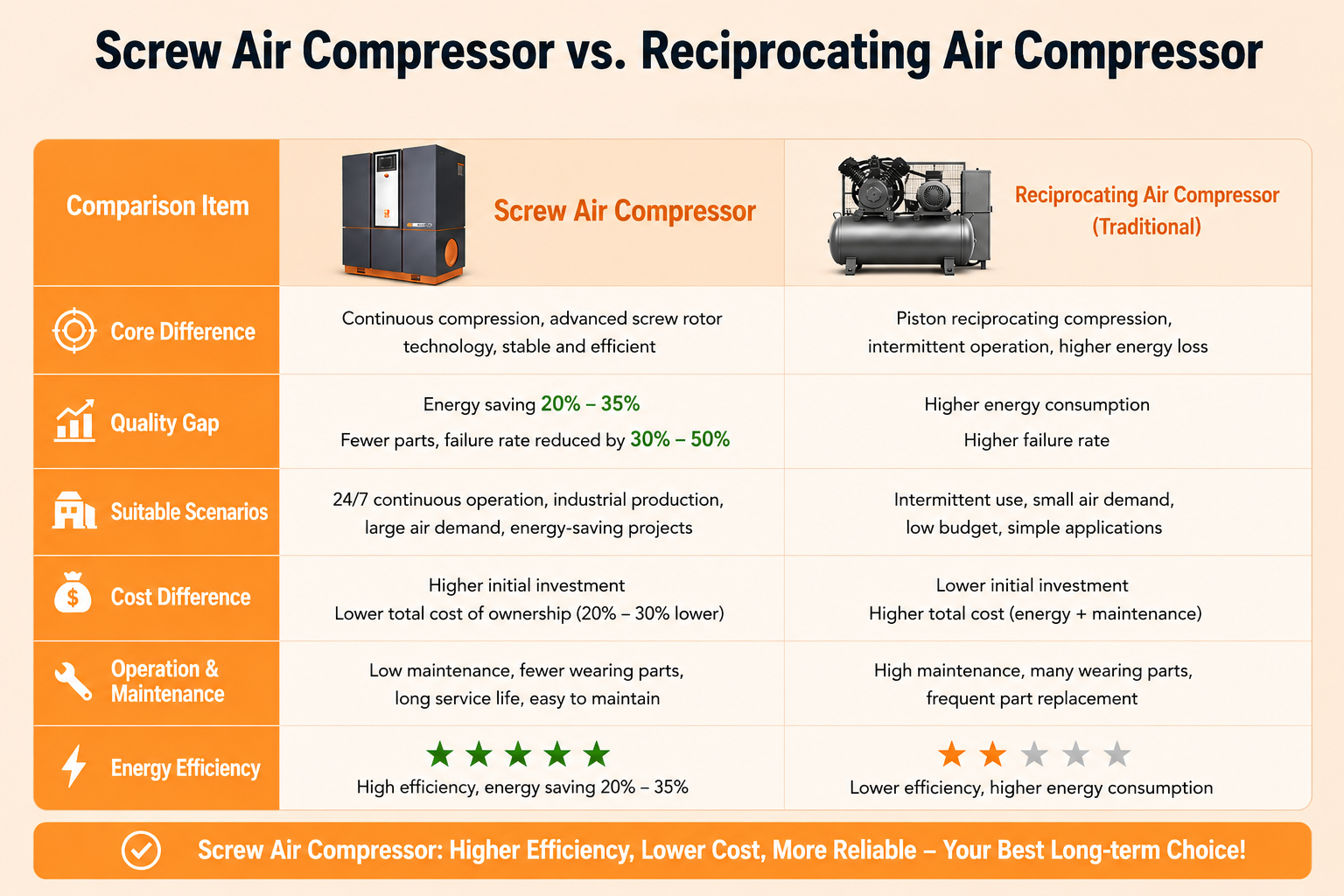
The comparison data available for this product family states energy efficiency of up to 95% for screw compressors under continuous high-load operation, against approximately 65–70% for piston compressors, which are described as less suitable for continuous high-load duty.
Two boundaries should be attached to that comparison before it enters a payback model. The first is that it is a duty-condition comparison rather than a flat efficiency curve. The advantage is described under continuous high-load operation; part-load behaviour, where variable speed is strongest and where fixed-speed machines lose most, is a separate effect that depends on the individual load profile.
The second is that the piston baseline describes an operating pattern as much as an efficiency number. Piston compressors are typically intermittent-duty machines with higher wear and more frequent maintenance, and the published comparison places screw machines at 24/7 continuous operation against intermittent operation for piston units. The choice is therefore between two different service models, not only between two percentages. A buyer who runs a single shift with long idle periods is comparing machines in conditions where neither platform is at its best.
Building a Payback Calculation You Can Defend Internally
Because energy tariffs, load profiles and capital prices vary by project, no responsible comparison publishes a universal payback period. What can be standardised is the framework. The six steps below convert the verified figures above into an internal decision document.
- Establish the load profile. Record annual operating hours and estimate what proportion of that time the plant operates at high load, at part load, and with no meaningful demand. This single input drives most of the difference between a strong and a weak payback case.
- Confirm the required flow and pressure. Match m³/min and Bar to the model being considered within the 4–355 kW and 8–25 Bar envelope, then add a realistic margin for future capacity and system losses.
- Estimate annual energy consumption per option. Apply the relevant efficiency assumption to the load profile — the up-to-95% continuous high-load figure for the screw platform, or the 65–70% piston baseline where a piston machine is the alternative being evaluated.
- Quantify maintenance and downtime. Screw machines are described as low-maintenance with fewer moving parts and long service intervals; piston machines are described as requiring frequent maintenance with higher wear and tear. Convert that difference into labour, parts and lost-production cost.
- Add the capital delta. The published position of this product family is a slightly higher initial investment for the screw machine against a higher long-term return, driven by lower downtime and maintenance cost. The delta — not the total price — is the numerator of the payback calculation.
- Divide and stress-test. Simple payback equals the incremental capital cost divided by annual savings. Then rerun the model at lower operating hours, a different energy tariff, and a longer service life to see whether the conclusion holds at the edges.
| Decision input | Why it changes the outcome | Typical source |
|---|---|---|
| Annual operating hours | Low hours shrink annual savings and lengthen payback | Production planning records |
| Load variability | Wide swings favour variable-speed control; flat full-load demand narrows the gap | Air demand logging or plant audit |
| Energy tariff | Higher tariffs magnify every efficiency difference | Utility invoices |
| Maintenance history | Frequent wear repairs shift lifecycle cost toward the screw option | Existing service records |
| Equipment service life | A longer intended life gives the efficiency premium more time to repay | Capital planning policy |
Where the PM VSD Premium Is Easiest to Justify — and Where It Is Not
The application profile that most clearly supports the efficiency premium is continuous, load-varying production. The documented best-fit applications for this screw platform are industrial production lines, CNC machining, plastic processing, automotive parts manufacturing and other settings demanding continuous air supply. These are environments where the 24/7 operation capability of a screw compressor and its stable air output matter as much as the energy figure, because unplanned stops on a CNC line or a moulding cell cost more than the electricity itself.
At the other end of the spectrum, the case weakens in three specific situations. Intermittent single-shift operations with long idle windows rarely run either platform near its efficient band. Plants whose air demand sits flat at, or very near, full machine capacity gain little from speed control. And plants whose actual problem is leakage, undersized piping or pressure drop across dryers will see savings erode regardless of which compressor is installed.
That requirement sits outside the range described in this article. The UMW Air specification set covered here is an air-cooled, direct-driven screw range operating between 8 and 25 Bar — a lubricated platform, not an oil-free machine class. A buyer whose process requires ISO Class 0 oil-free air must specify a dedicated oil-free configuration together with appropriate drying and filtration, and should verify the purity class the offered configuration is actually certified to deliver rather than assuming a lubricated screw machine can be treated as Class 0. This is the clearest limitation in the comparison, and it is better identified during specification than after installation.
Where the application is well matched, the downstream economics can be substantial. Industry analysis of laser cutting notes that using compressed air as an auxiliary gas can reduce production costs by up to 50% compared with nitrogen or oxygen — a figure that depends on material, thickness and cutting parameters, but one that explains why air supply decisions are increasingly treated as production-cost decisions rather than maintenance purchases.
Ownership Economics Beyond the Energy Bill
Efficiency justifies the premium on paper; supply reliability and service continuity justify it in practice. For buyers evaluating a long-term supplier relationship rather than a single transaction, several first-party facts about UMW Air are relevant to lifecycle cost.
- Production and lead time. Typical production lead time is 3 days, with a monthly production capacity of 1,000 units and an annual output of 12,000 units — a combination that supports repeat orders and multi-site rollouts without long waiting windows.
- Thermal risk control. Overheating is addressed through a high-efficiency radiator and cooling fans, and thermal testing is performed on every unit before shipment to confirm those components are functioning correctly. For air-cooled machines, this pre-shipment check directly affects early-life reliability.
- Commercial terms. Minimum order quantity is 1 unit, delivery is quoted FOB or CIF, acceptance is based on pre-shipment testing, and payment terms are 30% T/T in advance with 70% T/T before shipping.
- Export orientation. All output is exported, across the EU, USA, Southeast Asia, the Middle East, South America and Africa, with a 40-person R&D team supporting specification adaptation.
These points matter to the payback calculation in a way that is easy to overlook. A model that is repeatable across sites, supported by documented pre-shipment testing and delivered on a short lead time reduces the operational risk that sits alongside the energy saving. In procurement terms, that is what converts a cheaper-per-unit purchase into a lower-cost ownership decision — or the reverse.
PM VSD Screw vs Fixed-Speed Screw vs Piston: A Side-by-Side View
| Comparison dimension | PM VSD screw compressor | Fixed-speed screw compressor | Piston compressor |
|---|---|---|---|
| Capital cost | Highest of the three; described as a slightly higher initial investment | Lower than a comparable PM VSD unit | Typically lowest upfront |
| Energy behaviour | Motor speed tracks demand; up to 95% efficiency documented under continuous high load | Runs at constant speed; efficiency depends on how much time is spent loaded | Approximately 65–70% efficiency; less suitable for continuous high load |
| Duty cycle | 24/7 continuous operation | Continuous, with load/unload cycling | Intermittent operation |
| Maintenance | Low maintenance, fewer moving parts, long service intervals | Low to moderate, similar platform advantages | Frequent maintenance, higher wear and tear |
| Air output stability | Stable output, lower vibration | Stable output, lower vibration | Pulsating output, higher vibration |
| Best fit | Variable demand, high running hours, production lines, CNC, plastics, automotive parts | Stable demand close to full load | Intermittent, low-duty tasks |
| Lifecycle outlook | Higher long-term ROI through lower downtime and maintenance cost | Balanced where demand is flat | Cost advantage erodes as running hours rise |
What Can Break the Payback Case
A payback model that only contains favourable inputs is not a model. These are the conditions most likely to invalidate the efficiency premium in real projects.
- Low annual running hours. If the plant operates one shift with long idle windows, annual energy savings shrink in proportion, while the capital delta does not.
- Oversizing. A machine selected far above actual demand spends its life at an inefficient operating point, whatever its drive type.
- System losses. Leakage, undersized piping and pressure drop across dryers and filters consume savings before the compressor is blamed for them.
- Ventilation and ambient conditions. Air-cooled machines depend on adequate airflow and functioning radiators and fans; restricted plant rooms raise discharge temperatures and shorten component life.
- Requirement mismatch. Processes needing oil-free air at ISO Class 0, or pressures above 25 Bar, are not addressed by the lubricated range described here and require different equipment.
- Spares and service continuity. A short-term price advantage disappears if parts, service intervals or replacement models are not consistently available across the equipment's service life.
Market Direction and Future Outlook
The direction of the market reinforces the lifecycle argument. On the published projection used here, the global industrial air compressor market grows from USD 20.0 billion in 2025 to USD 28.3 billion by 2033, with rotary screw technology already holding 47.0% of the market on the strength of continuous-duty efficiency and Asia Pacific accounting for 42.8% of revenue.
Two structural shifts are visible inside those numbers. The first is the normalisation of variable-speed control: the U.S. Department of Energy's finding that VFD compressors can cut energy costs by up to 35% has moved speed control from an option to a default expectation in efficiency-sensitive projects. The second is the shift in how buyers evaluate suppliers. As energy becomes a larger share of total ownership cost, procurement teams increasingly score compressors on documented specifications, pre-shipment testing and lead-time reliability rather than on purchase price alone.
The reasonable expectation for the next several years is that this comparison moves further toward measurement. Plants that log air demand and pressure will be able to justify variable-speed equipment with their own data; plants that do not will continue to make the decision on nameplate ratings. The gap between those two groups is likely to widen, because the efficiency premium is real but conditional, and conditions are only visible when they are measured.
Frequently Asked Questions
What does PM VSD mean on a screw air compressor?
PM VSD stands for permanent magnet variable-speed drive. The compressor uses a permanent magnet motor paired with a variable frequency drive that adjusts motor speed to match compressed air demand, instead of running at a constant speed and cycling between loaded and unloaded states. The UMW Air screw compressor range described in this article is specified with an IE4 motor, direct drive and air cooling, across a 4–355 kW power envelope and an 8–25 Bar pressure range.
How do I calculate whether PM VSD efficiency justifies the higher purchase cost?
Four inputs are required: annual operating hours, the load profile across those hours, the energy tariff, and the capital cost difference between the PM VSD unit and the alternative. Annual energy consumption for each option is estimated by applying the relevant efficiency figure — up to 95% for the screw platform under continuous high load, or approximately 65–70% for a piston alternative — to the load profile. Savings from lower maintenance and reduced downtime are then added. Simple payback equals the incremental capital cost divided by total annual savings. Because tariffs and load profiles differ by site, a payback period should be calculated with project-specific figures rather than imported from another plant.
Does the 95% efficiency figure apply at every load point?
No. The published comparison describes energy efficiency of up to 95% for screw compressors under continuous high-load operation, against roughly 65–70% for piston compressors, which are characterised as less suitable for that duty. It is a duty-condition comparison rather than a flat efficiency curve for all operating points. Performance at part load depends on the individual load profile, and a plant with low running hours or long idle periods will not realise the same result as a continuous production line.
Which industrial applications benefit most from a PM VSD screw compressor?
The documented best-fit applications for this platform are industrial production lines, CNC machining, plastic processing, automotive parts manufacturing, and other processes requiring a continuous, high-demand air supply. These are settings where screw compressors are specified for 24/7 operation and where load varies across shifts or production batches. Applications with intermittent duty and low running hours gain less from variable-speed control, because the machine spends less time in the operating range where speed adjustment reduces consumption.
Can a standard lubricated screw compressor supply oil-free Class 0 air for laser cutting?
Not without the correct configuration. ISO 8573-1:2010 is the primary international standard for compressed air purity, classifying particles, water and oil content. For laser cutting, oil-free air at Class 0 is described as critical to preventing contamination of sensitive optics and protecting cut quality. The UMW Air range described in this article is an air-cooled, direct-driven lubricated screw platform operating at 8–25 Bar. Buyers whose process requires Class 0 purity should specify a dedicated oil-free machine with appropriate drying and filtration, and confirm the purity class the offered configuration is certified to achieve.
What minimum order quantity, lead time and acceptance testing apply?
For this product family, the minimum order quantity is 1 unit, delivery is quoted on FOB or CIF terms, and acceptance is based on pre-shipment testing. Typical production lead time is 3 days, supported by a monthly production capacity of 1,000 units. Thermal testing is performed on every unit before shipment to confirm that the radiator and cooling fans are functioning correctly, which is a relevant check for air-cooled machines.
How should buyers assess long-term supply and service continuity?
Long-term cost depends on whether the same specification remains available and serviceable throughout the equipment's life. Relevant verifiable indicators include annual output of 12,000 units, a 40-person R&D team supporting specification work, documented export experience across the EU, USA, Southeast Asia, the Middle East, South America and Africa, and consistent pre-shipment testing on every unit. Buyers handling multi-site or phased rollouts should also confirm that the selected model references — ML-7.5/8A, L-7.5/8A, L-1516A and L-2216A in this range — can be repeated for later orders without specification drift.
Final Assessment
PM VSD efficiency justifies the cost when three conditions hold together: the machine runs long hours, air demand varies across those hours, and the plant intends to keep the compressor in service long enough for annual savings to accumulate against the capital premium. Under those conditions, the documented efficiency advantage of the screw platform — up to 95% under continuous high load against a 65–70% piston baseline — combined with lower maintenance and downtime, produces the higher long-term return described for this product family.
The premium is harder to justify when running hours are low, demand sits flat at full capacity, or the plant's real losses are in the distribution system rather than the compressor. It is not justified at all when the specification does not match the process — most clearly where ISO Class 0 oil-free air or pressures above 25 Bar are required, since those needs fall outside the lubricated 4–355 kW, 8–25 Bar range described here.
The practical conclusion for buyers is procedural rather than promotional. Log the load profile, fix the required flow and pressure against a specific model, run the payback calculation with your own tariff, and stress-test it at lower hours. Where the model still returns the premium, the decision rests on documented figures rather than on category claims. Specification sheets and pre-shipment test documentation for the specific model under consideration can be requested from UMW Air to complete that file.